Lecturer @ SNU: Abdirizak Abdullahi A.rahman
Chapter 7:
Micropaleontology
Radiolaria
(Siliceous walled microfossils)
Introduction
 Radiolaria are holoplanktonic protozoa and form a part
of the zooplankton.
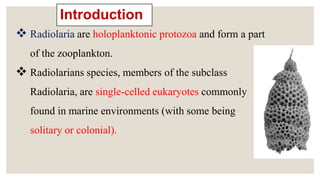
 Radiolarians species, members of the subclass
Radiolaria, are single-celled eukaryotes commonly
found in marine environments (with some being
solitary or colonial).
 It can be found floating near the surface or at water depths of
hundreds of metres.
 Like Foraminifera, Radiolarians are characterized by shells that
can be found in plenty of zones of high productivity (where
they reproduce in high numbers).
 For the most part, Radiolarians are free-living organisms that
feed on a variety of food sources in their environment.
 In the event of food scarcity, however, some of the species
have been shown to benefit from symbiotic relationships
with other organisms in their surroundings.
 Although some of the species are restricted to a specific
region, these organisms are widely spread in major oceanic
ecosystems across the world.
 Temperature, salinity and nutrient characteristics of the
water masses control the distribution of radiolarian
assemblages.
 The size of radiolarian varies from 30 μm to 2 mm in
diameter and some of them form macroscopic colonies
that may reach a size of a centimetre or larger.
Geological Range
 The radiolarians range from the Cambrian period, but the
skeleton-less forms may have evolved in the latest Precambrian.
 Their abundance in many rocks, their long geologic history, and
their diversity through time make them important sources of
information on the geologic age and structure of many deposits.
Ecology of Radiolarians Species
 Radiolarians species are widely distributed in major oceans
across the world.
 In this environment, Radiolarians can be found at various
depths, from the ocean surface to the bathypelagic depths
(1000 to 3000 meters below the ocean surface).
Morphology
 The Radiolaria, also called Radiozoa, are protozoa of diameter
0.1–0.2 mm that produce intricate mineral skeletons, typically
with a central capsule dividing the cell into the inner and outer
portions of endoplasm and ectoplasm.
 The elaborate mineral skeleton is usually made of silica
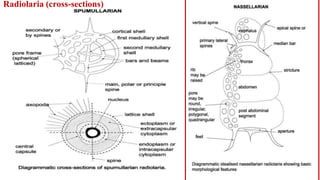
Radiolaria (cross-sections)
 The skeleton is enclosed within a cytoplasmic and not in direct
contact with the seawater.
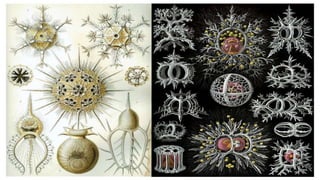
 The skeleton consists of a porous lattice shell of variable shapes
from spherical to spindle and conical (spicules,cortical shell)
 There may be concentric or overlapping lattice shells.
 The radial elements are hollow to solid spines (attached at one end
only), bars (attached at both ends to other elements) and simple
spicules.
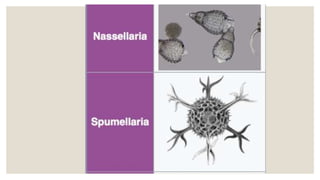
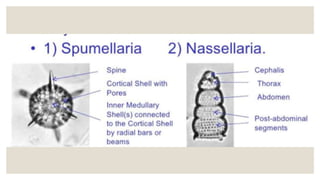
 There are two well-recognized divisions of radiolarian, Spumellaria,
Nassellaria
 Varying slightly from one subclass to another, the skeletons of
radiolarians are generally organized around spicules, or spines, which
are sharp, dense outcroppings from the main skeletal mass.
 Formed from the fusion of many of these spines is the outermost
skeleton, the cortical shell.
 Connecting this shell to the many concentrically organized inner shells
are bars or beams, which also serve to strengthen and support the entire
assembly.
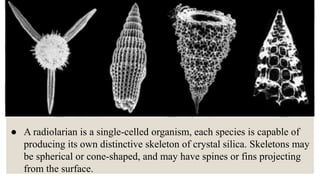
● A radiolarian is a single-celled organism, each species is capable of
producing its own distinctive skeleton of crystal silica. Skeletons may
be spherical or cone-shaped, and may have spines or fins projecting
from the surface.
Classification
❏ Extant radiolaria are classified using features of both the
preservable skeleton and the soft parts, which make the
classification of fossil forms extremely difficult
❏ A major problem with radiolarian classification is that
separate classifications have been established for the
Palaeozoic, Mesozoic and Cenozoic, and little has been
done to integrate them.
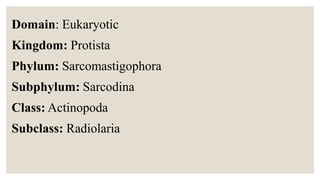
Domain: Eukaryotic
Kingdom: Protista
Phylum: Sarcomastigophora
Subphylum: Sarcodina
Class: Actinopoda
Subclass: Radiolaria
Application
potentially be very useful biostratigraphic and palaeoenvironmental
tools.
Radiolaria have a skeleton composed of silica and have an
extremely long geological range, they have become useful in the
study of sediments which lack calcareous fossils, either because of
deposition below the CCD (Carbonate Compensation Depth) or
because the strata being examined are too old.
Chap. 7 Radiolaria.pptx

Chap. 7 Radiolaria.pptx

  • 1.
    Lecturer @ SNU:Abdirizak Abdullahi A.rahman Chapter 7: Micropaleontology Radiolaria (Siliceous walled microfossils)
  • 3.
    Introduction  Radiolaria areholoplanktonic protozoa and form a part of the zooplankton.  Radiolarians species, members of the subclass Radiolaria, are single-celled eukaryotes commonly found in marine environments (with some being solitary or colonial).
  • 4.
     It canbe found floating near the surface or at water depths of hundreds of metres.  Like Foraminifera, Radiolarians are characterized by shells that can be found in plenty of zones of high productivity (where they reproduce in high numbers).  For the most part, Radiolarians are free-living organisms that feed on a variety of food sources in their environment.
  • 5.
     In theevent of food scarcity, however, some of the species have been shown to benefit from symbiotic relationships with other organisms in their surroundings.  Although some of the species are restricted to a specific region, these organisms are widely spread in major oceanic ecosystems across the world.
  • 6.
     Temperature, salinityand nutrient characteristics of the water masses control the distribution of radiolarian assemblages.  The size of radiolarian varies from 30 μm to 2 mm in diameter and some of them form macroscopic colonies that may reach a size of a centimetre or larger.
  • 7.
    Geological Range  Theradiolarians range from the Cambrian period, but the skeleton-less forms may have evolved in the latest Precambrian.  Their abundance in many rocks, their long geologic history, and their diversity through time make them important sources of information on the geologic age and structure of many deposits.
  • 8.
    Ecology of RadiolariansSpecies  Radiolarians species are widely distributed in major oceans across the world.  In this environment, Radiolarians can be found at various depths, from the ocean surface to the bathypelagic depths (1000 to 3000 meters below the ocean surface).
  • 9.
    Morphology  The Radiolaria,also called Radiozoa, are protozoa of diameter 0.1–0.2 mm that produce intricate mineral skeletons, typically with a central capsule dividing the cell into the inner and outer portions of endoplasm and ectoplasm.  The elaborate mineral skeleton is usually made of silica
  • 10.
  • 11.
     The skeletonis enclosed within a cytoplasmic and not in direct contact with the seawater.  The skeleton consists of a porous lattice shell of variable shapes from spherical to spindle and conical (spicules,cortical shell)  There may be concentric or overlapping lattice shells.  The radial elements are hollow to solid spines (attached at one end only), bars (attached at both ends to other elements) and simple spicules.  There are two well-recognized divisions of radiolarian, Spumellaria, Nassellaria
  • 13.
     Varying slightlyfrom one subclass to another, the skeletons of radiolarians are generally organized around spicules, or spines, which are sharp, dense outcroppings from the main skeletal mass.  Formed from the fusion of many of these spines is the outermost skeleton, the cortical shell.  Connecting this shell to the many concentrically organized inner shells are bars or beams, which also serve to strengthen and support the entire assembly.
  • 14.
    ● A radiolarianis a single-celled organism, each species is capable of producing its own distinctive skeleton of crystal silica. Skeletons may be spherical or cone-shaped, and may have spines or fins projecting from the surface.
  • 16.
    Classification ❏ Extant radiolariaare classified using features of both the preservable skeleton and the soft parts, which make the classification of fossil forms extremely difficult ❏ A major problem with radiolarian classification is that separate classifications have been established for the Palaeozoic, Mesozoic and Cenozoic, and little has been done to integrate them.
  • 17.
    Domain: Eukaryotic Kingdom: Protista Phylum:Sarcomastigophora Subphylum: Sarcodina Class: Actinopoda Subclass: Radiolaria
  • 18.
    Application potentially be veryuseful biostratigraphic and palaeoenvironmental tools. Radiolaria have a skeleton composed of silica and have an extremely long geological range, they have become useful in the study of sediments which lack calcareous fossils, either because of deposition below the CCD (Carbonate Compensation Depth) or because the strata being examined are too old.

Editor's Notes

  • #6 Symbiotic: interaction between two different organisms living in close physical association.