SEMINAR ON
CONTENTS
 Introduction
 Morphology of Chitinozoa
 Classification of Chitinozoa
 Palaeoecology
 Significance of Chitinozoa
 Stratigraphic distribution
 Conclusion
 Reference
8/3/2013 2
INTRODUCTION
 Microfossils are a heterogeneous bunch of fossil remains
studies as a single discipline because rock samples must
be processed in certain way to remove them and
microscope are must be used to study them.
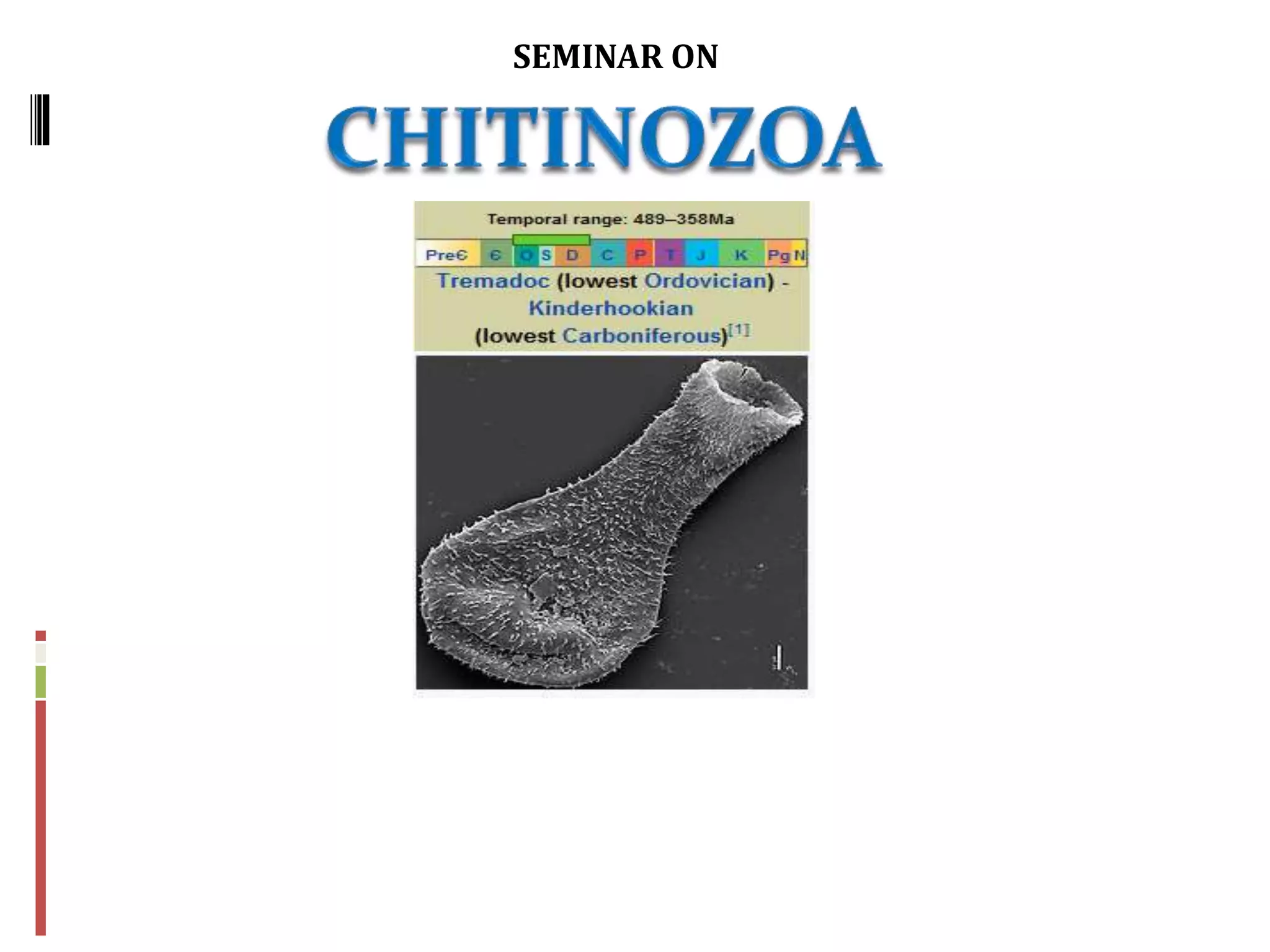
 The Chitinozoa are a group of extinct microscopic animal,
whose systematic position is not known.
 They lived throughout the Paleozoic era, but the majority
become extinct at the end of Devonian Period.
 The chitinozoa were first named & described by Eisenack
in 1931, who established a system for classifying
chitinozoans that is based upon morphology.
 Chitinozoa are a taxon of flask or bottle shaped, hollow
organic vesicles. Walls are unusually resistant to
oxidation, thermal alteration, Tectonism, and
Recrystalisation of CaCO3 matrix.
8/3/2013 3
APPEARANCE
 Chitinozoa range in length from around 50 to 2000 micrometers.
 They appear dark to almost opaque when viewed under an optical
microscope.
 External ornamentation is often preserved on the surface of the
fossils, in the form of hairs, loops or protrusions, which are some
times as large as the chamber itself.
 The range and complexity of ornament increased with time,
against a backdrop of decreasing organism size.
 The earliest Ordovician species were large and smooth-walled; by
the mid-Ordovician a large and expanding variety of ornament,
and of hollow appendages, was evident.
 While shorter appendages are generally solid, larger protrusions
tend to be hollow, with some of the largest displaying a spongy
internal structure.
8/3/2013 4
MORPHOLOGY OF CHITINOZOA
 The chitinozoan test consist of two main parts the chamber and the oral
tube which generally can be distinguished; these are shoulder, flanks,
basal margin and base, the terms being more or less self explanatory.
 Three types of structures on the basal margin are
1)Carina, 2)Siphon, 3) Appendices.
•Carina;- a sharp outward extension
from the chamber wall resembling a
skirt or the brim of hat.
•Siphon;- a hollow open ended tube
extending from the aboral end.
•Appendices;- generally discrete
processes suspended from the basal
margin.
8/3/2013 5
Contd..
 Oral tube;- the oral tube has two parts, the collar and the
neck. They may distinguished from each other but a change in
the wall’s profile.
 The collar encircles the aperture and sometimes terminates
in a fringe of small spines.
 The neck is a hollow, more or less cylindrical tube, however
few chitinozoans lack necks and collars altogether.
8/3/2013 6
TEST WALL
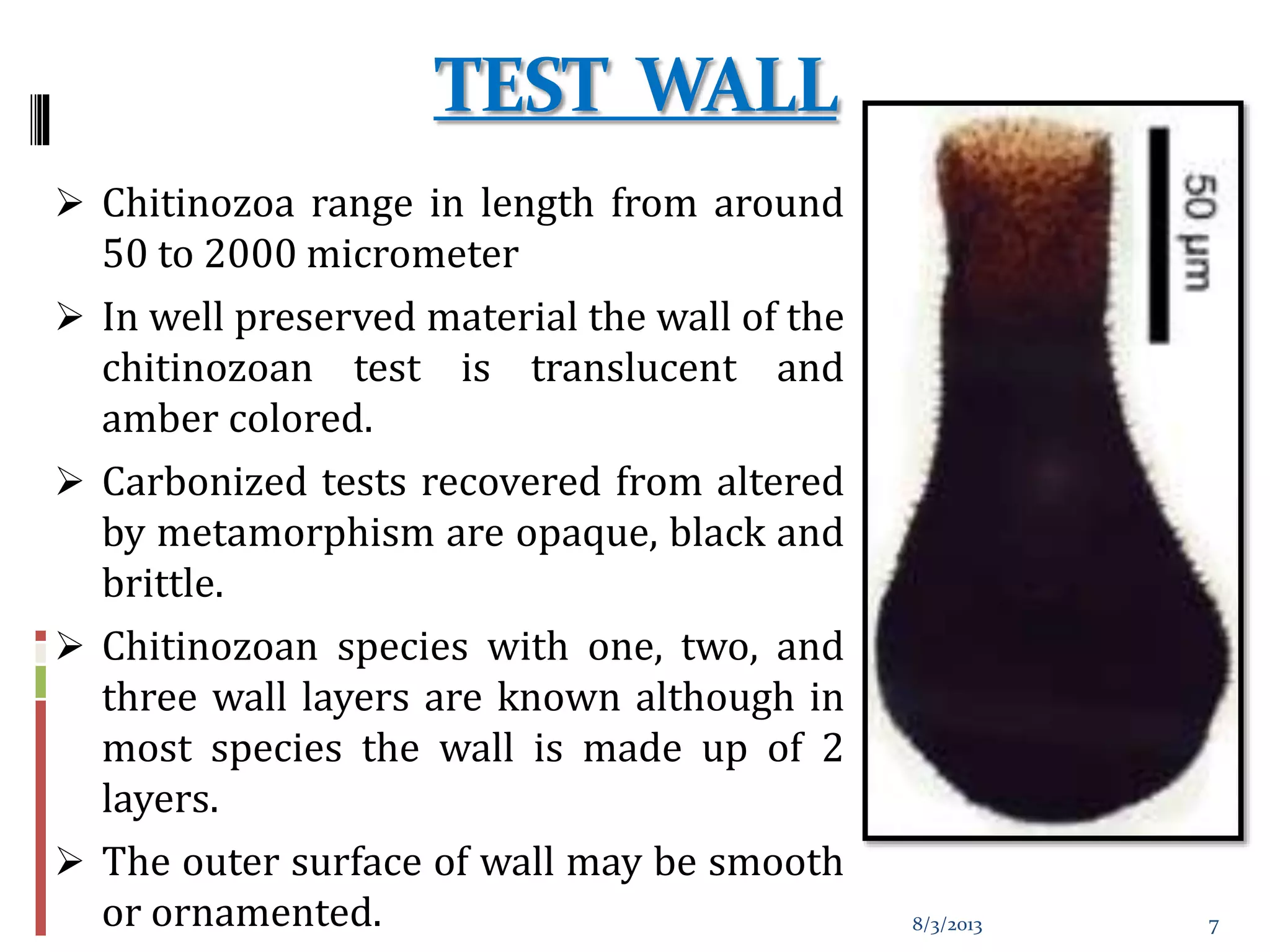
 Chitinozoa range in length from around
50 to 2000 micrometer
 In well preserved material the wall of the
chitinozoan test is translucent and
amber colored.
 Carbonized tests recovered from altered
by metamorphism are opaque, black and
brittle.
 Chitinozoan species with one, two, and
three wall layers are known although in
most species the wall is made up of 2
layers.
 The outer surface of wall may be smooth
or ornamented. 8/3/2013 7
THE VESICLE
 The chitinozoan vesicle ranges from 30-1500 micrometer, but
most are 150-300 micrometer long.
 The vesicle has a longitudinal axis of symmetry, sections
taken at right angles to this being radially symmetrical.
 The wall is two layered and of a dark brown or black chitin
like substance (pseudochitin)
 It encloses an empty body chamber that once housed the
organism.
 The oral end which bears the aperture, is usually produced
into a neck, whilst the aboral end is broader and closed off.
 The aperture is occluded by a separate operculum, whose
form and position is of taxonomic value.
8/3/2013 8
Desmochitina minor Eisenach. (A )single test .(B) chain
of three tests showing the apertures of two tests applied
to the bases of their orally adjacent neighbours; the
operculum of a fourth tests remains firmly attached to the
base of the test a lower left . (C). long spiral chain
consisting of numerous tests. Ordovician, Britain, (D)
cocoon (stippled).
Ancyrochitina alaticornis
Jenkins, with perforate
appendices, in lateral view.
(A) (B) (C) (D)
8/3/2013 9
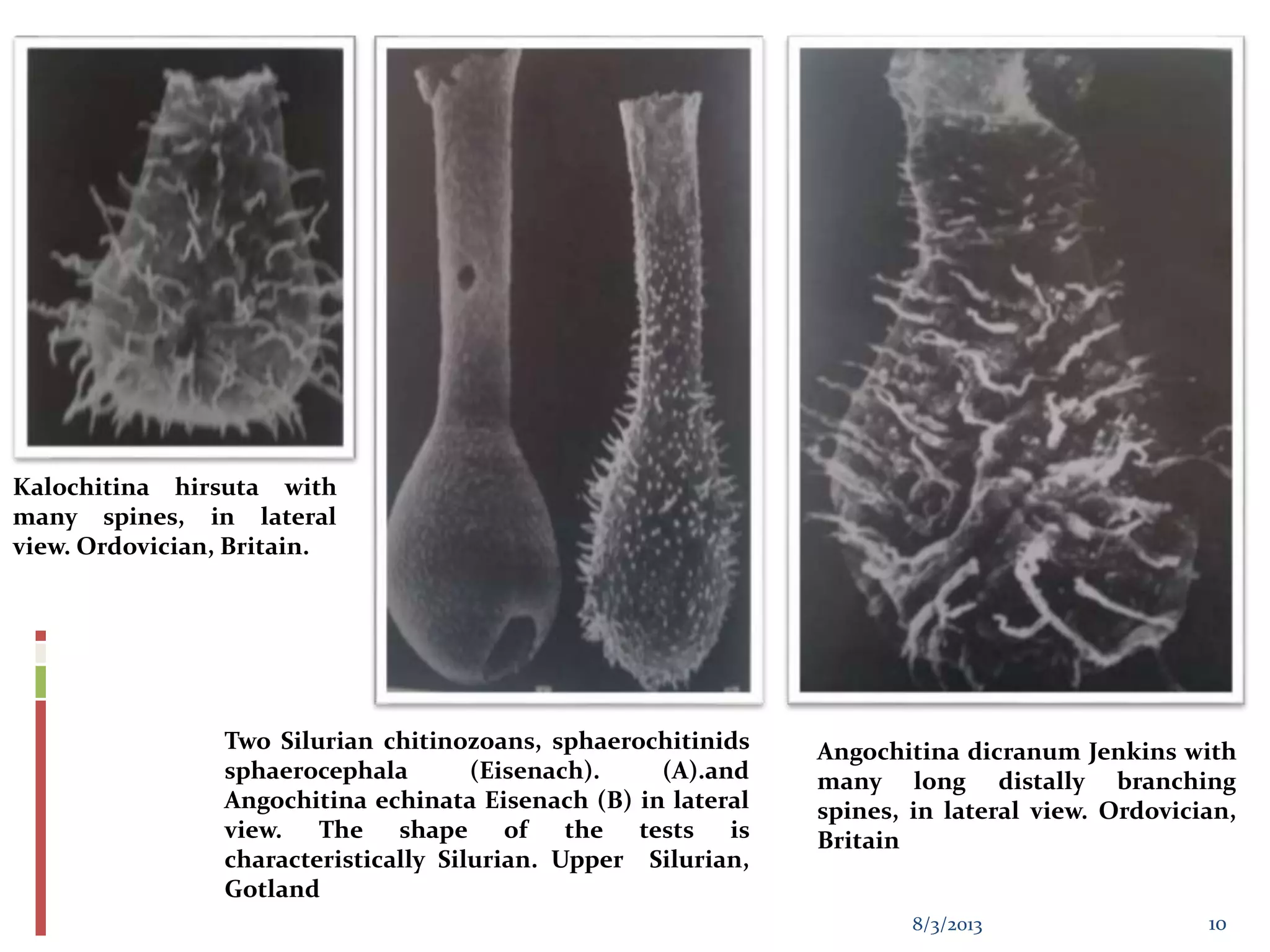
Angochitina dicranum Jenkins with
many long distally branching
spines, in lateral view. Ordovician,
Britain
Kalochitina hirsuta with
many spines, in lateral
view. Ordovician, Britain.
Two Silurian chitinozoans, sphaerochitinids
sphaerocephala (Eisenach). (A).and
Angochitina echinata Eisenach (B) in lateral
view. The shape of the tests is
characteristically Silurian. Upper Silurian,
Gotland
8/3/2013 10
Three Silurian chitinozoans, Ancyrochitina desmea Eiesnack (A), Ancyrochitina
pedavis Laufeld (B). And Gotlandochitina villosa Laufeld (C). In lateral view. The
shape of these tests is characteristically Silurian. Upper Silurian, Gotland
(A) (B) (C)
8/3/2013 11
CLASSIFICATION OF CHITINOZOA
 Classification within the chitinozoa is based largely upon the
gross morphology of the test.
 The genera so defined are arbitrarily, artificial grouping, not
necessarily reflecting the natural evolutionary relationship
between different kinds of chitinozoans.
 The original shape of a chitinozoan test requires careful
interpretation because most tests have to some extent, been
distorted by compression during compaction of sediment.
 Other digenetic changes particularly mineral recrystalisation,
also may alter the shapes of chitinozoan tests, and the various
chemical treatments used to free chitinozoans from rock
fragments may be responsible for slight changes in both
shape and size.
8/3/2013 12
Contd..
 Several characteristics used in defining genera are
1) The tendency for tests to occur in chain.
2) The overall shape of the test.
3) The nature of the basal margin.
4) The Internal structure.
5) Size
Group CHITINOZOAN
There are 9 genera
 Genus ANCYROCHITINA e.g. Ancyrochitina alaticornis,
 Genus CLATHROCHITINA e.g.- conochitina elegana
 Genus CONOCHITINA e.g. conochitina elegana
 Genus CYATHOCHITINA e.g. cyathochitina companalaeformis
 Genus DESMOCHITINA e.g. desmochitina minor
 Genus LAGENOCHITINA e.g. lagenochitina ovoidea
 Genus SIPHONOCHITINA e.g. siphonochitina formosa
 Genus KALOCHITINA e.g. kalochitina hirsute
 Genus HERCOCHITINA e.g hercochitina downiei
8/3/2013 13
PALAEOECOLOGY
 The fossil restriction to marine sediments can be taken as
sound evidence that the organisms dwelt in the Paleozoic seas
- which presents three main modes of life
 Infaunal — living within the sediment - the "burrowers“
 Benthic — dwelling upon the sea floor, perhaps anchored
in place - the "sitters“
 Pelagic — free-floating in the water column - the "drifters“
 An infaunal mode of life can be quickly ruled out, as the fossils
are sometimes found in alignment with the depositing
current; as nothing attached them to the bottom, they must
have fallen from the water column
8/3/2013 14
SIGNIFICANCE OF CHITINOZOA
 In the absence of other fossils, chitinozoan can be useful for local
stratigraphic correlations.
 Gradual evolutionary changes are detectable in some assemblages
and may prove useful for wider correlation but there has been
little use of international zonal schemes as yet.
 Chitinozoa have proven incredibly useful as a stratigraphic
markers in biostratigraphy during the Ordovician, Silurian and
Devonian periods.
 They are also widely distributed and appear in a variety of marine
depositional settings, making correlation easier; better still, they
can often be recognized in even quite strongly metamorphosed
rocks.
 Occurrence chitinozoan in less metamorphosed sedimentary rocks
may allow an approximation of the depositional environment .
8/3/2013 15
DISTRIBUTION AND ECOLOGY OF
CHITINOZOANS
 Chitinozoa are known only from marine sediments.
 They are common in rocks deposited under well aerated,
shallow-water conditions, especially in shales and siltstone,
but they are also found in limestone, dolomites, graptolitic
shales, slates and cherts.
 The wide facies tolerance and distribution tends to suggest
that chitinozoa were either planktonic or attached to floating
objects for at least part of their life cycle.
 Laufeld (1974) considered they were zooplanktonic with
evidence for blooms in late autumn.
8/3/2013 16
GEOLOGICAL HISTORY OF CHITINOZOA
 The oldest chitinozoans will be the Demochitina like sacs from
the upper Precambrian Chuar group of Arizona.
 This group is unknown in Cambrian rock, but appears again in
a major radiation of Ordovician Age.
 During Ordovician age morphologically simple vesicle, the
latter stock gradually dwindling through the Silurian and
dying out at the end of it.
 The more complex tanuchitinids also appeared in the
tremadocian, whilst the sphaerochitinids appeared in the late
Ordovician and characterized the Silurian and early Devonian
species.
 The age of chitinozoa ranging from Ordovician to Permian.
8/3/2013 17
CONCLUSION
 Chitinozoans are of flask-shaped, organic walled marine
microfossils of unknown origin.
 Shells are translucent and amber in colour.
 The chitinozoans evolved rapidly during the Ordovician,
Silurian, Devonian.
 Chitinozoans are useful for biostratigraphic zonation,
dating and correlation of rocks of Lower Paleozoic.
 They lived throughout the Paleozoic era, but the majority
become extinct at the end of Devonian Period.
8/3/2013 18
REFERENCE
Books:-
 Anne Boersma-Introduction to marine micropaleontology,
(1978)Page No:341-356
 M.D.Brasier- Microfossils ,(1981) Page No:147-148.
 Bilal U.Haq-introduction to micropaleontology, page No:341-
355.
Websites:-
 www.ucmp.berkeley.edu
 http://en.wikipedia.org/wiki/Chitinozoan
8/3/2013 19
Chitinozoa

Chitinozoa

  • 1.
  • 2.
    CONTENTS  Introduction  Morphologyof Chitinozoa  Classification of Chitinozoa  Palaeoecology  Significance of Chitinozoa  Stratigraphic distribution  Conclusion  Reference 8/3/2013 2
  • 3.
    INTRODUCTION  Microfossils area heterogeneous bunch of fossil remains studies as a single discipline because rock samples must be processed in certain way to remove them and microscope are must be used to study them.  The Chitinozoa are a group of extinct microscopic animal, whose systematic position is not known.  They lived throughout the Paleozoic era, but the majority become extinct at the end of Devonian Period.  The chitinozoa were first named & described by Eisenack in 1931, who established a system for classifying chitinozoans that is based upon morphology.  Chitinozoa are a taxon of flask or bottle shaped, hollow organic vesicles. Walls are unusually resistant to oxidation, thermal alteration, Tectonism, and Recrystalisation of CaCO3 matrix. 8/3/2013 3
  • 4.
    APPEARANCE  Chitinozoa rangein length from around 50 to 2000 micrometers.  They appear dark to almost opaque when viewed under an optical microscope.  External ornamentation is often preserved on the surface of the fossils, in the form of hairs, loops or protrusions, which are some times as large as the chamber itself.  The range and complexity of ornament increased with time, against a backdrop of decreasing organism size.  The earliest Ordovician species were large and smooth-walled; by the mid-Ordovician a large and expanding variety of ornament, and of hollow appendages, was evident.  While shorter appendages are generally solid, larger protrusions tend to be hollow, with some of the largest displaying a spongy internal structure. 8/3/2013 4
  • 5.
    MORPHOLOGY OF CHITINOZOA The chitinozoan test consist of two main parts the chamber and the oral tube which generally can be distinguished; these are shoulder, flanks, basal margin and base, the terms being more or less self explanatory.  Three types of structures on the basal margin are 1)Carina, 2)Siphon, 3) Appendices. •Carina;- a sharp outward extension from the chamber wall resembling a skirt or the brim of hat. •Siphon;- a hollow open ended tube extending from the aboral end. •Appendices;- generally discrete processes suspended from the basal margin. 8/3/2013 5
  • 6.
    Contd..  Oral tube;-the oral tube has two parts, the collar and the neck. They may distinguished from each other but a change in the wall’s profile.  The collar encircles the aperture and sometimes terminates in a fringe of small spines.  The neck is a hollow, more or less cylindrical tube, however few chitinozoans lack necks and collars altogether. 8/3/2013 6
  • 7.
    TEST WALL  Chitinozoarange in length from around 50 to 2000 micrometer  In well preserved material the wall of the chitinozoan test is translucent and amber colored.  Carbonized tests recovered from altered by metamorphism are opaque, black and brittle.  Chitinozoan species with one, two, and three wall layers are known although in most species the wall is made up of 2 layers.  The outer surface of wall may be smooth or ornamented. 8/3/2013 7
  • 8.
    THE VESICLE  Thechitinozoan vesicle ranges from 30-1500 micrometer, but most are 150-300 micrometer long.  The vesicle has a longitudinal axis of symmetry, sections taken at right angles to this being radially symmetrical.  The wall is two layered and of a dark brown or black chitin like substance (pseudochitin)  It encloses an empty body chamber that once housed the organism.  The oral end which bears the aperture, is usually produced into a neck, whilst the aboral end is broader and closed off.  The aperture is occluded by a separate operculum, whose form and position is of taxonomic value. 8/3/2013 8
  • 9.
    Desmochitina minor Eisenach.(A )single test .(B) chain of three tests showing the apertures of two tests applied to the bases of their orally adjacent neighbours; the operculum of a fourth tests remains firmly attached to the base of the test a lower left . (C). long spiral chain consisting of numerous tests. Ordovician, Britain, (D) cocoon (stippled). Ancyrochitina alaticornis Jenkins, with perforate appendices, in lateral view. (A) (B) (C) (D) 8/3/2013 9
  • 10.
    Angochitina dicranum Jenkinswith many long distally branching spines, in lateral view. Ordovician, Britain Kalochitina hirsuta with many spines, in lateral view. Ordovician, Britain. Two Silurian chitinozoans, sphaerochitinids sphaerocephala (Eisenach). (A).and Angochitina echinata Eisenach (B) in lateral view. The shape of the tests is characteristically Silurian. Upper Silurian, Gotland 8/3/2013 10
  • 11.
    Three Silurian chitinozoans,Ancyrochitina desmea Eiesnack (A), Ancyrochitina pedavis Laufeld (B). And Gotlandochitina villosa Laufeld (C). In lateral view. The shape of these tests is characteristically Silurian. Upper Silurian, Gotland (A) (B) (C) 8/3/2013 11
  • 12.
    CLASSIFICATION OF CHITINOZOA Classification within the chitinozoa is based largely upon the gross morphology of the test.  The genera so defined are arbitrarily, artificial grouping, not necessarily reflecting the natural evolutionary relationship between different kinds of chitinozoans.  The original shape of a chitinozoan test requires careful interpretation because most tests have to some extent, been distorted by compression during compaction of sediment.  Other digenetic changes particularly mineral recrystalisation, also may alter the shapes of chitinozoan tests, and the various chemical treatments used to free chitinozoans from rock fragments may be responsible for slight changes in both shape and size. 8/3/2013 12
  • 13.
    Contd..  Several characteristicsused in defining genera are 1) The tendency for tests to occur in chain. 2) The overall shape of the test. 3) The nature of the basal margin. 4) The Internal structure. 5) Size Group CHITINOZOAN There are 9 genera  Genus ANCYROCHITINA e.g. Ancyrochitina alaticornis,  Genus CLATHROCHITINA e.g.- conochitina elegana  Genus CONOCHITINA e.g. conochitina elegana  Genus CYATHOCHITINA e.g. cyathochitina companalaeformis  Genus DESMOCHITINA e.g. desmochitina minor  Genus LAGENOCHITINA e.g. lagenochitina ovoidea  Genus SIPHONOCHITINA e.g. siphonochitina formosa  Genus KALOCHITINA e.g. kalochitina hirsute  Genus HERCOCHITINA e.g hercochitina downiei 8/3/2013 13
  • 14.
    PALAEOECOLOGY  The fossilrestriction to marine sediments can be taken as sound evidence that the organisms dwelt in the Paleozoic seas - which presents three main modes of life  Infaunal — living within the sediment - the "burrowers“  Benthic — dwelling upon the sea floor, perhaps anchored in place - the "sitters“  Pelagic — free-floating in the water column - the "drifters“  An infaunal mode of life can be quickly ruled out, as the fossils are sometimes found in alignment with the depositing current; as nothing attached them to the bottom, they must have fallen from the water column 8/3/2013 14
  • 15.
    SIGNIFICANCE OF CHITINOZOA In the absence of other fossils, chitinozoan can be useful for local stratigraphic correlations.  Gradual evolutionary changes are detectable in some assemblages and may prove useful for wider correlation but there has been little use of international zonal schemes as yet.  Chitinozoa have proven incredibly useful as a stratigraphic markers in biostratigraphy during the Ordovician, Silurian and Devonian periods.  They are also widely distributed and appear in a variety of marine depositional settings, making correlation easier; better still, they can often be recognized in even quite strongly metamorphosed rocks.  Occurrence chitinozoan in less metamorphosed sedimentary rocks may allow an approximation of the depositional environment . 8/3/2013 15
  • 16.
    DISTRIBUTION AND ECOLOGYOF CHITINOZOANS  Chitinozoa are known only from marine sediments.  They are common in rocks deposited under well aerated, shallow-water conditions, especially in shales and siltstone, but they are also found in limestone, dolomites, graptolitic shales, slates and cherts.  The wide facies tolerance and distribution tends to suggest that chitinozoa were either planktonic or attached to floating objects for at least part of their life cycle.  Laufeld (1974) considered they were zooplanktonic with evidence for blooms in late autumn. 8/3/2013 16
  • 17.
    GEOLOGICAL HISTORY OFCHITINOZOA  The oldest chitinozoans will be the Demochitina like sacs from the upper Precambrian Chuar group of Arizona.  This group is unknown in Cambrian rock, but appears again in a major radiation of Ordovician Age.  During Ordovician age morphologically simple vesicle, the latter stock gradually dwindling through the Silurian and dying out at the end of it.  The more complex tanuchitinids also appeared in the tremadocian, whilst the sphaerochitinids appeared in the late Ordovician and characterized the Silurian and early Devonian species.  The age of chitinozoa ranging from Ordovician to Permian. 8/3/2013 17
  • 18.
    CONCLUSION  Chitinozoans areof flask-shaped, organic walled marine microfossils of unknown origin.  Shells are translucent and amber in colour.  The chitinozoans evolved rapidly during the Ordovician, Silurian, Devonian.  Chitinozoans are useful for biostratigraphic zonation, dating and correlation of rocks of Lower Paleozoic.  They lived throughout the Paleozoic era, but the majority become extinct at the end of Devonian Period. 8/3/2013 18
  • 19.
    REFERENCE Books:-  Anne Boersma-Introductionto marine micropaleontology, (1978)Page No:341-356  M.D.Brasier- Microfossils ,(1981) Page No:147-148.  Bilal U.Haq-introduction to micropaleontology, page No:341- 355. Websites:-  www.ucmp.berkeley.edu  http://en.wikipedia.org/wiki/Chitinozoan 8/3/2013 19