Conodonts
Pander
(1856)
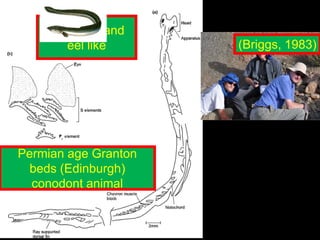
(Briggs, 1983)
Permian age Granton
beds (Edinburgh)
conodont animal
c. 40 mm and
eel like
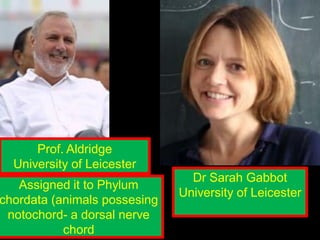
Prof. Aldridge
University of Leicester
Dr Sarah Gabbot
University of Leicester
Assigned it to Phylum
chordata (animals possesing
notochord- a dorsal nerve
chord
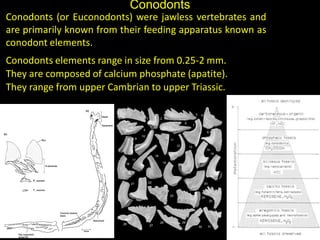
Conodonts
Conodonts (or Euconodonts) were jawless vertebrates and
are primarily known from their feeding apparatus known as
conodont elements.
Conodonts elements range in size from 0.25-2 mm.
They are composed of calcium phosphate (apatite).
They range from upper Cambrian to upper Triassic.
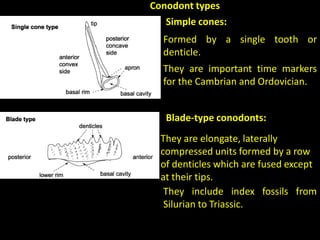
Simple cones:
Formed by a single tooth or
denticle.
They are important time markers
for the Cambrian and Ordovician.
They are elongate, laterally
compressed units formed by a row
of denticles which are fused except
at their tips.
Blade-type conodonts:
They include index fossils from
Silurian to Triassic.
Conodont types
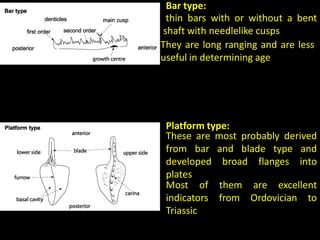
thin bars with or without a bent
shaft with needlelike cusps
Bar type:
They are long ranging and are less
useful in determining age
Platform type:
These are most probably derived
from bar and blade type and
developed broad flanges into
plates
Most of them are excellent
indicators from Ordovician to
Triassic
Many conodonts have short ranges and have worldwide
geographic distribution which makes them excellent index
fossils for Palaeozoic and Triassic sedimentary rocks. Marine
strata from Cambrian to Triassic are divided into about 150
conodont biozones.
Conodonts are also used in biogeographic and
palaeoecological studies.
Conodonts color alteration is used to interpret basin
histories, metamorphic studies and for the search of
hydrocarbons.
Conodonts elements geochemistry is used in the studies of
palaeoclimates and palaeoceanography.
Applications
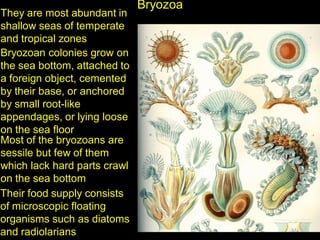
They are most abundant in
shallow seas of temperate
and tropical zones
Bryozoan colonies grow on
the sea bottom, attached to
a foreign object, cemented
by their base, or anchored
by small root-like
appendages, or lying loose
on the sea floor
Most of the bryozoans are
sessile but few of them
which lack hard parts crawl
on the sea bottom
Their food supply consists
of microscopic floating
organisms such as diatoms
and radiolarians
Bryozoa
Anatomy of a zooid
The individual bryozoan animal
is known as zooid
Bryozoans live as colonies
Zooids remain in
communication through out
Each zooid has a circular or
crescentic fleshy structure
called lophophore
Lophophore bears a series of
slender, ciliated and post-oral
tentacles.
The anus is near the mouth
The nervous system is
represented mainly by a small
nerve (ganglion) between the
mouth and the anus
Excretory organs are absent
Respiratory and circulatory
system are absent
Hard parts consists of calcium
carbonate
They reproduce asexually by
budding
Colonies which reproduce
sexually are hermaphrodite

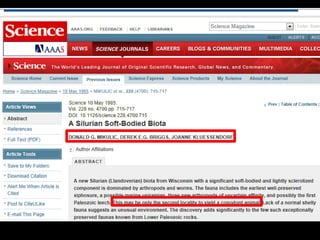
conodonts first discovery and introduction

  • 1.
  • 2.
    (Briggs, 1983) Permian ageGranton beds (Edinburgh) conodont animal c. 40 mm and eel like
  • 4.
    Prof. Aldridge University ofLeicester Dr Sarah Gabbot University of Leicester Assigned it to Phylum chordata (animals possesing notochord- a dorsal nerve chord
  • 5.
    Conodonts Conodonts (or Euconodonts)were jawless vertebrates and are primarily known from their feeding apparatus known as conodont elements. Conodonts elements range in size from 0.25-2 mm. They are composed of calcium phosphate (apatite). They range from upper Cambrian to upper Triassic.
  • 6.
    Simple cones: Formed bya single tooth or denticle. They are important time markers for the Cambrian and Ordovician. They are elongate, laterally compressed units formed by a row of denticles which are fused except at their tips. Blade-type conodonts: They include index fossils from Silurian to Triassic. Conodont types
  • 7.
    thin bars withor without a bent shaft with needlelike cusps Bar type: They are long ranging and are less useful in determining age Platform type: These are most probably derived from bar and blade type and developed broad flanges into plates Most of them are excellent indicators from Ordovician to Triassic
  • 8.
    Many conodonts haveshort ranges and have worldwide geographic distribution which makes them excellent index fossils for Palaeozoic and Triassic sedimentary rocks. Marine strata from Cambrian to Triassic are divided into about 150 conodont biozones. Conodonts are also used in biogeographic and palaeoecological studies. Conodonts color alteration is used to interpret basin histories, metamorphic studies and for the search of hydrocarbons. Conodonts elements geochemistry is used in the studies of palaeoclimates and palaeoceanography. Applications
  • 9.
    They are mostabundant in shallow seas of temperate and tropical zones Bryozoan colonies grow on the sea bottom, attached to a foreign object, cemented by their base, or anchored by small root-like appendages, or lying loose on the sea floor Most of the bryozoans are sessile but few of them which lack hard parts crawl on the sea bottom Their food supply consists of microscopic floating organisms such as diatoms and radiolarians Bryozoa
  • 10.
    Anatomy of azooid The individual bryozoan animal is known as zooid Bryozoans live as colonies Zooids remain in communication through out Each zooid has a circular or crescentic fleshy structure called lophophore Lophophore bears a series of slender, ciliated and post-oral tentacles. The anus is near the mouth The nervous system is represented mainly by a small nerve (ganglion) between the mouth and the anus
  • 11.
    Excretory organs areabsent Respiratory and circulatory system are absent Hard parts consists of calcium carbonate They reproduce asexually by budding Colonies which reproduce sexually are hermaphrodite