Meiosis
Deparment Of Botany
Preapared by
Dr. P. B.Cholke
(Assistant Professor in Botany)
Pune District Education Association’s
Anantrao Pawar College ,Pirangut,
Tal-Mulshi, Dist-Pune- 412115
• Meiosis.
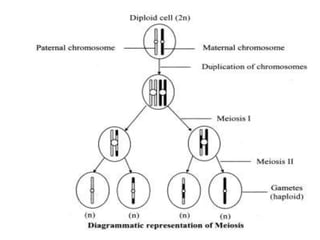
• Meiosis is reductional division in which the
chromosome number is reduced to half.
During meiosis, four haploid daughter cells
are formed from one parental cell.
• It is a process in which the chromosomes
duplicate only once but the cell divides twice.
• It results in formation of four haploid cells.
Hence, it is also called reduction division.
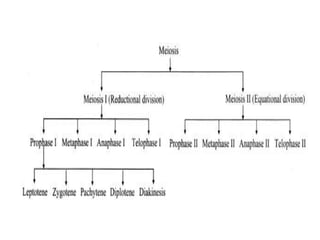
• The various stages in meiosis are
represented as follows:
• phases of meiosis I.
• Ans: Meiosis-I or reduction division
• Meiosis-I is completed through two stages as,
interphase and karyokinesis.
• Interphase:
• It is similar to that seen in mitosis and
involves the duplication of genetic material, i.e.
DNA.
• Karyokinesis:
• It shows the following phases:
• a. Prophase-I:
• It is the most complicated and longest phase
of meiotic division.
• It is further divided into five sub-phases viz:
leptotene, zygotene, pachytene, diplotene and
diakinesis.
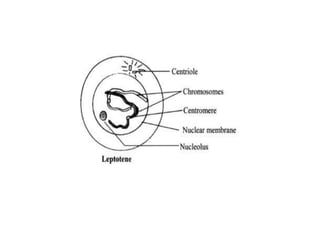
• i. Leptotene or leptonema or thin-thread stage
(leptos = thin, nema = thread):
• During this phase, nuclear membrane and
nucleolus start disintegrating.
• The chromatin network condenses and resolves
into long and thin thread like chromosomes.
• Each chromosome consists of two chromatids but
appear as a single thread.
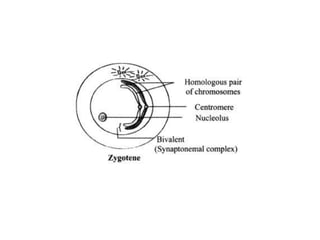
• ii. Zygotene or zygonema (Zygo = paired,
nema = thread):
• It is a phase in which homologous
chromosomes coming from two parents begin
to pair lengthwise.
• Such a pairing of homologous chromosomes is
called synapsis. The pairs of chromosomes at
this stage are called bivalents.
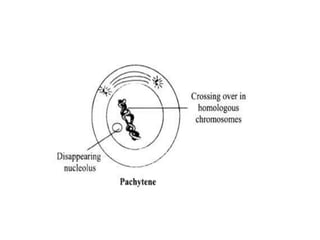
• iii. Pachytene or Pachynema (pachus = thick, nema =
thread):
• During this phase, chromosomes
condense further and appears short and thick.
• Each homologue shows two chromatids.
• Therefore, each bivalent now appears as
a tetrad consisting of four chromatids. The twisting of
chromatid arms results into breakage followed by reunion.
There is exchange of chromatid arms between non-sister
chromatids of homologous chromosomes.
• Non-sister chromatids of the
homologous chromosomes cross each other by exchanging
genetic material. This is known as crossing over.
• It occurs at one or more points caned
chiasmata.
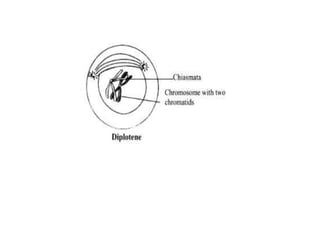
• iv. Diplotene stage (Diplos = two, nema =
thread):
• Homologous chromosomes repel
from each other and begin to separate.
• This phenomenon is called
repulsion.
• However, the chromatids remain
attached at the point of crossing over. Nucleolus
and nuclear membrane start disappearing.
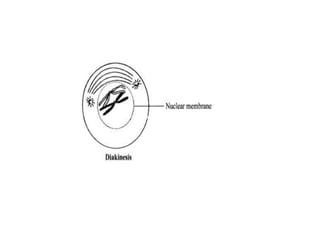
• v. Diakinesis:
• During this phase, chromosomes
continue to shorten and condense.
• As the separation proceeds, the
chiasmata are shifted to the end of the
chromatids.
• This process is called
terminalisation.
• The nucleolus and nuclear
membrane completely disappear and spindle
fibres begin to
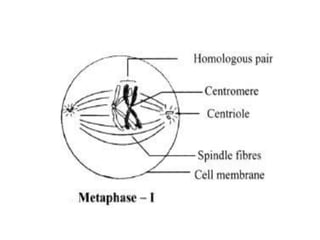
• b. Metaphase I:
• The spindle formation is completed
and occupies nuclear region.
• The bivalents move and arrange
themselves on the equatorial plane ..
• Each chromosome pair is attached by
spindle fibres at the centromere and extends
from the poles to the centro meres of
corresponding homologues.
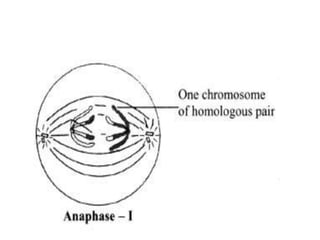
• c. Anaphase I:
• The chromosomal fibres contract and pull
the homologues and inter-chromosomal fibres appear
and extend so that homologous chromosomes start
moving towards opposite poles.
• However, the centromere does not divide so
that chromatids remain together.
• During this stage, homologous
chromosomes (i.e., homologues) which are still
attached at chiasmata, finally get separated.
• At the end of anaphase- I, each pole of the
cell possesses half the number of chromosomes.
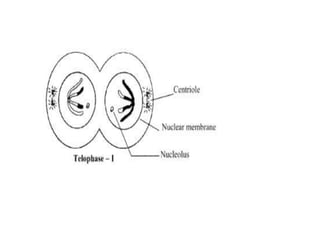
• d. Telophase I:
• The chromosomes uncoil to form
chromatin.
• The chromosomes become elongated
and indistinct.
• The spindle fibres disappear.
• The nucleolus and nuclear
membrane reappear forming two daughter
nuclei.
• e. Cytokinesis - I:
• Telophase-I is immediately followed
by division of the cytoplasm.
• The plasma membrane constricts in
the middle in animal cell, while a cell plate is
formed in plant cell to form two haploid
daughter cells.
• Each daughter cell contains a single
nucleus with a single set of chromosomes.
• Meiosis II:
• Both the haploid daughter cells that are formed at the end of
meiosis I undergo meiosis II.
• A short resting period between meiosis-I and meiosis-II is
called interkinesis.
• Meiosis-II is divided into two sub-stages as karyokinesis and
cytokinesis.
• The karyokinesis involves prophase-II, metaphase-II, anaphase-
II and telophase-II.
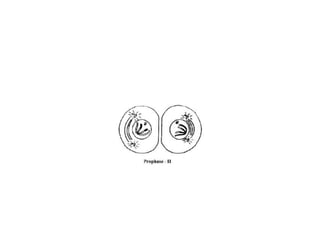
• i. Prophase IT:
• During this phase, chromosomes with chromatids
become very distinct.
• The nucleolus and nuclear membrane disappear.
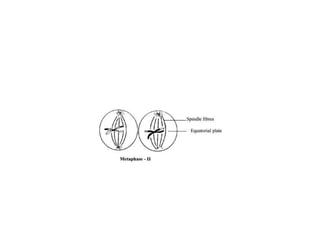
• ii. Metaphase IT:
• Spindle formation occurs and
chromosomes get arranged on the equatorial
plane.
• Chromosomes get connected to the
respective poles by the chromosomal fibres.
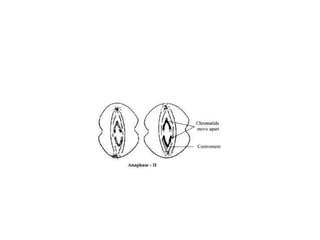
• iii. Anaphase IT:
• The centromere of each chromosome
divides and chromatids are separated.
• Each chromatid is now called daughter
chromosome. Inter-chromosomal fibres are
formed in between the centromeres of daughter
chromosome.
• They move towards opposite poles by
shortening of the chromosomal fibres and
elongation of interchromosomal fibres.
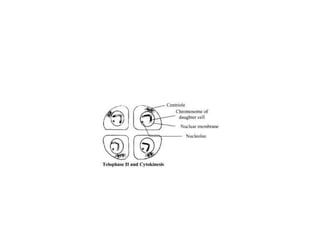
• iv. Telophase IT:
• The daughter chromosomes at each
pole starts uncoiling.
• The nucleolus reappears and the
nuclear membrane is formed around each
group of chromosomes forming two daughter
nuclei.
• The daughter chromosomes form
chromatin network.
• v. Cytokinesis - II:
• Telophase-II is followed by division of
cytoplasm of each cell to form two daughter
cells.
• At the end of meiosis-II, four haploid
daughter cells are produced.
• Significance of meiosis:
• i. Haploid gametes required for sexual
reproduction are formed by meiosis.
• ii. In plants, spores are formed due to
meiosis.
• iii. Meiosis introduces genetic
recombinations leading to variations and
evolution.
• iv. In meiosis, haploid gametes are formed,
these gametes unite at the time of fertilization
and thus chromosome number is restored.