NAXALISM IN
INDIA
HEENA GOYAL
LL.M IN CRIMINAL LAW
SARDAR PATEL UNIVERSITY OF POLICE, SECURITY AND
CRIMINAL JUSTICE
WHAT IS A COMMUNISM ?
 Communism means it is a political and economic ideology – closely
associated with the state Communism of the Soviet Union and China. It
aimed at state control of the economy to attain greater equality – often at
the expense of individual liberty.
 Communist economic and political theory was developed by Karl Marx. He
developed the concept of a ‘Dictatorship of the Proletariat’ arguing that
the working class should rule in the interests of the people, and ignore
democratic norms.
WHAT IS A SOCIALISM?
 The political idea that is based on the belief that all people are equal and
that money and property should be equally divided.
 Traditionally socialist parties may want to nationalize key public sector
industries (which are natural monopolies), but private firms are free to
operate in the free market. Rather than control individual firms, the state
implements rules to avoid the exploitation of workers and consumers.
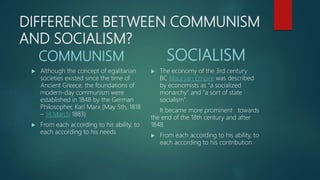
DIFFERENCE BETWEEN COMMUNISM
AND SOCIALISM?
COMMUNISM
 Although the concept of egalitarian
societies existed since the time of
Ancient Greece, the foundations of
modern-day communism were
established in 1848 by the German
Philosopher, Karl Marx (May 5th, 1818
– 14 March 1883)
 From each according to his ability, to
each according to his needs
SOCIALISM
 The economy of the 3rd century
BC Mauryan Empire was described
by economists as “a socialized
monarchy” and “a sort of state
socialism”.
It became more prominent towards
the end of the 18th century and after
1848
 From each according to his ability, to
each according to his contribution
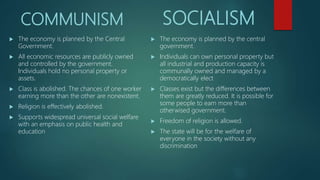
COMMUNISM
 The economy is planned by the Central
Government.
 All economic resources are publicly owned
and controlled by the government.
Individuals hold no personal property or
assets.
 Class is abolished. The chances of one worker
earning more than the other are nonexistent.
 Religion is effectively abolished.
 Supports widespread universal social welfare
with an emphasis on public health and
education
SOCIALISM
 The economy is planned by the central
government.
 Individuals can own personal property but
all industrial and production capacity is
communally owned and managed by a
democratically elect
 Classes exist but the differences between
them are greatly reduced. It is possible for
some people to earn more than
otherwised government.
 Freedom of religion is allowed.
 The state will be for the welfare of
everyone in the society without any
discrimination
WHY NAXALITES ARE COMMUNIST ?
 Naxalites' are followers of Che Guevara.
 But ,Mazumdar’s pro-China stance resonated throughout the CPI-M at a
time when international politics once again played a role in the fracture of
Indian communist parties.
 The CPI-M had an obligation to law and order, which it carried out,
however, this did not deter the movement which continued to gain
momentum. In fact, at its peak in 1969, Mazumdar officially split from the
CPI-M by forming the Communist Party of India- Marxist Leninist (CPI-
ML). Despite the name, Mazumdar was much more inspired by Maoist
ideology than Marxist or Leninist Doctrine. In fact, the slogan of the party
was: “China’s Chairman is our Chairman. Chinese path is our path”.
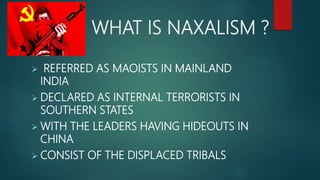
WHAT IS NAXALISM ?
 REFERRED AS MAOISTS IN MAINLAND
INDIA
 DECLARED AS INTERNAL TERRORISTS IN
SOUTHERN STATES
 WITH THE LEADERS HAVING HIDEOUTS IN
CHINA
 CONSIST OF THE DISPLACED TRIBALS
WHO ARE NAXLITE ?
 Common People who want equal social and financial status for all
peoples.
 Who want Basic amenities, infrastructure and opportunities to grow.
 The Naxalites say they are fighting Oppression and Exploitation to
create a classless society.
 The Naxalites operate mostly in the rural and Adivasi areas, often out
of the continuous jungles in these regions.
 Their motto is to show teeth and enlarge upon their ideology and if
possible support landless and poor.
Origin & History about Naxalism
 Naxalisim is originated by K. Sanyal who believed in communist ideology
and through that economic freedom will come when you fight with rich
who have amassed wealth.
 Charu Mujumdar, inspired by the doctrines of MAA Zedong of china.
Advocated that Indian Peasants and lower class trial's overthrow the
government and upper classes by force for whom he held responsible for
their plight.
 A large of urban elites were also attracted to their ideology.
Contd..
 The Naxal names come from the village of “NAXALBARI” in the state of
West Bengal where the movement originated.
 Their origin can be traced to the split in 1967 of the Communist Party of
India (Marxist), leading to the formation of the Communist Party of India (
Marxist-Leninist).
 ‘Naxalite’ or ‘Naxalism’ is an informed name given to radical, often
violent, revolutionary communist groups that were born out of the Sino-
soviet split in the Indian Communist Movement
Contd..
 Initially the movement had its center in west Bengal.
 Between the first phase of Naxalism (1967 to 1972) and today’s Maoist
movement, vast changes have occurred in the taxonomy of Naxalism.
 In Last years, it Spread into less developed areas of rural central and
eastern India, such as
- Chhattisgarh
- Orissa
- Andhra Pradesh
 It Spreaded through the activities of underground groups like the
Communist Party of India (Maoist).
Contd..
 Over the years, the trajectory of the movement, as also its character,
changed and it became more brutal and bloody.
 it has metamorphosed into a highly rigid and militaristic movement, more
intent on terrorizing segments of population than on supporting people’s
causes.
 Communist Party of India (Maoist) lost around 30 of its cadres in a covert
operation jointly organized by the Greyhounds of Andhra Pradesh and
the Special Operations Group of Odisha.
 Many claim that it marked the beginning of the end of the Naxalite
movement in the country.
WHAT WERE THEIR OBJECTIVES ?
 This small breakaway group was to capture additional lands of big
zemindaris and distribute the same among the tilling farmers and
landless laborers.
 The leadership for the first Naxal movement was provided by Charu
Majumdar, Kanu Sanyal and Jangal Santhal.
 Ultimate goal of Naxalites is to dismantle current Indian system of
governance and establish what they call as ‘TRUE PEOPLE’S
GOVERNMENT and a CLASS LESS SOCIETY’
 They are against form of democracy and political system.
HOW NAXALISM SPREAD IN INDIA?
 Naxals promote an ideology of "bringing about a New Democratic
Revolution by launching protracted People’s War, establish base areas,
organize People’s Army, and undertake militant mass movements”. This
Marxist-Leninist jargon, is beyond the comprehension of the rank and
file.
 Naxalism spreads by assuring to uphold the interests of the suppressed
ones against the prevailing injustices of the establishment, harassment by
petty government functionaries, extortion by policemen, and callousness
of officers in addressing their grievances.
 Naxalism is a sign of poor governance. It is not a coincidence that
Naxalism is more dominant in the under-developed areas and has
greater influence among those who have faced repercussions due to the
faulty socio-economic and political policies of governments.
CONTD…
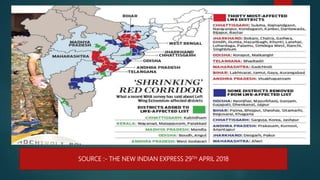
 The Red corridor from Tirupati in Andhra Pradesh to Pashupati in Nepal
where Naxals have an overarching influence is one of the under-
developed regions of the country. It would not be an exaggeration to say
that Naxalism is also a sign of poor governance
SOURCE :- THE NEW INDIAN EXPRESS 29TH APRIL 2018
Causes
 Social
- Poverty
- Socialization
- Rumors
- Social Motives
 Psychosocial
- Culture
- Leadership
- Impression Management
- Person Perception
 Political Factor
Major Attacks
 On 15th Feb. 2010, Naxalite attacked on a paramilitary camp in west Bengal, killed 24
paramilitary personnel, with many more reported missing.
 On 4th April 2010, Policemen were killed and ten wounded when rebels below up a
police bus in Orissa’s koraput district and Naxalite rebels killed 75 Indian paramilitary
personnel and 1 state police constable in a series of attacks on security convoys in
dantewada district in the central Indian state of Chhattisgarh.
 On 28th May 2010, the Naxalites derailed GYANESHWARI EXPRESS killing more than
150.
 2013- The Naxal attacks in Darbar Valley resulted in deaths of around 24 Indian
Nationalist Congress Leaders including the former state minister Mahendra Kamra and
the Chhattisgarh congress Chief Nand Kumar Patel.
 2014- Six Police Personnel including SHO, killed in Maoist attack in Chhattisgarh .
 2015- Special Task Force (STF) personals were killed in a Maoist ambush near
kankerlanka, Sukma, Chhattisgarh.
URBAN NAXALISM
 The phrase of Urban Naxals is loosely attributed to the people with naxalite
bent of mind residing in urban areas and working as activists, supporters and
protectors of the ideology while the active Naxals battle it out in the jungles
and vast swathes of Maoist-dominated areas.
 There are still numerous Naxalite factions active in the country’s eastern
states, along what has been infamously dubbed the Red Corridor
 Identity politics today has become India’s biggest socio-political malaise.
 It is now spreading its tentacles in Punjab, Haryana, Rajasthan and Gujarat.
Delhi is emerging as the center of Urban Naxalism.
 It did lose some of the support of the urban intelligentsia, but Maoism still
resonates with some of the more ideologically oriented elements in
universities and colleges.
CURRENT SCENAIRO….
 Naxal incidents have shown a different face of Naxlism, which is far away
from its initial targets. They are not only limited to attacks and explosions
but also actively involved in economic exploitation, paving way for the
rich businessman and industrialist to exploit the land, people and their
resources as much as they want.
 they have begun targeting India‘s seat of power—New Delhi—and many
other cities by setting up urban bases with the aim to penetrate and
influence policy makers, judiciary, media, civil liberty, human rights,
cultural, Dalit, women and youth organizations. So far, the urban units are
not indulging in violence. But who knows when they may start firing
guns.
OPERATION BARGA
 The CPI[M] in West Bengal carried out Operation Barga under which
share croppers were registered and given permanent and inheritable
rights on cultivation of their plots covering a total area of 11 lakhs acres.
Besides this, 1.37 lakh acres of ceiling surplus and benami lands were
acquired by the state government and distributed among 25 lakh
landless and marginal cultivators. This saw the emergence of a new class
loosely termed rural rich, which weakened the social and political power
enjoyed by landlords in the countryside, and resulted in the
disappearance of moneylenders and Naxalites. In Kerala the upper classes
were generally landlords. They had tenant farmers on their land who
deposited half the crop to their landlords. The landlords and their
progeny were educated and took up white collar jobs in the cities.
FOREST CONSERVATION ACT,1980
 The Forest Conservation Act, 1980 made this position irreversible by
declaring that no forest land shall be diverted to non-forest use without
the permission of the Union government. The punitive provisions of the
Act meant that eviction of Adivasi occupants of forest land took place on
a regular basis, resulting in considerable deprivation and suffering.
The Forest Rights Act (FRA), 2006
 Scheduled Tribes and Other Traditional Forest Dwellers (Recognition of
Forest Rights) Act 2006, which has come into force from 1st January 2008,
will make a difference if implemented faithfully.
 Objective :-
 To undo the historical injustice occurred to the forest dwelling
communities.
 To ensure land tenure, livelihood and food security of the forest dwelling
Scheduled Tribes and other traditional forest dwellers.
 To strengthen the conservation regime of the forests by including the
responsibilities and authority on Forest Rights holders for sustainable use,
conservation of biodiversity and maintenance of ecological balance.
 Rights under the Act:
 Title rights – Ownership to land that is being farmed by tribals or forest dwellers subject to a
maximum of 4 hectares; ownership is only for land that is actually being cultivated by the
concerned family, meaning that no new lands are granted.
 Use rights – to minor forest produce (also including ownership), to grazing areas, to pastoralist
routes, etc.
 Relief and development rights – to rehabilitation in case of illegal eviction or forced
displacement; and to basic amenities, subject to restrictions for forest protection.
Eligibility:
 Eligibility to get rights under the Act is confined to those who “primarily reside in forests” and
who depend on forests and forest land for a livelihood. Further, either the claimant must be a
member of the Scheduled Tribes scheduled in that area or must have been residing in the forest
for 75 years.
Process of recognition of rights:
 The Act provides that the gram Sabha, or village assembly, will initially
pass a resolution recommending whose rights to which resources
should be recognized.
 This resolution is then screened and approved at the level of the sub-
division (or taluka) and subsequently at the district level.
 The screening committees consist of three government officials
Revenue and Tribal Welfare departments) and three elected members
of the local body at that level. These committees also hear appeals.
RIGHT TO FAIR COMPENSATION AND TRANSPARENCY
IN LAND ACQUISITION , REHABILITATION AND
RESETTLEMENT ACT, 2013
 Acquiring land: For private project, 80% affected families must agree. For PPP
project, 70% affected families must agree. Only then land can be acquired.
 Social impact assessment: Under Social impact assessment (SIA) even need
to obtain consent of the affected artisans, laborers, share-croppers, tenant
farmers etc. whose (sustainable) livelihood will be affected because of the
given project.
 Compensation: Compensation proportion to market rates. 4 times the
market rate in rural area. 2 times in urban area. Affected artisans, small
traders, fishermen etc. will be given one-time payment, even if they don’t
own any land.
 To ensure food security: Fertile, irrigated, multi-cropped farmland can be
acquired only in last resort. If such fertile land is acquired, then Government
will have to develop equal size of wasteland for agriculture purpose.
CONTD…
 Private entities: If Government acquires the lands for private company-
the said private company will be responsible for relief and rehabilitation
of the affected people. Additional rehabilitation package for SC/ST
owners.
 Safeguards: State Governments have to setup dispute settlement
Chairman must be a district judge or lawyer for 7 years.
 Accountability: Head of the department will be made responsible, for any
offense from Government’s side. If project doesn’t start in 5 years, land
has to be returned to the original owner or the land bank. Establishment
of Land Acquisition, Rehabilitation and Resettlement Authority for speedy
disposal of disputes.
Unlawful Activities Prevention Act,1967
(UAPA)
 To provide for the more effective prevention of certain unlawful activities
of individuals and associations and for matters connected therewith.
 unlawful activity” refers to any action taken by individual or association
(whether by committing an act or by words, either spoken or written or
by signs to questions, disclaims, disrupts, or is intended to disrupt the
territorial integrity and sovereignty of India
SAMADHAN:
 S- Smart Leadership,
 A- Aggressive Strategy,
 M- Motivation and Training,
 A- Actionable Intelligence,
 D- Dashboard Based KPIs (Key Performance Indicators) and KRAs (Key
Result Areas),
 H- Harnessing Technology,
 A- Action plan for each Theatre, and
 N- No access to Financing.
GOVERNMENT POLICIES
 Operation Green Hunt: started in 2010 and massive deployment of security
forces was done in the naxal-affected areas. From 223 districts that were
affected due to Naxlism in the year 2010, the number has come down to 90
in nine years.
 Aspirational Districts Programme
 The Government’s approach is to deal with Left Wing Extremism in a holistic
manner, in the areas of security, development, ensuring rights and
entitlements of local communities, improvement in governance and public
perception management
 ‘Police’ and ‘Public Order’ being State subjects, action on maintenance of law
and order lies primarily in the domain of the State Governments.
 Filling up critical infrastructure gaps under the Scheme for Special
Infrastructure in Left Wing Extremism affected States.
Contd…
 Assistance in training of State Police through the Ministry of Defence.
 Assistance in community policing and civic action programmes.
 ‘National Policy and Action Plan to address Left Wing Extremism’,
aimed at eliminating the menace in the shortest possible timeframe.
 Anti-left wing extremism (A-LWE) policy to enhance the deployment
of central forces in the Naxal infested areas in the state
WAY TO END NAXALISM IN
INDIA
 Good governance
 Dialogue
 Gernate more employment and increase wages
 Rehabilitation and Resettlement
 Takes steps for welfare of the tribal
 Modernize law enforcement and agencies
CONCLUSION
 Through a holistic approach focusing on development and
security related interventions, the LWE problem can be
successfully tackled.
 Civil society and the media should build pressure on the
Maoists to eschew violence, join the mainstream and recognize
the fact that the socio-economic and political dynamics and
aspirations of 21st Century India are far removed from the
Maoist world-view.
 An ideology based on violence and annihilation is doomed to
fail in a democracy which offers legitimate forums of grievance
redressed.
Naxalism in India

Naxalism in India

  • 1.
    NAXALISM IN INDIA HEENA GOYAL LL.MIN CRIMINAL LAW SARDAR PATEL UNIVERSITY OF POLICE, SECURITY AND CRIMINAL JUSTICE
  • 2.
    WHAT IS ACOMMUNISM ?  Communism means it is a political and economic ideology – closely associated with the state Communism of the Soviet Union and China. It aimed at state control of the economy to attain greater equality – often at the expense of individual liberty.  Communist economic and political theory was developed by Karl Marx. He developed the concept of a ‘Dictatorship of the Proletariat’ arguing that the working class should rule in the interests of the people, and ignore democratic norms.
  • 3.
    WHAT IS ASOCIALISM?  The political idea that is based on the belief that all people are equal and that money and property should be equally divided.  Traditionally socialist parties may want to nationalize key public sector industries (which are natural monopolies), but private firms are free to operate in the free market. Rather than control individual firms, the state implements rules to avoid the exploitation of workers and consumers.
  • 4.
    DIFFERENCE BETWEEN COMMUNISM ANDSOCIALISM? COMMUNISM  Although the concept of egalitarian societies existed since the time of Ancient Greece, the foundations of modern-day communism were established in 1848 by the German Philosopher, Karl Marx (May 5th, 1818 – 14 March 1883)  From each according to his ability, to each according to his needs SOCIALISM  The economy of the 3rd century BC Mauryan Empire was described by economists as “a socialized monarchy” and “a sort of state socialism”. It became more prominent towards the end of the 18th century and after 1848  From each according to his ability, to each according to his contribution
  • 5.
    COMMUNISM  The economyis planned by the Central Government.  All economic resources are publicly owned and controlled by the government. Individuals hold no personal property or assets.  Class is abolished. The chances of one worker earning more than the other are nonexistent.  Religion is effectively abolished.  Supports widespread universal social welfare with an emphasis on public health and education SOCIALISM  The economy is planned by the central government.  Individuals can own personal property but all industrial and production capacity is communally owned and managed by a democratically elect  Classes exist but the differences between them are greatly reduced. It is possible for some people to earn more than otherwised government.  Freedom of religion is allowed.  The state will be for the welfare of everyone in the society without any discrimination
  • 6.
    WHY NAXALITES ARECOMMUNIST ?  Naxalites' are followers of Che Guevara.  But ,Mazumdar’s pro-China stance resonated throughout the CPI-M at a time when international politics once again played a role in the fracture of Indian communist parties.  The CPI-M had an obligation to law and order, which it carried out, however, this did not deter the movement which continued to gain momentum. In fact, at its peak in 1969, Mazumdar officially split from the CPI-M by forming the Communist Party of India- Marxist Leninist (CPI- ML). Despite the name, Mazumdar was much more inspired by Maoist ideology than Marxist or Leninist Doctrine. In fact, the slogan of the party was: “China’s Chairman is our Chairman. Chinese path is our path”.
  • 7.
    WHAT IS NAXALISM?  REFERRED AS MAOISTS IN MAINLAND INDIA  DECLARED AS INTERNAL TERRORISTS IN SOUTHERN STATES  WITH THE LEADERS HAVING HIDEOUTS IN CHINA  CONSIST OF THE DISPLACED TRIBALS
  • 8.
    WHO ARE NAXLITE?  Common People who want equal social and financial status for all peoples.  Who want Basic amenities, infrastructure and opportunities to grow.  The Naxalites say they are fighting Oppression and Exploitation to create a classless society.  The Naxalites operate mostly in the rural and Adivasi areas, often out of the continuous jungles in these regions.  Their motto is to show teeth and enlarge upon their ideology and if possible support landless and poor.
  • 9.
    Origin & Historyabout Naxalism  Naxalisim is originated by K. Sanyal who believed in communist ideology and through that economic freedom will come when you fight with rich who have amassed wealth.  Charu Mujumdar, inspired by the doctrines of MAA Zedong of china. Advocated that Indian Peasants and lower class trial's overthrow the government and upper classes by force for whom he held responsible for their plight.  A large of urban elites were also attracted to their ideology.
  • 10.
    Contd..  The Naxalnames come from the village of “NAXALBARI” in the state of West Bengal where the movement originated.  Their origin can be traced to the split in 1967 of the Communist Party of India (Marxist), leading to the formation of the Communist Party of India ( Marxist-Leninist).  ‘Naxalite’ or ‘Naxalism’ is an informed name given to radical, often violent, revolutionary communist groups that were born out of the Sino- soviet split in the Indian Communist Movement
  • 11.
    Contd..  Initially themovement had its center in west Bengal.  Between the first phase of Naxalism (1967 to 1972) and today’s Maoist movement, vast changes have occurred in the taxonomy of Naxalism.  In Last years, it Spread into less developed areas of rural central and eastern India, such as - Chhattisgarh - Orissa - Andhra Pradesh  It Spreaded through the activities of underground groups like the Communist Party of India (Maoist).
  • 12.
    Contd..  Over theyears, the trajectory of the movement, as also its character, changed and it became more brutal and bloody.  it has metamorphosed into a highly rigid and militaristic movement, more intent on terrorizing segments of population than on supporting people’s causes.  Communist Party of India (Maoist) lost around 30 of its cadres in a covert operation jointly organized by the Greyhounds of Andhra Pradesh and the Special Operations Group of Odisha.  Many claim that it marked the beginning of the end of the Naxalite movement in the country.
  • 13.
    WHAT WERE THEIROBJECTIVES ?  This small breakaway group was to capture additional lands of big zemindaris and distribute the same among the tilling farmers and landless laborers.  The leadership for the first Naxal movement was provided by Charu Majumdar, Kanu Sanyal and Jangal Santhal.  Ultimate goal of Naxalites is to dismantle current Indian system of governance and establish what they call as ‘TRUE PEOPLE’S GOVERNMENT and a CLASS LESS SOCIETY’  They are against form of democracy and political system.
  • 14.
    HOW NAXALISM SPREADIN INDIA?  Naxals promote an ideology of "bringing about a New Democratic Revolution by launching protracted People’s War, establish base areas, organize People’s Army, and undertake militant mass movements”. This Marxist-Leninist jargon, is beyond the comprehension of the rank and file.  Naxalism spreads by assuring to uphold the interests of the suppressed ones against the prevailing injustices of the establishment, harassment by petty government functionaries, extortion by policemen, and callousness of officers in addressing their grievances.  Naxalism is a sign of poor governance. It is not a coincidence that Naxalism is more dominant in the under-developed areas and has greater influence among those who have faced repercussions due to the faulty socio-economic and political policies of governments.
  • 15.
    CONTD…  The Redcorridor from Tirupati in Andhra Pradesh to Pashupati in Nepal where Naxals have an overarching influence is one of the under- developed regions of the country. It would not be an exaggeration to say that Naxalism is also a sign of poor governance
  • 16.
    SOURCE :- THENEW INDIAN EXPRESS 29TH APRIL 2018
  • 17.
    Causes  Social - Poverty -Socialization - Rumors - Social Motives  Psychosocial - Culture - Leadership - Impression Management - Person Perception  Political Factor
  • 18.
    Major Attacks  On15th Feb. 2010, Naxalite attacked on a paramilitary camp in west Bengal, killed 24 paramilitary personnel, with many more reported missing.  On 4th April 2010, Policemen were killed and ten wounded when rebels below up a police bus in Orissa’s koraput district and Naxalite rebels killed 75 Indian paramilitary personnel and 1 state police constable in a series of attacks on security convoys in dantewada district in the central Indian state of Chhattisgarh.  On 28th May 2010, the Naxalites derailed GYANESHWARI EXPRESS killing more than 150.  2013- The Naxal attacks in Darbar Valley resulted in deaths of around 24 Indian Nationalist Congress Leaders including the former state minister Mahendra Kamra and the Chhattisgarh congress Chief Nand Kumar Patel.  2014- Six Police Personnel including SHO, killed in Maoist attack in Chhattisgarh .  2015- Special Task Force (STF) personals were killed in a Maoist ambush near kankerlanka, Sukma, Chhattisgarh.
  • 19.
    URBAN NAXALISM  Thephrase of Urban Naxals is loosely attributed to the people with naxalite bent of mind residing in urban areas and working as activists, supporters and protectors of the ideology while the active Naxals battle it out in the jungles and vast swathes of Maoist-dominated areas.  There are still numerous Naxalite factions active in the country’s eastern states, along what has been infamously dubbed the Red Corridor  Identity politics today has become India’s biggest socio-political malaise.  It is now spreading its tentacles in Punjab, Haryana, Rajasthan and Gujarat. Delhi is emerging as the center of Urban Naxalism.  It did lose some of the support of the urban intelligentsia, but Maoism still resonates with some of the more ideologically oriented elements in universities and colleges.
  • 20.
    CURRENT SCENAIRO….  Naxalincidents have shown a different face of Naxlism, which is far away from its initial targets. They are not only limited to attacks and explosions but also actively involved in economic exploitation, paving way for the rich businessman and industrialist to exploit the land, people and their resources as much as they want.  they have begun targeting India‘s seat of power—New Delhi—and many other cities by setting up urban bases with the aim to penetrate and influence policy makers, judiciary, media, civil liberty, human rights, cultural, Dalit, women and youth organizations. So far, the urban units are not indulging in violence. But who knows when they may start firing guns.
  • 21.
    OPERATION BARGA  TheCPI[M] in West Bengal carried out Operation Barga under which share croppers were registered and given permanent and inheritable rights on cultivation of their plots covering a total area of 11 lakhs acres. Besides this, 1.37 lakh acres of ceiling surplus and benami lands were acquired by the state government and distributed among 25 lakh landless and marginal cultivators. This saw the emergence of a new class loosely termed rural rich, which weakened the social and political power enjoyed by landlords in the countryside, and resulted in the disappearance of moneylenders and Naxalites. In Kerala the upper classes were generally landlords. They had tenant farmers on their land who deposited half the crop to their landlords. The landlords and their progeny were educated and took up white collar jobs in the cities.
  • 22.
    FOREST CONSERVATION ACT,1980 The Forest Conservation Act, 1980 made this position irreversible by declaring that no forest land shall be diverted to non-forest use without the permission of the Union government. The punitive provisions of the Act meant that eviction of Adivasi occupants of forest land took place on a regular basis, resulting in considerable deprivation and suffering.
  • 23.
    The Forest RightsAct (FRA), 2006  Scheduled Tribes and Other Traditional Forest Dwellers (Recognition of Forest Rights) Act 2006, which has come into force from 1st January 2008, will make a difference if implemented faithfully.  Objective :-  To undo the historical injustice occurred to the forest dwelling communities.  To ensure land tenure, livelihood and food security of the forest dwelling Scheduled Tribes and other traditional forest dwellers.  To strengthen the conservation regime of the forests by including the responsibilities and authority on Forest Rights holders for sustainable use, conservation of biodiversity and maintenance of ecological balance.
  • 24.
     Rights underthe Act:  Title rights – Ownership to land that is being farmed by tribals or forest dwellers subject to a maximum of 4 hectares; ownership is only for land that is actually being cultivated by the concerned family, meaning that no new lands are granted.  Use rights – to minor forest produce (also including ownership), to grazing areas, to pastoralist routes, etc.  Relief and development rights – to rehabilitation in case of illegal eviction or forced displacement; and to basic amenities, subject to restrictions for forest protection. Eligibility:  Eligibility to get rights under the Act is confined to those who “primarily reside in forests” and who depend on forests and forest land for a livelihood. Further, either the claimant must be a member of the Scheduled Tribes scheduled in that area or must have been residing in the forest for 75 years.
  • 25.
    Process of recognitionof rights:  The Act provides that the gram Sabha, or village assembly, will initially pass a resolution recommending whose rights to which resources should be recognized.  This resolution is then screened and approved at the level of the sub- division (or taluka) and subsequently at the district level.  The screening committees consist of three government officials Revenue and Tribal Welfare departments) and three elected members of the local body at that level. These committees also hear appeals.
  • 26.
    RIGHT TO FAIRCOMPENSATION AND TRANSPARENCY IN LAND ACQUISITION , REHABILITATION AND RESETTLEMENT ACT, 2013  Acquiring land: For private project, 80% affected families must agree. For PPP project, 70% affected families must agree. Only then land can be acquired.  Social impact assessment: Under Social impact assessment (SIA) even need to obtain consent of the affected artisans, laborers, share-croppers, tenant farmers etc. whose (sustainable) livelihood will be affected because of the given project.  Compensation: Compensation proportion to market rates. 4 times the market rate in rural area. 2 times in urban area. Affected artisans, small traders, fishermen etc. will be given one-time payment, even if they don’t own any land.  To ensure food security: Fertile, irrigated, multi-cropped farmland can be acquired only in last resort. If such fertile land is acquired, then Government will have to develop equal size of wasteland for agriculture purpose.
  • 27.
    CONTD…  Private entities:If Government acquires the lands for private company- the said private company will be responsible for relief and rehabilitation of the affected people. Additional rehabilitation package for SC/ST owners.  Safeguards: State Governments have to setup dispute settlement Chairman must be a district judge or lawyer for 7 years.  Accountability: Head of the department will be made responsible, for any offense from Government’s side. If project doesn’t start in 5 years, land has to be returned to the original owner or the land bank. Establishment of Land Acquisition, Rehabilitation and Resettlement Authority for speedy disposal of disputes.
  • 28.
    Unlawful Activities PreventionAct,1967 (UAPA)  To provide for the more effective prevention of certain unlawful activities of individuals and associations and for matters connected therewith.  unlawful activity” refers to any action taken by individual or association (whether by committing an act or by words, either spoken or written or by signs to questions, disclaims, disrupts, or is intended to disrupt the territorial integrity and sovereignty of India
  • 29.
    SAMADHAN:  S- SmartLeadership,  A- Aggressive Strategy,  M- Motivation and Training,  A- Actionable Intelligence,  D- Dashboard Based KPIs (Key Performance Indicators) and KRAs (Key Result Areas),  H- Harnessing Technology,  A- Action plan for each Theatre, and  N- No access to Financing.
  • 30.
    GOVERNMENT POLICIES  OperationGreen Hunt: started in 2010 and massive deployment of security forces was done in the naxal-affected areas. From 223 districts that were affected due to Naxlism in the year 2010, the number has come down to 90 in nine years.  Aspirational Districts Programme  The Government’s approach is to deal with Left Wing Extremism in a holistic manner, in the areas of security, development, ensuring rights and entitlements of local communities, improvement in governance and public perception management  ‘Police’ and ‘Public Order’ being State subjects, action on maintenance of law and order lies primarily in the domain of the State Governments.  Filling up critical infrastructure gaps under the Scheme for Special Infrastructure in Left Wing Extremism affected States.
  • 31.
    Contd…  Assistance intraining of State Police through the Ministry of Defence.  Assistance in community policing and civic action programmes.  ‘National Policy and Action Plan to address Left Wing Extremism’, aimed at eliminating the menace in the shortest possible timeframe.  Anti-left wing extremism (A-LWE) policy to enhance the deployment of central forces in the Naxal infested areas in the state
  • 32.
    WAY TO ENDNAXALISM IN INDIA  Good governance  Dialogue  Gernate more employment and increase wages  Rehabilitation and Resettlement  Takes steps for welfare of the tribal  Modernize law enforcement and agencies
  • 33.
    CONCLUSION  Through aholistic approach focusing on development and security related interventions, the LWE problem can be successfully tackled.  Civil society and the media should build pressure on the Maoists to eschew violence, join the mainstream and recognize the fact that the socio-economic and political dynamics and aspirations of 21st Century India are far removed from the Maoist world-view.  An ideology based on violence and annihilation is doomed to fail in a democracy which offers legitimate forums of grievance redressed.