POLIOVIRUS
Supervised by
Dr.. Talib Abdullah Hussein
project by
Shams Imad Ali
1. What is Polio?
2. Symptoms
3. Vaccine
4. History
5. Causes
6. Risk factors
7. Prevention
POLIOVIRUS
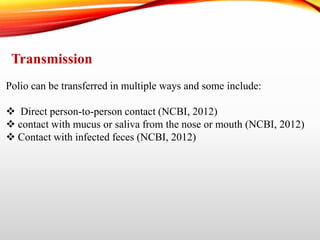
• Poliomyelitis is an acute infectious disease that in its serious form affects
the central nervous system.
• The destruction of motor neurons in the spinal cord results in flaccid
paralysis. However, most poliovirus infections are subclinical.
Polio can be transferred in multiple ways and some include:
 Direct person-to-person contact (NCBI, 2012)
 contact with mucus or saliva from the nose or mouth (NCBI, 2012)
 Contact with infected feces (NCBI, 2012)
Transmission
MORPHOLOGY POLIOVIRUS
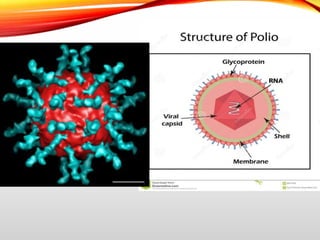
• Size: The virion is a spherical particle, about 27 nm in diameter
• Capsid: It consists of a capsid shell of 60 subunits, each consisting of
four viral proteins (VP1-VP4), arranged in icosahedral symmetry.
• Genome: The genome is a single strand of positive sense RNA.
• The virus can be crystallised, and arrays of virus crystals can be seen in
the cytoplasm of infected cells.
RESISTANCE POLIOVIRUS
1.Poliovirus is resistant to ether, chloroform, proteolytic enzymes of
the intestinal contents and detergents.
2. It is stable at pH 3.
3. In feces, virus can survive for months at 4°C, for years at –20 or –
70°C and at room temperature for several weeks,
4. They are inactivated when heated at 55°C for 30 minutes.
5. Drying rapidly inactivates enteroviruses by ultraviolet
light, and usually by drying.
6. Formaldehyde and oxidizing disinfectants destroy the
virus.
7. Chlorination destroys the virus in water but organic
matter delays inactivation.
8. Poliovirus does not survive lyophilization well
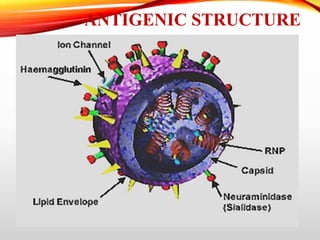
ANTIGENIC STRUCTURE
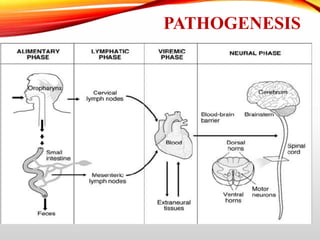
PATHOGENESIS
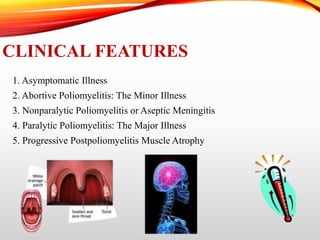
CLINICAL FEATURES
1. Asymptomatic Illness
2. Abortive Poliomyelitis: The Minor Illness
3. Nonparalytic Poliomyelitis or Aseptic Meningitis
4. Paralytic Poliomyelitis: The Major Illness
5. Progressive Postpoliomyelitis Muscle Atrophy
LABORATORY
DIAGNOSIS
SPECIMENS
• Blood, CSF, throat swabs and feces.
• Polioviruses may be isolated from the patient’s pharynx during the first
few days of illness, from the feces for as long as 30 days, but from the
CSF only rarely but can be obtained from the spinal cord and brain,
postmortem unlike other enteroviruses.
CULTURE
• Primary monkey kidney cells are usually employed.
• The virus growth is indicated by typical cytopathic effects in 2-3 days.
• An isolated virus is identified and typed by neutralization with specific
antiserum.
SEROLOGICAL TESTS
• Serodiagnosis is less often employed. Antibody rise can be
demonstrated in paired sera by neutralization or complement
fixation tests.
PROPHYLAXIS
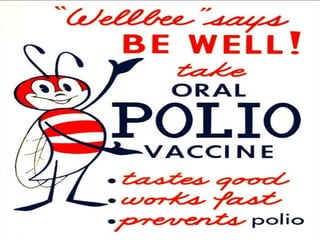
1. Inactivated polio vaccine (lPV)—Salk killed polio vaccine.
2. Oral polio vaccine (OPV)—Sabin live polio vaccine.
IMMUNISATION
SCHEDULE
• Primary course of 3 doses of OPV at one-month intervals, commencing the
first dose when infant is 6 weeks old.
• One booster dose of OPV is recommended 12 to 18 months later
poliovirus-190801072449.            pptx

poliovirus-190801072449. pptx

  • 1.
    POLIOVIRUS Supervised by Dr.. TalibAbdullah Hussein project by Shams Imad Ali
  • 2.
    1. What isPolio? 2. Symptoms 3. Vaccine 4. History 5. Causes 6. Risk factors 7. Prevention
  • 3.
    POLIOVIRUS • Poliomyelitis isan acute infectious disease that in its serious form affects the central nervous system. • The destruction of motor neurons in the spinal cord results in flaccid paralysis. However, most poliovirus infections are subclinical.
  • 4.
    Polio can betransferred in multiple ways and some include:  Direct person-to-person contact (NCBI, 2012)  contact with mucus or saliva from the nose or mouth (NCBI, 2012)  Contact with infected feces (NCBI, 2012) Transmission
  • 5.
    MORPHOLOGY POLIOVIRUS • Size:The virion is a spherical particle, about 27 nm in diameter • Capsid: It consists of a capsid shell of 60 subunits, each consisting of four viral proteins (VP1-VP4), arranged in icosahedral symmetry. • Genome: The genome is a single strand of positive sense RNA. • The virus can be crystallised, and arrays of virus crystals can be seen in the cytoplasm of infected cells.
  • 7.
    RESISTANCE POLIOVIRUS 1.Poliovirus isresistant to ether, chloroform, proteolytic enzymes of the intestinal contents and detergents. 2. It is stable at pH 3. 3. In feces, virus can survive for months at 4°C, for years at –20 or – 70°C and at room temperature for several weeks, 4. They are inactivated when heated at 55°C for 30 minutes.
  • 8.
    5. Drying rapidlyinactivates enteroviruses by ultraviolet light, and usually by drying. 6. Formaldehyde and oxidizing disinfectants destroy the virus. 7. Chlorination destroys the virus in water but organic matter delays inactivation. 8. Poliovirus does not survive lyophilization well
  • 9.
  • 10.
  • 11.
    CLINICAL FEATURES 1. AsymptomaticIllness 2. Abortive Poliomyelitis: The Minor Illness 3. Nonparalytic Poliomyelitis or Aseptic Meningitis 4. Paralytic Poliomyelitis: The Major Illness 5. Progressive Postpoliomyelitis Muscle Atrophy
  • 12.
  • 13.
    SPECIMENS • Blood, CSF,throat swabs and feces. • Polioviruses may be isolated from the patient’s pharynx during the first few days of illness, from the feces for as long as 30 days, but from the CSF only rarely but can be obtained from the spinal cord and brain, postmortem unlike other enteroviruses.
  • 14.
    CULTURE • Primary monkeykidney cells are usually employed. • The virus growth is indicated by typical cytopathic effects in 2-3 days. • An isolated virus is identified and typed by neutralization with specific antiserum.
  • 15.
    SEROLOGICAL TESTS • Serodiagnosisis less often employed. Antibody rise can be demonstrated in paired sera by neutralization or complement fixation tests.
  • 16.
    PROPHYLAXIS 1. Inactivated poliovaccine (lPV)—Salk killed polio vaccine. 2. Oral polio vaccine (OPV)—Sabin live polio vaccine.
  • 17.
    IMMUNISATION SCHEDULE • Primary courseof 3 doses of OPV at one-month intervals, commencing the first dose when infant is 6 weeks old. • One booster dose of OPV is recommended 12 to 18 months later