POLICIES AND PROGRAMMES
OF GOVERNMENT
TO IMPROVE EDUCATONAL OPPORTUNITES
FOR DISADVANTAGES GROUP
Agenda
• Introduction
• Who are Disadvantaged? – Indian
Context
• Commissions & Recommendations
• Government Policies and Programs
• Shortcomings
• Advantages
• Disadvantages
• Conclusions
Introduction
 Group within a society that is marginalized and has reduced
access to resources and services such as education, health, credit
and power.
 Socioeconomically disadvantaged are those who are on low
incomes who struggle to supply themselves and their family with
food, clothing and shelter.
 Education is the most important lever for social, economic and
political transformation.
 Education also acts as an integrative force in society, imparting
values that foster social cohesion and national identity.
Who are Disadvantaged – Indian Context
 In common parlance, the following are considered disadvantaged
sections
 Scheduled Castes (SCs)
 Scheduled Tribes (STs),
 Other Backward Classes (OBCs),
 Women/Girls,
 Children with Special Needs (CWSN), and
 Minorities
 The Socially Disadvantaged Groups include the Scheduled Castes
(SCs), the Scheduled Tribes (STs), the Other Backward Classes
(OBCs) and the Minorities. According to the 1991 Census, SCs
account for 138.23 million (16.5 percent); STs 67.76 million (8.1
percent); and Minorities 145.31 million (17.2 percent).
Empowerment of Disadvantaged Groups
 The Socially Disadvantaged Groups include – the Scheduled
Castes (SCs), the Scheduled Tribes (STs), the Other Backward
Classes (OBCs) and the Minorities. The Ninth Five Year Plan
is committed to empower these Groups, as the agents of socio-
economic change and development through a three pronged
strategy of
 Social Empowerment
 Economic Empowerment
 Social Justice.
 Empowering the Disabled
 Implementation of the Persons with Disabilities (Equal
Opportunities, Protection of Rights and Full Participation) Act,
1995
Commissions
 Kaka Kalelkar Commission
 The Backward Class Commission was appointed in 1953 with Kaka
Kalelkar as the Chairman.
 These recommendations are as follows:
 70 per cent of the seats in professional colleges should be reserved
for them and in making selections
 With respect to representation in Government and local body
services the Commission recommended the reservation of 25 per
cent of the class I vacancies, one third of the class II vacancies and
40 per cent of class III and IV for the other backward classes.
Commissions
Mandal Commission
 A Commission was appointed for backward classes in 1977 under
the Chairmanship of B.R Mandal.
These recommendations are as follows:
 27 per cent of reservations in the service and promotion
 In case the reserve quota is not filled, quota should be kept
reserved for three
 There should be relaxation in upper age limit
 Reservation policy should be applicable to all public sector and
Government undertakings
 Government should make legal provisions for implementation of
these recommendations.
Policies in Education
In recognition of education as a Fundamental Right,
to increase school enrolment and retention rates
amongst the children belonging to SCs, OBCs and
Minorities. Incentives like provisions
 Abolition of tuition fee in Government schools in all states, at least
up to the primary level.
 Free textbooks, uniforms, stationery, school bags etc. to these
students.
 The other major programmes of the Department of Elementary
Education & Literacy having relevance to SCs and OBCs
Policies in Education
To enable SC and ST students to pursue higher
technical studies, the following special provisions
have been extended by the Department of
Secondary & Higher Education :
 Reservation of seats for SCs/STs in the Central Government
institutions of higher education
 Relaxation in the minimum qualifying cut-off percentages for
admission to universities, colleges and technical institutions;
 Remedial and special coaching for SC/ ST students to improve
academic skills and linguistic
 Around 50 Junior Fellowships are awarded every year in sciences
to SC/ST candidates
Policies in Education
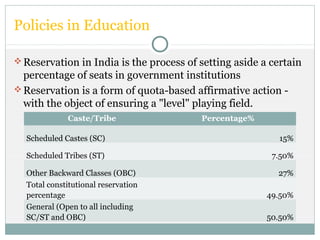
Reservation in India is the process of setting aside a certain
percentage of seats in government institutions
Reservation is a form of quota-based affirmative action -
with the object of ensuring a "level" playing field.
Caste/Tribe Percentage%
Scheduled Castes (SC) 15%
Scheduled Tribes (ST) 7.50%
Other Backward Classes (OBC) 27%
Total constitutional reservation
percentage 49.50%
General (Open to all including
SC/ST and OBC) 50.50%
Policies and Programs – SC/STs
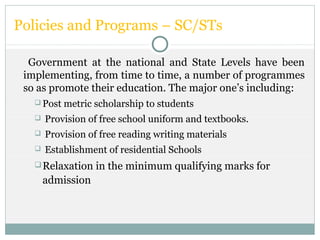
Government at the national and State Levels have been
implementing, from time to time, a number of programmes
so as promote their education. The major one’s including:
 Post metric scholarship to students
 Provision of free school uniform and textbooks.
 Provision of free reading writing materials
 Establishment of residential Schools
Relaxation in the minimum qualifying marks for
admission
Policies and Programs – SC/STs
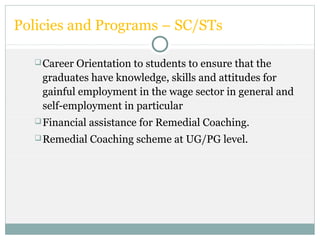
Career Orientation to students to ensure that the
graduates have knowledge, skills and attitudes for
gainful employment in the wage sector in general and
self-employment in particular
Financial assistance for Remedial Coaching.
Remedial Coaching scheme at UG/PG level.
Policies and Programs – OBCs
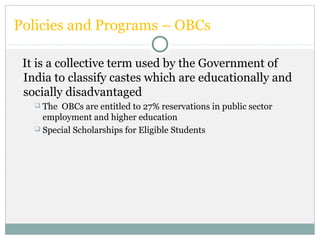
It is a collective term used by the Government of
India to classify castes which are educationally and
socially disadvantaged
 The OBCs are entitled to 27% reservations in public sector
employment and higher education
 Special Scholarships for Eligible Students
Policies and Programs – Minorities
The Government of India has notified five communities,
viz. Muslims, Christians, Sikhs, Budhists and Parsies as
religious minorities.
Below are the Programs of Karnataka Government for
Minorities
 Skill Development Programmes (Koushalya)
 Teaching & Learning Aids to Minority Schools
Policies and Programs – Women/Girls
The Constitution of India grants equality to women
and forbids any discrimination based on religion,
sex, race, caste or place of birth (Art.15). It also
empowers the States to practice protective
discrimination in favor of women.
Policies and Programs – Children With Special
Needs
There are three major Acts that deal with disability in
this country as follows:
Rehabilitation Council of India (RCI) Act 1992
Person with Disabilities (Equal Opportunities,
Protection of Rights & Full Participation) Act 1995.
National Trust for the Welfare of Persons with Autism,
Cerebral Palsy, Mental Retardation, and Multiple
disabilities Act 1999
Programs by Government of Karnataka
 Educational Schemas
 Nursery-Cum-Women-Welfare Centers
 Residential Schools
 Navodaya and Morarji Desai Residential Schools
 Admission of Scheduled Caste students to Ramakrishna Ashrama
School
 Scholarships
 INCENTIVE SCHOLARSHIPS FROM I TO IV STD. STUDENTS.
 INCENTIVE SCHOLARSHIPS TO HIGH SCHOOL GOING GIRLS.
 PRE-MATRIC SCHOLARSHIPS.
 MERIT SCHOLARSHIPS.
 POST-MATRIC SCHOLARSHIPS (GOI)
Programs by Government of Karnataka
 PRE-MATRIC SCHOLARSHIPS TO THE CHILDREN OF THOSE
PARENTS WHO ARE ENGAGED IN UN-CLEAN OCCUPATION.
 STATE POST-MATRIC SCHOLARSHIP.
 PRIZE MONEY TO MERITORIOUS STUDENTS.
 CASH PRIZE FOR RANK HOLDERS.
 FINANCIAL ASSISTANCE TO SC, M.Phil and PhD STUDENTS IN
KARNATAKA.
 BOOK BANK SCHEMES
 EXTRA STUDY TOUR CHARGES.
 FINANCIAL ASSISTANCE TO THE SC STUDENTS WHO ARE
SELECTED BY THE FOREIGN UNIVERSITIES FOR HIGHER
EDUCATION.
Advantages
 It gives an added incentive for emigration to other countries, reducing
population density.
 It helps government to fight the anti-incumbency factor in elections, just give
reservations to a few key castes 2 months before the election.
 It helps students from well-off families of certain castes to do better than
those from well-off families of other castes in IIT-JEE, while the deserving
students from poor families of backward castes who can't afford JEE
coaching can read about this and be happy for their caste-mates or whatever.
 Make sure the caste system in India survives till apocalypse, so that the caste
vote banks remain intact.
 Make sure that poor families from so-called 'upward' castes will find it really
hard to move up in life. Hey, it's karma for all the privileges your grand-
grand parents had!
Conclusion
Government and NGOs are working hand in hand
A lot conspiracies and red tapism still persist
Middle man still gets the major portion of funds
released by central and state government
Awareness of policies , benefits, reservation among
the disadvantateged groups is very less
What needs to be done?? Inclusion at work , in
educational institutions for which facilities must be
available for their smooth functioning and non
discrimination

Policies and programmes_of_government_to_improve_educatonal

  • 1.
    POLICIES AND PROGRAMMES OFGOVERNMENT TO IMPROVE EDUCATONAL OPPORTUNITES FOR DISADVANTAGES GROUP
  • 2.
    Agenda • Introduction • Whoare Disadvantaged? – Indian Context • Commissions & Recommendations • Government Policies and Programs • Shortcomings • Advantages • Disadvantages • Conclusions
  • 3.
    Introduction  Group withina society that is marginalized and has reduced access to resources and services such as education, health, credit and power.  Socioeconomically disadvantaged are those who are on low incomes who struggle to supply themselves and their family with food, clothing and shelter.  Education is the most important lever for social, economic and political transformation.  Education also acts as an integrative force in society, imparting values that foster social cohesion and national identity.
  • 4.
    Who are Disadvantaged– Indian Context  In common parlance, the following are considered disadvantaged sections  Scheduled Castes (SCs)  Scheduled Tribes (STs),  Other Backward Classes (OBCs),  Women/Girls,  Children with Special Needs (CWSN), and  Minorities  The Socially Disadvantaged Groups include the Scheduled Castes (SCs), the Scheduled Tribes (STs), the Other Backward Classes (OBCs) and the Minorities. According to the 1991 Census, SCs account for 138.23 million (16.5 percent); STs 67.76 million (8.1 percent); and Minorities 145.31 million (17.2 percent).
  • 5.
    Empowerment of DisadvantagedGroups  The Socially Disadvantaged Groups include – the Scheduled Castes (SCs), the Scheduled Tribes (STs), the Other Backward Classes (OBCs) and the Minorities. The Ninth Five Year Plan is committed to empower these Groups, as the agents of socio- economic change and development through a three pronged strategy of  Social Empowerment  Economic Empowerment  Social Justice.  Empowering the Disabled  Implementation of the Persons with Disabilities (Equal Opportunities, Protection of Rights and Full Participation) Act, 1995
  • 6.
    Commissions  Kaka KalelkarCommission  The Backward Class Commission was appointed in 1953 with Kaka Kalelkar as the Chairman.  These recommendations are as follows:  70 per cent of the seats in professional colleges should be reserved for them and in making selections  With respect to representation in Government and local body services the Commission recommended the reservation of 25 per cent of the class I vacancies, one third of the class II vacancies and 40 per cent of class III and IV for the other backward classes.
  • 7.
    Commissions Mandal Commission  ACommission was appointed for backward classes in 1977 under the Chairmanship of B.R Mandal. These recommendations are as follows:  27 per cent of reservations in the service and promotion  In case the reserve quota is not filled, quota should be kept reserved for three  There should be relaxation in upper age limit  Reservation policy should be applicable to all public sector and Government undertakings  Government should make legal provisions for implementation of these recommendations.
  • 8.
    Policies in Education Inrecognition of education as a Fundamental Right, to increase school enrolment and retention rates amongst the children belonging to SCs, OBCs and Minorities. Incentives like provisions  Abolition of tuition fee in Government schools in all states, at least up to the primary level.  Free textbooks, uniforms, stationery, school bags etc. to these students.  The other major programmes of the Department of Elementary Education & Literacy having relevance to SCs and OBCs
  • 9.
    Policies in Education Toenable SC and ST students to pursue higher technical studies, the following special provisions have been extended by the Department of Secondary & Higher Education :  Reservation of seats for SCs/STs in the Central Government institutions of higher education  Relaxation in the minimum qualifying cut-off percentages for admission to universities, colleges and technical institutions;  Remedial and special coaching for SC/ ST students to improve academic skills and linguistic  Around 50 Junior Fellowships are awarded every year in sciences to SC/ST candidates
  • 10.
    Policies in Education Reservationin India is the process of setting aside a certain percentage of seats in government institutions Reservation is a form of quota-based affirmative action - with the object of ensuring a "level" playing field. Caste/Tribe Percentage% Scheduled Castes (SC) 15% Scheduled Tribes (ST) 7.50% Other Backward Classes (OBC) 27% Total constitutional reservation percentage 49.50% General (Open to all including SC/ST and OBC) 50.50%
  • 11.
    Policies and Programs– SC/STs Government at the national and State Levels have been implementing, from time to time, a number of programmes so as promote their education. The major one’s including:  Post metric scholarship to students  Provision of free school uniform and textbooks.  Provision of free reading writing materials  Establishment of residential Schools Relaxation in the minimum qualifying marks for admission
  • 12.
    Policies and Programs– SC/STs Career Orientation to students to ensure that the graduates have knowledge, skills and attitudes for gainful employment in the wage sector in general and self-employment in particular Financial assistance for Remedial Coaching. Remedial Coaching scheme at UG/PG level.
  • 13.
    Policies and Programs– OBCs It is a collective term used by the Government of India to classify castes which are educationally and socially disadvantaged  The OBCs are entitled to 27% reservations in public sector employment and higher education  Special Scholarships for Eligible Students
  • 14.
    Policies and Programs– Minorities The Government of India has notified five communities, viz. Muslims, Christians, Sikhs, Budhists and Parsies as religious minorities. Below are the Programs of Karnataka Government for Minorities  Skill Development Programmes (Koushalya)  Teaching & Learning Aids to Minority Schools
  • 15.
    Policies and Programs– Women/Girls The Constitution of India grants equality to women and forbids any discrimination based on religion, sex, race, caste or place of birth (Art.15). It also empowers the States to practice protective discrimination in favor of women.
  • 16.
    Policies and Programs– Children With Special Needs There are three major Acts that deal with disability in this country as follows: Rehabilitation Council of India (RCI) Act 1992 Person with Disabilities (Equal Opportunities, Protection of Rights & Full Participation) Act 1995. National Trust for the Welfare of Persons with Autism, Cerebral Palsy, Mental Retardation, and Multiple disabilities Act 1999
  • 17.
    Programs by Governmentof Karnataka  Educational Schemas  Nursery-Cum-Women-Welfare Centers  Residential Schools  Navodaya and Morarji Desai Residential Schools  Admission of Scheduled Caste students to Ramakrishna Ashrama School  Scholarships  INCENTIVE SCHOLARSHIPS FROM I TO IV STD. STUDENTS.  INCENTIVE SCHOLARSHIPS TO HIGH SCHOOL GOING GIRLS.  PRE-MATRIC SCHOLARSHIPS.  MERIT SCHOLARSHIPS.  POST-MATRIC SCHOLARSHIPS (GOI)
  • 18.
    Programs by Governmentof Karnataka  PRE-MATRIC SCHOLARSHIPS TO THE CHILDREN OF THOSE PARENTS WHO ARE ENGAGED IN UN-CLEAN OCCUPATION.  STATE POST-MATRIC SCHOLARSHIP.  PRIZE MONEY TO MERITORIOUS STUDENTS.  CASH PRIZE FOR RANK HOLDERS.  FINANCIAL ASSISTANCE TO SC, M.Phil and PhD STUDENTS IN KARNATAKA.  BOOK BANK SCHEMES  EXTRA STUDY TOUR CHARGES.  FINANCIAL ASSISTANCE TO THE SC STUDENTS WHO ARE SELECTED BY THE FOREIGN UNIVERSITIES FOR HIGHER EDUCATION.
  • 19.
    Advantages  It givesan added incentive for emigration to other countries, reducing population density.  It helps government to fight the anti-incumbency factor in elections, just give reservations to a few key castes 2 months before the election.  It helps students from well-off families of certain castes to do better than those from well-off families of other castes in IIT-JEE, while the deserving students from poor families of backward castes who can't afford JEE coaching can read about this and be happy for their caste-mates or whatever.  Make sure the caste system in India survives till apocalypse, so that the caste vote banks remain intact.  Make sure that poor families from so-called 'upward' castes will find it really hard to move up in life. Hey, it's karma for all the privileges your grand- grand parents had!
  • 20.
    Conclusion Government and NGOsare working hand in hand A lot conspiracies and red tapism still persist Middle man still gets the major portion of funds released by central and state government Awareness of policies , benefits, reservation among the disadvantateged groups is very less What needs to be done?? Inclusion at work , in educational institutions for which facilities must be available for their smooth functioning and non discrimination