

RESERVATION SYSTEM IN INDIA
Present by..
Mehul Boghra (115348)
 Overview.
 Background.
 Before independence.
 After independence.
 Reservation In Employment.
 Reservation In Education.
 Beneficiary Group Of The Reservation System.
 Excluded From The Reservation System.
 Advantages And Disadvantages Of Reservation System.
Outline.
 The system of reservation in India comprises a series of affirmative action measures, such as
reserving access to seats in the various legislatures, to government jobs, and to enrolment in
higher educational institutions.
 listed as Scheduled cast and Scheduled Tribe by the Government of India.
 Over the years, the categories for affirmative action have been expanded beyond the lists of
Scheduled castes and tribes to include a special category of other backward classes(OBC).
 Reservation is governed by constitutional laws, statutory laws, and local rules and regulations.
The Scheduled castes (SC), scheduled tribes (ST) and Other Backward Classes (OBC), and in some
states Backward Classes among Muslims under a category called BC(M), are the primary
beneficiaries of the reservation policies under the Constitution.
Overview
Background.
Before Independence.
 In 1882 and 1891. Shahu, the maharaja of the princely state of Kolhapur, introduced reservation
in favor of non–Brahmin and backward classes, much of which came into force in 1902. He
provided free education to everyone and opened several hostels to make it easier for them to
receive it.
 the Prime Minister of Britain, Ramsay Macdonald, proposed the Communal Award, according to
which separate representation was to be provided for Muslims, Sikhs, Indian Christians, Anglo-
Indians, and Europeans. The depressed classes were assigned a number of seats to be filled by
election from constituencies in which only they could vote, although they could also vote in other
seats.
 Mahatma Gandhi fasted in protest against it but many among the depressed classes, including
their leader, B. R. Ambedkar, favored it. After negotiations, Gandhi reached an agreement with
Ambedkar to have a single Hindu electorate, with Dalits having seats reserved within it.
After Independence.
Count...
 After the independence of India in 1947 there were some major changes in favor of the
Scheduled Tribes (ST), Scheduled Castes (SC) and Other Backward Classes (OBC). A common form
of caste discrimination in India has been the practice of untouchability. SCs were the primary
targets of the practice, which was outlawed by the new Constitution of India.
 In 1954, the Ministry of Education suggested that 20 per cent of places should be reserved for the
SCs and STs in educational institutions with a provision to relax minimum qualifying marks for
admission by 5 per cent wherever required. In 1982, it was specified that 15 per cent and 7.5 per
cent of vacancies in public sector and government-aided educational institutes should be
reserved for the SC and ST candidates, respectively.
 Article 46 of the Constitution states that "The State shall promote with special care the
educational and economic interests of the weaker sections of the people, and, in particular, of the
Scheduled Castes and the Scheduled Tribes, and shall protect them from social injustice and all
forms of exploitation.
Reservation In Employment.
 A fixed percentage of India's government and public sector jobs are made exclusive for categories
of people largely based on their caste or tribe.
 The 1992 Supreme Court ruling in the Indra Sawhney case said that reservations in job
promotions are "unconstitutional" but allowed its continuation for five years. In 1995, the 77th
amendment to the Constitution was made to amend Article 16 before the five-year period
expired to continue with reservations for SC/STs in promotions. It was further modified through
the 85th amendment to give the benefit of consequential seniority to SC/ST candidates promoted
by reservation.
 The 81st amendment was made to the Constitution to permit the government to treat the
backlog of reserved vacancies as a separate and distinct group, to which the ceiling of 50 per cent
did not apply. The 82nd amendment inserted a provision in Article 335 to enable states to give
concessions to SC/ST candidates in promotion.
Reservation in education.
 In India most of the scholarships or student aid is available only to—SCs, STs, BCs, OBCs, women,
Muslims, and other minorities. Only about 0.7% of scholarships or student aid in India is based on
merit.
 The University Grants Commission (UGC) provides financial assistance to universities for the
establishment of Special Cells for SC/STs. The cells help universities implement the reservation
policy in student admission and staff recruitment processes for teaching and non-teaching jobs.
They also help the SC/ST categories integrate with the university community and help remove the
difficulties SC/ST individuals may have experienced
 New rules implementation of UPA Government do not provide scholarship scheme and
reservation quota of students and employees of colleges under central University and State
University approved by the UGC
Beneficiary Group Of The Reservation System.
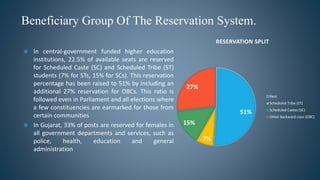
51%
7%
15%
27%
RESERVATION SPLIT
Rest
Scheduled Tribe (ST)
Scheduled Castes (SC)
Other Backward class (OBC)
 In central-government funded higher education
institutions, 22.5% of available seats are reserved
for Scheduled Caste (SC) and Scheduled Tribe (ST)
students (7% for STs, 15% for SCs). This reservation
percentage has been raised to 51% by including an
additional 27% reservation for OBCs. This ratio is
followed even in Parliament and all elections where
a few constituencies are earmarked for those from
certain communities
 In Gujarat, 33% of posts are reserved for females in
all government departments and services, such as
police, health, education and general
administration
Excluded From The Reservation System.
 Constitutional posts :
 The sons and daughters of the President of India, the Vice-President of India, Judges of the Supreme Court of India, the
High Courts chairman, Union Public Service Commission, members of the State Public Service Commission, Chief
Election Commissioner, any person holding positions of a constitutional nature.
 Service Category (class ‘A’ & ‘B’ Officer) :
 Those who have parent(s) that are Class I or Class II officers, or both parents are Class I or Class II officers but one of
them dies or suffers permanent incapacitation. The criteria used for sons and daughters of Group A and B are the same
for the employees of the Public sector
 Armed forces :
 The sons and daughters of parents either or both of whom is or are in the rank of colonel and above in the army or in
equivalent posts in the Navy, the Air Force, and the Paramilitary Force.
 Professional class and engaged in Trade and Industry :
 If a person has a high paying job such as physician, lawyer, chartered accountant, income tax consultant, dental
surgeon, engineer, architect, computer specialist, film artist or other film professional, author, sports person, sports
professional, media professional or any other vocations of like status.
Advantages And Disadvantages Of Reservation System
Advantages
1. Increase in no. of people from backward sections in various decision making i.e.,
Increase in representation from different sections of society.
2. It has helped some people from backward sections to achieve higher posts or services in the
public sector as well as in some private institutions.
3. It has encouraged the people to fight for the justice whenever there is violation of
their human rights.
4. Meritocracy is meaningless without equality. First of all people must be brought to the same
level whether it elevates a section or decelerates another regardless of merit.
5. Reservation has slowed down the process of forward becoming richer and backward becoming
poorer
Count…
Disadvantages
1. It is a form of ethnic discrimination. It's working as a barrier for inter-caste marriages.
2. It’s a biggest enemy of meritocracy. It's resulting into the degradation of quality of students and
workers enrolled in different institutions.
3. It’s propagating notion of caste based society instead of eliminating it.
4. Poor people from forward castes don’t have any social or economic advantage over rich people
from backward caste. If this prevails, it may result into the formation of another backward caste
of people belonging from poor people of forward caste.
5. Beneficiaries of reservation are largely from dominant class in backward castes. Marginalized
section still remains marginalized.
References.
1. en.Wikipedia.org
2. www.Quora.com
3. News.blogspot.com
4. www.slideshare.net
Thank You

Reservation system in India

  • 1.
    RESERVATION SYSTEM ININDIA Present by.. Mehul Boghra (115348)
  • 2.
     Overview.  Background. Before independence.  After independence.  Reservation In Employment.  Reservation In Education.  Beneficiary Group Of The Reservation System.  Excluded From The Reservation System.  Advantages And Disadvantages Of Reservation System. Outline.
  • 3.
     The systemof reservation in India comprises a series of affirmative action measures, such as reserving access to seats in the various legislatures, to government jobs, and to enrolment in higher educational institutions.  listed as Scheduled cast and Scheduled Tribe by the Government of India.  Over the years, the categories for affirmative action have been expanded beyond the lists of Scheduled castes and tribes to include a special category of other backward classes(OBC).  Reservation is governed by constitutional laws, statutory laws, and local rules and regulations. The Scheduled castes (SC), scheduled tribes (ST) and Other Backward Classes (OBC), and in some states Backward Classes among Muslims under a category called BC(M), are the primary beneficiaries of the reservation policies under the Constitution. Overview
  • 4.
    Background. Before Independence.  In1882 and 1891. Shahu, the maharaja of the princely state of Kolhapur, introduced reservation in favor of non–Brahmin and backward classes, much of which came into force in 1902. He provided free education to everyone and opened several hostels to make it easier for them to receive it.  the Prime Minister of Britain, Ramsay Macdonald, proposed the Communal Award, according to which separate representation was to be provided for Muslims, Sikhs, Indian Christians, Anglo- Indians, and Europeans. The depressed classes were assigned a number of seats to be filled by election from constituencies in which only they could vote, although they could also vote in other seats.  Mahatma Gandhi fasted in protest against it but many among the depressed classes, including their leader, B. R. Ambedkar, favored it. After negotiations, Gandhi reached an agreement with Ambedkar to have a single Hindu electorate, with Dalits having seats reserved within it.
  • 5.
    After Independence. Count...  Afterthe independence of India in 1947 there were some major changes in favor of the Scheduled Tribes (ST), Scheduled Castes (SC) and Other Backward Classes (OBC). A common form of caste discrimination in India has been the practice of untouchability. SCs were the primary targets of the practice, which was outlawed by the new Constitution of India.  In 1954, the Ministry of Education suggested that 20 per cent of places should be reserved for the SCs and STs in educational institutions with a provision to relax minimum qualifying marks for admission by 5 per cent wherever required. In 1982, it was specified that 15 per cent and 7.5 per cent of vacancies in public sector and government-aided educational institutes should be reserved for the SC and ST candidates, respectively.  Article 46 of the Constitution states that "The State shall promote with special care the educational and economic interests of the weaker sections of the people, and, in particular, of the Scheduled Castes and the Scheduled Tribes, and shall protect them from social injustice and all forms of exploitation.
  • 6.
    Reservation In Employment. A fixed percentage of India's government and public sector jobs are made exclusive for categories of people largely based on their caste or tribe.  The 1992 Supreme Court ruling in the Indra Sawhney case said that reservations in job promotions are "unconstitutional" but allowed its continuation for five years. In 1995, the 77th amendment to the Constitution was made to amend Article 16 before the five-year period expired to continue with reservations for SC/STs in promotions. It was further modified through the 85th amendment to give the benefit of consequential seniority to SC/ST candidates promoted by reservation.  The 81st amendment was made to the Constitution to permit the government to treat the backlog of reserved vacancies as a separate and distinct group, to which the ceiling of 50 per cent did not apply. The 82nd amendment inserted a provision in Article 335 to enable states to give concessions to SC/ST candidates in promotion.
  • 7.
    Reservation in education. In India most of the scholarships or student aid is available only to—SCs, STs, BCs, OBCs, women, Muslims, and other minorities. Only about 0.7% of scholarships or student aid in India is based on merit.  The University Grants Commission (UGC) provides financial assistance to universities for the establishment of Special Cells for SC/STs. The cells help universities implement the reservation policy in student admission and staff recruitment processes for teaching and non-teaching jobs. They also help the SC/ST categories integrate with the university community and help remove the difficulties SC/ST individuals may have experienced  New rules implementation of UPA Government do not provide scholarship scheme and reservation quota of students and employees of colleges under central University and State University approved by the UGC
  • 8.
    Beneficiary Group OfThe Reservation System. 51% 7% 15% 27% RESERVATION SPLIT Rest Scheduled Tribe (ST) Scheduled Castes (SC) Other Backward class (OBC)  In central-government funded higher education institutions, 22.5% of available seats are reserved for Scheduled Caste (SC) and Scheduled Tribe (ST) students (7% for STs, 15% for SCs). This reservation percentage has been raised to 51% by including an additional 27% reservation for OBCs. This ratio is followed even in Parliament and all elections where a few constituencies are earmarked for those from certain communities  In Gujarat, 33% of posts are reserved for females in all government departments and services, such as police, health, education and general administration
  • 9.
    Excluded From TheReservation System.  Constitutional posts :  The sons and daughters of the President of India, the Vice-President of India, Judges of the Supreme Court of India, the High Courts chairman, Union Public Service Commission, members of the State Public Service Commission, Chief Election Commissioner, any person holding positions of a constitutional nature.  Service Category (class ‘A’ & ‘B’ Officer) :  Those who have parent(s) that are Class I or Class II officers, or both parents are Class I or Class II officers but one of them dies or suffers permanent incapacitation. The criteria used for sons and daughters of Group A and B are the same for the employees of the Public sector  Armed forces :  The sons and daughters of parents either or both of whom is or are in the rank of colonel and above in the army or in equivalent posts in the Navy, the Air Force, and the Paramilitary Force.  Professional class and engaged in Trade and Industry :  If a person has a high paying job such as physician, lawyer, chartered accountant, income tax consultant, dental surgeon, engineer, architect, computer specialist, film artist or other film professional, author, sports person, sports professional, media professional or any other vocations of like status.
  • 10.
    Advantages And DisadvantagesOf Reservation System Advantages 1. Increase in no. of people from backward sections in various decision making i.e., Increase in representation from different sections of society. 2. It has helped some people from backward sections to achieve higher posts or services in the public sector as well as in some private institutions. 3. It has encouraged the people to fight for the justice whenever there is violation of their human rights. 4. Meritocracy is meaningless without equality. First of all people must be brought to the same level whether it elevates a section or decelerates another regardless of merit. 5. Reservation has slowed down the process of forward becoming richer and backward becoming poorer
  • 11.
    Count… Disadvantages 1. It isa form of ethnic discrimination. It's working as a barrier for inter-caste marriages. 2. It’s a biggest enemy of meritocracy. It's resulting into the degradation of quality of students and workers enrolled in different institutions. 3. It’s propagating notion of caste based society instead of eliminating it. 4. Poor people from forward castes don’t have any social or economic advantage over rich people from backward caste. If this prevails, it may result into the formation of another backward caste of people belonging from poor people of forward caste. 5. Beneficiaries of reservation are largely from dominant class in backward castes. Marginalized section still remains marginalized.
  • 12.
    References. 1. en.Wikipedia.org 2. www.Quora.com 3.News.blogspot.com 4. www.slideshare.net
  • 13.