Mistake Proofing

Presented by : Jani Saheb, PMP, CSSGB
1
ZQC
Zero Quality Control is our AIM
the idea being to produce zero defective products

Customers !
Manufacturing personnel !
Management !
2
When we achieve

We do not
need QC
Inspectors
any more

Zero Defects
QC

3
What Causes Defects?
1. Poor procedures or standards.
2. Machines.
3. Non-conforming material.
4. Worn tooling.
5. Human Mistakes.
Any more ?
Except for human mistakes these conditions can be
predicted and corrective action can be implemented to
eliminate the cause of defects
4
Yes !

There is a solution !

Poka Yoke (Mistake Proofing)
5


The phrase Poka-Yoke originates from the
Japanese words:
yokeru
poka =



=
to avoid
inadvertent/uninted errors

It is a methodology that is used to strive
toward zero defects by either preventing or
automatically detecting defects.
6
Originally called "fool proofing"

later changed to "mistake proofing
"fail safing“ so employees weren't offended,
The result is a business that wastes less
energy, time and resources doing things
wrong in the future.
7
•

•

•

Developed by Dr. Shigeo Shingo,
industrial engineer at Toyota who has
been credited with creating and
formalizing Zero Quality Control
(ZQC),
It is a simple technique to avoid
simple human error at work.
Identifying defects at the source
lowers the cost
8


Stop the defect at source

9


While visiting the Yamada Electric plant in 1961,
Shingo was told of a problem that the factory had with
one of its products



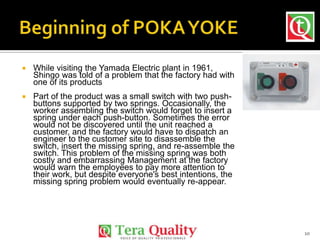
Part of the product was a small switch with two pushbuttons supported by two springs. Occasionally, the
worker assembling the switch would forget to insert a
spring under each push-button. Sometimes the error
would not be discovered until the unit reached a
customer, and the factory would have to dispatch an
engineer to the customer site to disassemble the
switch, insert the missing spring, and re-assemble the
switch. This problem of the missing spring was both
costly and embarrassing Management at the factory
would warn the employees to pay more attention to
their work, but despite everyone's best intentions, the
missing spring problem would eventually re-appear.

10


A poka-yoke device is any mechanism that
either prevents a mistake from being made or
makes the mistake obvious at a glance.

11
Mistakes :
are inevitable; people are human and cannot
be expected to concentrate all the time on the
work in front of them or to understand
completely the instructions they are given.
Defects :
result from allowing a mistake to reach
the customer, and defects are entirely
avoidable.
12
Prevention

Detection

 engineers the process

 signals the user when

so that it is
impossible to make a
mistake.
 remove the need of
correction.

a mistake has been
made.
 they do not enforce
the correction.

13
Here's the beauty of the methods...anyone,
from manager to line supervisor to line
employee can develop a poka yoke

14


India Rail Track Deaths Amount To 15,000
Each Year

15
16
17
3 Rules of POKA-YOKE

1. Don’t wait for the perfect POKA-YOKE. Do it now!
2. If your POKA-YOKE idea has better than 50% chance
to succeed…Do it!
3. Do it now….improve later!

18
 Operators and Machines will sometimes make mistakes.
 Recognize that it is natural for people to make mistakes.
 Not noticing that an error is made or a machine is not
functioning does not make a person stupid or foolish.

19
20
21
Thank you for viewing

22

Pokayoke tera quality

  • 1.
    Mistake Proofing Presented by: Jani Saheb, PMP, CSSGB 1
  • 2.
    ZQC Zero Quality Controlis our AIM the idea being to produce zero defective products Customers ! Manufacturing personnel ! Management ! 2
  • 3.
    When we achieve Wedo not need QC Inspectors any more Zero Defects QC 3
  • 4.
    What Causes Defects? 1.Poor procedures or standards. 2. Machines. 3. Non-conforming material. 4. Worn tooling. 5. Human Mistakes. Any more ? Except for human mistakes these conditions can be predicted and corrective action can be implemented to eliminate the cause of defects 4
  • 5.
    Yes ! There isa solution ! Poka Yoke (Mistake Proofing) 5
  • 6.
     The phrase Poka-Yokeoriginates from the Japanese words: yokeru poka =  = to avoid inadvertent/uninted errors It is a methodology that is used to strive toward zero defects by either preventing or automatically detecting defects. 6
  • 7.
    Originally called "foolproofing" later changed to "mistake proofing "fail safing“ so employees weren't offended, The result is a business that wastes less energy, time and resources doing things wrong in the future. 7
  • 8.
    • • • Developed by Dr.Shigeo Shingo, industrial engineer at Toyota who has been credited with creating and formalizing Zero Quality Control (ZQC), It is a simple technique to avoid simple human error at work. Identifying defects at the source lowers the cost 8
  • 9.
  • 10.
     While visiting theYamada Electric plant in 1961, Shingo was told of a problem that the factory had with one of its products  Part of the product was a small switch with two pushbuttons supported by two springs. Occasionally, the worker assembling the switch would forget to insert a spring under each push-button. Sometimes the error would not be discovered until the unit reached a customer, and the factory would have to dispatch an engineer to the customer site to disassemble the switch, insert the missing spring, and re-assemble the switch. This problem of the missing spring was both costly and embarrassing Management at the factory would warn the employees to pay more attention to their work, but despite everyone's best intentions, the missing spring problem would eventually re-appear. 10
  • 11.
     A poka-yoke deviceis any mechanism that either prevents a mistake from being made or makes the mistake obvious at a glance. 11
  • 12.
    Mistakes : are inevitable;people are human and cannot be expected to concentrate all the time on the work in front of them or to understand completely the instructions they are given. Defects : result from allowing a mistake to reach the customer, and defects are entirely avoidable. 12
  • 13.
    Prevention Detection  engineers theprocess  signals the user when so that it is impossible to make a mistake.  remove the need of correction. a mistake has been made.  they do not enforce the correction. 13
  • 14.
    Here's the beautyof the methods...anyone, from manager to line supervisor to line employee can develop a poka yoke 14
  • 15.
     India Rail TrackDeaths Amount To 15,000 Each Year 15
  • 16.
  • 17.
  • 18.
    3 Rules ofPOKA-YOKE 1. Don’t wait for the perfect POKA-YOKE. Do it now! 2. If your POKA-YOKE idea has better than 50% chance to succeed…Do it! 3. Do it now….improve later! 18
  • 19.
     Operators andMachines will sometimes make mistakes.  Recognize that it is natural for people to make mistakes.  Not noticing that an error is made or a machine is not functioning does not make a person stupid or foolish. 19
  • 20.
  • 21.
  • 22.
    Thank you forviewing 22