Poka-yoke
Introduction
• Poka-yoke is a Japanese term that means "mistake-proofing" or
"inadvertent error prevention".
• A poka-yoke is any mechanism in a process that helps an
equipment operator avoid mistakes and defects by preventing,
correcting, or drawing attention to human errors as they occur.
10/22/2021 Poka-yoke 2
• Poka-yoke is a Japanese quality control technique developed by
former Toyota engineer Shigeo Shingo.
• Translated as “mistake-proofing”, poka-yoke aims to prevent defects
in the manufacturing process that are the result of human error.
• Poka-yoke is a lean manufacturing technique that ensures that the
right conditions exist before a step in the process is executed.
• This makes it a preventative form of quality control since errors are
detected and then rectified before they occur.
10/22/2021 Poka-yoke 3
Understanding poka-yoke
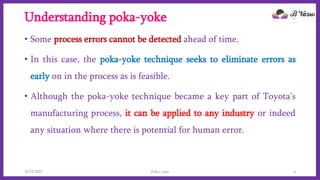
• Some process errors cannot be detected ahead of time.
• In this case, the poka-yoke technique seeks to eliminate errors as
early on in the process as is feasible.
• Although the poka-yoke technique became a key part of Toyota’s
manufacturing process, it can be applied to any industry or indeed
any situation where there is potential for human error.
10/22/2021 Poka-yoke 4
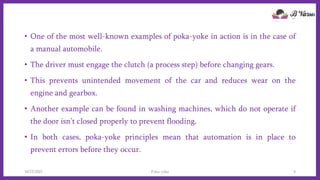
• One of the most well-known examples of poka-yoke in action is in the case of
a manual automobile.
• The driver must engage the clutch (a process step) before changing gears.
• This prevents unintended movement of the car and reduces wear on the
engine and gearbox.
• Another example can be found in washing machines, which do not operate if
the door isn’t closed properly to prevent flooding.
• In both cases, poka-yoke principles mean that automation is in place to
prevent errors before they occur.
10/22/2021 Poka-yoke 5
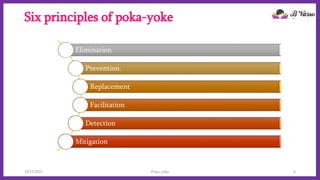
Six principles of poka-yoke
Elimination
Prevention.
Replacement
Facilitation
Detection
Mitigation
10/22/2021 Poka-yoke 6
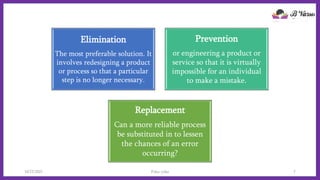
Elimination
The most preferable solution. It
involves redesigning a product
or process so that a particular
step is no longer necessary.
Prevention
or engineering a product or
service so that it is virtually
impossible for an individual
to make a mistake.
Replacement
Can a more reliable process
be substituted in to lessen
the chances of an error
occurring?
10/22/2021 Poka-yoke 7
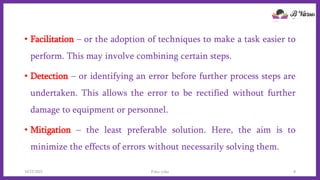
• Facilitation – or the adoption of techniques to make a task easier to
perform. This may involve combining certain steps.
• Detection – or identifying an error before further process steps are
undertaken. This allows the error to be rectified without further
damage to equipment or personnel.
• Mitigation – the least preferable solution. Here, the aim is to
minimize the effects of errors without necessarily solving them.
10/22/2021 Poka-yoke 8
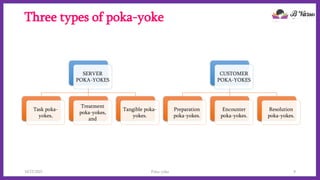
Three types of poka-yoke
SERVER
POKA-YOKES
Task poka-
yokes,
Treatment
poka-yokes,
and
Tangible poka-
yokes.
CUSTOMER
POKA-YOKES
Preparation
poka-yokes.
Encounter
poka-yokes.
Resolution
poka-yokes.
10/22/2021 Poka-yoke 9
Task poka-yokes.
• Task poka-yokes focus on server tasks and common mistakes servers
make while performing the service/task for the customer.
• A good example of a control-oriented, task poka-yoke is the coin return
machine used in may fast-food restaurants.
• The coin portion of a customer's change from payment is returned
automatically through these machines.
• This takes the control out of the hands of the cash register operator,
eliminating errors and speeding up the processing of customers.
10/22/2021 Poka-yoke 10
Treatment poka-yokes
• Treatment poka-yokes focus on the social interaction between the
customer and the server (i.e., eye contact, greeting).
• By mistake-proofing/standardizing what servers say and do to customers,
managers can reasonably ensure that customers receive proper, fair and
consistent treatment.
• Burger King utilized warning-oriented, treatment poka-yokes by placing
"cue cards" at the service point ensuring that servers know what to say
the minute they interface with the customer.
10/22/2021 Poka-yoke 11
Tangible poka-yokes.
• Tangible poka-yokes attempt to improve the tangible, physical
impression and experience for the customer in addition to the direct task
of the server (i.e., dirty office, unkempt server, sloppy documents).
• Motorola uses a control-oriented poka-yoke in the legal department by
having a second lawyer inspect all legal work for spelling, presentation,
and arithmetic.
• In this way, the legal department is ensuring that the "tangibles" of the
service are satisfactory in addition to the task of the service (legal work).
10/22/2021 Poka-yoke 12
Customer Poka-yokes-Preparation Poka-yokes.
• Preparation poka-yokes attempt to fully prepare the customer before
they even enter the service.
• An example of a warning-oriented, preparation poka-yoke is the notice a
university sends to each student prior to registration for the next
semester detailing the courses he needs to finish his degree.
• This system could be converted to a control system by having an
automated registration process which would not allow students to sign
up for classes out of sequence or until all prerequisites are met.
10/22/2021 Poka-yoke 13
Encounter Poka-yokes.
• Encounter poka-yokes attempt to fail-safe a customer at a service
who may misunderstand, ignore, or forget the nature of the service
or their role in it. A good example of a control-oriented, encounter
poka-yoke is the use of concrete curbing at an oil& lube shop that
directs customers so that they do not/cannot pull the wrong way
into the station. This system also assists in the selection process so
that customers are not served out of order.
10/22/2021 Poka-yoke 14
Resolution Poka-yokes.
• Resolution poka-yokes attempt to remind customers of the value of their
input to the continuous improvement of a service.
• A hotel which uses an automated check-out system through the
television in each room could attach a few questions to the check-out
process to ensure the customer provides feedback on key issues.
• This would be a control-oriented resolution poka-yoke.
• Obviously, one of the keys to the success of any customer-oriented poka-
yoke is to obtain willing customer participation.
10/22/2021 Poka-yoke 15
Benefits of poka-yoke principles for businesses
• Improved profitability
• Errors on production lines decrease profitability – whether that be through
line shutdowns or expensive worker injuries.
• But poka-yoke principles improve a company’s bottom line in other ways.
• For example, hotels now require that guests insert their key-card into a slot
to activate electricity in their room.
• Since many guests do not bother to turn the lights off after they leave, the
hotel can save money on wasted electricity consumption.
10/22/2021 Poka-yoke 16
• Improved productivity
• Preventing errors before they occur increases productivity.
• Online forms require that every field be filled out before submission.
• This reduces errors in forms resulting from incomplete or missing information,
saving the company time and money in having to chase up consumers for the
extra details.
• ATMs also chime or flash to remind the customer to retrieve their debit card and
cash.
• This greatly reduces the once common error of customers leaving their cards in
the machine.
• It also saves the bank money in loss prevention, giving customer support the
resources to deal with other problems.
10/22/2021 Poka-yoke 17
• Simplification of smaller, error-prone tasks
• Small tasks with high probability of error are particularly prevalent in some
industries such as the service and hospitality industries.
• Cashier errors in counting change, for example, are relatively
inconsequential errors in isolation that have the potential to lose a business
a lot of money over the long term.
10/22/2021 Poka-yoke 18
Key takeaways:
• Poka-yoke is a Japanese quality control technique that aims to make
processes error-proof.
• Although having origins in the manufacturing industry, poka-yoke
principles are useful in any scenario where there is potential for human
error.
• Poka-yoke error prevention is guided by six principles, with elimination
the most desirable and mitigation the least desirable.
• All six principles can nevertheless improve productivity, profitability,
and simplify smaller, error-prone manual tasks.
10/22/2021 Poka-yoke 19
Barriers to implementation
• Difficulty in accepting change
• Justification of the investment
• Using inappropriate and ineffective methods
• Time requirements
• Difficulty encountered as a result of continuous process
10/22/2021 Poka-yoke 20
Reference
• https://fourweekmba.com/poka-yoke/
• https://www.referenceforbusiness.com/management/Or-Pr/Poka-
Yoke.html
10/22/2021 Poka-yoke 21
B.Varun
9787608011
bvarun.me@gmail.com
varun.me@srit.org
varunnelson bvarun.me
varunme bvarunme
10/22/2021 Poka-yoke 22

Poka yoke

  • 1.
  • 2.
    Introduction • Poka-yoke isa Japanese term that means "mistake-proofing" or "inadvertent error prevention". • A poka-yoke is any mechanism in a process that helps an equipment operator avoid mistakes and defects by preventing, correcting, or drawing attention to human errors as they occur. 10/22/2021 Poka-yoke 2
  • 3.
    • Poka-yoke isa Japanese quality control technique developed by former Toyota engineer Shigeo Shingo. • Translated as “mistake-proofing”, poka-yoke aims to prevent defects in the manufacturing process that are the result of human error. • Poka-yoke is a lean manufacturing technique that ensures that the right conditions exist before a step in the process is executed. • This makes it a preventative form of quality control since errors are detected and then rectified before they occur. 10/22/2021 Poka-yoke 3
  • 4.
    Understanding poka-yoke • Someprocess errors cannot be detected ahead of time. • In this case, the poka-yoke technique seeks to eliminate errors as early on in the process as is feasible. • Although the poka-yoke technique became a key part of Toyota’s manufacturing process, it can be applied to any industry or indeed any situation where there is potential for human error. 10/22/2021 Poka-yoke 4
  • 5.
    • One ofthe most well-known examples of poka-yoke in action is in the case of a manual automobile. • The driver must engage the clutch (a process step) before changing gears. • This prevents unintended movement of the car and reduces wear on the engine and gearbox. • Another example can be found in washing machines, which do not operate if the door isn’t closed properly to prevent flooding. • In both cases, poka-yoke principles mean that automation is in place to prevent errors before they occur. 10/22/2021 Poka-yoke 5
  • 6.
    Six principles ofpoka-yoke Elimination Prevention. Replacement Facilitation Detection Mitigation 10/22/2021 Poka-yoke 6
  • 7.
    Elimination The most preferablesolution. It involves redesigning a product or process so that a particular step is no longer necessary. Prevention or engineering a product or service so that it is virtually impossible for an individual to make a mistake. Replacement Can a more reliable process be substituted in to lessen the chances of an error occurring? 10/22/2021 Poka-yoke 7
  • 8.
    • Facilitation –or the adoption of techniques to make a task easier to perform. This may involve combining certain steps. • Detection – or identifying an error before further process steps are undertaken. This allows the error to be rectified without further damage to equipment or personnel. • Mitigation – the least preferable solution. Here, the aim is to minimize the effects of errors without necessarily solving them. 10/22/2021 Poka-yoke 8
  • 9.
    Three types ofpoka-yoke SERVER POKA-YOKES Task poka- yokes, Treatment poka-yokes, and Tangible poka- yokes. CUSTOMER POKA-YOKES Preparation poka-yokes. Encounter poka-yokes. Resolution poka-yokes. 10/22/2021 Poka-yoke 9
  • 10.
    Task poka-yokes. • Taskpoka-yokes focus on server tasks and common mistakes servers make while performing the service/task for the customer. • A good example of a control-oriented, task poka-yoke is the coin return machine used in may fast-food restaurants. • The coin portion of a customer's change from payment is returned automatically through these machines. • This takes the control out of the hands of the cash register operator, eliminating errors and speeding up the processing of customers. 10/22/2021 Poka-yoke 10
  • 11.
    Treatment poka-yokes • Treatmentpoka-yokes focus on the social interaction between the customer and the server (i.e., eye contact, greeting). • By mistake-proofing/standardizing what servers say and do to customers, managers can reasonably ensure that customers receive proper, fair and consistent treatment. • Burger King utilized warning-oriented, treatment poka-yokes by placing "cue cards" at the service point ensuring that servers know what to say the minute they interface with the customer. 10/22/2021 Poka-yoke 11
  • 12.
    Tangible poka-yokes. • Tangiblepoka-yokes attempt to improve the tangible, physical impression and experience for the customer in addition to the direct task of the server (i.e., dirty office, unkempt server, sloppy documents). • Motorola uses a control-oriented poka-yoke in the legal department by having a second lawyer inspect all legal work for spelling, presentation, and arithmetic. • In this way, the legal department is ensuring that the "tangibles" of the service are satisfactory in addition to the task of the service (legal work). 10/22/2021 Poka-yoke 12
  • 13.
    Customer Poka-yokes-Preparation Poka-yokes. •Preparation poka-yokes attempt to fully prepare the customer before they even enter the service. • An example of a warning-oriented, preparation poka-yoke is the notice a university sends to each student prior to registration for the next semester detailing the courses he needs to finish his degree. • This system could be converted to a control system by having an automated registration process which would not allow students to sign up for classes out of sequence or until all prerequisites are met. 10/22/2021 Poka-yoke 13
  • 14.
    Encounter Poka-yokes. • Encounterpoka-yokes attempt to fail-safe a customer at a service who may misunderstand, ignore, or forget the nature of the service or their role in it. A good example of a control-oriented, encounter poka-yoke is the use of concrete curbing at an oil& lube shop that directs customers so that they do not/cannot pull the wrong way into the station. This system also assists in the selection process so that customers are not served out of order. 10/22/2021 Poka-yoke 14
  • 15.
    Resolution Poka-yokes. • Resolutionpoka-yokes attempt to remind customers of the value of their input to the continuous improvement of a service. • A hotel which uses an automated check-out system through the television in each room could attach a few questions to the check-out process to ensure the customer provides feedback on key issues. • This would be a control-oriented resolution poka-yoke. • Obviously, one of the keys to the success of any customer-oriented poka- yoke is to obtain willing customer participation. 10/22/2021 Poka-yoke 15
  • 16.
    Benefits of poka-yokeprinciples for businesses • Improved profitability • Errors on production lines decrease profitability – whether that be through line shutdowns or expensive worker injuries. • But poka-yoke principles improve a company’s bottom line in other ways. • For example, hotels now require that guests insert their key-card into a slot to activate electricity in their room. • Since many guests do not bother to turn the lights off after they leave, the hotel can save money on wasted electricity consumption. 10/22/2021 Poka-yoke 16
  • 17.
    • Improved productivity •Preventing errors before they occur increases productivity. • Online forms require that every field be filled out before submission. • This reduces errors in forms resulting from incomplete or missing information, saving the company time and money in having to chase up consumers for the extra details. • ATMs also chime or flash to remind the customer to retrieve their debit card and cash. • This greatly reduces the once common error of customers leaving their cards in the machine. • It also saves the bank money in loss prevention, giving customer support the resources to deal with other problems. 10/22/2021 Poka-yoke 17
  • 18.
    • Simplification ofsmaller, error-prone tasks • Small tasks with high probability of error are particularly prevalent in some industries such as the service and hospitality industries. • Cashier errors in counting change, for example, are relatively inconsequential errors in isolation that have the potential to lose a business a lot of money over the long term. 10/22/2021 Poka-yoke 18
  • 19.
    Key takeaways: • Poka-yokeis a Japanese quality control technique that aims to make processes error-proof. • Although having origins in the manufacturing industry, poka-yoke principles are useful in any scenario where there is potential for human error. • Poka-yoke error prevention is guided by six principles, with elimination the most desirable and mitigation the least desirable. • All six principles can nevertheless improve productivity, profitability, and simplify smaller, error-prone manual tasks. 10/22/2021 Poka-yoke 19
  • 20.
    Barriers to implementation •Difficulty in accepting change • Justification of the investment • Using inappropriate and ineffective methods • Time requirements • Difficulty encountered as a result of continuous process 10/22/2021 Poka-yoke 20
  • 21.
  • 22.