IntroductionIntroduction
 Scientific Name :- Trichosanthus dioica Roxb.
 Common Name :- Parwal, Parmal
 Origin :- India/Indo Malayan Region
 Chromosome No :- 2n=22
 It is a perennial cucurbit.
 Mostly cultivated in Bihar, Bengal, Madhya Pradesh and
Eastern U.P.
 Scientific Name :- Trichosanthus dioica Roxb.
 Common Name :- Parwal, Parmal
 Origin :- India/Indo Malayan Region
 Chromosome No :- 2n=22
 It is a perennial cucurbit.
 Mostly cultivated in Bihar, Bengal, Madhya Pradesh and
Eastern U.P.
Uses
 Fruits are used in making curry and pickles.
 A famous sweet by putting the fruits in sugar syrup is made
in India.
 The fruits are diuretic, laxative and cardiatonic.
 It is also recommended for bronchitis, high fever and
nervousness.
 Pointed gourd possesses the medicinal property of lowering
total cholesterol and blood sugar.
 Fruits are used in making curry and pickles.
 A famous sweet by putting the fruits in sugar syrup is made
in India.
 The fruits are diuretic, laxative and cardiatonic.
 It is also recommended for bronchitis, high fever and
nervousness.
 Pointed gourd possesses the medicinal property of lowering
total cholesterol and blood sugar.
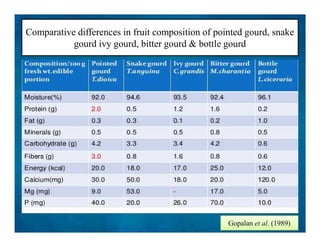
Comparative differences in fruit composition of pointed gourd, snake
gourd ivy gourd, bitter gourd & bottle gourd
Gopalan et al. (1989)Gopalan et al. (1989)
ContinueContinue
Medicinal value
 Medicinal value It is a very ancient ayurvadic medicinal
herb used in many medicines.
 It is a food for convalescents.
 Have diuretic & laxative properties.
 It is cardio tonic.
 Recommended for bronchitis, biliousness, high fever,
nervousness.
 Lowers cholesterol & blood sugar( Sharma &
pant,1988;chandrasekar et al,1989).
 Good for curing blood & skin diseases, also purifies blood.
 Relieve the feeling of food satiation & excessive thirst.
 Light & easy to digest, improves digestion strength.
 Medicinal value It is a very ancient ayurvadic medicinal
herb used in many medicines.
 It is a food for convalescents.
 Have diuretic & laxative properties.
 It is cardio tonic.
 Recommended for bronchitis, biliousness, high fever,
nervousness.
 Lowers cholesterol & blood sugar( Sharma &
pant,1988;chandrasekar et al,1989).
 Good for curing blood & skin diseases, also purifies blood.
 Relieve the feeling of food satiation & excessive thirst.
 Light & easy to digest, improves digestion strength.
• Used for treating Diabetes mellitus. It has been reported
that the presence of flavinoids & trace element like Cu, k
& Mg are responsible for anti- diabetic activity of pointed
gourd plants.( Kar et al, 1999).
• Juice of leaves used as tonic, febrifuge & in sub acute case
of enlargement of liver & spleen.
• Useful in itching & burning sensation.
• Good for skin ,improves complexion.
• Used for treating Diabetes mellitus. It has been reported
that the presence of flavinoids & trace element like Cu, k
& Mg are responsible for anti- diabetic activity of pointed
gourd plants.( Kar et al, 1999).
• Juice of leaves used as tonic, febrifuge & in sub acute case
of enlargement of liver & spleen.
• Useful in itching & burning sensation.
• Good for skin ,improves complexion.
• Antioxidant-Protects the body against oxidative stress by
neutralizing free radicals. Aqueous extracts of leaves of
T.dioica contains rich amount of polyphones which are
very potent natural antioxidants.
• Similarly in another study antioxidant activity of fruits of
T.dioica was evaluated & compared with ascorbic acid
(standard).
• The result showed that aqueous extract of T.dioica fruits
posses in vitro free radical scavenging activity (Sharmila et
al.2007)
• Antioxidant-Protects the body against oxidative stress by
neutralizing free radicals. Aqueous extracts of leaves of
T.dioica contains rich amount of polyphones which are
very potent natural antioxidants.
• Similarly in another study antioxidant activity of fruits of
T.dioica was evaluated & compared with ascorbic acid
(standard).
• The result showed that aqueous extract of T.dioica fruits
posses in vitro free radical scavenging activity (Sharmila et
al.2007)
• Cholesterol lowering activity – Sharma et al. 1988
reported that aqueous fruit extract of T.dioica exhibits
cholesterol & body weight lowering activities in both
normal & hyperglycemic rats.
• Anti diabetic- Sharma et al. 1989 & Chandrasekhar et al.
2008 reported that aqueous extract of T.dioica fruits
reduces the levels of fasting blood glucose, postprandial
glucose, asparate amino transferase, alanine amino
transferase, alkaline phosphatase, cretinine, urine sugar,
urine protein where as increases total protein & body
weight.
• Cholesterol lowering activity – Sharma et al. 1988
reported that aqueous fruit extract of T.dioica exhibits
cholesterol & body weight lowering activities in both
normal & hyperglycemic rats.
• Anti diabetic- Sharma et al. 1989 & Chandrasekhar et al.
2008 reported that aqueous extract of T.dioica fruits
reduces the levels of fasting blood glucose, postprandial
glucose, asparate amino transferase, alanine amino
transferase, alkaline phosphatase, cretinine, urine sugar,
urine protein where as increases total protein & body
weight.
 Glycemic property-Aqueous extracts of T.dioica leaves
has good hypoglycemic potential along with a high anti-
diabetic profile.(Rai et al.2008)
 Chandrasekhar et al. (1988) reported that pointed gourd
possesses the medicinal property of lowering blood sugar
level in rats.
 Bhujbal (1999) showed that polyherb formulation
including T.dioica is useful in skin disorder.
 Glycemic property-Aqueous extracts of T.dioica leaves
has good hypoglycemic potential along with a high anti-
diabetic profile.(Rai et al.2008)
 Chandrasekhar et al. (1988) reported that pointed gourd
possesses the medicinal property of lowering blood sugar
level in rats.
 Bhujbal (1999) showed that polyherb formulation
including T.dioica is useful in skin disorder.
• Hariti & Rathee (1996) reported that the oil of seeds of
T.dioica have antifungal property. They also studied the
antibacterial activity of oil T.dioica seeds against Bacilus
anthracis & Xanthomonas malacearum.
• Sharma & Pant et al.(1992) showed influence of alcoholic
extract of whole fruit of T.dioica on blood sugar, serum
lipids, lipoproteins & faecal sterols in normal albino
rabbits.
• Hariti & Rathee (1996) reported that the oil of seeds of
T.dioica have antifungal property. They also studied the
antibacterial activity of oil T.dioica seeds against Bacilus
anthracis & Xanthomonas malacearum.
• Sharma & Pant et al.(1992) showed influence of alcoholic
extract of whole fruit of T.dioica on blood sugar, serum
lipids, lipoproteins & faecal sterols in normal albino
rabbits.
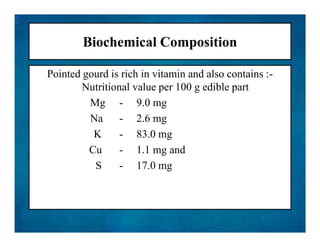
Biochemical Composition
Pointed gourd is rich in vitamin and also contains :-
Nutritional value per 100 g edible part
Mg - 9.0 mg
Na - 2.6 mg
K - 83.0 mg
Cu - 1.1 mg and
S - 17.0 mg
Pointed gourd is rich in vitamin and also contains :-
Nutritional value per 100 g edible part
Mg - 9.0 mg
Na - 2.6 mg
K - 83.0 mg
Cu - 1.1 mg and
S - 17.0 mg
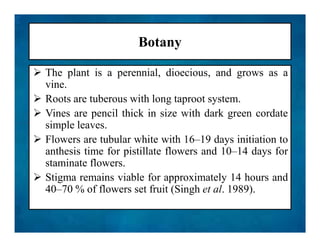
Botany
 The plant is a perennial, dioecious, and grows as a
vine.
 Roots are tuberous with long taproot system.
 Vines are pencil thick in size with dark green cordate
simple leaves.
 Flowers are tubular white with 16–19 days initiation to
anthesis time for pistillate flowers and 10–14 days for
staminate flowers.
 Stigma remains viable for approximately 14 hours and
40–70 % of flowers set fruit (Singh et al. 1989).
 The plant is a perennial, dioecious, and grows as a
vine.
 Roots are tuberous with long taproot system.
 Vines are pencil thick in size with dark green cordate
simple leaves.
 Flowers are tubular white with 16–19 days initiation to
anthesis time for pistillate flowers and 10–14 days for
staminate flowers.
 Stigma remains viable for approximately 14 hours and
40–70 % of flowers set fruit (Singh et al. 1989).
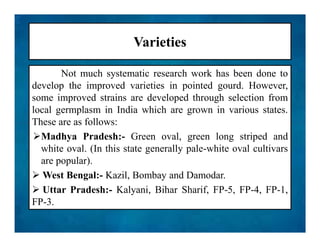
Varieties
Not much systematic research work has been done to
develop the improved varieties in pointed gourd. However,
some improved strains are developed through selection from
local germplasm in India which are grown in various states.
These are as follows:
Madhya Pradesh:- Green oval, green long striped and
white oval. (In this state generally pale-white oval cultivars
are popular).
 West Bengal:- Kazil, Bombay and Damodar.
 Uttar Pradesh:- Kalyani, Bihar Sharif, FP-5, FP-4, FP-1,
FP-3.
Not much systematic research work has been done to
develop the improved varieties in pointed gourd. However,
some improved strains are developed through selection from
local germplasm in India which are grown in various states.
These are as follows:
Madhya Pradesh:- Green oval, green long striped and
white oval. (In this state generally pale-white oval cultivars
are popular).
 West Bengal:- Kazil, Bombay and Damodar.
 Uttar Pradesh:- Kalyani, Bihar Sharif, FP-5, FP-4, FP-1,
FP-3.
Continue
 Other varieties:- Shankolia, Swarn Rekha, Swarn Alaukik
and Chota Hilli, Ches Elite Line, Ches Hybrid 1, Ches
Hybrids 2, Dandali, Hilli, Rajendra Parwal 1 and Rajendra
Parwal 2.
 Varieties grow in NAU, Navsari:- BCPG -3, BCPG – 4,
BCPG – 5, NPG-1, NPG-2, NPG-3, NPG-4, etc.
 Other varieties:- Shankolia, Swarn Rekha, Swarn Alaukik
and Chota Hilli, Ches Elite Line, Ches Hybrid 1, Ches
Hybrids 2, Dandali, Hilli, Rajendra Parwal 1 and Rajendra
Parwal 2.
 Varieties grow in NAU, Navsari:- BCPG -3, BCPG – 4,
BCPG – 5, NPG-1, NPG-2, NPG-3, NPG-4, etc.
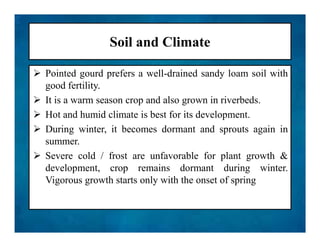
Soil and Climate
 Pointed gourd prefers a well-drained sandy loam soil with
good fertility.
 It is a warm season crop and also grown in riverbeds.
 Hot and humid climate is best for its development.
 During winter, it becomes dormant and sprouts again in
summer.
 Severe cold / frost are unfavorable for plant growth &
development, crop remains dormant during winter.
Vigorous growth starts only with the onset of spring
 Pointed gourd prefers a well-drained sandy loam soil with
good fertility.
 It is a warm season crop and also grown in riverbeds.
 Hot and humid climate is best for its development.
 During winter, it becomes dormant and sprouts again in
summer.
 Severe cold / frost are unfavorable for plant growth &
development, crop remains dormant during winter.
Vigorous growth starts only with the onset of spring
Propagation
• The pointed gourd is usually
propagated through vine cuttings and
root suckers.
• Seeds are not used in planting
because of poor germination and
inability to determine the sex of
plants before flowering. As a result,
crop established from seed may
contain 50% non fruiting male
plants.
• To propagate from root suckers,
tuberous roots of pointed gourd are
dug in the early spring, subdivided,
and replanted.
• The pointed gourd is usually
propagated through vine cuttings and
root suckers.
• Seeds are not used in planting
because of poor germination and
inability to determine the sex of
plants before flowering. As a result,
crop established from seed may
contain 50% non fruiting male
plants.
• To propagate from root suckers,
tuberous roots of pointed gourd are
dug in the early spring, subdivided,
and replanted.
Male-Female ration:
 As it is a Dioecious plant only one sex is determined in a
single plant.
 If all the plants in a field are male, there is no fruit set and
the total production is zero.
 For this reason, maintenance of male-female ratio is
necessary.
 A female: male ratio of 9:1 is optimum for ensuring
maximum fruit set.
 As it is a Dioecious plant only one sex is determined in a
single plant.
 If all the plants in a field are male, there is no fruit set and
the total production is zero.
 For this reason, maintenance of male-female ratio is
necessary.
 A female: male ratio of 9:1 is optimum for ensuring
maximum fruit set.
 Both pre-rooted and fresh vine cuttings are used for
propagation.
 Vine cuttings made in the fall of previous year and rooted
during winter are planted when danger from frost is over in
the spring in order to obtain a crop in the same year.
 Current year vine cuttings are also planted to establish the
crop during the summer, but optimum plant yield is only
obtained during the next year.
 Both pre-rooted and fresh vine cuttings are used for
propagation.
 Vine cuttings made in the fall of previous year and rooted
during winter are planted when danger from frost is over in
the spring in order to obtain a crop in the same year.
 Current year vine cuttings are also planted to establish the
crop during the summer, but optimum plant yield is only
obtained during the next year.
Varieties
Not much systematic research work has been done to
develop the improved varieties in pointed gourd. However,
some improved strains are developed through selection from
local germplasm in India which are grown in various states.
These are as follows:
Madhya Pradesh:- Green oval, green long striped and
white oval. (In this state generally pale-white oval cultivars
are popular).
Not much systematic research work has been done to
develop the improved varieties in pointed gourd. However,
some improved strains are developed through selection from
local germplasm in India which are grown in various states.
These are as follows:
Madhya Pradesh:- Green oval, green long striped and
white oval. (In this state generally pale-white oval cultivars
are popular).
20
Cont…..
 West Bengal:- Kazil, Bombay and Damodar.
 Uttar Pradesh:- Kalyani, Bihar Sharif, FP-5, FP-4, FP-1,
FP-3.
 Other varieties:- Shankolia, Swarn Rekha, Swarn Alaukik
and Chota Hilli, Ches Elite Line, Ches Hybrid 1, Ches
Hybrids 2, Dandali, Hilli, Rajendra Parwal 1 and Rajendra
Parwal 2.
 Varieties grow in NAU, Navsari:- BCPG -3, BCPG – 4,
BCPG – 5, NPG-1, NPG-2, NPG-3, NPG-4, etc.
 West Bengal:- Kazil, Bombay and Damodar.
 Uttar Pradesh:- Kalyani, Bihar Sharif, FP-5, FP-4, FP-1,
FP-3.
 Other varieties:- Shankolia, Swarn Rekha, Swarn Alaukik
and Chota Hilli, Ches Elite Line, Ches Hybrid 1, Ches
Hybrids 2, Dandali, Hilli, Rajendra Parwal 1 and Rajendra
Parwal 2.
 Varieties grow in NAU, Navsari:- BCPG -3, BCPG – 4,
BCPG – 5, NPG-1, NPG-2, NPG-3, NPG-4, etc.
21
Spacing and planting material
 Fresh vines used for field planting should have 8–10 nodes
per cutting and should be partially or fully defoliated to
check transpiration.
 About 2,000-2,500 cuttings are required to plant one ha
area of pointed gourd.
 The distance between plants is kept between 1.5–2.0 m ×
1.5–2.0 m depending on the method of training of vines.
 A female : male ratio of 9:1 is optimum for ensuring
maximum fruit set.
 Fresh vines used for field planting should have 8–10 nodes
per cutting and should be partially or fully defoliated to
check transpiration.
 About 2,000-2,500 cuttings are required to plant one ha
area of pointed gourd.
 The distance between plants is kept between 1.5–2.0 m ×
1.5–2.0 m depending on the method of training of vines.
 A female : male ratio of 9:1 is optimum for ensuring
maximum fruit set.
Time and Method of Planting
 Time: - February–March
 Planting Method:-
 Rooted cutting method: The cuttings from mature vines
are planted in the nursery, where they are allowed to strike
roots. These cuttings are then planted in February–March.
 Time: - February–March
 Planting Method:-
 Rooted cutting method: The cuttings from mature vines
are planted in the nursery, where they are allowed to strike
roots. These cuttings are then planted in February–March.
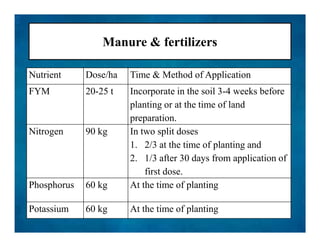
Manure & fertilizers
Nutrient Dose/ha Time & Method of Application
FYM 20-25 t Incorporate in the soil 3-4 weeks before
planting or at the time of land
preparation.
Nitrogen 90 kg In two split doses
1. 2/3 at the time of planting and
2. 1/3 after 30 days from application of
first dose.
Incorporate in the soil 3-4 weeks before
planting or at the time of land
preparation.
Nitrogen 90 kg In two split doses
1. 2/3 at the time of planting and
2. 1/3 after 30 days from application of
first dose.
Phosphorus 60 kg At the time of planting
Potassium 60 kg At the time of planting
Irrigation
 Water should be given as and when required.
 Early irrigation should be done more frequently.
 Irrigation at 20 days intervals is essential during winter
and 10 days intervals in summer.
 Water should be given as and when required.
 Early irrigation should be done more frequently.
 Irrigation at 20 days intervals is essential during winter
and 10 days intervals in summer.
Training
 Vines require training on
some form of aerial
support system to achieve
maximum fruit production.
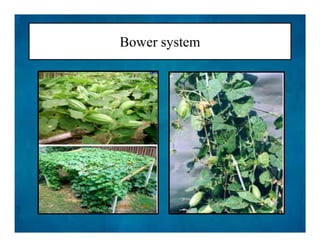
 Vines trained on bower
system compared to those
growing on the ground
gives high yield.
 Picking also become very
easy if the vines are
trained.
 Vines require training on
some form of aerial
support system to achieve
maximum fruit production.
 Vines trained on bower
system compared to those
growing on the ground
gives high yield.
 Picking also become very
easy if the vines are
trained.
Bower system
Practical utility of innovation :-
1- It is low cost as compared to other trailing system.
2- Increased yield up to 38.1 % over farmers' practice.
3- Easy plucking of fruits.
4- Easyness in intercultural operation.
5- Improved quality of fruits as there is no rotting.
6- Suitable for high rainfall area.
7- Suitable for small and marginal farmers.
8- It can be adopted for other crops like spine gourd, bitter
gourd, ridge gourd etc.
Pointed gourd cultivation is more remunerative
in triangular staking system
29
Practical utility of innovation :-
1- It is low cost as compared to other trailing system.
2- Increased yield up to 38.1 % over farmers' practice.
3- Easy plucking of fruits.
4- Easyness in intercultural operation.
5- Improved quality of fruits as there is no rotting.
6- Suitable for high rainfall area.
7- Suitable for small and marginal farmers.
8- It can be adopted for other crops like spine gourd, bitter
gourd, ridge gourd etc.
Trailing techniques adopted by farmer
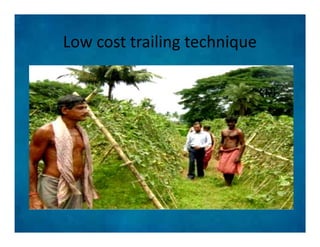
• Sri Banamali Pradhan of Dumukipur village,pipili,puri innovated one
low cost trailing technique to combat the rotting problem of pointed
gourd cultivation during rainy season.
• He started pointed gourd cultivation in an area of 0.5 ha. in
triangular staking system made up of bamboos and other locally
available staking materials.
• He placed a series of two bamboos in a triangular manner in a row
with spacing of 5 ft X 5 ft on both the sides.
• Bamboos stripes were tied horizontally between two triangular
bamboos and in between locally available staking materials were
given.
• Planting was done on both the sides of staking system at spacing
of 5 ft X 5 ft. In the system he harvested 256.2 q pointed gourd
per ha with a net income of Rs 2,19,510/- with an investment of
87,800per ha.
• Sri Banamali Pradhan of Dumukipur village,pipili,puri innovated one
low cost trailing technique to combat the rotting problem of pointed
gourd cultivation during rainy season.
• He started pointed gourd cultivation in an area of 0.5 ha. in
triangular staking system made up of bamboos and other locally
available staking materials.
• He placed a series of two bamboos in a triangular manner in a row
with spacing of 5 ft X 5 ft on both the sides.
• Bamboos stripes were tied horizontally between two triangular
bamboos and in between locally available staking materials were
given.
• Planting was done on both the sides of staking system at spacing
of 5 ft X 5 ft. In the system he harvested 256.2 q pointed gourd
per ha with a net income of Rs 2,19,510/- with an investment of
87,800per ha. 30
Low cost trailing technique
Weed management
 Weeding should be done only when plants have sprouted
and are well set.
 Hand removal and cultivation are the most widely practiced
method of eliminating weeds.
 The mulch provides a physical barrier between soil and
plant surfaces and reduces the amount of disease inoculums.
 Organic mulches, such as dry grass, straw, bark, banana
sheath composted sawdust and similar materials, can also be
used as physical barriers.
 Weeding should be done only when plants have sprouted
and are well set.
 Hand removal and cultivation are the most widely practiced
method of eliminating weeds.
 The mulch provides a physical barrier between soil and
plant surfaces and reduces the amount of disease inoculums.
 Organic mulches, such as dry grass, straw, bark, banana
sheath composted sawdust and similar materials, can also be
used as physical barriers.
Storage
 Singh (1989) recommended treatment of Pointed gourd
fruits with Waxol (12%) for increasing the shelf- life up to 8
days. In ordinary condition pointed gourd fruits can be
easily kept at room temperature for 3-4 days.
Harvesting and Yield
 Pointed gourd is ready for harvest in 80-90 DAP.
 Harvesting should be done when the fruits are immature,
tender and still green.
 Picking should be done frequently so that maximum fruits
could be harvested from a vine.
 Yield varies from 6-8 tonnes/ha in the first year, while it
may increase to 14-15 tonnes/ha during summer.
 Pointed gourd is ready for harvest in 80-90 DAP.
 Harvesting should be done when the fruits are immature,
tender and still green.
 Picking should be done frequently so that maximum fruits
could be harvested from a vine.
 Yield varies from 6-8 tonnes/ha in the first year, while it
may increase to 14-15 tonnes/ha during summer.
34
NAU Recommendation
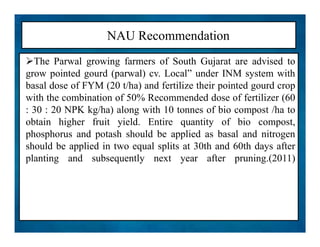
The Parwal growing farmers of South Gujarat are advised to
grow pointed gourd (parwal) cv. Local” under INM system with
basal dose of FYM (20 t/ha) and fertilize their pointed gourd crop
with the combination of 50% Recommended dose of fertilizer (60
: 30 : 20 NPK kg/ha) along with 10 tonnes of bio compost /ha to
obtain higher fruit yield. Entire quantity of bio compost,
phosphorus and potash should be applied as basal and nitrogen
should be applied in two equal splits at 30th and 60th days after
planting and subsequently next year after pruning.(2011)
The Parwal growing farmers of South Gujarat are advised to
grow pointed gourd (parwal) cv. Local” under INM system with
basal dose of FYM (20 t/ha) and fertilize their pointed gourd crop
with the combination of 50% Recommended dose of fertilizer (60
: 30 : 20 NPK kg/ha) along with 10 tonnes of bio compost /ha to
obtain higher fruit yield. Entire quantity of bio compost,
phosphorus and potash should be applied as basal and nitrogen
should be applied in two equal splits at 30th and 60th days after
planting and subsequently next year after pruning.(2011)
 The Parwal cv. Local growing peasantry of South Gujarat
area are advised to apply three foliar sprays in summer
months (on 1st week of March, 1st week of April and 1st
week of May ) of PGRs namely NAA 50 mg/l for increasing
per cent fruit set as well as for getting higher fruit
yield.(2011).
 The Parwal cv. Local growing peasantry of South Gujarat
area are advised to apply three foliar sprays in summer
months (on 1st week of March, 1st week of April and 1st
week of May ) of PGRs namely NAA 50 mg/l for increasing
per cent fruit set as well as for getting higher fruit
yield.(2011).
Pest management
Pest management
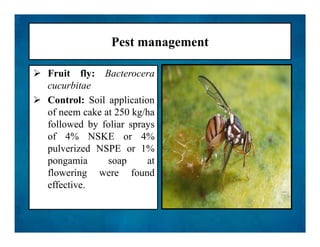
 Fruit fly: Bacterocera
cucurbitae
 Control: Soil application
of neem cake at 250 kg/ha
followed by foliar sprays
of 4% NSKE or 4%
pulverized NSPE or 1%
pongamia soap at
flowering were found
effective.
 Fruit fly: Bacterocera
cucurbitae
 Control: Soil application
of neem cake at 250 kg/ha
followed by foliar sprays
of 4% NSKE or 4%
pulverized NSPE or 1%
pongamia soap at
flowering were found
effective.
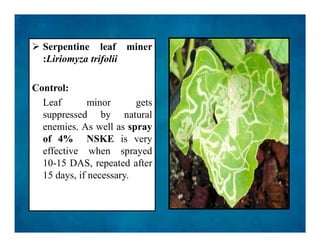
 Serpentine leaf miner
:Liriomyza trifolii
Control:
Leaf minor gets
suppressed by natural
enemies. As well as spray
of 4% NSKE is very
effective when sprayed
10-15 DAS, repeated after
15 days, if necessary.
 Serpentine leaf miner
:Liriomyza trifolii
Control:
Leaf minor gets
suppressed by natural
enemies. As well as spray
of 4% NSKE is very
effective when sprayed
10-15 DAS, repeated after
15 days, if necessary.
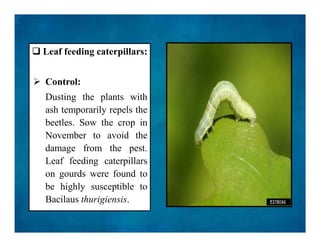
 Leaf feeding caterpillars:
 Control:
Dusting the plants with
ash temporarily repels the
beetles. Sow the crop in
November to avoid the
damage from the pest.
Leaf feeding caterpillars
on gourds were found to
be highly susceptible to
Bacilaus thurigiensis.
 Leaf feeding caterpillars:
 Control:
Dusting the plants with
ash temporarily repels the
beetles. Sow the crop in
November to avoid the
damage from the pest.
Leaf feeding caterpillars
on gourds were found to
be highly susceptible to
Bacilaus thurigiensis.
• Root-knot Nematode:
Meloidogyne sp.
Control:
• Pulverize the planting pit
soil and expose to
sunlight by repeated
raking. Heap 4” to 6” dry
trash and burn it before
application of compost.
• Add 250 g fresh neem
cake enriched with
Trichoderma harzianum
per planting pit to
effectively control.
• Root-knot Nematode:
Meloidogyne sp.
Control:
• Pulverize the planting pit
soil and expose to
sunlight by repeated
raking. Heap 4” to 6” dry
trash and burn it before
application of compost.
• Add 250 g fresh neem
cake enriched with
Trichoderma harzianum
per planting pit to
effectively control.
Epilachna beetle
Symptoms of damage:
• Both the adult and grub stages feed on the leaf surfaces
and skeletonize the leaves.
• The attacked leaves turn brown, dry up, and fall off.
• In case of sever infestation crops look like unhealthy and the
vigourity of plants adversely affected.
42
Symptoms of damage:
• Both the adult and grub stages feed on the leaf surfaces
and skeletonize the leaves.
• The attacked leaves turn brown, dry up, and fall off.
• In case of sever infestation crops look like unhealthy and the
vigourity of plants adversely affected.
Control:
•This pest can be controlled by
regular killing and picking of eggs
grubs and adults.
To control the pest Malathion /
Fyfanon / 50 EC @ 2ml of water can
be sprayed.
Symptoms of Damage :
• The grubs feed on the roots and underground portion of host plants
and fruits touching the soil.
• Infested fruits become unfit for human consumption.
• They prefer young seedling and tender leaves and damage may even
kill the seedlings.
3. Red pumpkin beetle:
43
Symptoms of Damage :
• The grubs feed on the roots and underground portion of host plants
and fruits touching the soil.
• Infested fruits become unfit for human consumption.
• They prefer young seedling and tender leaves and damage may even
kill the seedlings.
Control:
• collect and destroy of beetles in
early stage of infection.
• Spray Malathion @ 2ml/liter of
water for effective control.
• Dusting with 5% Malathion @
10 kg/ha.
Disease Management
• Fusarium wilt : (Fusarium oxysporum f. sp. Niveum)
Symptoms :
 The disease attack the plant at all stages of plant growth.
 When young seedlings are infected they damp off and die.
 In older plants the plant wilt and die within 10 days.
 Vascular discolaration can be seen. In wet weather, pinkish
or whitish fungal growth can be seen on dead stems.
Management :
 Collection and burning of infected plant.
 Seed treatment and soil application with Trichoderma viride
or Pseudomonas fluorescens.
 Use of disease free seeds.
• Fusarium wilt : (Fusarium oxysporum f. sp. Niveum)
Symptoms :
 The disease attack the plant at all stages of plant growth.
 When young seedlings are infected they damp off and die.
 In older plants the plant wilt and die within 10 days.
 Vascular discolaration can be seen. In wet weather, pinkish
or whitish fungal growth can be seen on dead stems.
Management :
 Collection and burning of infected plant.
 Seed treatment and soil application with Trichoderma viride
or Pseudomonas fluorescens.
 Use of disease free seeds.
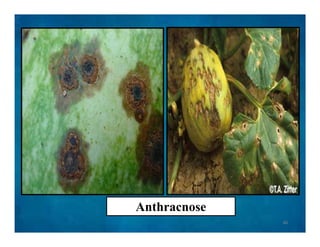
• Anthracnose (Collectorichum lagenarium) :
Symptoms
 Small yellowish or water soaked areas appears on leaves
which enlarge rapidly and turn brown in most cucurbits but
black in water melon.
 The affected bark break and fall of or the whole leaf dries.
When the infection occurs in stem, the whole vine is killed.
 When infection occurs in fruit pedicle, the young fruit may
be darken, shrivel and dry. Circular black cankers appear on
fruits.
 The spots may be up to 5 cm diameter based on the host and
environment.
 In the sunken black spots salmon coloured spores can be
seen.
Management
 Collection and destruction of infected plant.
• Anthracnose (Collectorichum lagenarium) :
Symptoms
 Small yellowish or water soaked areas appears on leaves
which enlarge rapidly and turn brown in most cucurbits but
black in water melon.
 The affected bark break and fall of or the whole leaf dries.
When the infection occurs in stem, the whole vine is killed.
 When infection occurs in fruit pedicle, the young fruit may
be darken, shrivel and dry. Circular black cankers appear on
fruits.
 The spots may be up to 5 cm diameter based on the host and
environment.
 In the sunken black spots salmon coloured spores can be
seen.
Management
 Collection and destruction of infected plant.
Anthracnose
46
Downy mildew (Pseudoperonospora cubensis)
Symptoms
 Symptoms resembling mosaic viz., pale green areas separated
by dark green areas appear on upper surface of leaf.
 During wet season, corresponding lower surface is covered
with faint purplish fungal growth.
 The entire leaf dries up quickly.
Management
 Use of bed system with wide spacing with good drainage and
air movement and exposure to sun help to check the disease
development.
Symptoms
 Symptoms resembling mosaic viz., pale green areas separated
by dark green areas appear on upper surface of leaf.
 During wet season, corresponding lower surface is covered
with faint purplish fungal growth.
 The entire leaf dries up quickly.
Management
 Use of bed system with wide spacing with good drainage and
air movement and exposure to sun help to check the disease
development.
• Fruit rot (Pythium aphenidermatum)
Symptoms
• Initially the skin of the fruit shows soft, dark green
water soaked lesions which gradually develop into a
watery soft rot.
• Cottony mycelium develop on the affected portions.
• The fruit in contract with the soil is attacked easily.
Management
• Keep fruits not in touch with soil.
• Fruit rot (Pythium aphenidermatum)
Symptoms
• Initially the skin of the fruit shows soft, dark green
water soaked lesions which gradually develop into a
watery soft rot.
• Cottony mycelium develop on the affected portions.
• The fruit in contract with the soil is attacked easily.
Management
• Keep fruits not in touch with soil.
Harvesting and YieldHarvesting and Yield
 Pointed gourd is ready for harvest in 80-90 DAP.
 Harvesting should be done when the fruits are immature,
tender and still green.
 Picking should be done frequently so that maximum fruits
could be harvested from a vine.
 Yield varies from 6-8 tonnes/ha in the first year, while it
may increase to 14-15 tonnes/ha during summer.
 Pointed gourd is ready for harvest in 80-90 DAP.
 Harvesting should be done when the fruits are immature,
tender and still green.
 Picking should be done frequently so that maximum fruits
could be harvested from a vine.
 Yield varies from 6-8 tonnes/ha in the first year, while it
may increase to 14-15 tonnes/ha during summer.
Storage and Marketing
• Fruits after harvesting can be stored under
ordinary conditions for about 3-4 days.
• Fruits are sent to the markets in the baskets or
gunny bags.
• Fruits after harvesting can be stored under
ordinary conditions for about 3-4 days.
• Fruits are sent to the markets in the baskets or
gunny bags.
References
 Bhujbal, M. (1999). Patoladi Quath in the management of skin disorder.
Deerghayu 58:72-76.
 Chandrasekhar, B., Mukherjee B, Mukherjee S. (1988). Blood sugar
lowering effect of Trichosanthes dioica Roxb. in experimental rat models.
Int J Cru Drug Res, 26: 102– 106.
 Gopalan, C.; Ramashashtri, B. and Balasubramanian, S. (1989). Nutritive
values of Indian foods. National Institute of Nutrition Publication,
Hyderabad, India.
 Hariti, M.; Rathee, P. (1995). Antibacterial activity of the unsaponifiable
fraction of the fixed oil of Trichosanthes seeds. Asian journal of chemistry,
7 (4): 909-911.
 Rai, D.; Rai, P.; Jaiswal, D.; Sharma, B. and Watal, G. (2008). Effect of
water extract of Trichosanthes dioica fruits in streptozotocin induced
diabetic rats. Indian Journal of Clinical Biochemistry, 23 (4): 387-390.
 Bhujbal, M. (1999). Patoladi Quath in the management of skin disorder.
Deerghayu 58:72-76.
 Chandrasekhar, B., Mukherjee B, Mukherjee S. (1988). Blood sugar
lowering effect of Trichosanthes dioica Roxb. in experimental rat models.
Int J Cru Drug Res, 26: 102– 106.
 Gopalan, C.; Ramashashtri, B. and Balasubramanian, S. (1989). Nutritive
values of Indian foods. National Institute of Nutrition Publication,
Hyderabad, India.
 Hariti, M.; Rathee, P. (1995). Antibacterial activity of the unsaponifiable
fraction of the fixed oil of Trichosanthes seeds. Asian journal of chemistry,
7 (4): 909-911.
 Rai, D.; Rai, P.; Jaiswal, D.; Sharma, B. and Watal, G. (2008). Effect of
water extract of Trichosanthes dioica fruits in streptozotocin induced
diabetic rats. Indian Journal of Clinical Biochemistry, 23 (4): 387-390.
 Rai, D.; Rai, P.; Jaiswal, D.; Sharma, B. and Watal, G.; (2008) Effect
of water extract of Trichosanthes dioica fruits in streptozotocin
induced diabetic rats. Indian Journal of Clinical Biochemistry, 23
(4): 387-390.
 Sharma, G.; Sarkar, A,; Pachori, S. and Pant, M. (1989).
Biochemical evaluation of raw Trichosanthes dioica whole fruit and
pulp in normal and milddiabetic human volunteers in relation to
lipid profile. Ind Drug 1989; 27: 24–28.
 Sharma, G.; Pandey D. and Pant M. (1990). Biochemical evaluation
of feeding Trichosanthes dioica seeds in normal and mild diabetic
human subjects in relation to lipid profile. Indian J. Physiol. Pharm.
34: 146–148.
 Sharmila, B,; Kumar, G. and Rajasekhara, P. (2007). Cholesterol-
lowering activity of the aqueous fruit extract of Trichosanthes dioica
in normal and streptozotocin diabetic rats. J Clin Dia Res, 1(4): 561-
569.
 Sharmila, B.; Kumar, G.; Rajasekhara, P.; (2007) Cholesterol-
lowering activity of the aqueous fruit extract of Trichosanthes dioica
in normal and streptozotocin diabetic rats. J Clin Dia Res, 1(4): 561-
569.
 Rai, D.; Rai, P.; Jaiswal, D.; Sharma, B. and Watal, G.; (2008) Effect
of water extract of Trichosanthes dioica fruits in streptozotocin
induced diabetic rats. Indian Journal of Clinical Biochemistry, 23
(4): 387-390.
 Sharma, G.; Sarkar, A,; Pachori, S. and Pant, M. (1989).
Biochemical evaluation of raw Trichosanthes dioica whole fruit and
pulp in normal and milddiabetic human volunteers in relation to
lipid profile. Ind Drug 1989; 27: 24–28.
 Sharma, G.; Pandey D. and Pant M. (1990). Biochemical evaluation
of feeding Trichosanthes dioica seeds in normal and mild diabetic
human subjects in relation to lipid profile. Indian J. Physiol. Pharm.
34: 146–148.
 Sharmila, B,; Kumar, G. and Rajasekhara, P. (2007). Cholesterol-
lowering activity of the aqueous fruit extract of Trichosanthes dioica
in normal and streptozotocin diabetic rats. J Clin Dia Res, 1(4): 561-
569.
 Sharmila, B.; Kumar, G.; Rajasekhara, P.; (2007) Cholesterol-
lowering activity of the aqueous fruit extract of Trichosanthes dioica
in normal and streptozotocin diabetic rats. J Clin Dia Res, 1(4): 561-
569.
Pointed gourd production technology

Pointed gourd production technology

  • 2.
    IntroductionIntroduction  Scientific Name:- Trichosanthus dioica Roxb.  Common Name :- Parwal, Parmal  Origin :- India/Indo Malayan Region  Chromosome No :- 2n=22  It is a perennial cucurbit.  Mostly cultivated in Bihar, Bengal, Madhya Pradesh and Eastern U.P.  Scientific Name :- Trichosanthus dioica Roxb.  Common Name :- Parwal, Parmal  Origin :- India/Indo Malayan Region  Chromosome No :- 2n=22  It is a perennial cucurbit.  Mostly cultivated in Bihar, Bengal, Madhya Pradesh and Eastern U.P.
  • 3.
    Uses  Fruits areused in making curry and pickles.  A famous sweet by putting the fruits in sugar syrup is made in India.  The fruits are diuretic, laxative and cardiatonic.  It is also recommended for bronchitis, high fever and nervousness.  Pointed gourd possesses the medicinal property of lowering total cholesterol and blood sugar.  Fruits are used in making curry and pickles.  A famous sweet by putting the fruits in sugar syrup is made in India.  The fruits are diuretic, laxative and cardiatonic.  It is also recommended for bronchitis, high fever and nervousness.  Pointed gourd possesses the medicinal property of lowering total cholesterol and blood sugar.
  • 4.
    Comparative differences infruit composition of pointed gourd, snake gourd ivy gourd, bitter gourd & bottle gourd Gopalan et al. (1989)Gopalan et al. (1989)
  • 5.
  • 6.
    Medicinal value  Medicinalvalue It is a very ancient ayurvadic medicinal herb used in many medicines.  It is a food for convalescents.  Have diuretic & laxative properties.  It is cardio tonic.  Recommended for bronchitis, biliousness, high fever, nervousness.  Lowers cholesterol & blood sugar( Sharma & pant,1988;chandrasekar et al,1989).  Good for curing blood & skin diseases, also purifies blood.  Relieve the feeling of food satiation & excessive thirst.  Light & easy to digest, improves digestion strength.  Medicinal value It is a very ancient ayurvadic medicinal herb used in many medicines.  It is a food for convalescents.  Have diuretic & laxative properties.  It is cardio tonic.  Recommended for bronchitis, biliousness, high fever, nervousness.  Lowers cholesterol & blood sugar( Sharma & pant,1988;chandrasekar et al,1989).  Good for curing blood & skin diseases, also purifies blood.  Relieve the feeling of food satiation & excessive thirst.  Light & easy to digest, improves digestion strength.
  • 7.
    • Used fortreating Diabetes mellitus. It has been reported that the presence of flavinoids & trace element like Cu, k & Mg are responsible for anti- diabetic activity of pointed gourd plants.( Kar et al, 1999). • Juice of leaves used as tonic, febrifuge & in sub acute case of enlargement of liver & spleen. • Useful in itching & burning sensation. • Good for skin ,improves complexion. • Used for treating Diabetes mellitus. It has been reported that the presence of flavinoids & trace element like Cu, k & Mg are responsible for anti- diabetic activity of pointed gourd plants.( Kar et al, 1999). • Juice of leaves used as tonic, febrifuge & in sub acute case of enlargement of liver & spleen. • Useful in itching & burning sensation. • Good for skin ,improves complexion.
  • 8.
    • Antioxidant-Protects thebody against oxidative stress by neutralizing free radicals. Aqueous extracts of leaves of T.dioica contains rich amount of polyphones which are very potent natural antioxidants. • Similarly in another study antioxidant activity of fruits of T.dioica was evaluated & compared with ascorbic acid (standard). • The result showed that aqueous extract of T.dioica fruits posses in vitro free radical scavenging activity (Sharmila et al.2007) • Antioxidant-Protects the body against oxidative stress by neutralizing free radicals. Aqueous extracts of leaves of T.dioica contains rich amount of polyphones which are very potent natural antioxidants. • Similarly in another study antioxidant activity of fruits of T.dioica was evaluated & compared with ascorbic acid (standard). • The result showed that aqueous extract of T.dioica fruits posses in vitro free radical scavenging activity (Sharmila et al.2007)
  • 9.
    • Cholesterol loweringactivity – Sharma et al. 1988 reported that aqueous fruit extract of T.dioica exhibits cholesterol & body weight lowering activities in both normal & hyperglycemic rats. • Anti diabetic- Sharma et al. 1989 & Chandrasekhar et al. 2008 reported that aqueous extract of T.dioica fruits reduces the levels of fasting blood glucose, postprandial glucose, asparate amino transferase, alanine amino transferase, alkaline phosphatase, cretinine, urine sugar, urine protein where as increases total protein & body weight. • Cholesterol lowering activity – Sharma et al. 1988 reported that aqueous fruit extract of T.dioica exhibits cholesterol & body weight lowering activities in both normal & hyperglycemic rats. • Anti diabetic- Sharma et al. 1989 & Chandrasekhar et al. 2008 reported that aqueous extract of T.dioica fruits reduces the levels of fasting blood glucose, postprandial glucose, asparate amino transferase, alanine amino transferase, alkaline phosphatase, cretinine, urine sugar, urine protein where as increases total protein & body weight.
  • 10.
     Glycemic property-Aqueousextracts of T.dioica leaves has good hypoglycemic potential along with a high anti- diabetic profile.(Rai et al.2008)  Chandrasekhar et al. (1988) reported that pointed gourd possesses the medicinal property of lowering blood sugar level in rats.  Bhujbal (1999) showed that polyherb formulation including T.dioica is useful in skin disorder.  Glycemic property-Aqueous extracts of T.dioica leaves has good hypoglycemic potential along with a high anti- diabetic profile.(Rai et al.2008)  Chandrasekhar et al. (1988) reported that pointed gourd possesses the medicinal property of lowering blood sugar level in rats.  Bhujbal (1999) showed that polyherb formulation including T.dioica is useful in skin disorder.
  • 11.
    • Hariti &Rathee (1996) reported that the oil of seeds of T.dioica have antifungal property. They also studied the antibacterial activity of oil T.dioica seeds against Bacilus anthracis & Xanthomonas malacearum. • Sharma & Pant et al.(1992) showed influence of alcoholic extract of whole fruit of T.dioica on blood sugar, serum lipids, lipoproteins & faecal sterols in normal albino rabbits. • Hariti & Rathee (1996) reported that the oil of seeds of T.dioica have antifungal property. They also studied the antibacterial activity of oil T.dioica seeds against Bacilus anthracis & Xanthomonas malacearum. • Sharma & Pant et al.(1992) showed influence of alcoholic extract of whole fruit of T.dioica on blood sugar, serum lipids, lipoproteins & faecal sterols in normal albino rabbits.
  • 12.
    Biochemical Composition Pointed gourdis rich in vitamin and also contains :- Nutritional value per 100 g edible part Mg - 9.0 mg Na - 2.6 mg K - 83.0 mg Cu - 1.1 mg and S - 17.0 mg Pointed gourd is rich in vitamin and also contains :- Nutritional value per 100 g edible part Mg - 9.0 mg Na - 2.6 mg K - 83.0 mg Cu - 1.1 mg and S - 17.0 mg
  • 13.
    Botany  The plantis a perennial, dioecious, and grows as a vine.  Roots are tuberous with long taproot system.  Vines are pencil thick in size with dark green cordate simple leaves.  Flowers are tubular white with 16–19 days initiation to anthesis time for pistillate flowers and 10–14 days for staminate flowers.  Stigma remains viable for approximately 14 hours and 40–70 % of flowers set fruit (Singh et al. 1989).  The plant is a perennial, dioecious, and grows as a vine.  Roots are tuberous with long taproot system.  Vines are pencil thick in size with dark green cordate simple leaves.  Flowers are tubular white with 16–19 days initiation to anthesis time for pistillate flowers and 10–14 days for staminate flowers.  Stigma remains viable for approximately 14 hours and 40–70 % of flowers set fruit (Singh et al. 1989).
  • 14.
    Varieties Not much systematicresearch work has been done to develop the improved varieties in pointed gourd. However, some improved strains are developed through selection from local germplasm in India which are grown in various states. These are as follows: Madhya Pradesh:- Green oval, green long striped and white oval. (In this state generally pale-white oval cultivars are popular).  West Bengal:- Kazil, Bombay and Damodar.  Uttar Pradesh:- Kalyani, Bihar Sharif, FP-5, FP-4, FP-1, FP-3. Not much systematic research work has been done to develop the improved varieties in pointed gourd. However, some improved strains are developed through selection from local germplasm in India which are grown in various states. These are as follows: Madhya Pradesh:- Green oval, green long striped and white oval. (In this state generally pale-white oval cultivars are popular).  West Bengal:- Kazil, Bombay and Damodar.  Uttar Pradesh:- Kalyani, Bihar Sharif, FP-5, FP-4, FP-1, FP-3.
  • 15.
    Continue  Other varieties:-Shankolia, Swarn Rekha, Swarn Alaukik and Chota Hilli, Ches Elite Line, Ches Hybrid 1, Ches Hybrids 2, Dandali, Hilli, Rajendra Parwal 1 and Rajendra Parwal 2.  Varieties grow in NAU, Navsari:- BCPG -3, BCPG – 4, BCPG – 5, NPG-1, NPG-2, NPG-3, NPG-4, etc.  Other varieties:- Shankolia, Swarn Rekha, Swarn Alaukik and Chota Hilli, Ches Elite Line, Ches Hybrid 1, Ches Hybrids 2, Dandali, Hilli, Rajendra Parwal 1 and Rajendra Parwal 2.  Varieties grow in NAU, Navsari:- BCPG -3, BCPG – 4, BCPG – 5, NPG-1, NPG-2, NPG-3, NPG-4, etc.
  • 16.
    Soil and Climate Pointed gourd prefers a well-drained sandy loam soil with good fertility.  It is a warm season crop and also grown in riverbeds.  Hot and humid climate is best for its development.  During winter, it becomes dormant and sprouts again in summer.  Severe cold / frost are unfavorable for plant growth & development, crop remains dormant during winter. Vigorous growth starts only with the onset of spring  Pointed gourd prefers a well-drained sandy loam soil with good fertility.  It is a warm season crop and also grown in riverbeds.  Hot and humid climate is best for its development.  During winter, it becomes dormant and sprouts again in summer.  Severe cold / frost are unfavorable for plant growth & development, crop remains dormant during winter. Vigorous growth starts only with the onset of spring
  • 17.
    Propagation • The pointedgourd is usually propagated through vine cuttings and root suckers. • Seeds are not used in planting because of poor germination and inability to determine the sex of plants before flowering. As a result, crop established from seed may contain 50% non fruiting male plants. • To propagate from root suckers, tuberous roots of pointed gourd are dug in the early spring, subdivided, and replanted. • The pointed gourd is usually propagated through vine cuttings and root suckers. • Seeds are not used in planting because of poor germination and inability to determine the sex of plants before flowering. As a result, crop established from seed may contain 50% non fruiting male plants. • To propagate from root suckers, tuberous roots of pointed gourd are dug in the early spring, subdivided, and replanted.
  • 18.
    Male-Female ration:  Asit is a Dioecious plant only one sex is determined in a single plant.  If all the plants in a field are male, there is no fruit set and the total production is zero.  For this reason, maintenance of male-female ratio is necessary.  A female: male ratio of 9:1 is optimum for ensuring maximum fruit set.  As it is a Dioecious plant only one sex is determined in a single plant.  If all the plants in a field are male, there is no fruit set and the total production is zero.  For this reason, maintenance of male-female ratio is necessary.  A female: male ratio of 9:1 is optimum for ensuring maximum fruit set.
  • 19.
     Both pre-rootedand fresh vine cuttings are used for propagation.  Vine cuttings made in the fall of previous year and rooted during winter are planted when danger from frost is over in the spring in order to obtain a crop in the same year.  Current year vine cuttings are also planted to establish the crop during the summer, but optimum plant yield is only obtained during the next year.  Both pre-rooted and fresh vine cuttings are used for propagation.  Vine cuttings made in the fall of previous year and rooted during winter are planted when danger from frost is over in the spring in order to obtain a crop in the same year.  Current year vine cuttings are also planted to establish the crop during the summer, but optimum plant yield is only obtained during the next year.
  • 20.
    Varieties Not much systematicresearch work has been done to develop the improved varieties in pointed gourd. However, some improved strains are developed through selection from local germplasm in India which are grown in various states. These are as follows: Madhya Pradesh:- Green oval, green long striped and white oval. (In this state generally pale-white oval cultivars are popular). Not much systematic research work has been done to develop the improved varieties in pointed gourd. However, some improved strains are developed through selection from local germplasm in India which are grown in various states. These are as follows: Madhya Pradesh:- Green oval, green long striped and white oval. (In this state generally pale-white oval cultivars are popular). 20 Cont…..
  • 21.
     West Bengal:-Kazil, Bombay and Damodar.  Uttar Pradesh:- Kalyani, Bihar Sharif, FP-5, FP-4, FP-1, FP-3.  Other varieties:- Shankolia, Swarn Rekha, Swarn Alaukik and Chota Hilli, Ches Elite Line, Ches Hybrid 1, Ches Hybrids 2, Dandali, Hilli, Rajendra Parwal 1 and Rajendra Parwal 2.  Varieties grow in NAU, Navsari:- BCPG -3, BCPG – 4, BCPG – 5, NPG-1, NPG-2, NPG-3, NPG-4, etc.  West Bengal:- Kazil, Bombay and Damodar.  Uttar Pradesh:- Kalyani, Bihar Sharif, FP-5, FP-4, FP-1, FP-3.  Other varieties:- Shankolia, Swarn Rekha, Swarn Alaukik and Chota Hilli, Ches Elite Line, Ches Hybrid 1, Ches Hybrids 2, Dandali, Hilli, Rajendra Parwal 1 and Rajendra Parwal 2.  Varieties grow in NAU, Navsari:- BCPG -3, BCPG – 4, BCPG – 5, NPG-1, NPG-2, NPG-3, NPG-4, etc. 21
  • 22.
    Spacing and plantingmaterial  Fresh vines used for field planting should have 8–10 nodes per cutting and should be partially or fully defoliated to check transpiration.  About 2,000-2,500 cuttings are required to plant one ha area of pointed gourd.  The distance between plants is kept between 1.5–2.0 m × 1.5–2.0 m depending on the method of training of vines.  A female : male ratio of 9:1 is optimum for ensuring maximum fruit set.  Fresh vines used for field planting should have 8–10 nodes per cutting and should be partially or fully defoliated to check transpiration.  About 2,000-2,500 cuttings are required to plant one ha area of pointed gourd.  The distance between plants is kept between 1.5–2.0 m × 1.5–2.0 m depending on the method of training of vines.  A female : male ratio of 9:1 is optimum for ensuring maximum fruit set.
  • 23.
    Time and Methodof Planting  Time: - February–March  Planting Method:-  Rooted cutting method: The cuttings from mature vines are planted in the nursery, where they are allowed to strike roots. These cuttings are then planted in February–March.  Time: - February–March  Planting Method:-  Rooted cutting method: The cuttings from mature vines are planted in the nursery, where they are allowed to strike roots. These cuttings are then planted in February–March.
  • 24.
    Manure & fertilizers NutrientDose/ha Time & Method of Application FYM 20-25 t Incorporate in the soil 3-4 weeks before planting or at the time of land preparation. Nitrogen 90 kg In two split doses 1. 2/3 at the time of planting and 2. 1/3 after 30 days from application of first dose. Incorporate in the soil 3-4 weeks before planting or at the time of land preparation. Nitrogen 90 kg In two split doses 1. 2/3 at the time of planting and 2. 1/3 after 30 days from application of first dose. Phosphorus 60 kg At the time of planting Potassium 60 kg At the time of planting
  • 25.
    Irrigation  Water shouldbe given as and when required.  Early irrigation should be done more frequently.  Irrigation at 20 days intervals is essential during winter and 10 days intervals in summer.  Water should be given as and when required.  Early irrigation should be done more frequently.  Irrigation at 20 days intervals is essential during winter and 10 days intervals in summer.
  • 26.
    Training  Vines requiretraining on some form of aerial support system to achieve maximum fruit production.  Vines trained on bower system compared to those growing on the ground gives high yield.  Picking also become very easy if the vines are trained.  Vines require training on some form of aerial support system to achieve maximum fruit production.  Vines trained on bower system compared to those growing on the ground gives high yield.  Picking also become very easy if the vines are trained.
  • 28.
  • 29.
    Practical utility ofinnovation :- 1- It is low cost as compared to other trailing system. 2- Increased yield up to 38.1 % over farmers' practice. 3- Easy plucking of fruits. 4- Easyness in intercultural operation. 5- Improved quality of fruits as there is no rotting. 6- Suitable for high rainfall area. 7- Suitable for small and marginal farmers. 8- It can be adopted for other crops like spine gourd, bitter gourd, ridge gourd etc. Pointed gourd cultivation is more remunerative in triangular staking system 29 Practical utility of innovation :- 1- It is low cost as compared to other trailing system. 2- Increased yield up to 38.1 % over farmers' practice. 3- Easy plucking of fruits. 4- Easyness in intercultural operation. 5- Improved quality of fruits as there is no rotting. 6- Suitable for high rainfall area. 7- Suitable for small and marginal farmers. 8- It can be adopted for other crops like spine gourd, bitter gourd, ridge gourd etc.
  • 30.
    Trailing techniques adoptedby farmer • Sri Banamali Pradhan of Dumukipur village,pipili,puri innovated one low cost trailing technique to combat the rotting problem of pointed gourd cultivation during rainy season. • He started pointed gourd cultivation in an area of 0.5 ha. in triangular staking system made up of bamboos and other locally available staking materials. • He placed a series of two bamboos in a triangular manner in a row with spacing of 5 ft X 5 ft on both the sides. • Bamboos stripes were tied horizontally between two triangular bamboos and in between locally available staking materials were given. • Planting was done on both the sides of staking system at spacing of 5 ft X 5 ft. In the system he harvested 256.2 q pointed gourd per ha with a net income of Rs 2,19,510/- with an investment of 87,800per ha. • Sri Banamali Pradhan of Dumukipur village,pipili,puri innovated one low cost trailing technique to combat the rotting problem of pointed gourd cultivation during rainy season. • He started pointed gourd cultivation in an area of 0.5 ha. in triangular staking system made up of bamboos and other locally available staking materials. • He placed a series of two bamboos in a triangular manner in a row with spacing of 5 ft X 5 ft on both the sides. • Bamboos stripes were tied horizontally between two triangular bamboos and in between locally available staking materials were given. • Planting was done on both the sides of staking system at spacing of 5 ft X 5 ft. In the system he harvested 256.2 q pointed gourd per ha with a net income of Rs 2,19,510/- with an investment of 87,800per ha. 30
  • 31.
  • 32.
    Weed management  Weedingshould be done only when plants have sprouted and are well set.  Hand removal and cultivation are the most widely practiced method of eliminating weeds.  The mulch provides a physical barrier between soil and plant surfaces and reduces the amount of disease inoculums.  Organic mulches, such as dry grass, straw, bark, banana sheath composted sawdust and similar materials, can also be used as physical barriers.  Weeding should be done only when plants have sprouted and are well set.  Hand removal and cultivation are the most widely practiced method of eliminating weeds.  The mulch provides a physical barrier between soil and plant surfaces and reduces the amount of disease inoculums.  Organic mulches, such as dry grass, straw, bark, banana sheath composted sawdust and similar materials, can also be used as physical barriers.
  • 33.
    Storage  Singh (1989)recommended treatment of Pointed gourd fruits with Waxol (12%) for increasing the shelf- life up to 8 days. In ordinary condition pointed gourd fruits can be easily kept at room temperature for 3-4 days.
  • 34.
    Harvesting and Yield Pointed gourd is ready for harvest in 80-90 DAP.  Harvesting should be done when the fruits are immature, tender and still green.  Picking should be done frequently so that maximum fruits could be harvested from a vine.  Yield varies from 6-8 tonnes/ha in the first year, while it may increase to 14-15 tonnes/ha during summer.  Pointed gourd is ready for harvest in 80-90 DAP.  Harvesting should be done when the fruits are immature, tender and still green.  Picking should be done frequently so that maximum fruits could be harvested from a vine.  Yield varies from 6-8 tonnes/ha in the first year, while it may increase to 14-15 tonnes/ha during summer. 34
  • 35.
    NAU Recommendation The Parwalgrowing farmers of South Gujarat are advised to grow pointed gourd (parwal) cv. Local” under INM system with basal dose of FYM (20 t/ha) and fertilize their pointed gourd crop with the combination of 50% Recommended dose of fertilizer (60 : 30 : 20 NPK kg/ha) along with 10 tonnes of bio compost /ha to obtain higher fruit yield. Entire quantity of bio compost, phosphorus and potash should be applied as basal and nitrogen should be applied in two equal splits at 30th and 60th days after planting and subsequently next year after pruning.(2011) The Parwal growing farmers of South Gujarat are advised to grow pointed gourd (parwal) cv. Local” under INM system with basal dose of FYM (20 t/ha) and fertilize their pointed gourd crop with the combination of 50% Recommended dose of fertilizer (60 : 30 : 20 NPK kg/ha) along with 10 tonnes of bio compost /ha to obtain higher fruit yield. Entire quantity of bio compost, phosphorus and potash should be applied as basal and nitrogen should be applied in two equal splits at 30th and 60th days after planting and subsequently next year after pruning.(2011)
  • 36.
     The Parwalcv. Local growing peasantry of South Gujarat area are advised to apply three foliar sprays in summer months (on 1st week of March, 1st week of April and 1st week of May ) of PGRs namely NAA 50 mg/l for increasing per cent fruit set as well as for getting higher fruit yield.(2011).  The Parwal cv. Local growing peasantry of South Gujarat area are advised to apply three foliar sprays in summer months (on 1st week of March, 1st week of April and 1st week of May ) of PGRs namely NAA 50 mg/l for increasing per cent fruit set as well as for getting higher fruit yield.(2011).
  • 37.
  • 38.
    Pest management  Fruitfly: Bacterocera cucurbitae  Control: Soil application of neem cake at 250 kg/ha followed by foliar sprays of 4% NSKE or 4% pulverized NSPE or 1% pongamia soap at flowering were found effective.  Fruit fly: Bacterocera cucurbitae  Control: Soil application of neem cake at 250 kg/ha followed by foliar sprays of 4% NSKE or 4% pulverized NSPE or 1% pongamia soap at flowering were found effective.
  • 39.
     Serpentine leafminer :Liriomyza trifolii Control: Leaf minor gets suppressed by natural enemies. As well as spray of 4% NSKE is very effective when sprayed 10-15 DAS, repeated after 15 days, if necessary.  Serpentine leaf miner :Liriomyza trifolii Control: Leaf minor gets suppressed by natural enemies. As well as spray of 4% NSKE is very effective when sprayed 10-15 DAS, repeated after 15 days, if necessary.
  • 40.
     Leaf feedingcaterpillars:  Control: Dusting the plants with ash temporarily repels the beetles. Sow the crop in November to avoid the damage from the pest. Leaf feeding caterpillars on gourds were found to be highly susceptible to Bacilaus thurigiensis.  Leaf feeding caterpillars:  Control: Dusting the plants with ash temporarily repels the beetles. Sow the crop in November to avoid the damage from the pest. Leaf feeding caterpillars on gourds were found to be highly susceptible to Bacilaus thurigiensis.
  • 41.
    • Root-knot Nematode: Meloidogynesp. Control: • Pulverize the planting pit soil and expose to sunlight by repeated raking. Heap 4” to 6” dry trash and burn it before application of compost. • Add 250 g fresh neem cake enriched with Trichoderma harzianum per planting pit to effectively control. • Root-knot Nematode: Meloidogyne sp. Control: • Pulverize the planting pit soil and expose to sunlight by repeated raking. Heap 4” to 6” dry trash and burn it before application of compost. • Add 250 g fresh neem cake enriched with Trichoderma harzianum per planting pit to effectively control.
  • 42.
    Epilachna beetle Symptoms ofdamage: • Both the adult and grub stages feed on the leaf surfaces and skeletonize the leaves. • The attacked leaves turn brown, dry up, and fall off. • In case of sever infestation crops look like unhealthy and the vigourity of plants adversely affected. 42 Symptoms of damage: • Both the adult and grub stages feed on the leaf surfaces and skeletonize the leaves. • The attacked leaves turn brown, dry up, and fall off. • In case of sever infestation crops look like unhealthy and the vigourity of plants adversely affected. Control: •This pest can be controlled by regular killing and picking of eggs grubs and adults. To control the pest Malathion / Fyfanon / 50 EC @ 2ml of water can be sprayed.
  • 43.
    Symptoms of Damage: • The grubs feed on the roots and underground portion of host plants and fruits touching the soil. • Infested fruits become unfit for human consumption. • They prefer young seedling and tender leaves and damage may even kill the seedlings. 3. Red pumpkin beetle: 43 Symptoms of Damage : • The grubs feed on the roots and underground portion of host plants and fruits touching the soil. • Infested fruits become unfit for human consumption. • They prefer young seedling and tender leaves and damage may even kill the seedlings. Control: • collect and destroy of beetles in early stage of infection. • Spray Malathion @ 2ml/liter of water for effective control. • Dusting with 5% Malathion @ 10 kg/ha.
  • 44.
    Disease Management • Fusariumwilt : (Fusarium oxysporum f. sp. Niveum) Symptoms :  The disease attack the plant at all stages of plant growth.  When young seedlings are infected they damp off and die.  In older plants the plant wilt and die within 10 days.  Vascular discolaration can be seen. In wet weather, pinkish or whitish fungal growth can be seen on dead stems. Management :  Collection and burning of infected plant.  Seed treatment and soil application with Trichoderma viride or Pseudomonas fluorescens.  Use of disease free seeds. • Fusarium wilt : (Fusarium oxysporum f. sp. Niveum) Symptoms :  The disease attack the plant at all stages of plant growth.  When young seedlings are infected they damp off and die.  In older plants the plant wilt and die within 10 days.  Vascular discolaration can be seen. In wet weather, pinkish or whitish fungal growth can be seen on dead stems. Management :  Collection and burning of infected plant.  Seed treatment and soil application with Trichoderma viride or Pseudomonas fluorescens.  Use of disease free seeds.
  • 45.
    • Anthracnose (Collectorichumlagenarium) : Symptoms  Small yellowish or water soaked areas appears on leaves which enlarge rapidly and turn brown in most cucurbits but black in water melon.  The affected bark break and fall of or the whole leaf dries. When the infection occurs in stem, the whole vine is killed.  When infection occurs in fruit pedicle, the young fruit may be darken, shrivel and dry. Circular black cankers appear on fruits.  The spots may be up to 5 cm diameter based on the host and environment.  In the sunken black spots salmon coloured spores can be seen. Management  Collection and destruction of infected plant. • Anthracnose (Collectorichum lagenarium) : Symptoms  Small yellowish or water soaked areas appears on leaves which enlarge rapidly and turn brown in most cucurbits but black in water melon.  The affected bark break and fall of or the whole leaf dries. When the infection occurs in stem, the whole vine is killed.  When infection occurs in fruit pedicle, the young fruit may be darken, shrivel and dry. Circular black cankers appear on fruits.  The spots may be up to 5 cm diameter based on the host and environment.  In the sunken black spots salmon coloured spores can be seen. Management  Collection and destruction of infected plant.
  • 46.
  • 47.
    Downy mildew (Pseudoperonosporacubensis) Symptoms  Symptoms resembling mosaic viz., pale green areas separated by dark green areas appear on upper surface of leaf.  During wet season, corresponding lower surface is covered with faint purplish fungal growth.  The entire leaf dries up quickly. Management  Use of bed system with wide spacing with good drainage and air movement and exposure to sun help to check the disease development. Symptoms  Symptoms resembling mosaic viz., pale green areas separated by dark green areas appear on upper surface of leaf.  During wet season, corresponding lower surface is covered with faint purplish fungal growth.  The entire leaf dries up quickly. Management  Use of bed system with wide spacing with good drainage and air movement and exposure to sun help to check the disease development.
  • 48.
    • Fruit rot(Pythium aphenidermatum) Symptoms • Initially the skin of the fruit shows soft, dark green water soaked lesions which gradually develop into a watery soft rot. • Cottony mycelium develop on the affected portions. • The fruit in contract with the soil is attacked easily. Management • Keep fruits not in touch with soil. • Fruit rot (Pythium aphenidermatum) Symptoms • Initially the skin of the fruit shows soft, dark green water soaked lesions which gradually develop into a watery soft rot. • Cottony mycelium develop on the affected portions. • The fruit in contract with the soil is attacked easily. Management • Keep fruits not in touch with soil.
  • 49.
    Harvesting and YieldHarvestingand Yield  Pointed gourd is ready for harvest in 80-90 DAP.  Harvesting should be done when the fruits are immature, tender and still green.  Picking should be done frequently so that maximum fruits could be harvested from a vine.  Yield varies from 6-8 tonnes/ha in the first year, while it may increase to 14-15 tonnes/ha during summer.  Pointed gourd is ready for harvest in 80-90 DAP.  Harvesting should be done when the fruits are immature, tender and still green.  Picking should be done frequently so that maximum fruits could be harvested from a vine.  Yield varies from 6-8 tonnes/ha in the first year, while it may increase to 14-15 tonnes/ha during summer.
  • 50.
    Storage and Marketing •Fruits after harvesting can be stored under ordinary conditions for about 3-4 days. • Fruits are sent to the markets in the baskets or gunny bags. • Fruits after harvesting can be stored under ordinary conditions for about 3-4 days. • Fruits are sent to the markets in the baskets or gunny bags.
  • 51.
    References  Bhujbal, M.(1999). Patoladi Quath in the management of skin disorder. Deerghayu 58:72-76.  Chandrasekhar, B., Mukherjee B, Mukherjee S. (1988). Blood sugar lowering effect of Trichosanthes dioica Roxb. in experimental rat models. Int J Cru Drug Res, 26: 102– 106.  Gopalan, C.; Ramashashtri, B. and Balasubramanian, S. (1989). Nutritive values of Indian foods. National Institute of Nutrition Publication, Hyderabad, India.  Hariti, M.; Rathee, P. (1995). Antibacterial activity of the unsaponifiable fraction of the fixed oil of Trichosanthes seeds. Asian journal of chemistry, 7 (4): 909-911.  Rai, D.; Rai, P.; Jaiswal, D.; Sharma, B. and Watal, G. (2008). Effect of water extract of Trichosanthes dioica fruits in streptozotocin induced diabetic rats. Indian Journal of Clinical Biochemistry, 23 (4): 387-390.  Bhujbal, M. (1999). Patoladi Quath in the management of skin disorder. Deerghayu 58:72-76.  Chandrasekhar, B., Mukherjee B, Mukherjee S. (1988). Blood sugar lowering effect of Trichosanthes dioica Roxb. in experimental rat models. Int J Cru Drug Res, 26: 102– 106.  Gopalan, C.; Ramashashtri, B. and Balasubramanian, S. (1989). Nutritive values of Indian foods. National Institute of Nutrition Publication, Hyderabad, India.  Hariti, M.; Rathee, P. (1995). Antibacterial activity of the unsaponifiable fraction of the fixed oil of Trichosanthes seeds. Asian journal of chemistry, 7 (4): 909-911.  Rai, D.; Rai, P.; Jaiswal, D.; Sharma, B. and Watal, G. (2008). Effect of water extract of Trichosanthes dioica fruits in streptozotocin induced diabetic rats. Indian Journal of Clinical Biochemistry, 23 (4): 387-390.
  • 52.
     Rai, D.;Rai, P.; Jaiswal, D.; Sharma, B. and Watal, G.; (2008) Effect of water extract of Trichosanthes dioica fruits in streptozotocin induced diabetic rats. Indian Journal of Clinical Biochemistry, 23 (4): 387-390.  Sharma, G.; Sarkar, A,; Pachori, S. and Pant, M. (1989). Biochemical evaluation of raw Trichosanthes dioica whole fruit and pulp in normal and milddiabetic human volunteers in relation to lipid profile. Ind Drug 1989; 27: 24–28.  Sharma, G.; Pandey D. and Pant M. (1990). Biochemical evaluation of feeding Trichosanthes dioica seeds in normal and mild diabetic human subjects in relation to lipid profile. Indian J. Physiol. Pharm. 34: 146–148.  Sharmila, B,; Kumar, G. and Rajasekhara, P. (2007). Cholesterol- lowering activity of the aqueous fruit extract of Trichosanthes dioica in normal and streptozotocin diabetic rats. J Clin Dia Res, 1(4): 561- 569.  Sharmila, B.; Kumar, G.; Rajasekhara, P.; (2007) Cholesterol- lowering activity of the aqueous fruit extract of Trichosanthes dioica in normal and streptozotocin diabetic rats. J Clin Dia Res, 1(4): 561- 569.  Rai, D.; Rai, P.; Jaiswal, D.; Sharma, B. and Watal, G.; (2008) Effect of water extract of Trichosanthes dioica fruits in streptozotocin induced diabetic rats. Indian Journal of Clinical Biochemistry, 23 (4): 387-390.  Sharma, G.; Sarkar, A,; Pachori, S. and Pant, M. (1989). Biochemical evaluation of raw Trichosanthes dioica whole fruit and pulp in normal and milddiabetic human volunteers in relation to lipid profile. Ind Drug 1989; 27: 24–28.  Sharma, G.; Pandey D. and Pant M. (1990). Biochemical evaluation of feeding Trichosanthes dioica seeds in normal and mild diabetic human subjects in relation to lipid profile. Indian J. Physiol. Pharm. 34: 146–148.  Sharmila, B,; Kumar, G. and Rajasekhara, P. (2007). Cholesterol- lowering activity of the aqueous fruit extract of Trichosanthes dioica in normal and streptozotocin diabetic rats. J Clin Dia Res, 1(4): 561- 569.  Sharmila, B.; Kumar, G.; Rajasekhara, P.; (2007) Cholesterol- lowering activity of the aqueous fruit extract of Trichosanthes dioica in normal and streptozotocin diabetic rats. J Clin Dia Res, 1(4): 561- 569.