OIL YIELDING PLANTS
Name: Ishrat
UID: 21BSM1083
Course: BSC Medical
Group: B
INTRODUCTION
They’re plants that produce oils, which can be extracted for
various purposes. Some common examples include olive
trees, soybeans, sunflowers, and coconut palms. These oils
can be used for cooking, skincare, and even fuels.
OBJECTIVES
We will study about following aspects of oil yielding plants
 Classification
 Common name
 Botanical description
 Economic importance
 Medicinal importance
 Nutritional value
BRASSICA NIGRA
Classification
Kingdom: plantae
Division: Magnoliophyta
Class: Magnoliopsida
Order: Brassicales
Family: Brassicaceae
 Genus: Brassica
 Species: nigra
Common Name: Rai
Botanical Description: Brassica nigra is of importance not
only as a crop plant but it also contributed to the evolution
of several species in the genus Brassica. It is an annual
herbaceous plant which grows to a height of about 1 m.
Leaves are petiolate, alternate and dark green hairy.
Economic Importance: Oils: Seeds of Brassica campestris
(mustard), Brassica juncea (Rayo), Brassica nigra (black
mustard), Brassica alba (white mustard) are used for
extraction of oil which is used for cooking, burning, etc.
Cattle feed and manure: The remains of seeds after
extracting oil can be used as cattle feed and manure
Medicinal Importance: It may be used against diabetes, cancer, psoriasis, fungi, and
bacteria and act as an antioxidant. It may be used for neurodegenerative disorders like
Alzheimer’s disease and Parkinson’s disease. Additionally, it may reduce pain and
inflammation.
Nutritional Value: One cup (56 grams) of chopped raw mustard greens provides
Calories: 15
Protein: 2 grams
Fat: less than 1 gram
Carbs: 3 grams
Fiber: 2 grams
Sugar: 1 gram
Vitamin A: 9% of the Daily Value (DV)
Vitamin B6 (pyridoxine): 6% of the DV
Vitamin C: 44% of the DV
Vitamin E: 8% of the DV
Vitamin K: 120% of the DV
Copper: 10% of the DV
Phyllanthus Emblica
Classification
 Kingdom- Plantae
 Phyllum: Tracheophyta
 Class: Magnoliopsida
 Order: Malpighiales
 Family: Phyllanthaceae
 Genus: Phyllanthus
 Species: emblica
Common name: Indian gooseberry , Amla
Botanical description: It is a small to medium-sized tree
with a crooked trunk and spreading branches, and grayish-
green bark that peels off in flakes.
Economic Importance: Amla oil is used all the world. Amla is
used in sauces, candy, dried chips, pickle, jellies and
powder. It is even used in the dyeing industry. It extract is
popularly used in the ink.
Medicinal Importance: All parts of the plant are used for
medicinal purposes, especially the fruit, which has been
used in Ayurveda as a potent rasayana and in traditional
medicine for the treatment of diarrhea, jaundice, and
inflammation.
Nutritional Value: 100 grams of raw Amla (Indian
Gooseberry) contains 478 mg vitamin C and 5 grams of fiber
content. The following values are approximate values, which
may differ according to variety, season and type of Indian
Gooseberry. The percentage of recommended daily
allowance is based on 2000 calories per day.
Vitamin C content also varies from 440 mg/100g to 800
mg/100g.
LINUM USITATISSIMUM
Classification :
 Kingdom: Plantae
 Division: Magnoliophyta
 Class: Magnoliopsida
 Order: Linales
 Family: Linaceae
 Genus: Linum
 Species: usitatissimum
Common Name: Flaxseed or linseed
Botanical Description: Linum usitatissimum is one of the
nearly 230 species of the family Linaceae which comprises
about 14 genera. L. usitatissimum is an annual herbaceous
whose genus Linum includes nearly two thirds of the total
species of the Linaceae family.
Economic Importance: Flax fiber is used in the textile
industry for linen cloth and also in paper industry. The
residues remaining after the oil extraction from linseed
contains about 35-40% protein and 3-4% oil, a rich source of
feed to livestock like cattle and buffalo.
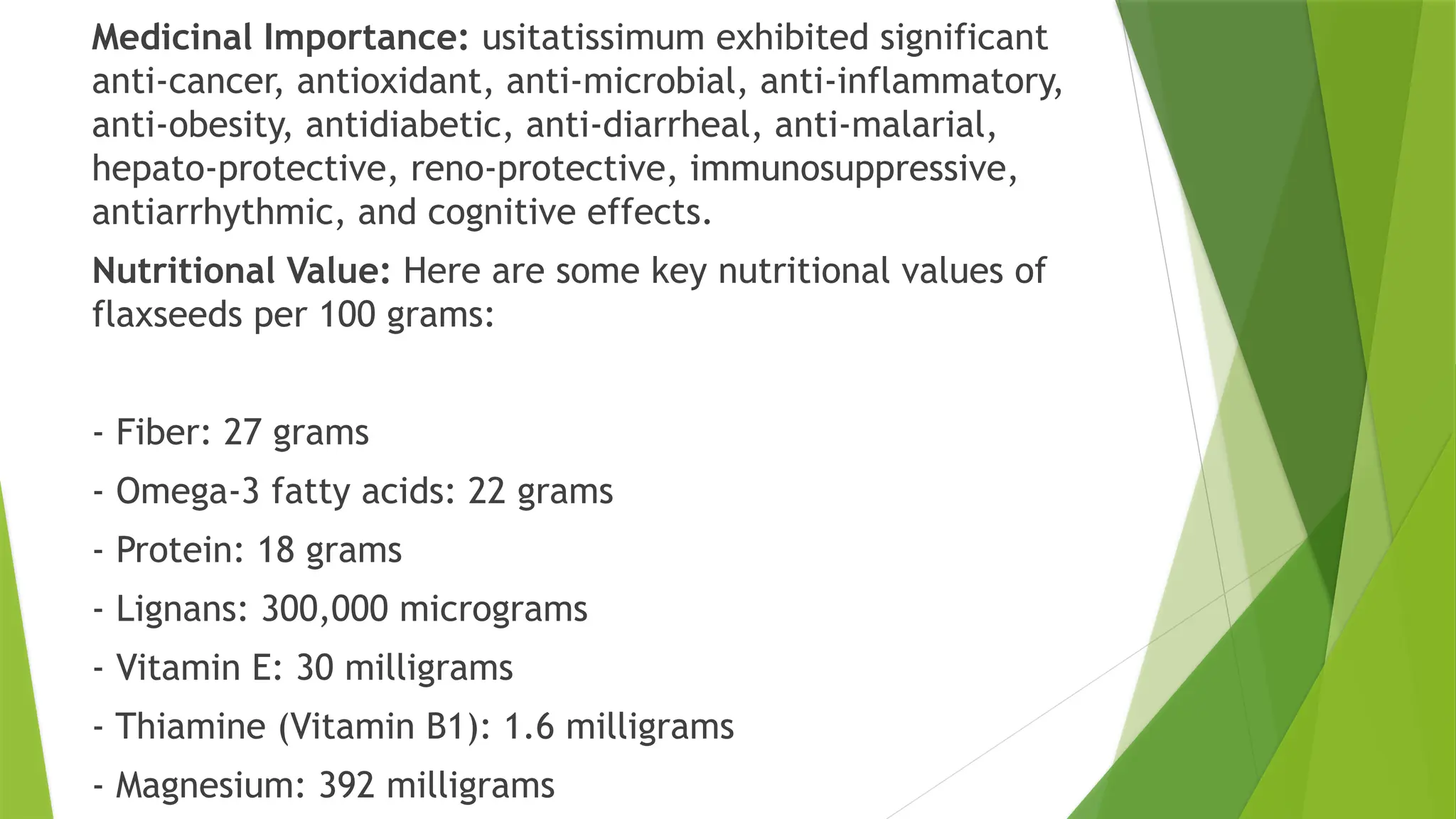
Medicinal Importance: usitatissimum exhibited significant
anti-cancer, antioxidant, anti-microbial, anti-inflammatory,
anti-obesity, antidiabetic, anti-diarrheal, anti-malarial,
hepato-protective, reno-protective, immunosuppressive,
antiarrhythmic, and cognitive effects.
Nutritional Value: Here are some key nutritional values of
flaxseeds per 100 grams:
- Fiber: 27 grams
- Omega-3 fatty acids: 22 grams
- Protein: 18 grams
- Lignans: 300,000 micrograms
- Vitamin E: 30 milligrams
- Thiamine (Vitamin B1): 1.6 milligrams
- Magnesium: 392 milligrams

oil yielding plants_21BSM1083.pptx presentation

  • 1.
    OIL YIELDING PLANTS Name:Ishrat UID: 21BSM1083 Course: BSC Medical Group: B
  • 2.
    INTRODUCTION They’re plants thatproduce oils, which can be extracted for various purposes. Some common examples include olive trees, soybeans, sunflowers, and coconut palms. These oils can be used for cooking, skincare, and even fuels.
  • 3.
    OBJECTIVES We will studyabout following aspects of oil yielding plants  Classification  Common name  Botanical description  Economic importance  Medicinal importance  Nutritional value
  • 4.
    BRASSICA NIGRA Classification Kingdom: plantae Division:Magnoliophyta Class: Magnoliopsida Order: Brassicales Family: Brassicaceae  Genus: Brassica  Species: nigra
  • 5.
    Common Name: Rai BotanicalDescription: Brassica nigra is of importance not only as a crop plant but it also contributed to the evolution of several species in the genus Brassica. It is an annual herbaceous plant which grows to a height of about 1 m. Leaves are petiolate, alternate and dark green hairy. Economic Importance: Oils: Seeds of Brassica campestris (mustard), Brassica juncea (Rayo), Brassica nigra (black mustard), Brassica alba (white mustard) are used for extraction of oil which is used for cooking, burning, etc. Cattle feed and manure: The remains of seeds after extracting oil can be used as cattle feed and manure
  • 6.
    Medicinal Importance: Itmay be used against diabetes, cancer, psoriasis, fungi, and bacteria and act as an antioxidant. It may be used for neurodegenerative disorders like Alzheimer’s disease and Parkinson’s disease. Additionally, it may reduce pain and inflammation. Nutritional Value: One cup (56 grams) of chopped raw mustard greens provides Calories: 15 Protein: 2 grams Fat: less than 1 gram Carbs: 3 grams Fiber: 2 grams Sugar: 1 gram Vitamin A: 9% of the Daily Value (DV) Vitamin B6 (pyridoxine): 6% of the DV Vitamin C: 44% of the DV Vitamin E: 8% of the DV Vitamin K: 120% of the DV Copper: 10% of the DV
  • 7.
    Phyllanthus Emblica Classification  Kingdom-Plantae  Phyllum: Tracheophyta  Class: Magnoliopsida  Order: Malpighiales  Family: Phyllanthaceae  Genus: Phyllanthus  Species: emblica
  • 8.
    Common name: Indiangooseberry , Amla Botanical description: It is a small to medium-sized tree with a crooked trunk and spreading branches, and grayish- green bark that peels off in flakes. Economic Importance: Amla oil is used all the world. Amla is used in sauces, candy, dried chips, pickle, jellies and powder. It is even used in the dyeing industry. It extract is popularly used in the ink.
  • 9.
    Medicinal Importance: Allparts of the plant are used for medicinal purposes, especially the fruit, which has been used in Ayurveda as a potent rasayana and in traditional medicine for the treatment of diarrhea, jaundice, and inflammation. Nutritional Value: 100 grams of raw Amla (Indian Gooseberry) contains 478 mg vitamin C and 5 grams of fiber content. The following values are approximate values, which may differ according to variety, season and type of Indian Gooseberry. The percentage of recommended daily allowance is based on 2000 calories per day. Vitamin C content also varies from 440 mg/100g to 800 mg/100g.
  • 10.
    LINUM USITATISSIMUM Classification : Kingdom: Plantae  Division: Magnoliophyta  Class: Magnoliopsida  Order: Linales  Family: Linaceae  Genus: Linum  Species: usitatissimum
  • 11.
    Common Name: Flaxseedor linseed Botanical Description: Linum usitatissimum is one of the nearly 230 species of the family Linaceae which comprises about 14 genera. L. usitatissimum is an annual herbaceous whose genus Linum includes nearly two thirds of the total species of the Linaceae family. Economic Importance: Flax fiber is used in the textile industry for linen cloth and also in paper industry. The residues remaining after the oil extraction from linseed contains about 35-40% protein and 3-4% oil, a rich source of feed to livestock like cattle and buffalo.
  • 12.
    Medicinal Importance: usitatissimumexhibited significant anti-cancer, antioxidant, anti-microbial, anti-inflammatory, anti-obesity, antidiabetic, anti-diarrheal, anti-malarial, hepato-protective, reno-protective, immunosuppressive, antiarrhythmic, and cognitive effects. Nutritional Value: Here are some key nutritional values of flaxseeds per 100 grams: - Fiber: 27 grams - Omega-3 fatty acids: 22 grams - Protein: 18 grams - Lignans: 300,000 micrograms - Vitamin E: 30 milligrams - Thiamine (Vitamin B1): 1.6 milligrams - Magnesium: 392 milligrams