INSECT PESTS OF CUCURBITS
R. Regmi
Assistant professor
Department of entomology
Insect pests of cucurbits
Major insect pests
• Red Pumpkin Beetle, Aulacophora foveicollis (Coleoptera:
Chrysomelidae)
• Cucurbits Stink Bug, Cordius janus (Hemiptera: Pentatomidae)
• Pumpkin Fruit Fly, Bactrocera curcubitae (Diptera: Tephritidae)
• Spotted Beetle, Epilachna vigintioctopunctata / E. Pussillanima
(Coleoptera: Coccinellidae)
Red pumpkin beetle Cucurbit stink bug
Spotted beetle, Epilachna beetle Cucurbit fruit fly
Minor insect pests
• Cutworm, Agrotis segetum/A. ipsilon (Lepidoptera: Noctuidae)
• Flea Beetle, Phyllotreta crucifera (Coleoptera: Chrysomelidae)
• Aphids, Aphis gossypii/ Myzus persicae (Homoptera: Aphididae)
• Whitefly, Bemisia tabaci (Homoptera: Aleyrodidae)
• Soybean Hairy Caterpillar, Spilarctia casigneta (Lepidoptera:
Arctiidae)
• Banded Blister Beetle, Mylabris orientalis (Coleoptera: Meloidae)
• Semilooper, Anadividia (Phytometra) peponis (Lepidoptera:
Noctuidae)
• Stem Boring Beetle, Apomecyna saltator (Coleoptera: Cerambicidae)
Cutworm ` Flea beetle
White fly Peach aphid Banded blister beetle
Stem boring beetle
MYZUS PERSICAE (PEACH-POTATO APHID)
APHID COLONYALATE FORM APTEROUS
Soybean hairy catterpillar
Red Pumpkin Beetle, Aulacophora
foveicollis (Coleoptera: Chrysomelidae)
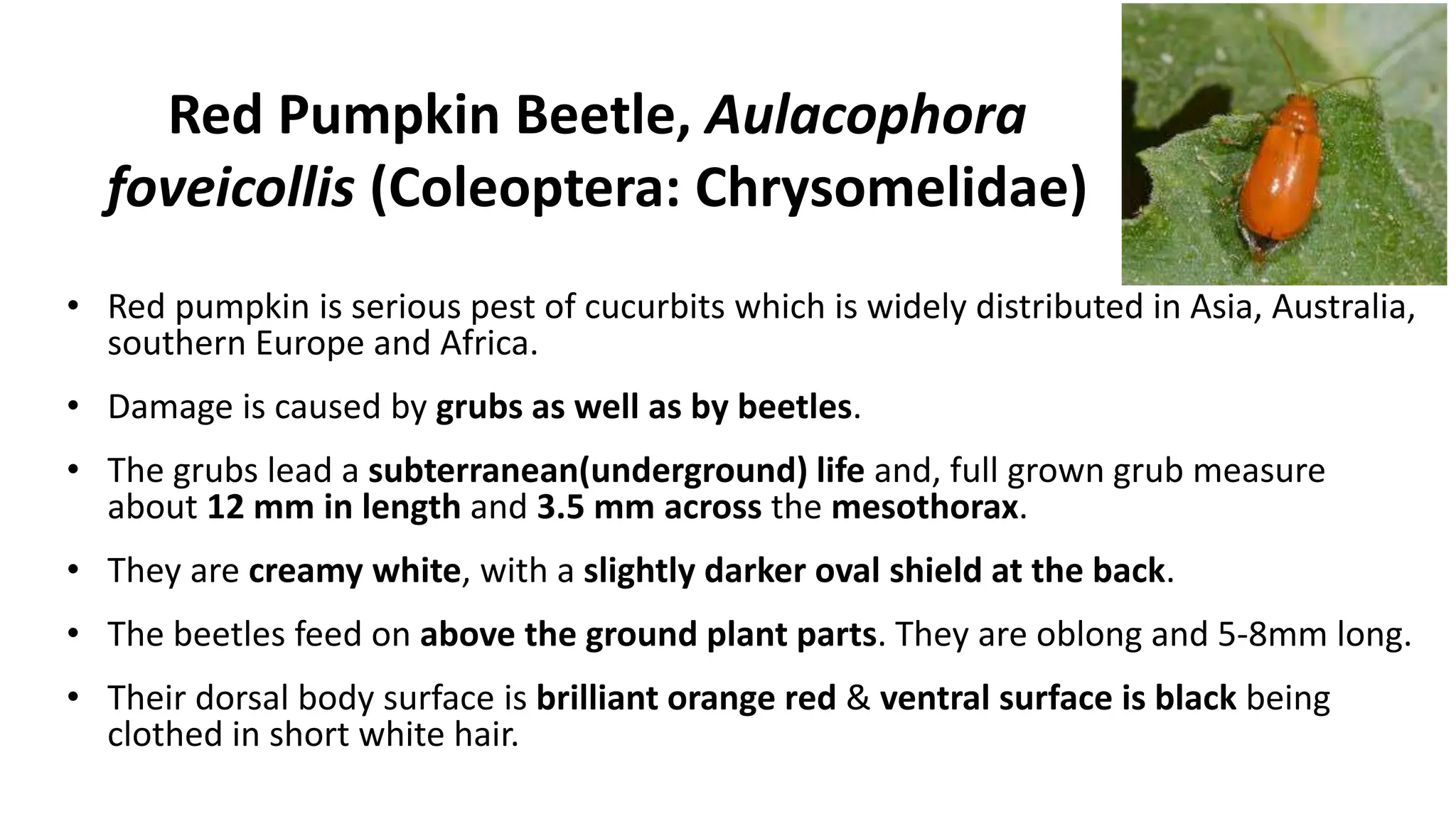
• Red pumpkin is serious pest of cucurbits which is widely distributed in Asia, Australia,
southern Europe and Africa.
• Damage is caused by grubs as well as by beetles.
• The grubs lead a subterranean(underground) life and, full grown grub measure
about 12 mm in length and 3.5 mm across the mesothorax.
• They are creamy white, with a slightly darker oval shield at the back.
• The beetles feed on above the ground plant parts. They are oblong and 5-8mm long.
• Their dorsal body surface is brilliant orange red & ventral surface is black being
clothed in short white hair.
Life cycle:
• The beetles are found concealed in groups under dry weeds, bushes & plant
remains or in the cervices of soil.
• They resume activity as soon as the season warms up
• In life span of 60-85 days, lay about 300 oval yellow eggs singly or in batches of 8-9
in moist soil, near the base of the plants.
• The eggs hatch in 6-15 days and the grubs remain below the soil surface feeding on
roots, underground stems of creepers and on fruits laying in contact with the soil.
• They are full grown in 13-25 days and pupate in thick walled earthen chambers in
the soil, at a depth of about 20-25 cm.
• The pupal stage lasts 7-17 days and the beetles, on emergence, begin to feed and
breed.
• The life cycle is completed in 26-37 days and the pest breeds five times from March
to October.
Damage:
• The beetles are very destructive to cucurbitaceous vegetables,
particularly during March-April when the creepers are very
young.
• The grubs damage the plants by boring into the roots,
underground stems & sometimes into the fruits touching the
soil.
• The beetles injure the cotyledons, flowers and foliage by
biting holes into them.
• The early sown cucurbits are to severely damage.
Management:
• Infested fields plough deep to kill the grubs in the soil.
• Flooding irrigation in the field.
• Sow the crop in November to avoid damage by this pest
• Apply 7Kg of carbofuran 3G per ha 3-4 cm deep in the soil near
the base of the plants just after germination and irrigate.
• Spray 375g of Carbaryl 50WP in 250 liters of water per ha
Cucurbits Stink Bug, Cordius janus (Hemiptera:
Pentatomidae)
• The cucurbits stink bugs attack all members of the cucurbits.
• Adults are winged and grayish brown.
• The edges of the abdomen and underside of the insect have orange to
orange brown stripes.
• Feeding by piercing and sucking mouthparts occurs primarily on the
plant foliage and tender stems.
• Sometimes, cucurbits stink bugs may also damage on fruits.
• The associated damage symptoms include wilting of leaves and
ultimately result black or dry out.
Life Cycle:
• Cucurbits stink bug egg are 1/16 inch long & laid in clusters of 15-40
on the undersides of leaves or stems.
• Eggs are bronze to brick red in color and hatch in 1 to 2 weeks.
• The colour of nymph ranges from mottled white to greenish gray,
which have black legs.
• Later on, they turn dark brown & resemble with adults.
• The nymphs have partial development of wings, whereas the adults
have full-grown wings.
• The nymph become adult in 4 weeks.
• The total life cycle completes within 4-5 weeks.
Management:
• Collect and destroy the different stages of bug.
• Field sanitation, removal of weed hosts and other
overwintering sites of bugs.
• Parasitiod like a Tachinid fly (attack nymph and adult) and
some wasps (Hymenoptera: Encyrtidae and Scelionidae are egg
parasition) can be used for management.
• Spray 1 liter of malathion 50EC in 250 liters of water per ha.
• Spray Rogor (dimethoate) 30 EC @1ml/liter of water.
Pumpkin Fruit Fly, Bactrocera curcubitae (Diptera:
Tephritidae)
• This is the most destructive pest of cucurbits.
• Only the maggot cause damage by feeding on near ripe fruits, riddling
(piercing ) them and polluting the pulp.
• The maggots are legless and appear as headless, dirty white wriggling
creatures, thicker at one end and tapering to a point at the other.
• A full grown maggot is 9-10 mm long & 2 mm broad in the middle.
• The adult flies are reddish brown with lemon yellow markings on the
thorax and have fuscous areas on the outer margin of their wings.
Life cycle
• This pest is active throughout the year, but the life cycle is prolonged during winter.
• The adult flies emerge form pupae in the morning hours and mate at dusk.
• It takes a few days for the eggs to mature inside the body of female which starts
laying them within 14 days.
• During winter, the pre-oviposition period is prolonged.
• They oviposit in comparatively soft fruits avoiding those with hard rind.
• The selection of a suitable sites and the actual laying of eggs take about 6-8 minutes.
• A cavity is made by sharp ovipositor and about a dozen white cylindrical egg are laid,
mostly in the evening hours.
• After laying the eggs, the female releases a gummy secretion which cements the
tissues surrounding the pucture and makes the entrance water proof.
• The female, on an average lay 58-95 eggs in 14-54 days.
Life cycle continue
• The egg hatch in 1-9 days and the maggots bore into the pulp forming galleries.
• The attacked fruits decay because of secondary bacterial infection.
• The larva are full grown in 3 days during summer & 3 weeks during winter.
• The mature larvae come out of the rotten fruits and move away in jumps of 12-20
cm.
• These are made possible by folding & unfolding the two ends of the elongated
body.
• After reaching a suitable place, they bury themselves about 5 mm deep in the soil
and pupate.
• The pupae are barrel shaped, light brown & they transform themselves into winged
adults in 6-9 days in the rainy season and 3-4 weeks in the winter.
• There are several generations in a year.
Damage:
• The maggot pollute and destroy fruits by feeding on the pulp.
• The damage caused by this fruit fly is most serious in cucurbits
• After the first shower of the monsoon, the infestation often
reaches up to 100 percent
Management:
• The regular removal & destruction of the infested fruits
• Frequent raking of the soil under the vine/ ploughing the infested field after crop
harvested can help in killing the pupae.
• Install Cue lure trap (3 traps per ropani)
• Foliar spray of malathion 50%EC @ 2ml/liter @2g jaggery/liter of malation solution.
• Treat root zone soil of plants with Malation 5% Dust@ 20 kg/ha to kill hibernating
pupa
• Use protein bait spray (Malathion+hydrolysed protein+ water at few spots in a field.
Both male and female are attracted to ammonia generated by protein sources.
• Use food lure@ 1kg pumpkin and & 100 gm of jaggery and 10 ml malathion.
• Apply bait spray containing 50ml malation 50EC +0.5kg of sugar in 50 liters of water
per ha. Repeat the spray if problem is serious.
Spotted Beetle, Epilachna vigintioctopunctata / E.
dodecastigma (Coleoptera: Coccinellidae)
• 2 species of spotted beetle Epilachna dodecastigma, E. vigintioctopunctata attacked different
cucurbits and also solanaceous crops like brinjal, tomtato and potato.
• Another species E. demurili, attacks cucurbitaceous vegetable exclusively.
• Damage is caused by the beetles as well as the grubs.
• Beetles of all the three species are about 8-9 mm in length & 5-6 mm in width.
• E. viginitioctopunctata beetles are deep red and usually have 7-14 black spot on the each elytron
whose tip is somewhat pointed.
• Beetles of E. dodecastigma are deep copper- coloured and have six black spot on each elytron whose
tip is rounded.
• E. demurili beetles have a dull appearances and are light copper coloured. Each of their elytron
bears six black spots surrounded by yellowish rings.
• Grubs of all the three species are about 6 mm long, yellowish in colour and have six rows of long
branched spines.
Life cycle
• The life cycle & mode of damage of the three species of spotted beetle are very similar.
• Considering their abundance, E. vigintioctopunctata is the most important.
• It passes the winter as a hibernating adult among heaps of dry plants or in cracks & cervices in the soil.
• It resumes activity during March- April & lays yellow cigar shaped eggs, mostly on the underside of leaves,
in batches of 5-40 each.
• A single female can lay up to 400 eggs in her lifetime.
• The egg hatch in 2.9-5 days at 35-25 °C.
• The grubs feed on the lower epidermis of leaves and are full grown in 7-17 days at 35-25 °C
• The pupae are darker and are found fixed on the leaves, stems and most commonly, at the base of plants.
• The pupal stage lasts from 5- 13 days at 35-25 °C.
• The pest passes through several breeds from March to October and its population maximum at the end of
April or in early May.
• During the hot and dry months, the number declines greatly but the population again builds up in August.
Damage:
• Both the adults and grub cause damage by feeding on the
lower and upper surface of leaves.
• They eat up regular areas of the leaf tissue, leaving parallel
band of uneaten tissue in between.
• The leaves become a lace like appearances.
• They turn brown, dry up and fall off and completely skeletonize
the plants.
Management
• Field sanitation
• Collect and destroy the infested leaves along with insect in
initial stages
• Spray 625ml of malathion 50EC in 325 litres of water per ha at
10 days intervals as soon as the pest appears.
Insect pests of cucurbits

Insect pests of cucurbits

  • 1.
    INSECT PESTS OFCUCURBITS R. Regmi Assistant professor Department of entomology
  • 2.
    Insect pests ofcucurbits Major insect pests • Red Pumpkin Beetle, Aulacophora foveicollis (Coleoptera: Chrysomelidae) • Cucurbits Stink Bug, Cordius janus (Hemiptera: Pentatomidae) • Pumpkin Fruit Fly, Bactrocera curcubitae (Diptera: Tephritidae) • Spotted Beetle, Epilachna vigintioctopunctata / E. Pussillanima (Coleoptera: Coccinellidae)
  • 3.
    Red pumpkin beetleCucurbit stink bug Spotted beetle, Epilachna beetle Cucurbit fruit fly
  • 4.
    Minor insect pests •Cutworm, Agrotis segetum/A. ipsilon (Lepidoptera: Noctuidae) • Flea Beetle, Phyllotreta crucifera (Coleoptera: Chrysomelidae) • Aphids, Aphis gossypii/ Myzus persicae (Homoptera: Aphididae) • Whitefly, Bemisia tabaci (Homoptera: Aleyrodidae) • Soybean Hairy Caterpillar, Spilarctia casigneta (Lepidoptera: Arctiidae) • Banded Blister Beetle, Mylabris orientalis (Coleoptera: Meloidae) • Semilooper, Anadividia (Phytometra) peponis (Lepidoptera: Noctuidae) • Stem Boring Beetle, Apomecyna saltator (Coleoptera: Cerambicidae)
  • 5.
    Cutworm ` Fleabeetle White fly Peach aphid Banded blister beetle Stem boring beetle
  • 6.
    MYZUS PERSICAE (PEACH-POTATOAPHID) APHID COLONYALATE FORM APTEROUS
  • 7.
  • 8.
    Red Pumpkin Beetle,Aulacophora foveicollis (Coleoptera: Chrysomelidae) • Red pumpkin is serious pest of cucurbits which is widely distributed in Asia, Australia, southern Europe and Africa. • Damage is caused by grubs as well as by beetles. • The grubs lead a subterranean(underground) life and, full grown grub measure about 12 mm in length and 3.5 mm across the mesothorax. • They are creamy white, with a slightly darker oval shield at the back. • The beetles feed on above the ground plant parts. They are oblong and 5-8mm long. • Their dorsal body surface is brilliant orange red & ventral surface is black being clothed in short white hair.
  • 9.
    Life cycle: • Thebeetles are found concealed in groups under dry weeds, bushes & plant remains or in the cervices of soil. • They resume activity as soon as the season warms up • In life span of 60-85 days, lay about 300 oval yellow eggs singly or in batches of 8-9 in moist soil, near the base of the plants. • The eggs hatch in 6-15 days and the grubs remain below the soil surface feeding on roots, underground stems of creepers and on fruits laying in contact with the soil. • They are full grown in 13-25 days and pupate in thick walled earthen chambers in the soil, at a depth of about 20-25 cm. • The pupal stage lasts 7-17 days and the beetles, on emergence, begin to feed and breed. • The life cycle is completed in 26-37 days and the pest breeds five times from March to October.
  • 10.
    Damage: • The beetlesare very destructive to cucurbitaceous vegetables, particularly during March-April when the creepers are very young. • The grubs damage the plants by boring into the roots, underground stems & sometimes into the fruits touching the soil. • The beetles injure the cotyledons, flowers and foliage by biting holes into them. • The early sown cucurbits are to severely damage.
  • 11.
    Management: • Infested fieldsplough deep to kill the grubs in the soil. • Flooding irrigation in the field. • Sow the crop in November to avoid damage by this pest • Apply 7Kg of carbofuran 3G per ha 3-4 cm deep in the soil near the base of the plants just after germination and irrigate. • Spray 375g of Carbaryl 50WP in 250 liters of water per ha
  • 12.
    Cucurbits Stink Bug,Cordius janus (Hemiptera: Pentatomidae) • The cucurbits stink bugs attack all members of the cucurbits. • Adults are winged and grayish brown. • The edges of the abdomen and underside of the insect have orange to orange brown stripes. • Feeding by piercing and sucking mouthparts occurs primarily on the plant foliage and tender stems. • Sometimes, cucurbits stink bugs may also damage on fruits. • The associated damage symptoms include wilting of leaves and ultimately result black or dry out.
  • 13.
    Life Cycle: • Cucurbitsstink bug egg are 1/16 inch long & laid in clusters of 15-40 on the undersides of leaves or stems. • Eggs are bronze to brick red in color and hatch in 1 to 2 weeks. • The colour of nymph ranges from mottled white to greenish gray, which have black legs. • Later on, they turn dark brown & resemble with adults. • The nymphs have partial development of wings, whereas the adults have full-grown wings. • The nymph become adult in 4 weeks. • The total life cycle completes within 4-5 weeks.
  • 14.
    Management: • Collect anddestroy the different stages of bug. • Field sanitation, removal of weed hosts and other overwintering sites of bugs. • Parasitiod like a Tachinid fly (attack nymph and adult) and some wasps (Hymenoptera: Encyrtidae and Scelionidae are egg parasition) can be used for management. • Spray 1 liter of malathion 50EC in 250 liters of water per ha. • Spray Rogor (dimethoate) 30 EC @1ml/liter of water.
  • 15.
    Pumpkin Fruit Fly,Bactrocera curcubitae (Diptera: Tephritidae) • This is the most destructive pest of cucurbits. • Only the maggot cause damage by feeding on near ripe fruits, riddling (piercing ) them and polluting the pulp. • The maggots are legless and appear as headless, dirty white wriggling creatures, thicker at one end and tapering to a point at the other. • A full grown maggot is 9-10 mm long & 2 mm broad in the middle. • The adult flies are reddish brown with lemon yellow markings on the thorax and have fuscous areas on the outer margin of their wings.
  • 16.
    Life cycle • Thispest is active throughout the year, but the life cycle is prolonged during winter. • The adult flies emerge form pupae in the morning hours and mate at dusk. • It takes a few days for the eggs to mature inside the body of female which starts laying them within 14 days. • During winter, the pre-oviposition period is prolonged. • They oviposit in comparatively soft fruits avoiding those with hard rind. • The selection of a suitable sites and the actual laying of eggs take about 6-8 minutes. • A cavity is made by sharp ovipositor and about a dozen white cylindrical egg are laid, mostly in the evening hours. • After laying the eggs, the female releases a gummy secretion which cements the tissues surrounding the pucture and makes the entrance water proof. • The female, on an average lay 58-95 eggs in 14-54 days.
  • 19.
    Life cycle continue •The egg hatch in 1-9 days and the maggots bore into the pulp forming galleries. • The attacked fruits decay because of secondary bacterial infection. • The larva are full grown in 3 days during summer & 3 weeks during winter. • The mature larvae come out of the rotten fruits and move away in jumps of 12-20 cm. • These are made possible by folding & unfolding the two ends of the elongated body. • After reaching a suitable place, they bury themselves about 5 mm deep in the soil and pupate. • The pupae are barrel shaped, light brown & they transform themselves into winged adults in 6-9 days in the rainy season and 3-4 weeks in the winter. • There are several generations in a year.
  • 20.
    Damage: • The maggotpollute and destroy fruits by feeding on the pulp. • The damage caused by this fruit fly is most serious in cucurbits • After the first shower of the monsoon, the infestation often reaches up to 100 percent
  • 21.
    Management: • The regularremoval & destruction of the infested fruits • Frequent raking of the soil under the vine/ ploughing the infested field after crop harvested can help in killing the pupae. • Install Cue lure trap (3 traps per ropani) • Foliar spray of malathion 50%EC @ 2ml/liter @2g jaggery/liter of malation solution. • Treat root zone soil of plants with Malation 5% Dust@ 20 kg/ha to kill hibernating pupa • Use protein bait spray (Malathion+hydrolysed protein+ water at few spots in a field. Both male and female are attracted to ammonia generated by protein sources. • Use food lure@ 1kg pumpkin and & 100 gm of jaggery and 10 ml malathion. • Apply bait spray containing 50ml malation 50EC +0.5kg of sugar in 50 liters of water per ha. Repeat the spray if problem is serious.
  • 22.
    Spotted Beetle, Epilachnavigintioctopunctata / E. dodecastigma (Coleoptera: Coccinellidae) • 2 species of spotted beetle Epilachna dodecastigma, E. vigintioctopunctata attacked different cucurbits and also solanaceous crops like brinjal, tomtato and potato. • Another species E. demurili, attacks cucurbitaceous vegetable exclusively. • Damage is caused by the beetles as well as the grubs. • Beetles of all the three species are about 8-9 mm in length & 5-6 mm in width. • E. viginitioctopunctata beetles are deep red and usually have 7-14 black spot on the each elytron whose tip is somewhat pointed. • Beetles of E. dodecastigma are deep copper- coloured and have six black spot on each elytron whose tip is rounded. • E. demurili beetles have a dull appearances and are light copper coloured. Each of their elytron bears six black spots surrounded by yellowish rings. • Grubs of all the three species are about 6 mm long, yellowish in colour and have six rows of long branched spines.
  • 23.
    Life cycle • Thelife cycle & mode of damage of the three species of spotted beetle are very similar. • Considering their abundance, E. vigintioctopunctata is the most important. • It passes the winter as a hibernating adult among heaps of dry plants or in cracks & cervices in the soil. • It resumes activity during March- April & lays yellow cigar shaped eggs, mostly on the underside of leaves, in batches of 5-40 each. • A single female can lay up to 400 eggs in her lifetime. • The egg hatch in 2.9-5 days at 35-25 °C. • The grubs feed on the lower epidermis of leaves and are full grown in 7-17 days at 35-25 °C • The pupae are darker and are found fixed on the leaves, stems and most commonly, at the base of plants. • The pupal stage lasts from 5- 13 days at 35-25 °C. • The pest passes through several breeds from March to October and its population maximum at the end of April or in early May. • During the hot and dry months, the number declines greatly but the population again builds up in August.
  • 25.
    Damage: • Both theadults and grub cause damage by feeding on the lower and upper surface of leaves. • They eat up regular areas of the leaf tissue, leaving parallel band of uneaten tissue in between. • The leaves become a lace like appearances. • They turn brown, dry up and fall off and completely skeletonize the plants.
  • 26.
    Management • Field sanitation •Collect and destroy the infested leaves along with insect in initial stages • Spray 625ml of malathion 50EC in 325 litres of water per ha at 10 days intervals as soon as the pest appears.