Insect pest of sorghum
(Sorghum shoot fly)
Ehtisham Ali Hussain
BAGF15E258
University College Of Agriculture,
University Of Sargodha
CONTENTS
• Introduction of sorghum
• Taxanomy (sorghum shoot fly)
• Identification
• Host plants , status of pest
• Life cycle
• Seasonal occurrence
• Economic importance
• Symptoms /signs
• Mode of Damages
• Control (Cultural , chemical , biological)
• New research
SORGHUM
 Family : Graminae
 Locally known as (Jawar) and is
grown as a fodder crop in Pakistan.
 It is multi- use cereal ;contain
grains , forage and sweet types.
 Sowing time ( from 3rd week of
march to mid-September )
 Sorghum is the worlds fifth most important
cereal crop after maize , rice, wheat and barley.
 Pakistan produce 50-70 (t/ha) sorghum as a
fodder.
TAXANOMY (SORGHUM SHOOT FLY )
(Atherigona soccata)
• Kingdom: Animalia
• Phylum : Arthropda
• Class : Insecta
• Order : Diptera
• Family : Duscidae
• Genus : Atherigona
• Specie : soccata
Identification
Eggs are white in colour .
• Eggs are laid on the under side.
of leaves of 7 to 8 days of seedlings
or on young tillers.
• one to three eggs are laid per leaf.
• The white eggs have an elongate
shape
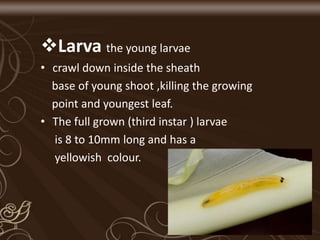
Larva the young larvae
• crawl down inside the sheath
base of young shoot ,killing the growing
point and youngest leaf.
• The full grown (third instar ) larvae
is 8 to 10mm long and has a
yellowish colour.
Pupa usually takes place
in the base of dead shoot , but
sometimes in the soil.
• The pupal period takes place about 7 days.
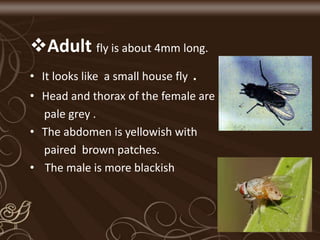
Adult fly is about 4mm long.
• It looks like a small house fly .
• Head and thorax of the female are
pale grey .
• The abdomen is yellowish with
paired brown patches.
• The male is more blackish
Host plants
• Major host : sorghum
• Alternative host : rice , maize , millet
wheat
Pest status : major pest of sorghum
Life cycle
• The female places its eggs singly on the lower
surface of leaf blades.
• A life cycle (egg to adult) may take 3-6 weeks
• Annually the pest can complete up to 10
generations.
Seasonal occurrence
• The insects attack at the seedling and late
sown crops are attacked badly.
• the shoot fly population begins to increase in
July , peak in august- September.
• Cloudy weather favors multiplication of the
insects.
Economic importance
• Sorghum shoot fly is considered to be one
of the most important and destructive
pests.
• Plants are attacked at the seedling stage.
• Feeding on plants growing point may kill the
central stem, causing (dead heart).
• This symptom of infestation appear within
2-3 days after attack.
• While insect cause 12% loss in sorghum
production…shoot fly is responsible for 5%.
Symptoms
• Growing point / stems – dead heart
• Growing point / stems –internal feeding , boring
• Growing point / stems - odour
Control
CULTURAL CONTROL
• Early sowing
• Use resistant varieties
when available
• Transplanting
• Inter-cultivation /weeding
• Crop rotation /cropping system
• Field sanitation and tillage
Biological control
• A number of natural enemies
have been recorded
on sorghum shoot fly
• Abrolophus sp.
• Trichogramma sp.
• Trichogrammatoidea sp.
Chemical control
• carbofuran 3 G OR PHORATE 10g at 20
kg/ha seed furrows
• Sorghum treated seeds ( systemic
insecticide) seed feeding and seedling insect
pest
Thank you!!

Sorghum shoot fly

  • 1.
    Insect pest ofsorghum (Sorghum shoot fly) Ehtisham Ali Hussain BAGF15E258 University College Of Agriculture, University Of Sargodha
  • 2.
    CONTENTS • Introduction ofsorghum • Taxanomy (sorghum shoot fly) • Identification • Host plants , status of pest • Life cycle • Seasonal occurrence • Economic importance • Symptoms /signs • Mode of Damages • Control (Cultural , chemical , biological) • New research
  • 3.
    SORGHUM  Family :Graminae  Locally known as (Jawar) and is grown as a fodder crop in Pakistan.  It is multi- use cereal ;contain grains , forage and sweet types.  Sowing time ( from 3rd week of march to mid-September )  Sorghum is the worlds fifth most important cereal crop after maize , rice, wheat and barley.  Pakistan produce 50-70 (t/ha) sorghum as a fodder.
  • 4.
    TAXANOMY (SORGHUM SHOOTFLY ) (Atherigona soccata) • Kingdom: Animalia • Phylum : Arthropda • Class : Insecta • Order : Diptera • Family : Duscidae • Genus : Atherigona • Specie : soccata
  • 5.
    Identification Eggs are whitein colour . • Eggs are laid on the under side. of leaves of 7 to 8 days of seedlings or on young tillers. • one to three eggs are laid per leaf. • The white eggs have an elongate shape
  • 6.
    Larva the younglarvae • crawl down inside the sheath base of young shoot ,killing the growing point and youngest leaf. • The full grown (third instar ) larvae is 8 to 10mm long and has a yellowish colour.
  • 7.
    Pupa usually takesplace in the base of dead shoot , but sometimes in the soil. • The pupal period takes place about 7 days.
  • 8.
    Adult fly isabout 4mm long. • It looks like a small house fly . • Head and thorax of the female are pale grey . • The abdomen is yellowish with paired brown patches. • The male is more blackish
  • 9.
    Host plants • Majorhost : sorghum • Alternative host : rice , maize , millet wheat Pest status : major pest of sorghum
  • 10.
    Life cycle • Thefemale places its eggs singly on the lower surface of leaf blades. • A life cycle (egg to adult) may take 3-6 weeks • Annually the pest can complete up to 10 generations.
  • 11.
    Seasonal occurrence • Theinsects attack at the seedling and late sown crops are attacked badly. • the shoot fly population begins to increase in July , peak in august- September. • Cloudy weather favors multiplication of the insects.
  • 12.
    Economic importance • Sorghumshoot fly is considered to be one of the most important and destructive pests. • Plants are attacked at the seedling stage. • Feeding on plants growing point may kill the central stem, causing (dead heart). • This symptom of infestation appear within 2-3 days after attack. • While insect cause 12% loss in sorghum production…shoot fly is responsible for 5%.
  • 14.
    Symptoms • Growing point/ stems – dead heart • Growing point / stems –internal feeding , boring • Growing point / stems - odour
  • 15.
    Control CULTURAL CONTROL • Earlysowing • Use resistant varieties when available • Transplanting • Inter-cultivation /weeding • Crop rotation /cropping system • Field sanitation and tillage
  • 16.
    Biological control • Anumber of natural enemies have been recorded on sorghum shoot fly • Abrolophus sp. • Trichogramma sp. • Trichogrammatoidea sp.
  • 17.
    Chemical control • carbofuran3 G OR PHORATE 10g at 20 kg/ha seed furrows • Sorghum treated seeds ( systemic insecticide) seed feeding and seedling insect pest
  • 18.