MODULE 1: INTRODUCTION TO SCIENCE, TECHNOLOGY, AND SOCIETY
Science
●​ Origin: Comes from the Latin word scientia, meaning ‘knowledge’.
●​ Definition: Refers to a systematic and methodical activity of building and organizing
knowledge about how the universe behaves through observation, experimentation, or
both.
The Nature of Science
●​ Importance: It is a critical component of scientific literacy. It enhances your
understanding of science concepts and enables you to make informed decisions about
scientifically-based personal and societal issues.
THE FOLLOWING SUMS UP THE NATURE OF SCIENCE:
1.​ The World is Understandable:
○​ Science presumes that the things and events in the universe occur in consistent
patterns that are comprehensible through careful, systematic study.
○​ Scientists believe that through the use of intellect, and with the aid of instruments
that extend the senses, people can discover patterns in all of nature.
2.​ Science Explains and Predicts:
○​ Scientists strive to make sense of observations of phenomena by constructing
explanations that are consistent with currently accepted scientific principles.
○​ Such explanations or theories may be either broad or restricted, but they must be
logically sound and incorporate a significant body of scientifically valid
observations.
○​ The credibility of scientific theories often comes from their ability to show
relationships among phenomena that previously seemed unrelated.
○​ For example, the theory of moving continents has grown in credibility as it has
shown relationships among diverse phenomena such as earthquakes, volcanoes,
the match between types of fossils on different continents, the shapes of
continents, and the contours of the ocean floors.
3.​ Science Demands Evidence:
○​ The validity of scientific claims is settled by referring to observations of
phenomena.
○​ Hence, scientists concentrate on getting accurate data.
○​ Such evidence is obtained by observations and measurements taken in
situations that range from natural settings (such as a forest) to completely
contrived ones (such as the laboratory).
○​ To make their observations, scientists use their own senses, instruments (such
as microscopes) that enhance those senses, and instruments that tap
characteristics quite different from what humans can sense (such as magnetic
fields).
○​ Scientists observe passively (earthquakes, bird migrations), make collections
(rocks, shells), and actively probe the world (as by boring into the earth's crust or
administering experimental medicines).
4.​ Scientific Ideas are Open to Change:
○​ Science is more of a process than a set body of knowledge.
○​ Scientists are always testing and revising their ideas, and as new observations
are made, existing ideas may be challenged.
○​ Ideas may be replaced with new ideas that better fit the facts, but more often
existing ideas are simply revised.
○​ For example, when scientists discovered how genes control genetic traits, they
didn't throw out Mendel's laws of inheritance.
○​ The new discoveries helped to explain why Mendel's laws apply to certain traits
but not others.
○​ They showed that Mendel's laws are part of a bigger picture.
○​ Through many new discoveries over time, scientists gradually build an
increasingly accurate and detailed understanding of the natural world.
5.​ Science is a Complex Social Activity:
○​ Scientific work involves many individuals doing many different kinds of work and
goes on to some degree in all nations of the world.
○​ Men and women of all ethnic and national backgrounds participate in science and
its applications.
○​ These people—scientists and engineers, mathematicians, physicians,
technicians, computer programmers, librarians, and others—may focus on
scientific knowledge either for its own sake or for a particular practical purpose,
and they may be concerned with data gathering, theory building, instrument
building, or communicating.
6.​ Science Cannot Provide Complete Answers to All Questions:
○​ There are many matters that cannot usefully be examined in a scientific way.
○​ There are, for instance, beliefs that by their very nature cannot be proved or
disproved (such as the existence of supernatural powers and beings, or the true
purposes of life).
○​ In other cases, a scientific approach that may be valid is likely to be rejected as
irrelevant by people who hold to certain beliefs (such as in miracles,
fortune-telling, astrology, and superstition).
○​ Nor do scientists have the means to settle issues concerning good and evil,
although they can sometimes contribute to the discussion of such issues by
identifying the likely consequences of particular actions, which may be helpful in
weighing alternatives.
Technology
●​ Origin: The word often attached side by side with science comes from the Greek word
techne, meaning ‘art, skill or cunning of hand’.
●​ Definition: Involves the development and use of materials, tools, and approaches for
solving human problems and helping to fulfill human needs and desires.
○​ Many of the products of technology help humans accomplish tasks that would
otherwise be very difficult or impossible to carry out.
○​ Provides many benefits, but it also produces associated costs and risks.
○​ Is also a way of knowing and is also a process of exploration and
experimentation.
○​ Is both a form of knowledge that uses concepts and skills from other disciplines
and the application of this knowledge to meet an identified need or to solve a
specific problem using materials, energy, and tools.
Science, Technology, and Society (STS)
●​ Definition: How the different aspects of society shape and influence the progression and
further development of science and technology is the area of concern of a relatively new
academic discipline.
●​ Origin: Is a relatively young field that combines previously independent and older
disciplines, such as the history of science, philosophy of science, and sociology of
science.
○​ As an academic field, STS, according to Harvard University’s Kennedy School
(2018), traces its roots from the interwar period and the start of the Cold War.
○​ Seeks to bridge the gap between two traditionally exclusive cultures—humanities
(interpretive) and natural sciences (rational)—so that humans will be able to
better confront the moral, ethical, and existential dilemmas brought by the
continued developments in science and technology.
○​ Also calls for educating you (our students) so that you will be able to apply
science and technology (tools, knowledge, process, and products) to solve
problems in your environment.
○​ Is an important academic discipline to help you do science so as to be functional
and not just graduates who are alien to your own society.
○​ Aims to help students develop adaptability, equipped with not only academic
skills but with a range of practical skills that will make you a functional citizen.
LIST OF ETHICAL DILEMMAS AND POLICY ISSUES IN SCIENCE AND
TECHNOLOGY FOR 2018:
1.)​ Helix - A digital app store designed to read genomes.
2.)​ Bless U-2 and Pepper – First robot priest and monk.
3.)​ Emotion Sensing Facial Recognition – A software being developed to assess your
reactions to anything such as shopping and
playing games.
4.)​ Ransomware – A way of holding data hostage through hacking and requiring a ransom
to be paid.
5.)​ Textalyzer – A device that analyses whether a driver was using his or her phone during
an accident.
6.)​ Social Credit System – A system of scoring citizens through their actions by placing
them under constant surveillance (which china plays to adopt).
7.)​ Google Clips – A hands-free camera that lets the user capture every moment effortlessly.
8.)​ Sentencing Software – A mysterious algorithm designed to aid courts in sentencing
decisions.
9.)​ Friendbot – An app that stores the deceased’s digital footprint so one can still chat with
them.
10.)​ Citizen App – An app that notifies users of ongoing crimes or major events in a
specific area.
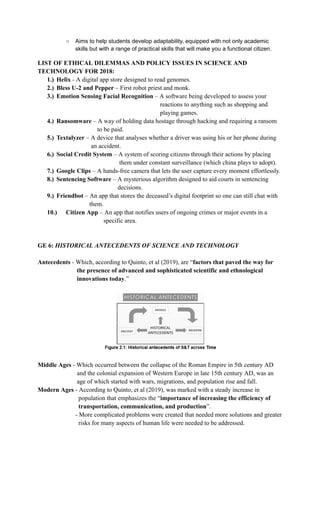
GE 6: HISTORICAL ANTECEDENTS OF SCIENCE AND TECHNOLOGY
Antecedents - Which, according to Quinto, et al (2019), are “factors that paved the way for
the presence of advanced and sophisticated scientific and ethnological
innovations today.”
Middle Ages - Which occurred between the collapse of the Roman Empire in 5th century AD
and the colonial expansion of Western Europe in late 15th century AD, was an
age of which started with wars, migrations, and population rise and fall.
Modern Ages - According to Quinto, et al (2019), was marked with a steady increase in
population that emphasizes the “importance of increasing the efficiency of
transportation, communication, and production”.
- More complicated problems were created that needed more solutions and greater
risks for many aspects of human life were needed to be addressed.
MODULE 2: INTELLECTUAL REVOLUTION
Intellectual Revolution - Historical changes in thoughts, beliefs and social institutions arising
from new ideas and principles.
- For science and technology the intellectual revolution is called a
scientific revolution (historical period when science became important
and influential to specific era).
- This is used to refer to greek speculations about the “nature” in the
period before Socrates.
- Hence the alternative term are pre-socratic or non-theologial or first
philosophy.
- Revealed how society was transformed by science and technology.
- The transformation was by promoting critical thinking and creating
rules to provide equal opportunities to people.
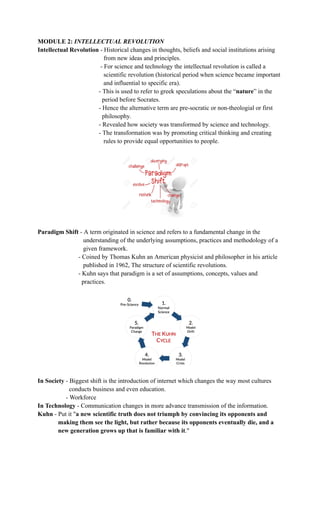
Paradigm Shift - A term originated in science and refers to a fundamental change in the
understanding of the underlying assumptions, practices and methodology of a
given framework.
- Coined by Thomas Kuhn an American physicist and philosopher in his article
published in 1962, The structure of scientific revolutions.
- Kuhn says that paradigm is a set of assumptions, concepts, values and
practices.
In Society - Biggest shift is the introduction of internet which changes the way most cultures
conducts business and even education.
- Workforce
In Technology - Communication changes in more advance transmission of the information.
Kuhn - Put it "a new scientific truth does not triumph by convincing its opponents and
making them see the light, but rather because its opponents eventually die, and a
new generation grows up that is familiar with it."
THREE REVOLUTION:
1.)​ Copernican Revolution - Early times, people were fascinated with the celestial bodies
namely stars, sun, moon and planets.
- Their curiosity were on the components of universe and how
these bodies moves.
2.)​ Darwinian Revolution - Or change over time, is the process by which modern
organisms have descended from ancient organisms.
- A scientific theory is a well-supported testable explanation of
phenomena that have occurred in the natural world.
3.)​ Freudian Revolution - Relates to the ideas of Sigmund Freud about the way in which
people’s hidden thought and feelings influence their behavior
with respect to the cause and treatment of neurotic and psychotic
states, dreams and the like.
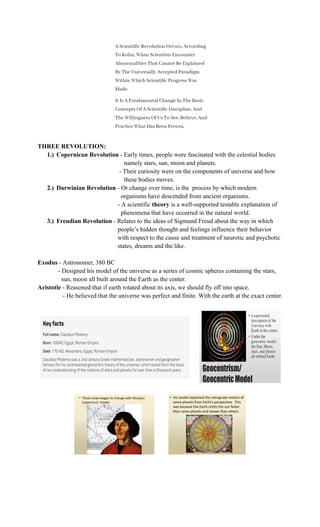
Exodus - Astronomer, 380 BC
- Designed his model of the universe as a series of cosmic spheres containing the stars,
sun, moon all built around the Earth as the center.
Aristotle - Reasoned that if earth rotated about its axis, we should fly off into space.
- He believed that the universe was perfect and finite. With the earth at the exact center.
​
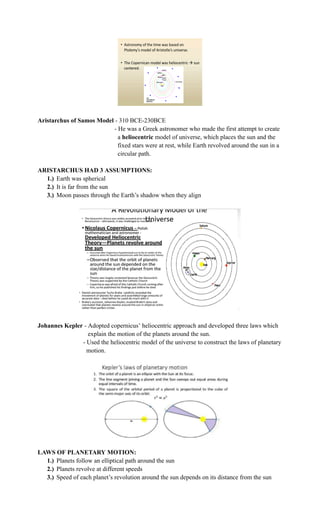
Aristarchus of Samos Model - 310 BCE-230BCE
- He was a Greek astronomer who made the first attempt to create
a heliocentric model of universe, which places the sun and the
fixed stars were at rest, while Earth revolved around the sun in a
circular path.
ARISTARCHUS HAD 3 ASSUMPTIONS:
1.)​ Earth was spherical
2.)​ It is far from the sun
3.)​ Moon passes through the Earth’s shadow when they align
Johannes Kepler - Adopted copernicus’ heliocentric approach and developed three laws which
explain the motion of the planets around the sun.
- Used the heliocentric model of the universe to construct the laws of planetary
motion.
LAWS OF PLANETARY MOTION:
1.)​ Planets follow an elliptical path around the sun
2.)​ Planets revolve at different speeds
3.)​ Speed of each planet’s revolution around the sun depends on its distance from the sun
Galileo Galilei - Italian scientist, made advances in with the Heliocentric Theory.
- Used telescope to observed the movement of Jupiter’s 4 brightest moons -
Charted them to showed that planets orbit objects of greater mass or
gravitational pool.
- The reason why planets, including the earth, orbit the sun in ellipticals.
- Galileo’s findings get him in trouble with the Catholic church - is placed under
house arrest till his death - had to say his theory was wrong or he would be
executed for heresy - Galileo was officially pardoned by the Catholic Church in
1992.
Isaac Newton - Focus was gravity and physics - had been sitting under an apple tree when an
apple zonked him on the head and he determined to find out why objects fell
towards the earth rather than away.
- Also published Principia - States gravity (law of Universal Gravitation)
attracts mass from different lines to a single point - formula explains how
astrophysical phenomena like the passing of comets, tides, and equinoxes occur
(F = Gm1m2/r2
).
ENGLISH SCIENTIST ISAAC NEWTON FORMULATED HIS 3 LAWS OF MOTION:
1.)​ Law of Inertia - Object at rest will remain at rest until force acts on it.
2.)​ Acceleration is produced when force acts on object - Grater the mass of the object the
more force is required to accelerate it.
3.)​ For every action, there is an equal but opposit reaction.
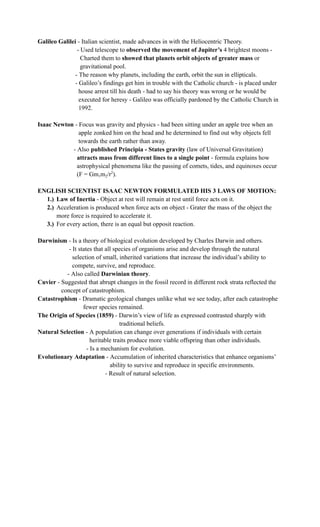
Darwinism - Is a theory of biological evolution developed by Charles Darwin and others.
- It states that all species of organisms arise and develop through the natural
selection of small, inherited variations that increase the individual’s ability to
compete, survive, and reproduce.
- Also called Darwinian theory.
Cuvier - Suggested that abrupt changes in the fossil record in different rock strata reflected the
concept of catastrophism.
Catastrophism - Dramatic geological changes unlike what we see today, after each catastrophe
fewer species remained.
The Origin of Species (1859) - Darwin’s view of life as expressed contrasted sharply with
traditional beliefs.
Natural Selection - A population can change over generations if individuals with certain
heritable traits produce more viable offspring than other individuals.
- Is a mechanism for evolution.
Evolutionary Adaptation - Accumulation of inherited characteristics that enhance organisms’
ability to survive and reproduce in specific environments.
- Result of natural selection.
By Namara - This field was considered more of an art rather than science and was classified
under the area of philosophy (2018).
By American Psychological Association - It is the scientific study of the mind and behavior.
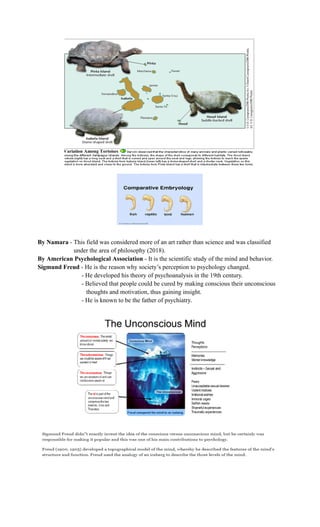
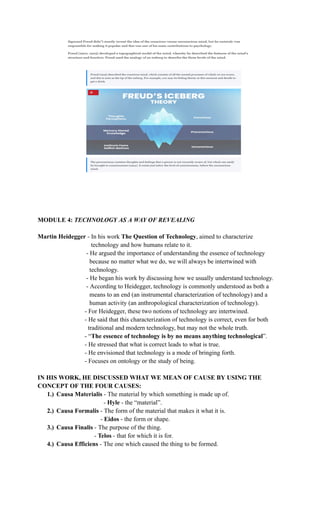
Sigmund Freud - He is the reason why society’s perception to psychology changed.
- He developed his theory of psychoanalysis in the 19th century.
- Believed that people could be cured by making conscious their unconscious
thoughts and motivation, thus gaining insight.
- He is known to be the father of psychiatry.
MODULE 4: TECHNOLOGY AS A WAY OF REVEALING
Martin Heidegger - In his work The Question of Technology, aimed to characterize
technology and how humans relate to it.
- He argued the importance of understanding the essence of technology
because no matter what we do, we will always be intertwined with
technology.
- He began his work by discussing how we usually understand technology.
- According to Heidegger, technology is commonly understood as both a
means to an end (an instrumental characterization of technology) and a
human activity (an anthropological characterization of technology).
- For Heidegger, these two notions of technology are intertwined.
- He said that this characterization of technology is correct, even for both
traditional and modern technology, but may not the whole truth.
- “The essence of technology is by no means anything technological”.
- He stressed that what is correct leads to what is true.
- He envisioned that technology is a mode of bringing forth.
​ ​ - Focuses on ontology or the study of being.
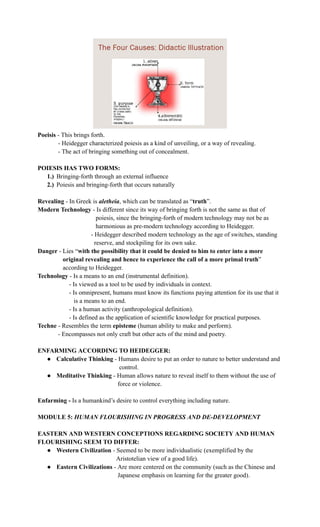
IN HIS WORK, HE DISCUSSED WHAT WE MEAN OF CAUSE BY USING THE
CONCEPT OF THE FOUR CAUSES:
1.)​ Causa Materialis - The material by which something is made up of.
- Hyle - the “material”.
2.)​ Causa Formalis - The form of the material that makes it what it is.
- Eidos - the form or shape.
3.)​ Causa Finalis - The purpose of the thing.
- Telos - that for which it is for.
4.)​ Causa Efficiens - The one which caused the thing to be formed.
Poeisis - This brings forth.
- Heidegger characterized poiesis as a kind of unveiling, or a way of revealing.
- The act of bringing something out of concealment.
POIESIS HAS TWO FORMS:
1.)​ Bringing-forth through an external influence
2.)​ Poiesis and bringing-forth that occurs naturally
Revealing - In Greek is aletheia, which can be translated as “truth”.
Modern Technology - Is different since its way of bringing forth is not the same as that of
poiesis, since the bringing-forth of modern technology may not be as
harmonious as pre-modern technology according to Heidegger.
- Heidegger described modern technology as the age of switches, standing
reserve, and stockpiling for its own sake.
Danger - Lies “with the possibility that it could be denied to him to enter into a more
original revealing and hence to experience the call of a more primal truth”
according to Heidegger.
Technology - Is a means to an end (instrumental definition).
- Is viewed as a tool to be used by individuals in context.
- Is omnipresent, humans must know its functions paying attention for its use that it
is a means to an end.
- Is a human activity (anthropological definition).
- Is defined as the application of scientific knowledge for practical purposes.
Techne - Resembles the term episteme (human ability to make and perform).
- Encompasses not only craft but other acts of the mind and poetry.
ENFARMING ACCORDING TO HEIDEGGER:
●​ Calculative Thinking - Humans desire to put an order to nature to better understand and
control.
●​ Meditative Thinking - Human allows nature to reveal itself to them without the use of
force or violence.
Enfarming - Is a humankind’s desire to control everything including nature.
MODULE 5: HUMAN FLOURISHING IN PROGRESS AND DE-DEVELOPMENT
EASTERN AND WESTERN CONCEPTIONS REGARDING SOCIETY AND HUMAN
FLOURISHING SEEM TO DIFFER:
●​ Western Civilization - Seemed to be more individualistic (exemplified by the
Aristotelian view of a good life).
●​ Eastern Civilizations - Are more centered on the community (such as the Chinese and
Japanese emphasis on learning for the greater good).
ACCORDING TO BANDARLIPE ET.AL. (2019), THE FOLLOWING ARE SOME
CHARACTERISTICS OF HUMAN FLOURISHING:
1.)​ All humans aim to flourish.
2.)​ Human flourishing involves putting into action one’s capacities, capabilities, and virtues.
3.)​ Human flourishing depends on free will.
4.)​ Human flourishing is sustained over time.
5.)​ Human flourishing involves doing well in broad domains of human life.
Humans - Have attained certain progresses that we lack before.
Mortality Rates - Are lowered due to less death due to diseases and childbirth.
Life Spans - Have increased because of better medical care and health conditions.
Literacy Rates - Also increased through better access to education and more alternatives or
modes of learning.
Productivity - Has also increased, though differing in levels in many countries, which increased
food supply and income of families.
Jason Hickel - An anthropologist at the London School of Economics, also questioned this in
the context of economics.
- Proposed a solution that is different from what is usually thought of.
- In his article Forget ‘developing’ poor countries, it’s time to de-develop rich
countries, he looked into poverty and how current measures in eradicating this
global problem fails and instead the gap between rich and poor countries are
continuing to widen.
- He questions the need for continuing growth and how this growth negatively
affects countries.
- He also introduced the concept of de-development as a way of bridging the gap
between countries of different levels of development.
Hickel’s Concept of De-development - An alternative in narrowing the gap between rich and
poor countries.
De-development - Is the idea is that the rich countries should slow down in their consumption so
that poor nations can “catch-up.”
GE 6: THE GOOD LIFE
Good Life - The luxury of living in comfort.
- Characterized by happiness from living and contented in life.
- Aristotle states that the good life consists in the possession, over the course of a
lifetime, of all things that are really good for us.
Aristotle - Who lived from 384 to 322 BC, is probably the most important ancient Greek
philosopher and scientist.
- He was a student of Plato, who was then a student of Socrates. Together, they were
considered the 'Big Three of Greek Philosophy.'
- Was the teacher of Alexander the Great.
- Aristotle’s background in biological subjects made him more of an empiricist (truth
discovered primarily by the senses) as compared to the mathematician Plato’s
rationalism (truth discovered primarily by reason.)
- Attended Plato’s academy but founded his own school, the Lyceum, later in his life.
- Influenced more subjects for a longer period of time than any thinker in the history.
- His scientific ideas were orthodoxy for 2000 years, his logic is still used, and his
influence in many areas of philosophy is still felt.
- His thought in multiple fields was considered definitive for millennia, and his work in
ethics and politics is still widely influential today.
- He is one of the greatest thinkers in the history of western philosophy.
ARISTOTLE WROTE ON AN AMAZING RANGE OF TOPICS INCLUDING:
Logic Meteorology
Metaphysics Biology
Physics Psychology
Epistemology Ethics
Astronomy Politics
Law Poetics
ARISTOTLE’S WORK CONTAINS TWO WORKS THAT MAINLY CONCERN
ETHICS:
1.)​ Nicomachean Ethics - Which may refer to one of his sons named Nicomachus.
- Is the more popular of these two Aristotelian works.
- Abbreviated as NE or sometimes EN.
- Is a work that deals with “the nature of moral life and human
happiness based on the unique essence of human nature”.
- It is concerned with the "end of the things we pursue in our
actions," what he calls the "best good" for a human being.
- Aristotle discussed his concept of what good is, what a good life is, and how to attain it.
- Is an attempt to describe what it takes for a human being to live a good life.
- The key concept in the NE is the idea of eudaimonia usually translated into English as
“happiness”.
2.)​ Eudemian Ethics - Which may refer to one of his friends, Eudemus of Rhodes.
- Some of the Books in the Eudemian Ethics are identical to that of the
Nicomachean Ethics, and it was thought Eudemian Ethics was
written first before Nicomachean Ethics.
THE OUTLINE OF THE SAID BOOK IS AS FOLLOW:
●​ NE I.1095a-I.1096a.​ ​ ​ The best good
●​ NE I.1097b-I.1098a. ​ ​ ​ The argument from function
●​ NE I.1102a-II.1109b.​ ​ ​ Virtue and the soul
●​ NE III.1109b-1115a.​ ​ ​ Necessary conditions for virtue
●​ NE III.1115a-IV.1128b.​ ​ Virtues of character
●​ NE V.1129a-1138b.​ ​ ​ Justice
●​ NE VI.1138b-1145a.​ ​ ​ Virtues of thought
●​ NE VII.1145a-1154b.​​ ​ Continence, pleasure
●​ NE VIII.1155a-IX.1172a.​ ​ Friendship
●​ NE X.1172a-1181b.​ ​ ​ Pleasure, happiness, legislation
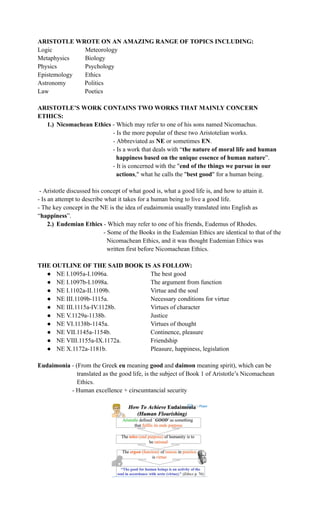
Eudaimonia - (From the Greek eu meaning good and daimon meaning spirit), which can be
translated as the good life, is the subject of Book 1 of Aristotle’s Nicomachean
Ethics.
- Human excellence + cirscumtancial security
HUMANS HAVE BOTH EXCELLENCES OF INTELLECT:
1.)​ Theoretical - Intellectual virtue or virtue of thought, and excellences of character.
2.)​ Practical Reason - Moral virtue or virtue of character.
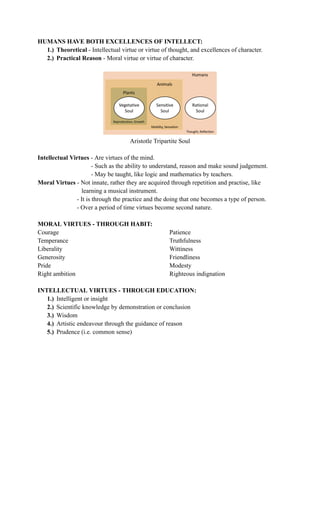
Aristotle Tripartite Soul
Intellectual Virtues - Are virtues of the mind.
- Such as the ability to understand, reason and make sound judgement.
- May be taught, like logic and mathematics by teachers.
Moral Virtues - Not innate, rather they are acquired through repetition and practise, like
learning a musical instrument.
- It is through the practice and the doing that one becomes a type of person.
- Over a period of time virtues become second nature.
MORAL VIRTUES - THROUGH HABIT:
Courage
Temperance
Liberality
Generosity
Pride
Right ambition
Patience
Truthfulness
Wittiness
Friendliness
Modesty
Righteous indignation
INTELLECTUAL VIRTUES - THROUGH EDUCATION:
1.)​ Intelligent or insight
2.)​ Scientific knowledge by demonstration or conclusion
3.)​ Wisdom
4.)​ Artistic endeavour through the guidance of reason
5.)​ Prudence (i.e. common sense)
StsScienceinbound5682193252727902034.pdf

  • 1.
    MODULE 1: INTRODUCTIONTO SCIENCE, TECHNOLOGY, AND SOCIETY Science ●​ Origin: Comes from the Latin word scientia, meaning ‘knowledge’. ●​ Definition: Refers to a systematic and methodical activity of building and organizing knowledge about how the universe behaves through observation, experimentation, or both. The Nature of Science ●​ Importance: It is a critical component of scientific literacy. It enhances your understanding of science concepts and enables you to make informed decisions about scientifically-based personal and societal issues. THE FOLLOWING SUMS UP THE NATURE OF SCIENCE: 1.​ The World is Understandable: ○​ Science presumes that the things and events in the universe occur in consistent patterns that are comprehensible through careful, systematic study. ○​ Scientists believe that through the use of intellect, and with the aid of instruments that extend the senses, people can discover patterns in all of nature. 2.​ Science Explains and Predicts: ○​ Scientists strive to make sense of observations of phenomena by constructing explanations that are consistent with currently accepted scientific principles. ○​ Such explanations or theories may be either broad or restricted, but they must be logically sound and incorporate a significant body of scientifically valid observations. ○​ The credibility of scientific theories often comes from their ability to show relationships among phenomena that previously seemed unrelated. ○​ For example, the theory of moving continents has grown in credibility as it has shown relationships among diverse phenomena such as earthquakes, volcanoes, the match between types of fossils on different continents, the shapes of continents, and the contours of the ocean floors. 3.​ Science Demands Evidence: ○​ The validity of scientific claims is settled by referring to observations of phenomena. ○​ Hence, scientists concentrate on getting accurate data. ○​ Such evidence is obtained by observations and measurements taken in situations that range from natural settings (such as a forest) to completely contrived ones (such as the laboratory). ○​ To make their observations, scientists use their own senses, instruments (such as microscopes) that enhance those senses, and instruments that tap characteristics quite different from what humans can sense (such as magnetic fields). ○​ Scientists observe passively (earthquakes, bird migrations), make collections (rocks, shells), and actively probe the world (as by boring into the earth's crust or administering experimental medicines). 4.​ Scientific Ideas are Open to Change: ○​ Science is more of a process than a set body of knowledge. ○​ Scientists are always testing and revising their ideas, and as new observations are made, existing ideas may be challenged. ○​ Ideas may be replaced with new ideas that better fit the facts, but more often existing ideas are simply revised. ○​ For example, when scientists discovered how genes control genetic traits, they didn't throw out Mendel's laws of inheritance. ○​ The new discoveries helped to explain why Mendel's laws apply to certain traits but not others. ○​ They showed that Mendel's laws are part of a bigger picture.
  • 2.
    ○​ Through manynew discoveries over time, scientists gradually build an increasingly accurate and detailed understanding of the natural world. 5.​ Science is a Complex Social Activity: ○​ Scientific work involves many individuals doing many different kinds of work and goes on to some degree in all nations of the world. ○​ Men and women of all ethnic and national backgrounds participate in science and its applications. ○​ These people—scientists and engineers, mathematicians, physicians, technicians, computer programmers, librarians, and others—may focus on scientific knowledge either for its own sake or for a particular practical purpose, and they may be concerned with data gathering, theory building, instrument building, or communicating. 6.​ Science Cannot Provide Complete Answers to All Questions: ○​ There are many matters that cannot usefully be examined in a scientific way. ○​ There are, for instance, beliefs that by their very nature cannot be proved or disproved (such as the existence of supernatural powers and beings, or the true purposes of life). ○​ In other cases, a scientific approach that may be valid is likely to be rejected as irrelevant by people who hold to certain beliefs (such as in miracles, fortune-telling, astrology, and superstition). ○​ Nor do scientists have the means to settle issues concerning good and evil, although they can sometimes contribute to the discussion of such issues by identifying the likely consequences of particular actions, which may be helpful in weighing alternatives. Technology ●​ Origin: The word often attached side by side with science comes from the Greek word techne, meaning ‘art, skill or cunning of hand’. ●​ Definition: Involves the development and use of materials, tools, and approaches for solving human problems and helping to fulfill human needs and desires. ○​ Many of the products of technology help humans accomplish tasks that would otherwise be very difficult or impossible to carry out. ○​ Provides many benefits, but it also produces associated costs and risks. ○​ Is also a way of knowing and is also a process of exploration and experimentation. ○​ Is both a form of knowledge that uses concepts and skills from other disciplines and the application of this knowledge to meet an identified need or to solve a specific problem using materials, energy, and tools. Science, Technology, and Society (STS) ●​ Definition: How the different aspects of society shape and influence the progression and further development of science and technology is the area of concern of a relatively new academic discipline. ●​ Origin: Is a relatively young field that combines previously independent and older disciplines, such as the history of science, philosophy of science, and sociology of science. ○​ As an academic field, STS, according to Harvard University’s Kennedy School (2018), traces its roots from the interwar period and the start of the Cold War. ○​ Seeks to bridge the gap between two traditionally exclusive cultures—humanities (interpretive) and natural sciences (rational)—so that humans will be able to better confront the moral, ethical, and existential dilemmas brought by the continued developments in science and technology. ○​ Also calls for educating you (our students) so that you will be able to apply science and technology (tools, knowledge, process, and products) to solve problems in your environment. ○​ Is an important academic discipline to help you do science so as to be functional and not just graduates who are alien to your own society.
  • 3.
    ○​ Aims tohelp students develop adaptability, equipped with not only academic skills but with a range of practical skills that will make you a functional citizen. LIST OF ETHICAL DILEMMAS AND POLICY ISSUES IN SCIENCE AND TECHNOLOGY FOR 2018: 1.)​ Helix - A digital app store designed to read genomes. 2.)​ Bless U-2 and Pepper – First robot priest and monk. 3.)​ Emotion Sensing Facial Recognition – A software being developed to assess your reactions to anything such as shopping and playing games. 4.)​ Ransomware – A way of holding data hostage through hacking and requiring a ransom to be paid. 5.)​ Textalyzer – A device that analyses whether a driver was using his or her phone during an accident. 6.)​ Social Credit System – A system of scoring citizens through their actions by placing them under constant surveillance (which china plays to adopt). 7.)​ Google Clips – A hands-free camera that lets the user capture every moment effortlessly. 8.)​ Sentencing Software – A mysterious algorithm designed to aid courts in sentencing decisions. 9.)​ Friendbot – An app that stores the deceased’s digital footprint so one can still chat with them. 10.)​ Citizen App – An app that notifies users of ongoing crimes or major events in a specific area. GE 6: HISTORICAL ANTECEDENTS OF SCIENCE AND TECHNOLOGY Antecedents - Which, according to Quinto, et al (2019), are “factors that paved the way for the presence of advanced and sophisticated scientific and ethnological innovations today.” Middle Ages - Which occurred between the collapse of the Roman Empire in 5th century AD and the colonial expansion of Western Europe in late 15th century AD, was an age of which started with wars, migrations, and population rise and fall. Modern Ages - According to Quinto, et al (2019), was marked with a steady increase in population that emphasizes the “importance of increasing the efficiency of transportation, communication, and production”. - More complicated problems were created that needed more solutions and greater risks for many aspects of human life were needed to be addressed.
  • 4.
    MODULE 2: INTELLECTUALREVOLUTION Intellectual Revolution - Historical changes in thoughts, beliefs and social institutions arising from new ideas and principles. - For science and technology the intellectual revolution is called a scientific revolution (historical period when science became important and influential to specific era). - This is used to refer to greek speculations about the “nature” in the period before Socrates. - Hence the alternative term are pre-socratic or non-theologial or first philosophy. - Revealed how society was transformed by science and technology. - The transformation was by promoting critical thinking and creating rules to provide equal opportunities to people. Paradigm Shift - A term originated in science and refers to a fundamental change in the understanding of the underlying assumptions, practices and methodology of a given framework. - Coined by Thomas Kuhn an American physicist and philosopher in his article published in 1962, The structure of scientific revolutions. - Kuhn says that paradigm is a set of assumptions, concepts, values and practices. In Society - Biggest shift is the introduction of internet which changes the way most cultures conducts business and even education. - Workforce In Technology - Communication changes in more advance transmission of the information. Kuhn - Put it "a new scientific truth does not triumph by convincing its opponents and making them see the light, but rather because its opponents eventually die, and a new generation grows up that is familiar with it."
  • 5.
    THREE REVOLUTION: 1.)​ CopernicanRevolution - Early times, people were fascinated with the celestial bodies namely stars, sun, moon and planets. - Their curiosity were on the components of universe and how these bodies moves. 2.)​ Darwinian Revolution - Or change over time, is the process by which modern organisms have descended from ancient organisms. - A scientific theory is a well-supported testable explanation of phenomena that have occurred in the natural world. 3.)​ Freudian Revolution - Relates to the ideas of Sigmund Freud about the way in which people’s hidden thought and feelings influence their behavior with respect to the cause and treatment of neurotic and psychotic states, dreams and the like. Exodus - Astronomer, 380 BC - Designed his model of the universe as a series of cosmic spheres containing the stars, sun, moon all built around the Earth as the center. Aristotle - Reasoned that if earth rotated about its axis, we should fly off into space. - He believed that the universe was perfect and finite. With the earth at the exact center. ​
  • 6.
    Aristarchus of SamosModel - 310 BCE-230BCE - He was a Greek astronomer who made the first attempt to create a heliocentric model of universe, which places the sun and the fixed stars were at rest, while Earth revolved around the sun in a circular path. ARISTARCHUS HAD 3 ASSUMPTIONS: 1.)​ Earth was spherical 2.)​ It is far from the sun 3.)​ Moon passes through the Earth’s shadow when they align Johannes Kepler - Adopted copernicus’ heliocentric approach and developed three laws which explain the motion of the planets around the sun. - Used the heliocentric model of the universe to construct the laws of planetary motion. LAWS OF PLANETARY MOTION: 1.)​ Planets follow an elliptical path around the sun 2.)​ Planets revolve at different speeds 3.)​ Speed of each planet’s revolution around the sun depends on its distance from the sun
  • 7.
    Galileo Galilei -Italian scientist, made advances in with the Heliocentric Theory. - Used telescope to observed the movement of Jupiter’s 4 brightest moons - Charted them to showed that planets orbit objects of greater mass or gravitational pool. - The reason why planets, including the earth, orbit the sun in ellipticals. - Galileo’s findings get him in trouble with the Catholic church - is placed under house arrest till his death - had to say his theory was wrong or he would be executed for heresy - Galileo was officially pardoned by the Catholic Church in 1992. Isaac Newton - Focus was gravity and physics - had been sitting under an apple tree when an apple zonked him on the head and he determined to find out why objects fell towards the earth rather than away. - Also published Principia - States gravity (law of Universal Gravitation) attracts mass from different lines to a single point - formula explains how astrophysical phenomena like the passing of comets, tides, and equinoxes occur (F = Gm1m2/r2 ). ENGLISH SCIENTIST ISAAC NEWTON FORMULATED HIS 3 LAWS OF MOTION: 1.)​ Law of Inertia - Object at rest will remain at rest until force acts on it. 2.)​ Acceleration is produced when force acts on object - Grater the mass of the object the more force is required to accelerate it. 3.)​ For every action, there is an equal but opposit reaction. Darwinism - Is a theory of biological evolution developed by Charles Darwin and others. - It states that all species of organisms arise and develop through the natural selection of small, inherited variations that increase the individual’s ability to compete, survive, and reproduce. - Also called Darwinian theory. Cuvier - Suggested that abrupt changes in the fossil record in different rock strata reflected the concept of catastrophism. Catastrophism - Dramatic geological changes unlike what we see today, after each catastrophe fewer species remained. The Origin of Species (1859) - Darwin’s view of life as expressed contrasted sharply with traditional beliefs. Natural Selection - A population can change over generations if individuals with certain heritable traits produce more viable offspring than other individuals. - Is a mechanism for evolution. Evolutionary Adaptation - Accumulation of inherited characteristics that enhance organisms’ ability to survive and reproduce in specific environments. - Result of natural selection.
  • 8.
    By Namara -This field was considered more of an art rather than science and was classified under the area of philosophy (2018). By American Psychological Association - It is the scientific study of the mind and behavior. Sigmund Freud - He is the reason why society’s perception to psychology changed. - He developed his theory of psychoanalysis in the 19th century. - Believed that people could be cured by making conscious their unconscious thoughts and motivation, thus gaining insight. - He is known to be the father of psychiatry.
  • 9.
    MODULE 4: TECHNOLOGYAS A WAY OF REVEALING Martin Heidegger - In his work The Question of Technology, aimed to characterize technology and how humans relate to it. - He argued the importance of understanding the essence of technology because no matter what we do, we will always be intertwined with technology. - He began his work by discussing how we usually understand technology. - According to Heidegger, technology is commonly understood as both a means to an end (an instrumental characterization of technology) and a human activity (an anthropological characterization of technology). - For Heidegger, these two notions of technology are intertwined. - He said that this characterization of technology is correct, even for both traditional and modern technology, but may not the whole truth. - “The essence of technology is by no means anything technological”. - He stressed that what is correct leads to what is true. - He envisioned that technology is a mode of bringing forth. ​ ​ - Focuses on ontology or the study of being. IN HIS WORK, HE DISCUSSED WHAT WE MEAN OF CAUSE BY USING THE CONCEPT OF THE FOUR CAUSES: 1.)​ Causa Materialis - The material by which something is made up of. - Hyle - the “material”. 2.)​ Causa Formalis - The form of the material that makes it what it is. - Eidos - the form or shape. 3.)​ Causa Finalis - The purpose of the thing. - Telos - that for which it is for. 4.)​ Causa Efficiens - The one which caused the thing to be formed.
  • 10.
    Poeisis - Thisbrings forth. - Heidegger characterized poiesis as a kind of unveiling, or a way of revealing. - The act of bringing something out of concealment. POIESIS HAS TWO FORMS: 1.)​ Bringing-forth through an external influence 2.)​ Poiesis and bringing-forth that occurs naturally Revealing - In Greek is aletheia, which can be translated as “truth”. Modern Technology - Is different since its way of bringing forth is not the same as that of poiesis, since the bringing-forth of modern technology may not be as harmonious as pre-modern technology according to Heidegger. - Heidegger described modern technology as the age of switches, standing reserve, and stockpiling for its own sake. Danger - Lies “with the possibility that it could be denied to him to enter into a more original revealing and hence to experience the call of a more primal truth” according to Heidegger. Technology - Is a means to an end (instrumental definition). - Is viewed as a tool to be used by individuals in context. - Is omnipresent, humans must know its functions paying attention for its use that it is a means to an end. - Is a human activity (anthropological definition). - Is defined as the application of scientific knowledge for practical purposes. Techne - Resembles the term episteme (human ability to make and perform). - Encompasses not only craft but other acts of the mind and poetry. ENFARMING ACCORDING TO HEIDEGGER: ●​ Calculative Thinking - Humans desire to put an order to nature to better understand and control. ●​ Meditative Thinking - Human allows nature to reveal itself to them without the use of force or violence. Enfarming - Is a humankind’s desire to control everything including nature. MODULE 5: HUMAN FLOURISHING IN PROGRESS AND DE-DEVELOPMENT EASTERN AND WESTERN CONCEPTIONS REGARDING SOCIETY AND HUMAN FLOURISHING SEEM TO DIFFER: ●​ Western Civilization - Seemed to be more individualistic (exemplified by the Aristotelian view of a good life). ●​ Eastern Civilizations - Are more centered on the community (such as the Chinese and Japanese emphasis on learning for the greater good).
  • 11.
    ACCORDING TO BANDARLIPEET.AL. (2019), THE FOLLOWING ARE SOME CHARACTERISTICS OF HUMAN FLOURISHING: 1.)​ All humans aim to flourish. 2.)​ Human flourishing involves putting into action one’s capacities, capabilities, and virtues. 3.)​ Human flourishing depends on free will. 4.)​ Human flourishing is sustained over time. 5.)​ Human flourishing involves doing well in broad domains of human life. Humans - Have attained certain progresses that we lack before. Mortality Rates - Are lowered due to less death due to diseases and childbirth. Life Spans - Have increased because of better medical care and health conditions. Literacy Rates - Also increased through better access to education and more alternatives or modes of learning. Productivity - Has also increased, though differing in levels in many countries, which increased food supply and income of families. Jason Hickel - An anthropologist at the London School of Economics, also questioned this in the context of economics. - Proposed a solution that is different from what is usually thought of. - In his article Forget ‘developing’ poor countries, it’s time to de-develop rich countries, he looked into poverty and how current measures in eradicating this global problem fails and instead the gap between rich and poor countries are continuing to widen. - He questions the need for continuing growth and how this growth negatively affects countries. - He also introduced the concept of de-development as a way of bridging the gap between countries of different levels of development. Hickel’s Concept of De-development - An alternative in narrowing the gap between rich and poor countries. De-development - Is the idea is that the rich countries should slow down in their consumption so that poor nations can “catch-up.” GE 6: THE GOOD LIFE Good Life - The luxury of living in comfort. - Characterized by happiness from living and contented in life. - Aristotle states that the good life consists in the possession, over the course of a lifetime, of all things that are really good for us. Aristotle - Who lived from 384 to 322 BC, is probably the most important ancient Greek philosopher and scientist. - He was a student of Plato, who was then a student of Socrates. Together, they were considered the 'Big Three of Greek Philosophy.' - Was the teacher of Alexander the Great. - Aristotle’s background in biological subjects made him more of an empiricist (truth discovered primarily by the senses) as compared to the mathematician Plato’s rationalism (truth discovered primarily by reason.) - Attended Plato’s academy but founded his own school, the Lyceum, later in his life. - Influenced more subjects for a longer period of time than any thinker in the history. - His scientific ideas were orthodoxy for 2000 years, his logic is still used, and his influence in many areas of philosophy is still felt. - His thought in multiple fields was considered definitive for millennia, and his work in ethics and politics is still widely influential today. - He is one of the greatest thinkers in the history of western philosophy.
  • 12.
    ARISTOTLE WROTE ONAN AMAZING RANGE OF TOPICS INCLUDING: Logic Meteorology Metaphysics Biology Physics Psychology Epistemology Ethics Astronomy Politics Law Poetics ARISTOTLE’S WORK CONTAINS TWO WORKS THAT MAINLY CONCERN ETHICS: 1.)​ Nicomachean Ethics - Which may refer to one of his sons named Nicomachus. - Is the more popular of these two Aristotelian works. - Abbreviated as NE or sometimes EN. - Is a work that deals with “the nature of moral life and human happiness based on the unique essence of human nature”. - It is concerned with the "end of the things we pursue in our actions," what he calls the "best good" for a human being. - Aristotle discussed his concept of what good is, what a good life is, and how to attain it. - Is an attempt to describe what it takes for a human being to live a good life. - The key concept in the NE is the idea of eudaimonia usually translated into English as “happiness”. 2.)​ Eudemian Ethics - Which may refer to one of his friends, Eudemus of Rhodes. - Some of the Books in the Eudemian Ethics are identical to that of the Nicomachean Ethics, and it was thought Eudemian Ethics was written first before Nicomachean Ethics. THE OUTLINE OF THE SAID BOOK IS AS FOLLOW: ●​ NE I.1095a-I.1096a.​ ​ ​ The best good ●​ NE I.1097b-I.1098a. ​ ​ ​ The argument from function ●​ NE I.1102a-II.1109b.​ ​ ​ Virtue and the soul ●​ NE III.1109b-1115a.​ ​ ​ Necessary conditions for virtue ●​ NE III.1115a-IV.1128b.​ ​ Virtues of character ●​ NE V.1129a-1138b.​ ​ ​ Justice ●​ NE VI.1138b-1145a.​ ​ ​ Virtues of thought ●​ NE VII.1145a-1154b.​​ ​ Continence, pleasure ●​ NE VIII.1155a-IX.1172a.​ ​ Friendship ●​ NE X.1172a-1181b.​ ​ ​ Pleasure, happiness, legislation Eudaimonia - (From the Greek eu meaning good and daimon meaning spirit), which can be translated as the good life, is the subject of Book 1 of Aristotle’s Nicomachean Ethics. - Human excellence + cirscumtancial security
  • 13.
    HUMANS HAVE BOTHEXCELLENCES OF INTELLECT: 1.)​ Theoretical - Intellectual virtue or virtue of thought, and excellences of character. 2.)​ Practical Reason - Moral virtue or virtue of character. Aristotle Tripartite Soul Intellectual Virtues - Are virtues of the mind. - Such as the ability to understand, reason and make sound judgement. - May be taught, like logic and mathematics by teachers. Moral Virtues - Not innate, rather they are acquired through repetition and practise, like learning a musical instrument. - It is through the practice and the doing that one becomes a type of person. - Over a period of time virtues become second nature. MORAL VIRTUES - THROUGH HABIT: Courage Temperance Liberality Generosity Pride Right ambition Patience Truthfulness Wittiness Friendliness Modesty Righteous indignation INTELLECTUAL VIRTUES - THROUGH EDUCATION: 1.)​ Intelligent or insight 2.)​ Scientific knowledge by demonstration or conclusion 3.)​ Wisdom 4.)​ Artistic endeavour through the guidance of reason 5.)​ Prudence (i.e. common sense)