


Towards a philosophy of
techno-science
Federica Russo
Philosophy & ILLC | University of Amsterdam
Science&Technology Studies | University College London
russofederica.wordpress.com| @federicarusso
2
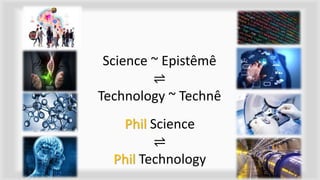
Science ~ Epistêmê
⇌
Technology ~ Technê
3
Phil Science
⇌
Phil Technology
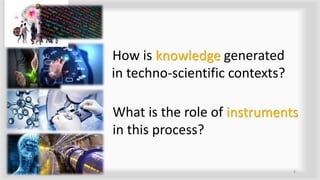
How is knowledge generated
in techno-scientific contexts?
4
What is the role of instruments
in this process?
Overview
The Phil Sci – Phil Tech divide
Parallel debates
How studying practices can fill the gap
Two episodes of techno-science
Exposure research and computational history of ideas
What is knowledge, and how is it produced in techno-scientific practices?
Poiêsis: How human and artificial agents co-produce knowledge
The epistemic and normative aspects of poiêsis
5
The Phil Sci – Phil Tech Divide
6
Parallel contexts and debates
• Distinct institutional contexts
• Consider: learned societies, conferences, job openings, …
• Distinct academic outputs
• Very little cross-reference in major publications in either field
• Very little mutual recognition in terms of authors, main themes
7
Distinct objects of investigation
• Types of knowledge
• Sci: aims at truth | Tech: usefulness for practical purposes
• Hierarchy
• First Sci, then Tech (in line with first epistêmê, then technê)
• Different relation to reality
• Sci: discovery | Tech: creation
• Different outputs
• Sci: theories | Tech: artefacts
• Objects
• Sci: unchanging objects | Tech: created objects, hence mutable
• Who is instrumental to whom
• True science is supposedly necessary for technological innovation
8
Boon, 2011
“In Defence of Engineering Sciences:
On the Epistemological Relations
between Science and Technology.”
Techné
How wide is the gap?
• Philosophy of Science in Practice
• A recent attempt to broaden up Anglo-Americal Phil Sci
• French Epistemology
• A neglected tradition in which the gap did not quite exist
9
Turning attention to the practice
10
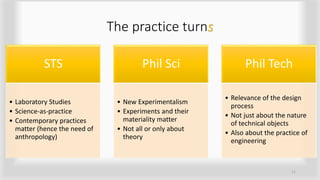
The practice turns
11
STS
• Laboratory Studies
• Science-as-practice
• Contemporary practices
matter (hence the need of
anthropology)
Phil Sci
• New Experimentalism
• Experiments and their
materiality matter
• Not all or only about
theory
Phil Tech
• Relevance of the design
process
• Not just about the nature
of technical objects
• Also about the practice of
engineering
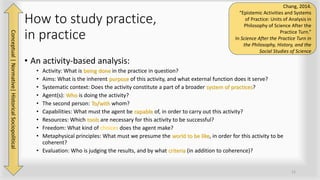
How to study practice,
in practice
• An activity-based analysis:
• Activity: What is being done in the practice in question?
• Aims: What is the inherent purpose of this activity, and what external function does it serve?
• Systematic context: Does the activity constitute a part of a broader system of practices?
• Agent(s): Who is doing the activity?
• The second person: To/with whom?
• Capabilities: What must the agent be capable of, in order to carry out this activity?
• Resources: Which tools are necessary for this activity to be successful?
• Freedom: What kind of choices does the agent make?
• Metaphysical principles: What must we presume the world to be like, in order for this activity to be
coherent?
• Evaluation: Who is judging the results, and by what criteria (in addition to coherence)?
12
Chang, 2014.
“Epistemic Activities and Systems
of Practice: Units of Analysis in
Philosophy of Science After the
Practice Turn.”
In Science After the Practice Turn in
the Philosophy, History, and the
Social Studies of Science
Conceptual
|
Normative|
Historical
Sociopolitical
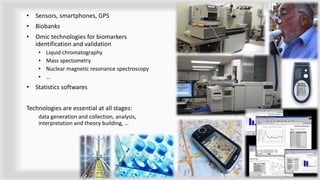
Exposure research
Two episodes of techno-science
13
• Sensors, smartphones, GPS
• Biobanks
• Omic technologies for biomarkers
identification and validation
• Liquid chromatography
• Mass spectometry
• Nuclear magnetic resonance spectroscopy
• …
• Statistics softwares
Technologies are essential at all stages:
data generation and collection, analysis,
interpretation and theory building, …
14
Computational history of ideas
Two episodes of techno-science
15
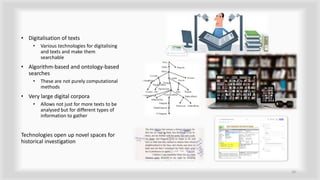
• Digitalisation of texts
• Various technologies for digitalising
and texts and make them
searchable
• Algorithm-based and ontology-based
searches
• These are not purely computational
methods
• Very large digital corpora
• Allows not just for more texts to be
analysed but for different types of
information to gather
Technologies open up novel spaces for
historical investigation
16
What is ‘knowledge’?
17
What is ‘knowledge’?
Who produces knowledge?
18
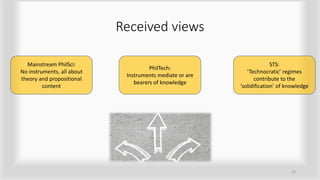
Received views
19
Mainstream PhilSci:
No instruments, all about
theory and propositional
content
PhilTech:
Instruments mediate or are
bearers of knowledge
STS:
‘Technocratic’ regimes
contribute to the
‘solidification’ of knowledge
ReDiEM Knowledge
Knowledge is a product of techno-scientific activities carried out by epistemic agents, it is often
expressed in propositional form in natural language, it is also encapsulated in material objects, and is
situated with respect to a number of social, cultural, or material aspects
Not a definition, but a broad characterisation
Elements about Relation, Distribution, Embodiment, Materiality are as important as propositional content
and vernacularity
These elements are interrelated, rather than isolated
Any element can become more prominent, depending on the specific question at hand
My question, reformulated:
How to cash out the partnership of human and artificial agents
in the process of knowledge production? 20
Why so much emphasis on instruments?
Instruments seem to do more than just
Mediating between us and the world
Augmenting our capacities to see the smaller or the bigger
Enhancing ability to analyse more data
Instruments have a proper epistemic role in the process of knowledge
production
21
Poiêsis
Or, how human and artificial epistemic agents co-produce knowledge
The legacy
From Greek thinking:
Poiêsis is about producting artefacts, it is about technê rather than epistêmê
At the root of the (alleged) superiority of epistêmê over technê
From contemporary Philosophy of Information
Poiêsis is (also) about producing the situations moral agents are in, and that are
subject to ethical assessment
Useful to reduce moral luck
23
The semantic space of the poiêsis
The poietic character of human epistemic agents:
The production of artefacts by human agents
A topos of Greek philosophy and of philosophy of technology, not my main interest here;
The production of knowledge by human epistemic agents;
An expansion of Phil Information ‘homo poieticus’ as moral agent, it includes human epistemic
agents as techno-scientists and as philosophers
The poietic character of artificial agents
The power of technical objects to interact and modify the environment
Digital and analogue technologies have this power (in degrees), we learn from Simondon
The partnership of human and artificial epistemic agents
This partnership comes with important responsibilities, both epistemic and moral ones
24
Why does it matter?
25
Knowledge production is distributed
Human and artificial epistemic agents produce knowledge
An epistemic point:
Knowledge production is not a prerogative of us human(s)
Technologies, the environment, materiality and embodiment, situatedness … are all essential
elements
A normative point
Distribution in the process of production of knowledge does not mean less responsibility from
us human epistemic agents
We still have responsibility for the knowledge we produce, the artefacts we design and develop,
the policies we implement, …
Epistemology and ethics must go hand in hand
26
A vision for the field
27
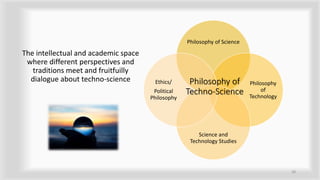
Philosophy of Science
Philosophy
of
Technology
Science and
Technology Studies
Ethics/
Political
Philosophy
Philosophy of
Techno-Science
The intellectual and academic space
where different perspectives and
traditions meet and fruitfuilly
dialogue about techno-science
28
The journey begins here
29
Thank you for your attention

Towards a Philosophy of Techno-Science

  • 1.
    Towards a philosophyof techno-science Federica Russo Philosophy & ILLC | University of Amsterdam Science&Technology Studies | University College London russofederica.wordpress.com| @federicarusso
  • 2.
  • 3.
    Science ~ Epistêmê ⇌ Technology~ Technê 3 Phil Science ⇌ Phil Technology
  • 4.
    How is knowledgegenerated in techno-scientific contexts? 4 What is the role of instruments in this process?
  • 5.
    Overview The Phil Sci– Phil Tech divide Parallel debates How studying practices can fill the gap Two episodes of techno-science Exposure research and computational history of ideas What is knowledge, and how is it produced in techno-scientific practices? Poiêsis: How human and artificial agents co-produce knowledge The epistemic and normative aspects of poiêsis 5
  • 6.
    The Phil Sci– Phil Tech Divide 6
  • 7.
    Parallel contexts anddebates • Distinct institutional contexts • Consider: learned societies, conferences, job openings, … • Distinct academic outputs • Very little cross-reference in major publications in either field • Very little mutual recognition in terms of authors, main themes 7
  • 8.
    Distinct objects ofinvestigation • Types of knowledge • Sci: aims at truth | Tech: usefulness for practical purposes • Hierarchy • First Sci, then Tech (in line with first epistêmê, then technê) • Different relation to reality • Sci: discovery | Tech: creation • Different outputs • Sci: theories | Tech: artefacts • Objects • Sci: unchanging objects | Tech: created objects, hence mutable • Who is instrumental to whom • True science is supposedly necessary for technological innovation 8 Boon, 2011 “In Defence of Engineering Sciences: On the Epistemological Relations between Science and Technology.” Techné
  • 9.
    How wide isthe gap? • Philosophy of Science in Practice • A recent attempt to broaden up Anglo-Americal Phil Sci • French Epistemology • A neglected tradition in which the gap did not quite exist 9
  • 10.
    Turning attention tothe practice 10
  • 11.
    The practice turns 11 STS •Laboratory Studies • Science-as-practice • Contemporary practices matter (hence the need of anthropology) Phil Sci • New Experimentalism • Experiments and their materiality matter • Not all or only about theory Phil Tech • Relevance of the design process • Not just about the nature of technical objects • Also about the practice of engineering
  • 12.
    How to studypractice, in practice • An activity-based analysis: • Activity: What is being done in the practice in question? • Aims: What is the inherent purpose of this activity, and what external function does it serve? • Systematic context: Does the activity constitute a part of a broader system of practices? • Agent(s): Who is doing the activity? • The second person: To/with whom? • Capabilities: What must the agent be capable of, in order to carry out this activity? • Resources: Which tools are necessary for this activity to be successful? • Freedom: What kind of choices does the agent make? • Metaphysical principles: What must we presume the world to be like, in order for this activity to be coherent? • Evaluation: Who is judging the results, and by what criteria (in addition to coherence)? 12 Chang, 2014. “Epistemic Activities and Systems of Practice: Units of Analysis in Philosophy of Science After the Practice Turn.” In Science After the Practice Turn in the Philosophy, History, and the Social Studies of Science Conceptual | Normative| Historical Sociopolitical
  • 13.
    Exposure research Two episodesof techno-science 13
  • 14.
    • Sensors, smartphones,GPS • Biobanks • Omic technologies for biomarkers identification and validation • Liquid chromatography • Mass spectometry • Nuclear magnetic resonance spectroscopy • … • Statistics softwares Technologies are essential at all stages: data generation and collection, analysis, interpretation and theory building, … 14
  • 15.
    Computational history ofideas Two episodes of techno-science 15
  • 16.
    • Digitalisation oftexts • Various technologies for digitalising and texts and make them searchable • Algorithm-based and ontology-based searches • These are not purely computational methods • Very large digital corpora • Allows not just for more texts to be analysed but for different types of information to gather Technologies open up novel spaces for historical investigation 16
  • 17.
  • 18.
    What is ‘knowledge’? Whoproduces knowledge? 18
  • 19.
    Received views 19 Mainstream PhilSci: Noinstruments, all about theory and propositional content PhilTech: Instruments mediate or are bearers of knowledge STS: ‘Technocratic’ regimes contribute to the ‘solidification’ of knowledge
  • 20.
    ReDiEM Knowledge Knowledge isa product of techno-scientific activities carried out by epistemic agents, it is often expressed in propositional form in natural language, it is also encapsulated in material objects, and is situated with respect to a number of social, cultural, or material aspects Not a definition, but a broad characterisation Elements about Relation, Distribution, Embodiment, Materiality are as important as propositional content and vernacularity These elements are interrelated, rather than isolated Any element can become more prominent, depending on the specific question at hand My question, reformulated: How to cash out the partnership of human and artificial agents in the process of knowledge production? 20
  • 21.
    Why so muchemphasis on instruments? Instruments seem to do more than just Mediating between us and the world Augmenting our capacities to see the smaller or the bigger Enhancing ability to analyse more data Instruments have a proper epistemic role in the process of knowledge production 21
  • 22.
    Poiêsis Or, how humanand artificial epistemic agents co-produce knowledge
  • 23.
    The legacy From Greekthinking: Poiêsis is about producting artefacts, it is about technê rather than epistêmê At the root of the (alleged) superiority of epistêmê over technê From contemporary Philosophy of Information Poiêsis is (also) about producing the situations moral agents are in, and that are subject to ethical assessment Useful to reduce moral luck 23
  • 24.
    The semantic spaceof the poiêsis The poietic character of human epistemic agents: The production of artefacts by human agents A topos of Greek philosophy and of philosophy of technology, not my main interest here; The production of knowledge by human epistemic agents; An expansion of Phil Information ‘homo poieticus’ as moral agent, it includes human epistemic agents as techno-scientists and as philosophers The poietic character of artificial agents The power of technical objects to interact and modify the environment Digital and analogue technologies have this power (in degrees), we learn from Simondon The partnership of human and artificial epistemic agents This partnership comes with important responsibilities, both epistemic and moral ones 24
  • 25.
    Why does itmatter? 25
  • 26.
    Knowledge production isdistributed Human and artificial epistemic agents produce knowledge An epistemic point: Knowledge production is not a prerogative of us human(s) Technologies, the environment, materiality and embodiment, situatedness … are all essential elements A normative point Distribution in the process of production of knowledge does not mean less responsibility from us human epistemic agents We still have responsibility for the knowledge we produce, the artefacts we design and develop, the policies we implement, … Epistemology and ethics must go hand in hand 26
  • 27.
    A vision forthe field 27
  • 28.
    Philosophy of Science Philosophy of Technology Scienceand Technology Studies Ethics/ Political Philosophy Philosophy of Techno-Science The intellectual and academic space where different perspectives and traditions meet and fruitfuilly dialogue about techno-science 28
  • 29.
    The journey beginshere 29 Thank you for your attention

Editor's Notes

  • #2 As heir of Greek thinking, we are used to separate science from technology, episteme from techne, philosophy of science from philosophy of technology. A closer look at the practice of science, however, shows that technologies are more than mediating instruments – they are part and parcel of the process of knoweldge production. In this talk, I reconstruct how the gap between (Phil) Tech and (Phil) Sci came about and make a modest proposal to bridge it. Turning our attention to techno-scientific practices, I shall argue, helps us recognise the ways in which we human epistemic agents produce knowledge together with artificial epistemic agents. I sketch the contours of an epistemology for techno-scientific practices, and I anticipate some of the challenges ahead, notably about ontology and normative questions.
  • #3 Instruments in science. We tend to think of big instruments, e.g. LHD, mass spectometers, big optical telescopes … But instruments have been used since much earlier, some we still use today …
  • #14 What is exposure research How it goes beyond traditional epidemiology Technology plays a major role in this fundamental change
  • #15 Emphasise that this is important because biomarkers are not there for us to find, as cherries on a tree or strawberries in a bush Remember passage in Hacking Repr & Inter, where he also says that it would be miracoulous if sci phenomena were out there to be picked as cherries on a tree
  • #16 What it is – digital humanities > history of ideas + computational methods Research currently done in-house!
  • #18 To understand why this is problematic, one needs to understand the state of the art. But state of the art is quite different, depending on whether one looks into Phil Sci, Phil Tech, or STS
  • #21 HERE GIVE EXAMPLES OF REDIEM-K IN THE 2 CASE STUDIES