Science, Technology, and
Society
S
C
I
E
N
C
E
is a systematic and methodical
approach to understanding the
natural world.
It involves observing,
experimenting, and analyzing
phenomena to develop
explanations and predictions
about how things work.
Science relies on empirical
evidence—information
obtained through sensory
experience and
experimentation—and often
uses the scientific method,
which includes making
observations, forming
hypotheses, conducting
experiments, and drawing
conclusions.
The goal of science is
to build reliable
knowledge that can be
tested and refined over
time. It encompasses a
wide range of fields,
such as physics,
chemistry, biology, and
social sciences, each
focusing on different
aspects of the natural
and social world.
Through its processes
and methods, science
aims to expand our
understanding, solve
problems, and improve
our quality of life.
The word "science" comes from
the Latin word "scientia," which
means "knowledge" or
"understanding." The Latin term
itself is derived from "scio,"
which means "to know" or "to
understand."
Detail on the etymology:
Latin Origin:
1. "Scientia": In Latin,
"scientia" refers to
knowledge or the body of
knowledge accumulated
through study and
practice.
2. "Scio": This Latin verb
means "I know" or "I
understand," and it is the
root of "scientia."
Understanding Science
Science is the systematic pursuit of knowledge, using empirical
methods to understand the natural world and universe. It builds
a body of testable explanations and predictions.
T
E
C
H
N
O
L
O
G
Y
in relation to science, refers
to the practical application
of scientific knowledge and
principles to develop tools,
systems, and methods that
solve problems, improve
processes, and enhance
human capabilities. It
represents the intersection
where scientific discoveries
are transformed into
practical innovations and
solutions.
The word "technology" has its origins in
Greek, derived from two roots:
1.Greek Roots:
"Techne: This Greek word means "art,"
"skill," or "craft." It refers to the
practical application of knowledge,
particularly in making things or solving
problems.
1. Logia: This suffix means "study" or
"science" and comes from the Greek
word "logos", which means "word,"
"reason," or "discourse."
2.Formation:
1. "Technologia": In Greek,
"technologia" combines "techne"
with "logia" to mean "systematic
treatment of art" or "study of craft."
The Role of Technology
Definition
Technology is the application of
scientific knowledge for
practical purposes, including
tools, machines, and systems
that solve problems and
improve human life.
Examples
Smartphones, renewable energy
systems, and medical devices
are all examples of how
technology harnesses scientific
principles.
Impact
Technological advancements
can significantly impact society,
transforming how we
communicate, work, and live.
S
O
C
I
E
T
Y
is a group of people living
together in a community and
interacting with each other,
sharing common interests, norms,
and institutions.
Society determines
how and when new
technologies and
scientific discoveries
are adopted and
integrated into daily
life.
This includes
everything from using
smartphones and
medical technologies
to how communities
adapt to
environmental
technologies.
Adoption and Use
Scientific and
technological
innovations can
significantly impact
society by improving
quality of life,
enhancing productivity,
and solving problems.
Example,
advancements in
medicine can lead to
better health outcomes,
while technological
innovations can drive
economic growth.
Impact and Benefits
Society plays a
crucial role in
setting ethical
standards and
regulations for the
use of science and
technology.
This involves
debates about
privacy, safety, and
the moral
implications of new
technologies, such
as genetic editing
or artificial
intelligence.
Ethics and Regulation
The word "society" comes from
the Latin word "societas," which
means "association" or
"fellowship." Latin Origin:
"Societas": This Latin term derives
from "socius," which means
"companion" or "ally." The root
word "socius" conveys the idea of
companionship or partnership.
The Influence of Society
1 Cultural Values
A society's cultural norms
and values can shape the
direction and application
of science and technology.
2 Ethical Considerations
Societal concerns about
the ethical implications of
new technologies can
influence their
development and use.
3 Accessibility
The accessibility and
distribution of scientific
and technological
advancements can impact
different segments of
society.
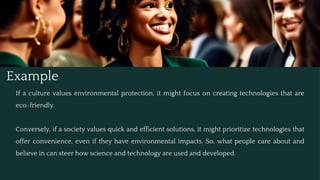
Example
If a culture values environmental protection, it might focus on creating technologies that are
eco-friendly.
Conversely, if a society values quick and efficient solutions, it might prioritize technologies that
offer convenience, even if they have environmental impacts. So, what people care about and
believe in can steer how science and technology are used and developed.
The Interconnected Cycle
1
Scientific Discoveries
New scientific knowledge leads to technological
innovations.
2
Technological Advancements
Technological progress enables further scientific
research and exploration.
3
Societal Impacts
Societal changes and needs drive the direction of
science and technology.
preencoded.png
1.When scientists discover new facts or understandings about the world, these
discoveries often lead to new technologies. For example, learning about electricity led
to inventions like the light bulb and computers.
The Interconnected Cycle
1
Scientific Discoveries
New scientific knowledge leads to technological
innovations.
2 3
When scientists discover new facts or understandings about the world, these
discoveries often lead to new technologies. For example, learning about electricity
led to inventions like the light bulb and computers.
The Interconnected Cycle
1 2
Technological Advancements
Technological progress enables further scientific
research and exploration.
3
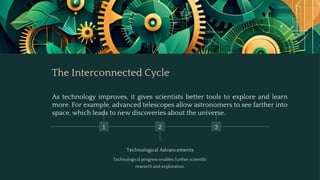
As technology improves, it gives scientists better tools to explore and learn
more. For example, advanced telescopes allow astronomers to see farther into
space, which leads to new discoveries about the universe.
The Interconnected Cycle
1 2 3
Societal Impacts
Societal changes and needs drive the direction of
science and technology.
The needs and interests of society shape what scientists and engineers focus on. If people
are concerned about climate change, for instance, there will be more effort and
resources directed towards developing green technologies and researching renewable
energy sources.
In summary, new scientific discoveries lead to new technologies, better
technology helps scientists explore more, and society’s needs guide
what science and technology focus on.
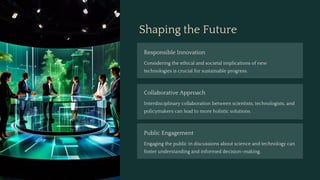
Shaping the Future
Responsible Innovation
Considering the ethical and societal implications of new
technologies is crucial for sustainable progress.
Collaborative Approach
Interdisciplinary collaboration between scientists, technologists, and
policymakers can lead to more holistic solutions.
Public Engagement
Engaging the public in discussions about science and technology can
foster understanding and informed decision-making.
Artificial Intelligence (AI) and Automation: The rapid
advancement in AI, including developments in generative models
like ChatGPT, is raising concerns about job displacement, privacy,
ethics, and decision-making processes. Society needs to engage in
discussions about how to regulate AI, ensure ethical use, and
address the impact on employment.
Ethics of Emerging Technologies: Technologies such as facial
recognition, surveillance systems, and deepfakes pose ethical
challenges. Public discourse is necessary to establish guidelines and
regulations to protect civil liberties while leveraging technological
advancements.
https://video.ucdavis.edu/media/Deep+Fake+of+Barack
+Obama/1_6zmvebuf
Bioethics and Biotechnology: Advances in gene editing (e.g., CRISPR),
personalized medicine, and biotechnology raise ethical questions about
their use. Societal debate is necessary to navigate issues related to
genetic privacy, the potential for genetic modifications, and equitable
access to these technologies.
Clustered Regularly Interspaced Short Palindromic Repeats." It is a
powerful tool used in genetic engineering and molecular biology to
edit DNA with high precision.
Exploring Connections Considering the Ethical and Societal Implications of New
Technologies is Crucial for Sustainable Progress: When creating or
using new technologies, it's important to think about their impact on
people and society. For instance, while artificial intelligence can bring
many benefits, it’s important to consider issues like privacy, job
displacement, and fairness to ensure it’s used in a way that benefits
everyone.
Interdisciplinary Collaboration Between Scientists, Technologists,
and Policymakers Can Lead to More Holistic Solutions: Combining
expertise from different fields—such as science, technology, and
public policy—can lead to better solutions. For example, developing
new healthcare technologies requires input from medical
researchers, engineers, and policymakers to ensure they’re effective,
safe, and accessible.
Engaging the Public in Discussions About Science and Technology
Can Foster Understanding and Informed Decision-Making: Involving
people in conversations about science and technology helps them
understand how these areas affect their lives and enables them to
make informed choices. For instance, public input on genetic editing
can help guide regulations that balance innovation with ethical
considerations.
Conclusion
The systematic pursuit of
knowledge about the natural world
drives our understanding of how
things work, leading to the
development of new technologies
and practical applications.
This scientific knowledge not
only advances our capabilities
but also transforms society, as
the community continually
shapes and is shaped by these
innovations.
By bridging the gap between
research and real-world
applications, and considering
the broader impacts on
society, we can foster a more
informed and progressive
world, where science and
technology serve the greater
good.
for progress to be responsible and effective, we need to consider
the broader impacts of technology, work together across different
fields, and involve the public in discussions.
T H A N K Y O U

Science, Technology and society STS-INTRO.pdf

  • 1.
  • 2.
    S C I E N C E is a systematicand methodical approach to understanding the natural world. It involves observing, experimenting, and analyzing phenomena to develop explanations and predictions about how things work. Science relies on empirical evidence—information obtained through sensory experience and experimentation—and often uses the scientific method, which includes making observations, forming hypotheses, conducting experiments, and drawing conclusions. The goal of science is to build reliable knowledge that can be tested and refined over time. It encompasses a wide range of fields, such as physics, chemistry, biology, and social sciences, each focusing on different aspects of the natural and social world. Through its processes and methods, science aims to expand our understanding, solve problems, and improve our quality of life. The word "science" comes from the Latin word "scientia," which means "knowledge" or "understanding." The Latin term itself is derived from "scio," which means "to know" or "to understand." Detail on the etymology: Latin Origin: 1. "Scientia": In Latin, "scientia" refers to knowledge or the body of knowledge accumulated through study and practice. 2. "Scio": This Latin verb means "I know" or "I understand," and it is the root of "scientia."
  • 3.
    Understanding Science Science isthe systematic pursuit of knowledge, using empirical methods to understand the natural world and universe. It builds a body of testable explanations and predictions.
  • 4.
    T E C H N O L O G Y in relation toscience, refers to the practical application of scientific knowledge and principles to develop tools, systems, and methods that solve problems, improve processes, and enhance human capabilities. It represents the intersection where scientific discoveries are transformed into practical innovations and solutions. The word "technology" has its origins in Greek, derived from two roots: 1.Greek Roots: "Techne: This Greek word means "art," "skill," or "craft." It refers to the practical application of knowledge, particularly in making things or solving problems. 1. Logia: This suffix means "study" or "science" and comes from the Greek word "logos", which means "word," "reason," or "discourse." 2.Formation: 1. "Technologia": In Greek, "technologia" combines "techne" with "logia" to mean "systematic treatment of art" or "study of craft."
  • 5.
    The Role ofTechnology Definition Technology is the application of scientific knowledge for practical purposes, including tools, machines, and systems that solve problems and improve human life. Examples Smartphones, renewable energy systems, and medical devices are all examples of how technology harnesses scientific principles. Impact Technological advancements can significantly impact society, transforming how we communicate, work, and live.
  • 6.
    S O C I E T Y is a groupof people living together in a community and interacting with each other, sharing common interests, norms, and institutions. Society determines how and when new technologies and scientific discoveries are adopted and integrated into daily life. This includes everything from using smartphones and medical technologies to how communities adapt to environmental technologies. Adoption and Use Scientific and technological innovations can significantly impact society by improving quality of life, enhancing productivity, and solving problems. Example, advancements in medicine can lead to better health outcomes, while technological innovations can drive economic growth. Impact and Benefits Society plays a crucial role in setting ethical standards and regulations for the use of science and technology. This involves debates about privacy, safety, and the moral implications of new technologies, such as genetic editing or artificial intelligence. Ethics and Regulation The word "society" comes from the Latin word "societas," which means "association" or "fellowship." Latin Origin: "Societas": This Latin term derives from "socius," which means "companion" or "ally." The root word "socius" conveys the idea of companionship or partnership.
  • 7.
    The Influence ofSociety 1 Cultural Values A society's cultural norms and values can shape the direction and application of science and technology. 2 Ethical Considerations Societal concerns about the ethical implications of new technologies can influence their development and use. 3 Accessibility The accessibility and distribution of scientific and technological advancements can impact different segments of society.
  • 8.
    Example If a culturevalues environmental protection, it might focus on creating technologies that are eco-friendly. Conversely, if a society values quick and efficient solutions, it might prioritize technologies that offer convenience, even if they have environmental impacts. So, what people care about and believe in can steer how science and technology are used and developed.
  • 9.
    The Interconnected Cycle 1 ScientificDiscoveries New scientific knowledge leads to technological innovations. 2 Technological Advancements Technological progress enables further scientific research and exploration. 3 Societal Impacts Societal changes and needs drive the direction of science and technology. preencoded.png
  • 10.
    1.When scientists discovernew facts or understandings about the world, these discoveries often lead to new technologies. For example, learning about electricity led to inventions like the light bulb and computers. The Interconnected Cycle 1 Scientific Discoveries New scientific knowledge leads to technological innovations. 2 3 When scientists discover new facts or understandings about the world, these discoveries often lead to new technologies. For example, learning about electricity led to inventions like the light bulb and computers.
  • 11.
    The Interconnected Cycle 12 Technological Advancements Technological progress enables further scientific research and exploration. 3 As technology improves, it gives scientists better tools to explore and learn more. For example, advanced telescopes allow astronomers to see farther into space, which leads to new discoveries about the universe.
  • 12.
    The Interconnected Cycle 12 3 Societal Impacts Societal changes and needs drive the direction of science and technology. The needs and interests of society shape what scientists and engineers focus on. If people are concerned about climate change, for instance, there will be more effort and resources directed towards developing green technologies and researching renewable energy sources.
  • 13.
    In summary, newscientific discoveries lead to new technologies, better technology helps scientists explore more, and society’s needs guide what science and technology focus on.
  • 14.
    Shaping the Future ResponsibleInnovation Considering the ethical and societal implications of new technologies is crucial for sustainable progress. Collaborative Approach Interdisciplinary collaboration between scientists, technologists, and policymakers can lead to more holistic solutions. Public Engagement Engaging the public in discussions about science and technology can foster understanding and informed decision-making.
  • 15.
    Artificial Intelligence (AI)and Automation: The rapid advancement in AI, including developments in generative models like ChatGPT, is raising concerns about job displacement, privacy, ethics, and decision-making processes. Society needs to engage in discussions about how to regulate AI, ensure ethical use, and address the impact on employment. Ethics of Emerging Technologies: Technologies such as facial recognition, surveillance systems, and deepfakes pose ethical challenges. Public discourse is necessary to establish guidelines and regulations to protect civil liberties while leveraging technological advancements. https://video.ucdavis.edu/media/Deep+Fake+of+Barack +Obama/1_6zmvebuf Bioethics and Biotechnology: Advances in gene editing (e.g., CRISPR), personalized medicine, and biotechnology raise ethical questions about their use. Societal debate is necessary to navigate issues related to genetic privacy, the potential for genetic modifications, and equitable access to these technologies. Clustered Regularly Interspaced Short Palindromic Repeats." It is a powerful tool used in genetic engineering and molecular biology to edit DNA with high precision.
  • 16.
    Exploring Connections Consideringthe Ethical and Societal Implications of New Technologies is Crucial for Sustainable Progress: When creating or using new technologies, it's important to think about their impact on people and society. For instance, while artificial intelligence can bring many benefits, it’s important to consider issues like privacy, job displacement, and fairness to ensure it’s used in a way that benefits everyone. Interdisciplinary Collaboration Between Scientists, Technologists, and Policymakers Can Lead to More Holistic Solutions: Combining expertise from different fields—such as science, technology, and public policy—can lead to better solutions. For example, developing new healthcare technologies requires input from medical researchers, engineers, and policymakers to ensure they’re effective, safe, and accessible. Engaging the Public in Discussions About Science and Technology Can Foster Understanding and Informed Decision-Making: Involving people in conversations about science and technology helps them understand how these areas affect their lives and enables them to make informed choices. For instance, public input on genetic editing can help guide regulations that balance innovation with ethical considerations.
  • 17.
    Conclusion The systematic pursuitof knowledge about the natural world drives our understanding of how things work, leading to the development of new technologies and practical applications. This scientific knowledge not only advances our capabilities but also transforms society, as the community continually shapes and is shaped by these innovations. By bridging the gap between research and real-world applications, and considering the broader impacts on society, we can foster a more informed and progressive world, where science and technology serve the greater good. for progress to be responsible and effective, we need to consider the broader impacts of technology, work together across different fields, and involve the public in discussions.
  • 18.
    T H AN K Y O U