Poetry Collection
“A poem begins as a lump in the
throat, a sense of wrong, a
homesickness, a lovesickness.”
- Robert Frost
POEMS
Poetry Collection
1. Five Senses
2. Diamante
3. Cinquain
4. Color Poem
5. I Wish. . .
6. 8-Line Rhyming
7. Build-A-Poem
8. Haiku
9. Limerick
10. Concrete
11. If I were. . .
12. I Used To. . .But Now. . .
13. Clerihew
ORGANIZING POEMS
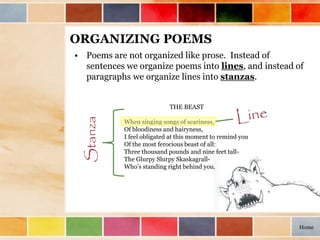
• Poems are not organized like prose. Instead of
sentences we organize poems into lines, and instead of
paragraphs we organize lines into stanzas.
THE BEAST
When singing songs of scariness,
Of bloodiness and hairyness,
I feel obligated at this moment to remind you
Of the most ferocious beast of all:
Three thousand pounds and nine feet tall-
The Glurpy Slurpy Skaskagrall-
Who’s standing right behind you.
Stanza
Home
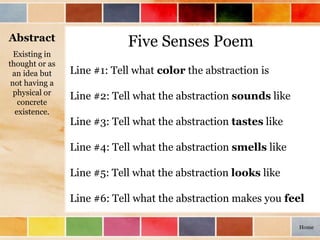
Five Senses Poem
Line #1: Tell what color the abstraction is
Line #2: Tell what the abstraction sounds like
Line #3: Tell what the abstraction tastes like
Line #4: Tell what the abstraction smells like
Line #5: Tell what the abstraction looks like
Line #6: Tell what the abstraction makes you feel
Abstract
Existing in
thought or as
an idea but
not having a
physical or
concrete
existence.
Home
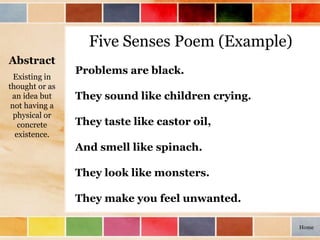
Five Senses Poem (Example)
Problems are black.
They sound like children crying.
They taste like castor oil,
And smell like spinach.
They look like monsters.
They make you feel unwanted.
Abstract
Existing in
thought or as
an idea but
not having a
physical or
concrete
existence.
Home
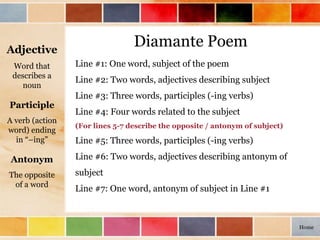
Diamante Poem
Line #1: One word, subject of the poem
Line #2: Two words, adjectives describing subject
Line #3: Three words, participles (-ing verbs)
Line #4: Four words related to the subject
(For lines 5-7 describe the opposite / antonym of subject)
Line #5: Three words, participles (-ing verbs)
Line #6: Two words, adjectives describing antonym of
subject
Line #7: One word, antonym of subject in Line #1
Adjective
Word that
describes a
noun
Participle
A verb (action
word) ending
in “–ing”
Antonym
The opposite
of a word
Home
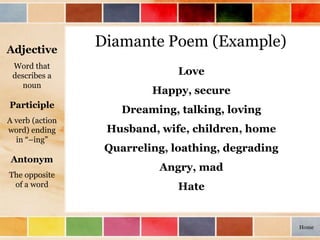
Diamante Poem (Example)
Love
Happy, secure
Dreaming, talking, loving
Husband, wife, children, home
Quarreling, loathing, degrading
Angry, mad
Hate
Adjective
Word that
describes a
noun
Participle
A verb (action
word) ending
in “–ing”
Antonym
The opposite
of a word
Home
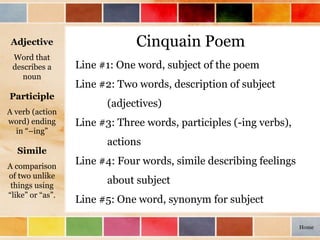
Cinquain Poem
Line #1: One word, subject of the poem
Line #2: Two words, description of subject
(adjectives)
Line #3: Three words, participles (-ing verbs),
actions
Line #4: Four words, simile describing feelings
about subject
Line #5: One word, synonym for subject
Adjective
Word that
describes a
noun
Participle
A verb (action
word) ending
in “–ing”
Simile
A comparison
of two unlike
things using
“like” or “as”.
Home
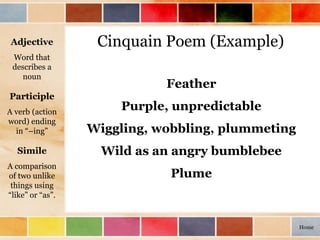
Cinquain Poem (Example)
Feather
Purple, unpredictable
Wiggling, wobbling, plummeting
Wild as an angry bumblebee
Plume
Adjective
Word that
describes a
noun
Participle
A verb (action
word) ending
in “–ing”
Simile
A comparison
of two unlike
things using
“like” or “as”.
Home
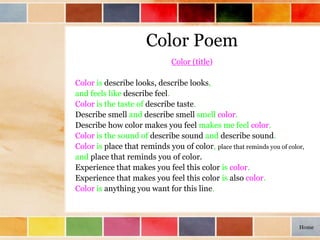
Color Poem
Color (title)
Color is describe looks, describe looks,
and feels like describe feel.
Color is the taste of describe taste.
Describe smell and describe smell smell color.
Describe how color makes you feel makes me feel color.
Color is the sound of describe sound and describe sound.
Color is place that reminds you of color, place that reminds you of color,
and place that reminds you of color.
Experience that makes you feel this color is color.
Experience that makes you feel this color is also color.
Color is anything you want for this line.
Home
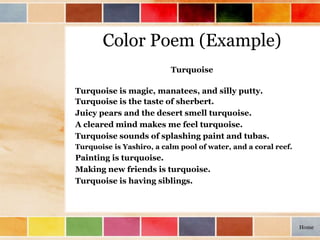
Color Poem (Example)
Turquoise
Turquoise is magic, manatees, and silly putty.
Turquoise is the taste of sherbert.
Juicy pears and the desert smell turquoise.
A cleared mind makes me feel turquoise.
Turquoise sounds of splashing paint and tubas.
Turquoise is Yashiro, a calm pool of water, and a coral reef.
Painting is turquoise.
Making new friends is turquoise.
Turquoise is having siblings.
Home
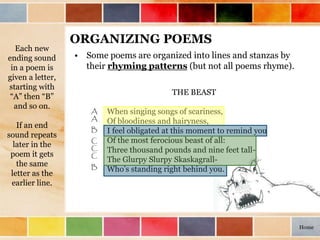
ORGANIZING POEMS
• Some poems are organized into lines and stanzas by
their rhyming patterns (but not all poems rhyme).
THE BEAST
When singing songs of scariness,
Of bloodiness and hairyness,
I feel obligated at this moment to remind you
Of the most ferocious beast of all:
Three thousand pounds and nine feet tall-
The Glurpy Slurpy Skaskagrall-
Who’s standing right behind you.
A
A
B
B
C
C
C
Each new
ending sound
in a poem is
given a letter,
starting with
“A” then “B”
and so on.
If an end
sound repeats
later in the
poem it gets
the same
letter as the
earlier line.
Home
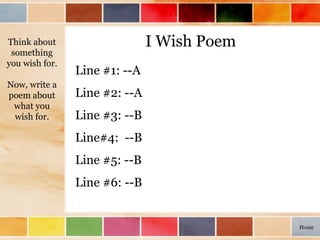
I Wish Poem
Line #1: --A
Line #2: --A
Line #3: --B
Line#4: --B
Line #5: --B
Line #6: --B
Think about
something
you wish for.
Now, write a
poem about
what you
wish for.
Home
I Wish Poem (Example)Think about
things you
wish for.
Now, write a
poem about
what you
wish for.
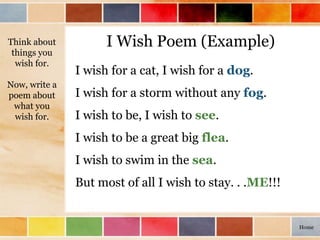
I wish for a cat, I wish for a dog.
I wish for a storm without any fog.
I wish to be, I wish to see.
I wish to be a great big flea.
I wish to swim in the sea.
But most of all I wish to stay. . .ME!!!
Home
Each new
ending sound
in a poem is
given a letter,
starting with
“A” then “B”
and so on.
If an end
sound repeats
later in the
poem it gets
the same
letter as the
earlier line.
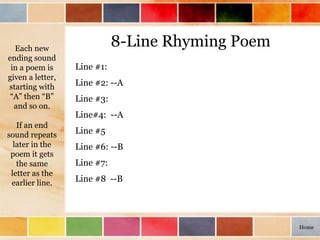
8-Line Rhyming Poem
Line #1:
Line #2: --A
Line #3:
Line#4: --A
Line #5
Line #6: --B
Line #7:
Line #8 --B
Home
Each new
ending sound
in a poem is
given a letter,
starting with
“A” then “B”
and so on.
If an end
sound repeats
later in the
poem it gets
the same
letter as the
earlier line.
8-Line Rhyming Poem (Example)
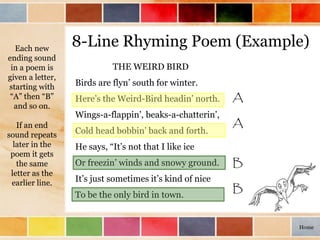
THE WEIRD BIRD
Birds are flyn’ south for winter.
Here’s the Weird-Bird headin’ north.
Wings-a-flappin’, beaks-a-chatterin’,
Cold head bobbin’ back and forth.
He says, “It’s not that I like ice
Or freezin’ winds and snowy ground.
It’s just sometimes it’s kind of nice
To be the only bird in town.
A
A
B
B
Home
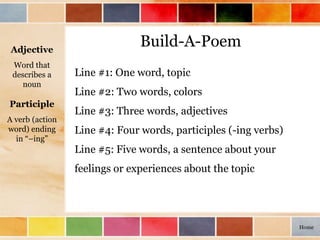
Build-A-Poem
Line #1: One word, topic
Line #2: Two words, colors
Line #3: Three words, adjectives
Line #4: Four words, participles (-ing verbs)
Line #5: Five words, a sentence about your
feelings or experiences about the topic
Adjective
Word that
describes a
noun
Participle
A verb (action
word) ending
in “–ing”
Home
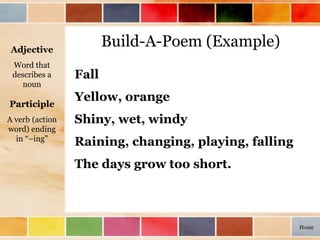
Build-A-Poem (Example)
Fall
Yellow, orange
Shiny, wet, windy
Raining, changing, playing, falling
The days grow too short.
Adjective
Word that
describes a
noun
Participle
A verb (action
word) ending
in “–ing”
Home
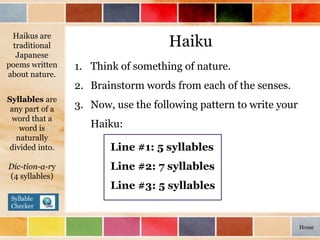
Haiku
1. Think of something of nature.
2. Brainstorm words from each of the senses.
3. Now, use the following pattern to write your
Haiku:
Haikus are
traditional
Japanese
poems written
about nature.
Line #1: 5 syllables
Line #2: 7 syllables
Line #3: 5 syllables
Syllables are
any part of a
word that a
word is
naturally
divided into.
Dic-tion-a-ry
(4 syllables)
Syllable
Checker
Home
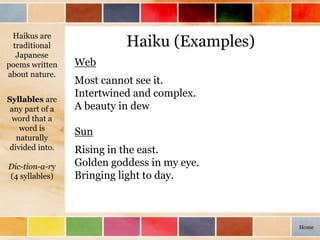
Haiku (Examples)
Web
Most cannot see it.
Intertwined and complex.
A beauty in dew
Sun
Rising in the east.
Golden goddess in my eye.
Bringing light to day.
Haikus are
traditional
Japanese
poems written
about nature.
Syllables are
any part of a
word that a
word is
naturally
divided into.
Dic-tion-a-ry
(4 syllables)
Home
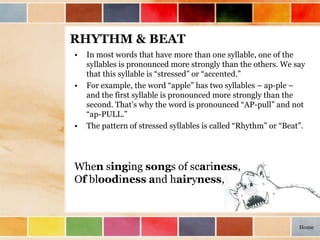
RHYTHM & BEAT
• In most words that have more than one syllable, one of the
syllables is pronounced more strongly than the others. We say
that this syllable is “stressed” or “accented.”
• For example, the word “apple” has two syllables – ap-ple –
and the first syllable is pronounced more strongly than the
second. That’s why the word is pronounced “AP-pull” and not
“ap-PULL.”
• The pattern of stressed syllables is called “Rhythm” or “Beat”.
When singing songs of scariness,
Of bloodiness and hairyness,
Home
Limericks
• Five line poem meant to be humorous
• Rhyming patter = A-A-B-B-A
• Lines 1, 2, and 5 contain 3 beats and
rhyme
• Lines 3 and 4 have two beats and
rhyme
A Limerick is
a rhyming
riddle that
uses rhythm.
Rhythm is
the pattern of
stressed and
unstressed
syllables in a
line of poetry.
Home
Limerick (Example)
A flea and a fly in a flue
Were caught, so what could they do?
Said the fly, “Let us flee!”
“Let us fly!” Said the flea.
So they flew through a flaw in the flue.
A Limerick is
a rhyming
riddle that
uses rhythm.
Rhythm is
the pattern of
stressed and
unstressed
syllables in a
line of poetry.
Home
Limerick (Practice)
There once was a pauper named Meg.
Who accidentally broke her ______.
She slipped on the _______.
Not once, but thrice.
Take no pity on her, I _______.
Can you guess which words should fill in the blanks?
A Limerick is
a rhyming
riddle that
uses rhythm.
Rhythm is
the pattern of
stressed and
unstressed
syllables in a
line of poetry.
Home
Concrete Poems
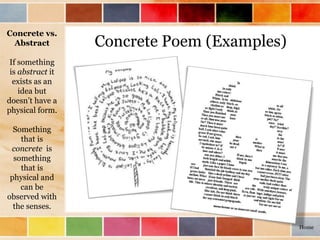
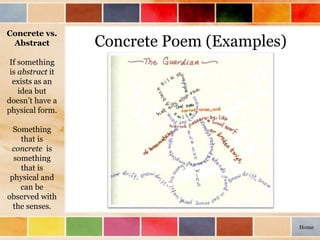
• A way of putting words on paper to give a
visual effect to match the topic and feeling of
the poem – the shape expresses what the
poem is about.
• Use strong, colorful words to describe topic
• Remember to think about the five senses
Concrete vs.
Abstract
If something
is abstract it
exists as an
idea but
doesn’t have a
physical form.
Something
that is
concrete is
something
that is
physical and
can be
observed with
the senses.
Home
Concrete Poem (Examples)
Concrete vs.
Abstract
If something
is abstract it
exists as an
idea but
doesn’t have a
physical form.
Something
that is
concrete is
something
that is
physical and
can be
observed with
the senses.
Home
Concrete Poem (Examples)
Concrete vs.
Abstract
If something
is abstract it
exists as an
idea but
doesn’t have a
physical form.
Something
that is
concrete is
something
that is
physical and
can be
observed with
the senses.
Home
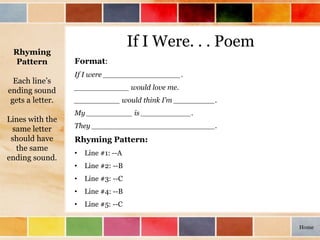
If I Were. . . Poem
Format:
If I were _________________.
____________ would love me.
__________ would think I’m _________.
My __________ is ___________.
They ___________________________.
Rhyming Pattern:
• Line #1: --A
• Line #2: --B
• Line #3: --C
• Line #4: --B
• Line #5: --C
Rhyming
Pattern
Each line’s
ending sound
gets a letter.
Lines with the
same letter
should have
the same
ending sound.
Home
If I Were. . . Poem
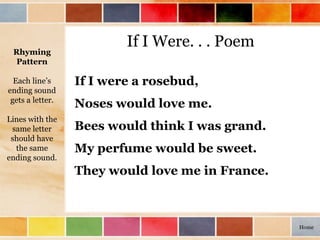
If I were a rosebud,
Noses would love me.
Bees would think I was grand.
My perfume would be sweet.
They would love me in France.
Rhyming
Pattern
Each line’s
ending sound
gets a letter.
Lines with the
same letter
should have
the same
ending sound.
Home
I Used To. . .But Now. . . Poem
Think about
how much
you’ve
changed since
the beginning
of this year.
What things
did you used
to like or do
that you don’t
like any more
or do
differently
now?
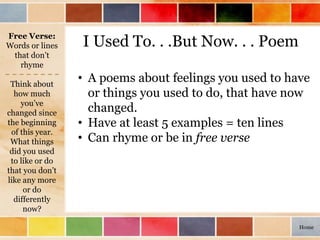
• A poems about feelings you used to have
or things you used to do, that have now
changed.
• Have at least 5 examples = ten lines
• Can rhyme or be in free verse
Free Verse:
Words or lines
that don’t
rhyme
Home
I Used To. . .But Now. . . Poem
Think about
how much
you’ve
changed since
the beginning
of this year.
What things
did you used
to like or do
that you don’t
like any more
or do
differently
now?
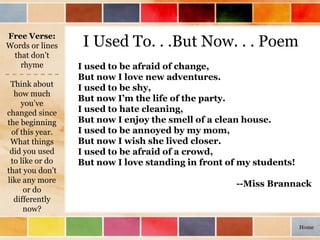
I used to be afraid of change,
But now I love new adventures.
I used to be shy,
But now I’m the life of the party.
I used to hate cleaning,
But now I enjoy the smell of a clean house.
I used to be annoyed by my mom,
But now I wish she lived closer.
I used to be afraid of a crowd,
But now I love standing in front of my students!
--Miss Brannack
Free Verse:
Words or lines
that don’t
rhyme
Home
Clerihew Poem
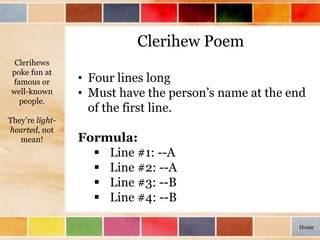
• Four lines long
• Must have the person’s name at the end
of the first line.
Formula:
 Line #1: --A
 Line #2: --A
 Line #3: --B
 Line #4: --B
Clerihews
poke fun at
famous or
well-known
people.
They’re light-
hearted, not
mean!
Home
Clerihew Poem (Example)
There once was a teacher named Mr. Thompson,
Who was definitely not from Wisconsin.
One day he forgot his glasses,
And couldn’t find any of his classes!
Clerihews
poke fun at
famous or
well-known
people.
They’re light-
hearted, not
mean!
Home

Poetry Types

  • 1.
    Poetry Collection “A poembegins as a lump in the throat, a sense of wrong, a homesickness, a lovesickness.” - Robert Frost
  • 2.
    POEMS Poetry Collection 1. FiveSenses 2. Diamante 3. Cinquain 4. Color Poem 5. I Wish. . . 6. 8-Line Rhyming 7. Build-A-Poem 8. Haiku 9. Limerick 10. Concrete 11. If I were. . . 12. I Used To. . .But Now. . . 13. Clerihew
  • 3.
    ORGANIZING POEMS • Poemsare not organized like prose. Instead of sentences we organize poems into lines, and instead of paragraphs we organize lines into stanzas. THE BEAST When singing songs of scariness, Of bloodiness and hairyness, I feel obligated at this moment to remind you Of the most ferocious beast of all: Three thousand pounds and nine feet tall- The Glurpy Slurpy Skaskagrall- Who’s standing right behind you. Stanza Home
  • 4.
    Five Senses Poem Line#1: Tell what color the abstraction is Line #2: Tell what the abstraction sounds like Line #3: Tell what the abstraction tastes like Line #4: Tell what the abstraction smells like Line #5: Tell what the abstraction looks like Line #6: Tell what the abstraction makes you feel Abstract Existing in thought or as an idea but not having a physical or concrete existence. Home
  • 5.
    Five Senses Poem(Example) Problems are black. They sound like children crying. They taste like castor oil, And smell like spinach. They look like monsters. They make you feel unwanted. Abstract Existing in thought or as an idea but not having a physical or concrete existence. Home
  • 6.
    Diamante Poem Line #1:One word, subject of the poem Line #2: Two words, adjectives describing subject Line #3: Three words, participles (-ing verbs) Line #4: Four words related to the subject (For lines 5-7 describe the opposite / antonym of subject) Line #5: Three words, participles (-ing verbs) Line #6: Two words, adjectives describing antonym of subject Line #7: One word, antonym of subject in Line #1 Adjective Word that describes a noun Participle A verb (action word) ending in “–ing” Antonym The opposite of a word Home
  • 7.
    Diamante Poem (Example) Love Happy,secure Dreaming, talking, loving Husband, wife, children, home Quarreling, loathing, degrading Angry, mad Hate Adjective Word that describes a noun Participle A verb (action word) ending in “–ing” Antonym The opposite of a word Home
  • 8.
    Cinquain Poem Line #1:One word, subject of the poem Line #2: Two words, description of subject (adjectives) Line #3: Three words, participles (-ing verbs), actions Line #4: Four words, simile describing feelings about subject Line #5: One word, synonym for subject Adjective Word that describes a noun Participle A verb (action word) ending in “–ing” Simile A comparison of two unlike things using “like” or “as”. Home
  • 9.
    Cinquain Poem (Example) Feather Purple,unpredictable Wiggling, wobbling, plummeting Wild as an angry bumblebee Plume Adjective Word that describes a noun Participle A verb (action word) ending in “–ing” Simile A comparison of two unlike things using “like” or “as”. Home
  • 10.
    Color Poem Color (title) Coloris describe looks, describe looks, and feels like describe feel. Color is the taste of describe taste. Describe smell and describe smell smell color. Describe how color makes you feel makes me feel color. Color is the sound of describe sound and describe sound. Color is place that reminds you of color, place that reminds you of color, and place that reminds you of color. Experience that makes you feel this color is color. Experience that makes you feel this color is also color. Color is anything you want for this line. Home
  • 11.
    Color Poem (Example) Turquoise Turquoiseis magic, manatees, and silly putty. Turquoise is the taste of sherbert. Juicy pears and the desert smell turquoise. A cleared mind makes me feel turquoise. Turquoise sounds of splashing paint and tubas. Turquoise is Yashiro, a calm pool of water, and a coral reef. Painting is turquoise. Making new friends is turquoise. Turquoise is having siblings. Home
  • 12.
    ORGANIZING POEMS • Somepoems are organized into lines and stanzas by their rhyming patterns (but not all poems rhyme). THE BEAST When singing songs of scariness, Of bloodiness and hairyness, I feel obligated at this moment to remind you Of the most ferocious beast of all: Three thousand pounds and nine feet tall- The Glurpy Slurpy Skaskagrall- Who’s standing right behind you. A A B B C C C Each new ending sound in a poem is given a letter, starting with “A” then “B” and so on. If an end sound repeats later in the poem it gets the same letter as the earlier line. Home
  • 13.
    I Wish Poem Line#1: --A Line #2: --A Line #3: --B Line#4: --B Line #5: --B Line #6: --B Think about something you wish for. Now, write a poem about what you wish for. Home
  • 14.
    I Wish Poem(Example)Think about things you wish for. Now, write a poem about what you wish for. I wish for a cat, I wish for a dog. I wish for a storm without any fog. I wish to be, I wish to see. I wish to be a great big flea. I wish to swim in the sea. But most of all I wish to stay. . .ME!!! Home
  • 15.
    Each new ending sound ina poem is given a letter, starting with “A” then “B” and so on. If an end sound repeats later in the poem it gets the same letter as the earlier line. 8-Line Rhyming Poem Line #1: Line #2: --A Line #3: Line#4: --A Line #5 Line #6: --B Line #7: Line #8 --B Home
  • 16.
    Each new ending sound ina poem is given a letter, starting with “A” then “B” and so on. If an end sound repeats later in the poem it gets the same letter as the earlier line. 8-Line Rhyming Poem (Example) THE WEIRD BIRD Birds are flyn’ south for winter. Here’s the Weird-Bird headin’ north. Wings-a-flappin’, beaks-a-chatterin’, Cold head bobbin’ back and forth. He says, “It’s not that I like ice Or freezin’ winds and snowy ground. It’s just sometimes it’s kind of nice To be the only bird in town. A A B B Home
  • 17.
    Build-A-Poem Line #1: Oneword, topic Line #2: Two words, colors Line #3: Three words, adjectives Line #4: Four words, participles (-ing verbs) Line #5: Five words, a sentence about your feelings or experiences about the topic Adjective Word that describes a noun Participle A verb (action word) ending in “–ing” Home
  • 18.
    Build-A-Poem (Example) Fall Yellow, orange Shiny,wet, windy Raining, changing, playing, falling The days grow too short. Adjective Word that describes a noun Participle A verb (action word) ending in “–ing” Home
  • 19.
    Haiku 1. Think ofsomething of nature. 2. Brainstorm words from each of the senses. 3. Now, use the following pattern to write your Haiku: Haikus are traditional Japanese poems written about nature. Line #1: 5 syllables Line #2: 7 syllables Line #3: 5 syllables Syllables are any part of a word that a word is naturally divided into. Dic-tion-a-ry (4 syllables) Syllable Checker Home
  • 20.
    Haiku (Examples) Web Most cannotsee it. Intertwined and complex. A beauty in dew Sun Rising in the east. Golden goddess in my eye. Bringing light to day. Haikus are traditional Japanese poems written about nature. Syllables are any part of a word that a word is naturally divided into. Dic-tion-a-ry (4 syllables) Home
  • 21.
    RHYTHM & BEAT •In most words that have more than one syllable, one of the syllables is pronounced more strongly than the others. We say that this syllable is “stressed” or “accented.” • For example, the word “apple” has two syllables – ap-ple – and the first syllable is pronounced more strongly than the second. That’s why the word is pronounced “AP-pull” and not “ap-PULL.” • The pattern of stressed syllables is called “Rhythm” or “Beat”. When singing songs of scariness, Of bloodiness and hairyness, Home
  • 22.
    Limericks • Five linepoem meant to be humorous • Rhyming patter = A-A-B-B-A • Lines 1, 2, and 5 contain 3 beats and rhyme • Lines 3 and 4 have two beats and rhyme A Limerick is a rhyming riddle that uses rhythm. Rhythm is the pattern of stressed and unstressed syllables in a line of poetry. Home
  • 23.
    Limerick (Example) A fleaand a fly in a flue Were caught, so what could they do? Said the fly, “Let us flee!” “Let us fly!” Said the flea. So they flew through a flaw in the flue. A Limerick is a rhyming riddle that uses rhythm. Rhythm is the pattern of stressed and unstressed syllables in a line of poetry. Home
  • 24.
    Limerick (Practice) There oncewas a pauper named Meg. Who accidentally broke her ______. She slipped on the _______. Not once, but thrice. Take no pity on her, I _______. Can you guess which words should fill in the blanks? A Limerick is a rhyming riddle that uses rhythm. Rhythm is the pattern of stressed and unstressed syllables in a line of poetry. Home
  • 25.
    Concrete Poems • Away of putting words on paper to give a visual effect to match the topic and feeling of the poem – the shape expresses what the poem is about. • Use strong, colorful words to describe topic • Remember to think about the five senses Concrete vs. Abstract If something is abstract it exists as an idea but doesn’t have a physical form. Something that is concrete is something that is physical and can be observed with the senses. Home
  • 26.
    Concrete Poem (Examples) Concretevs. Abstract If something is abstract it exists as an idea but doesn’t have a physical form. Something that is concrete is something that is physical and can be observed with the senses. Home
  • 27.
    Concrete Poem (Examples) Concretevs. Abstract If something is abstract it exists as an idea but doesn’t have a physical form. Something that is concrete is something that is physical and can be observed with the senses. Home
  • 28.
    If I Were.. . Poem Format: If I were _________________. ____________ would love me. __________ would think I’m _________. My __________ is ___________. They ___________________________. Rhyming Pattern: • Line #1: --A • Line #2: --B • Line #3: --C • Line #4: --B • Line #5: --C Rhyming Pattern Each line’s ending sound gets a letter. Lines with the same letter should have the same ending sound. Home
  • 29.
    If I Were.. . Poem If I were a rosebud, Noses would love me. Bees would think I was grand. My perfume would be sweet. They would love me in France. Rhyming Pattern Each line’s ending sound gets a letter. Lines with the same letter should have the same ending sound. Home
  • 30.
    I Used To.. .But Now. . . Poem Think about how much you’ve changed since the beginning of this year. What things did you used to like or do that you don’t like any more or do differently now? • A poems about feelings you used to have or things you used to do, that have now changed. • Have at least 5 examples = ten lines • Can rhyme or be in free verse Free Verse: Words or lines that don’t rhyme Home
  • 31.
    I Used To.. .But Now. . . Poem Think about how much you’ve changed since the beginning of this year. What things did you used to like or do that you don’t like any more or do differently now? I used to be afraid of change, But now I love new adventures. I used to be shy, But now I’m the life of the party. I used to hate cleaning, But now I enjoy the smell of a clean house. I used to be annoyed by my mom, But now I wish she lived closer. I used to be afraid of a crowd, But now I love standing in front of my students! --Miss Brannack Free Verse: Words or lines that don’t rhyme Home
  • 32.
    Clerihew Poem • Fourlines long • Must have the person’s name at the end of the first line. Formula:  Line #1: --A  Line #2: --A  Line #3: --B  Line #4: --B Clerihews poke fun at famous or well-known people. They’re light- hearted, not mean! Home
  • 33.
    Clerihew Poem (Example) Thereonce was a teacher named Mr. Thompson, Who was definitely not from Wisconsin. One day he forgot his glasses, And couldn’t find any of his classes! Clerihews poke fun at famous or well-known people. They’re light- hearted, not mean! Home