By :
Pristya Riefca Sari (1105085031)
Rustiah (1105085048)
Yunita Bone (1105085041)
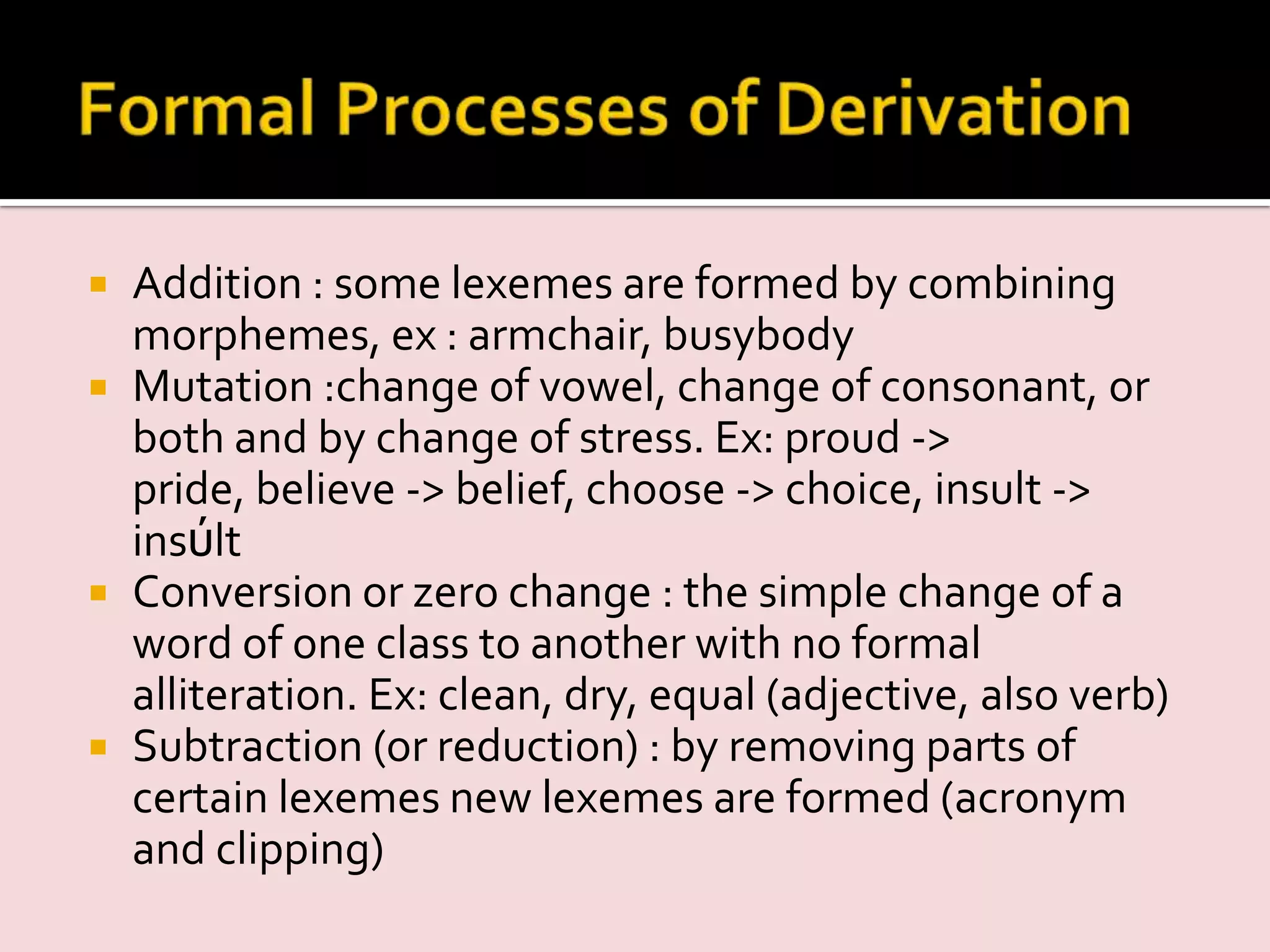
 Addition : some lexemes are formed by combining
morphemes, ex : armchair, busybody
 Mutation :change of vowel, change of consonant, or
both and by change of stress. Ex: proud ->
pride, believe -> belief, choose -> choice, insult ->
insύlt
 Conversion or zero change : the simple change of a
word of one class to another with no formal
alliteration. Ex: clean, dry, equal (adjective, also verb)
 Subtraction (or reduction) : by removing parts of
certain lexemes new lexemes are formed (acronym
and clipping)
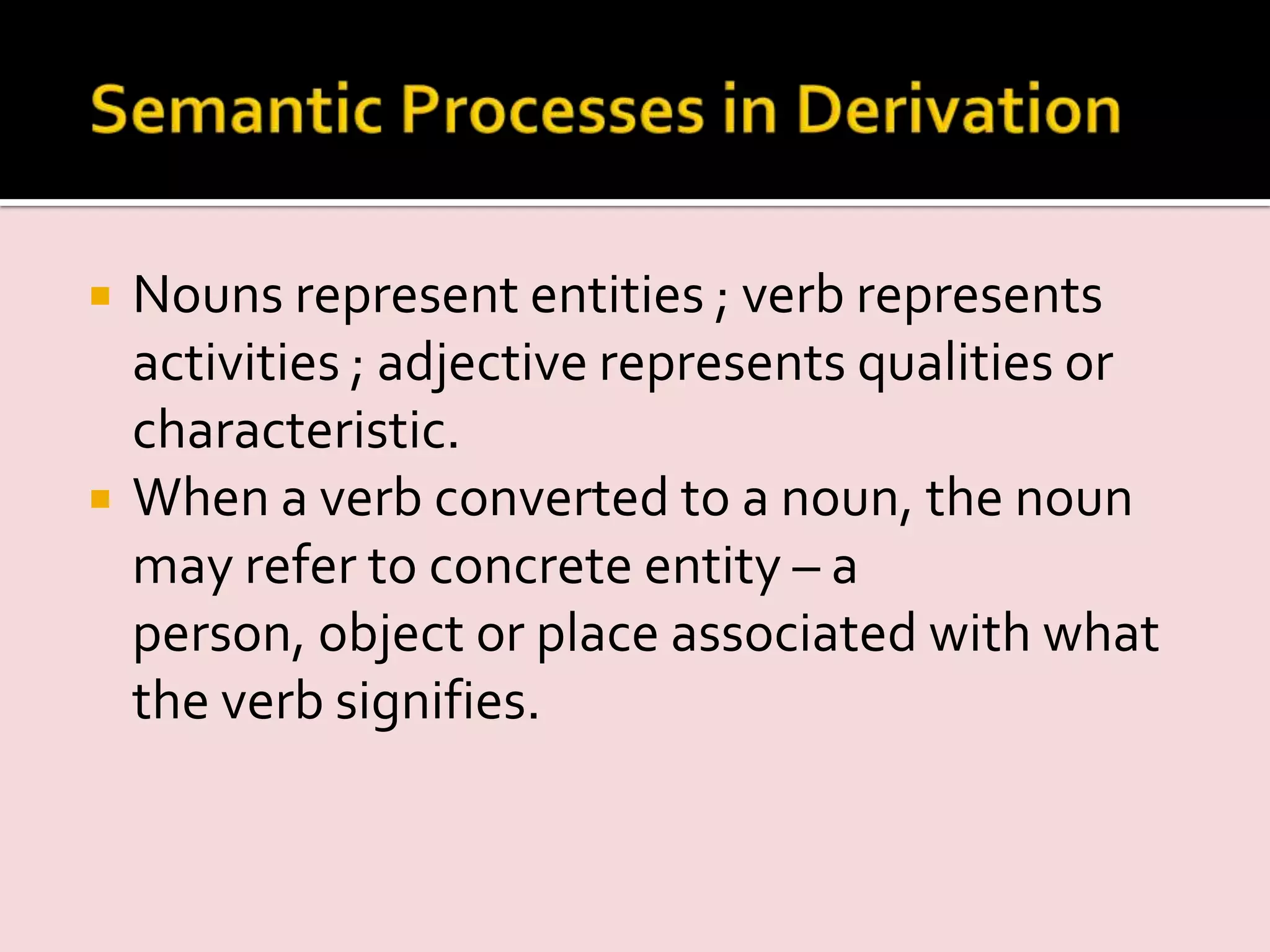
 Nouns represent entities ; verb represents
activities ; adjective represents qualities or
characteristic.
 When a verb converted to a noun, the noun
may refer to concrete entity – a
person, object or place associated with what
the verb signifies.
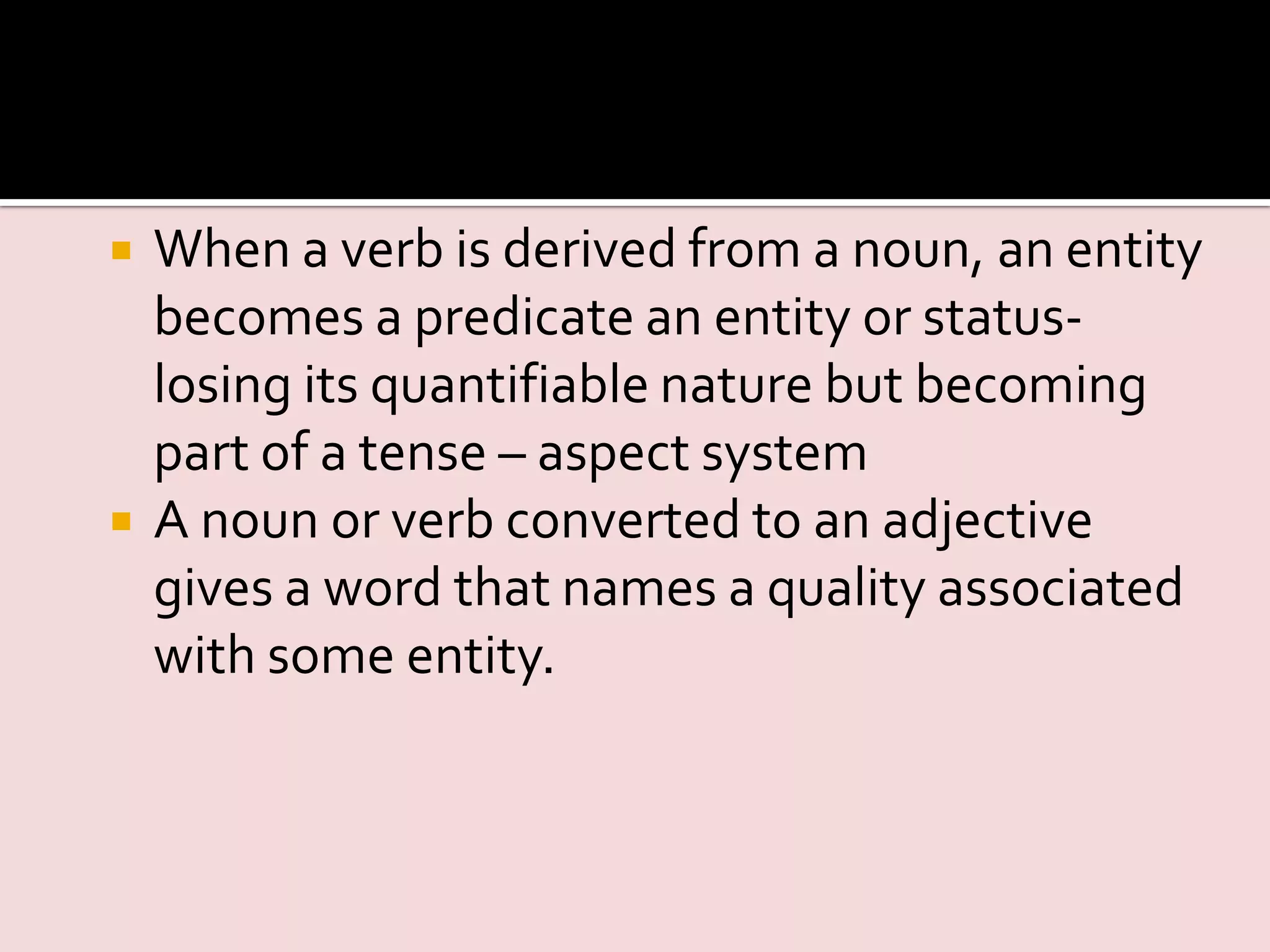
 When a verb is derived from a noun, an entity
becomes a predicate an entity or status-
losing its quantifiable nature but becoming
part of a tense – aspect system
 A noun or verb converted to an adjective
gives a word that names a quality associated
with some entity.
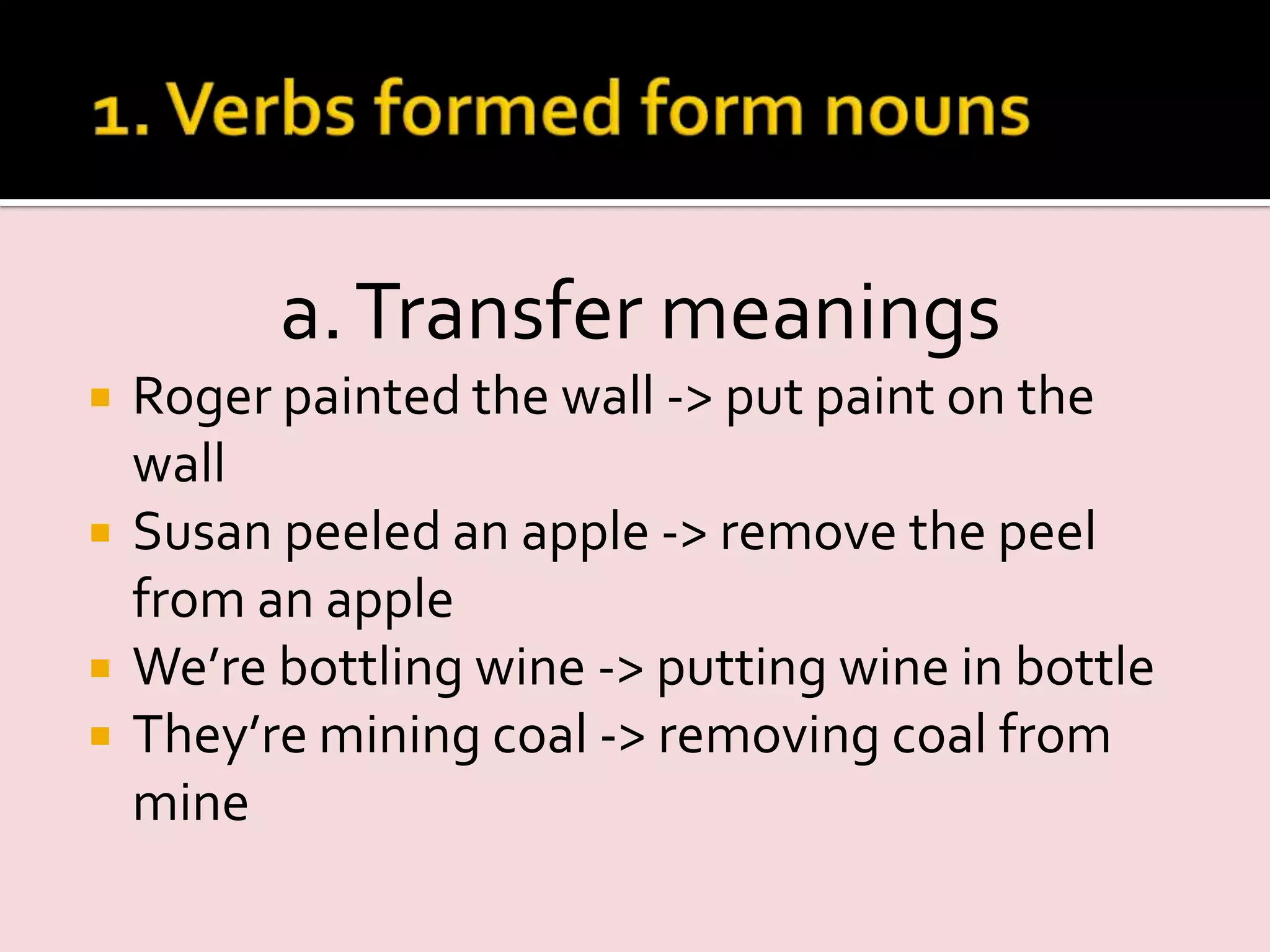
a.Transfer meanings
 Roger painted the wall -> put paint on the
wall
 Susan peeled an apple -> remove the peel
from an apple
 We’re bottling wine -> putting wine in bottle
 They’re mining coal -> removing coal from
mine
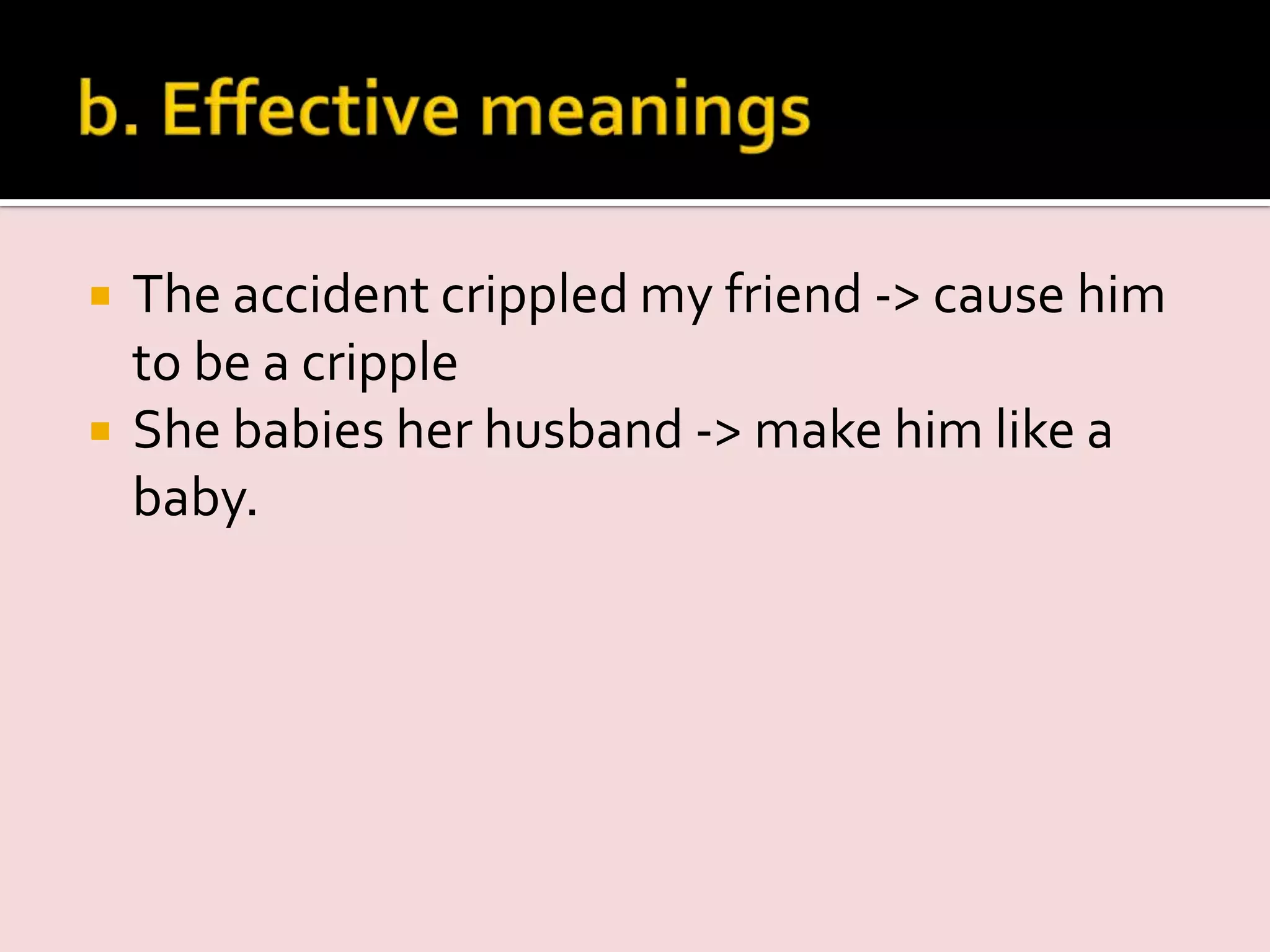
 The accident crippled my friend -> cause him
to be a cripple
 She babies her husband -> make him like a
baby.
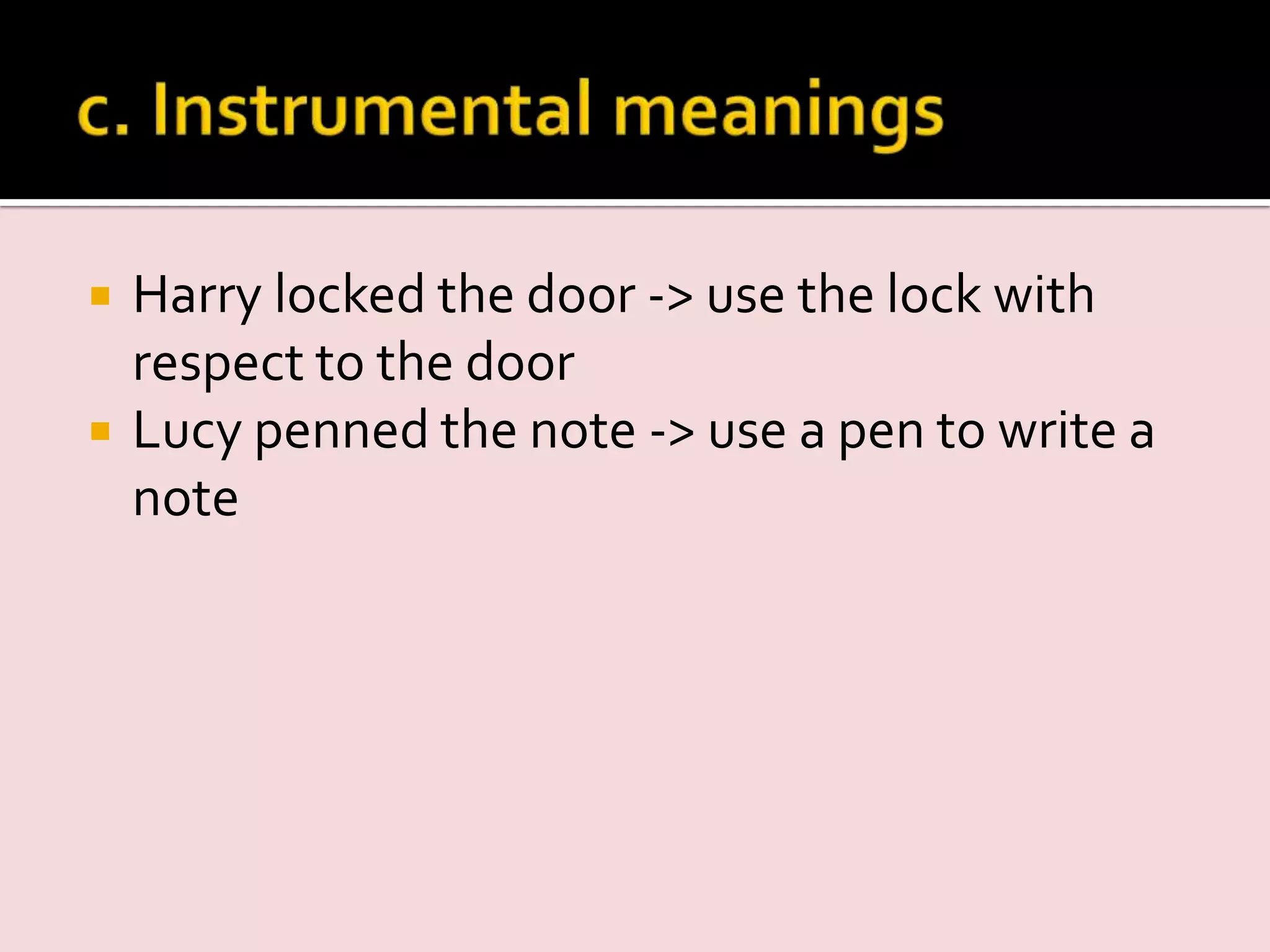
 Harry locked the door -> use the lock with
respect to the door
 Lucy penned the note -> use a pen to write a
note
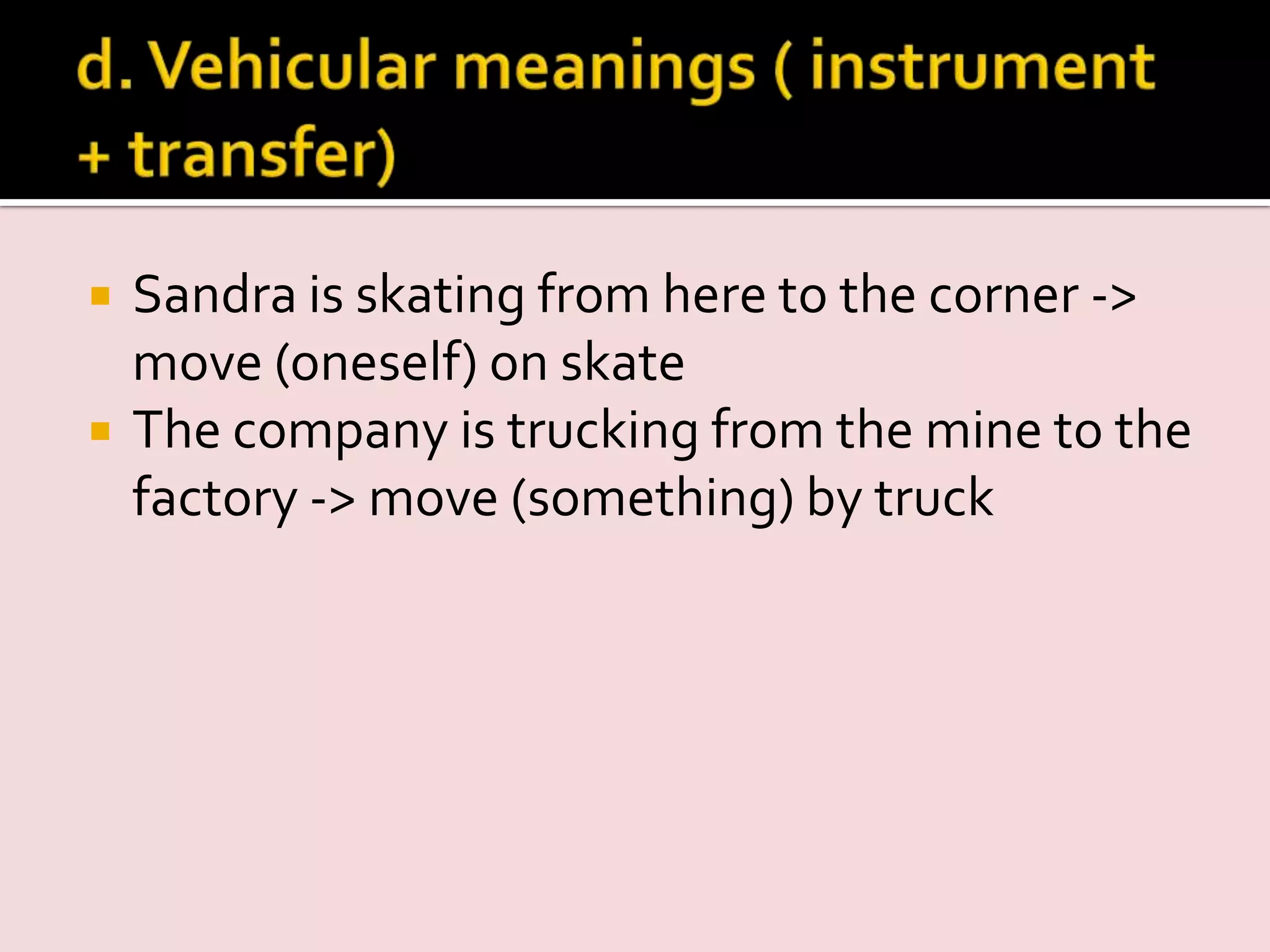
 Sandra is skating from here to the corner ->
move (oneself) on skate
 The company is trucking from the mine to the
factory -> move (something) by truck
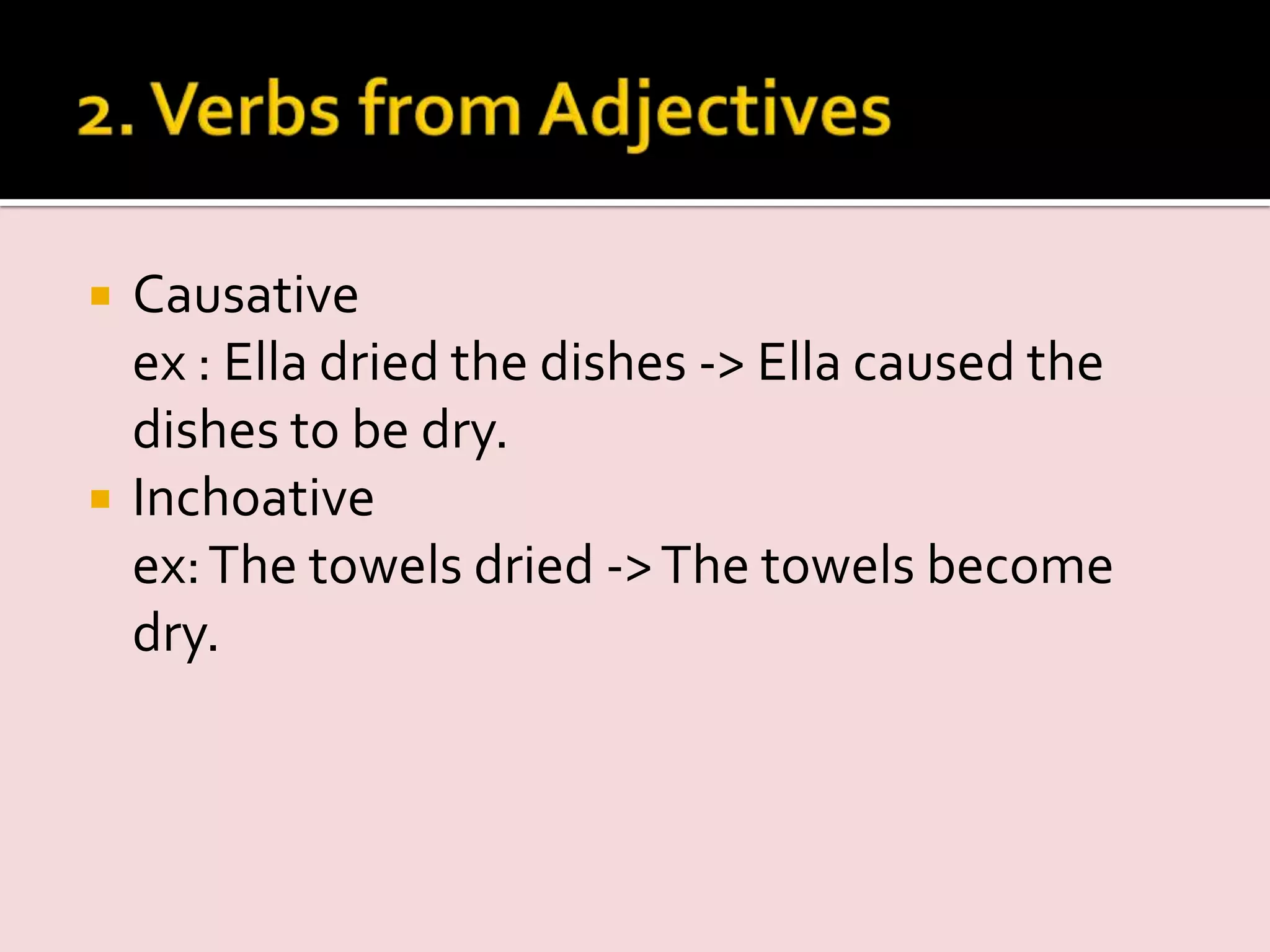
 Causative
ex : Ella dried the dishes -> Ella caused the
dishes to be dry.
 Inchoative
ex:The towels dried ->The towels become
dry.
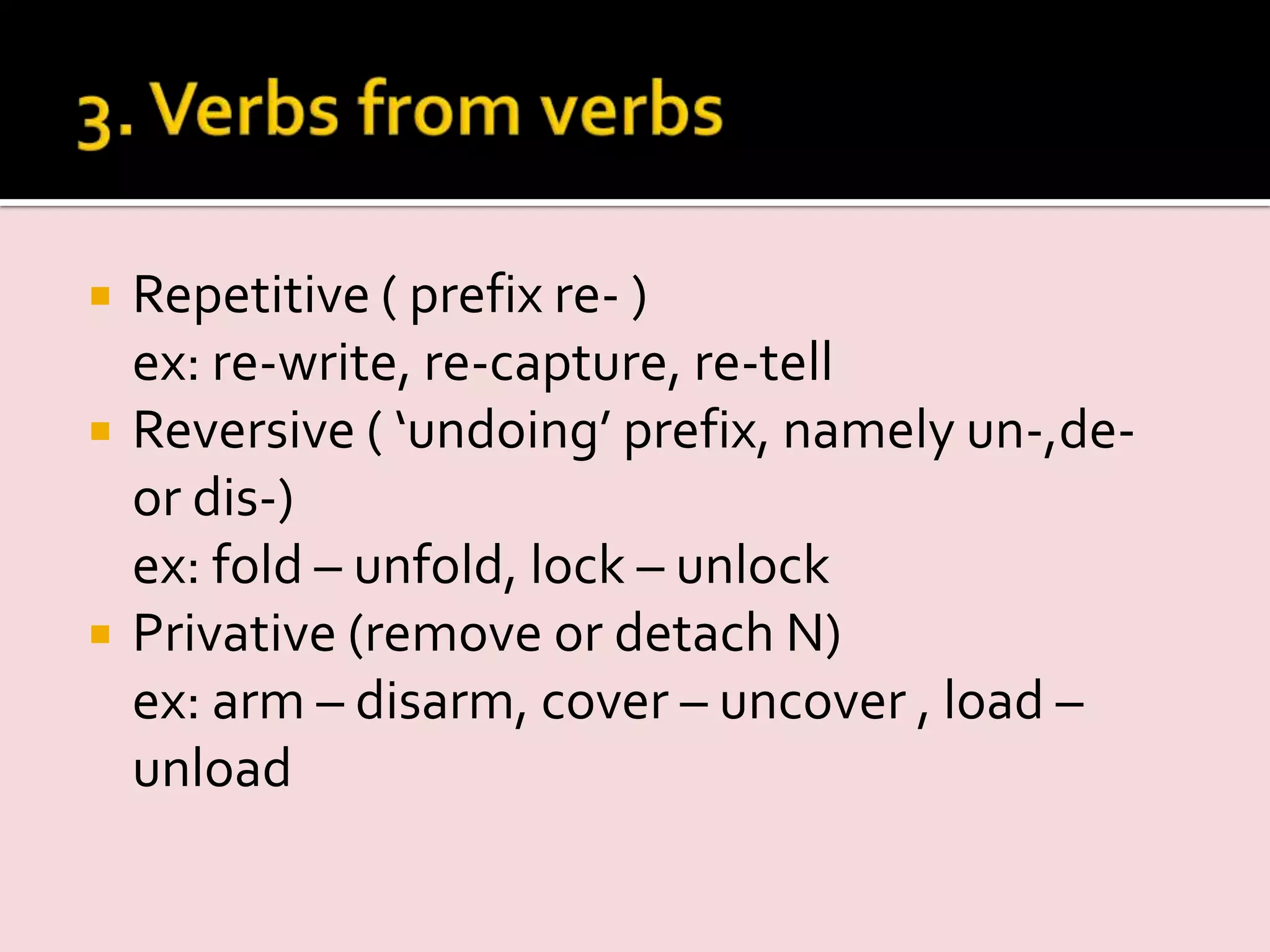
 Repetitive ( prefix re- )
ex: re-write, re-capture, re-tell
 Reversive ( ‘undoing’ prefix, namely un-,de-
or dis-)
ex: fold – unfold, lock – unlock
 Privative (remove or detach N)
ex: arm – disarm, cover – uncover , load –
unload
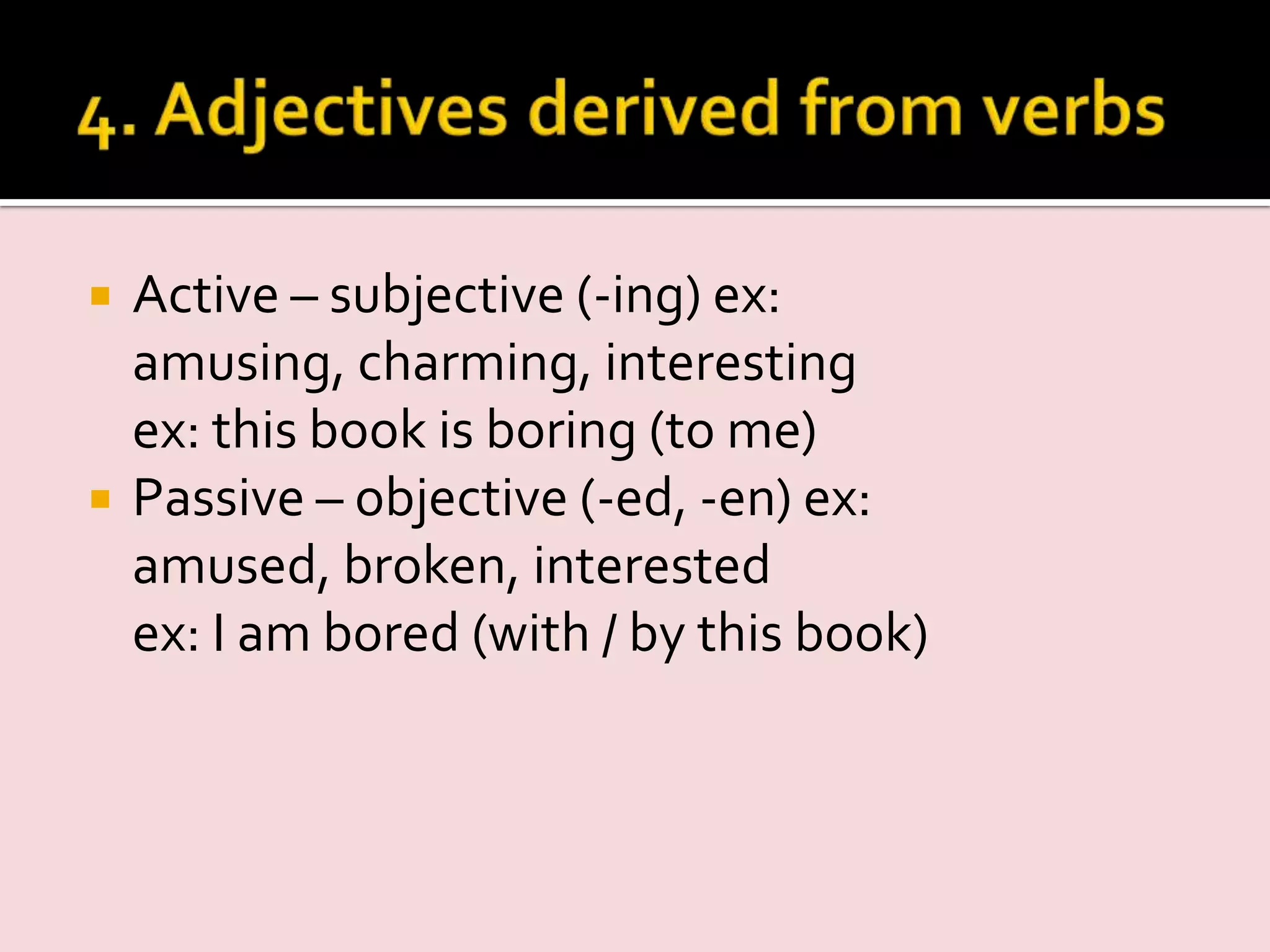
 Active – subjective (-ing) ex:
amusing, charming, interesting
ex: this book is boring (to me)
 Passive – objective (-ed, -en) ex:
amused, broken, interested
ex: I am bored (with / by this book)
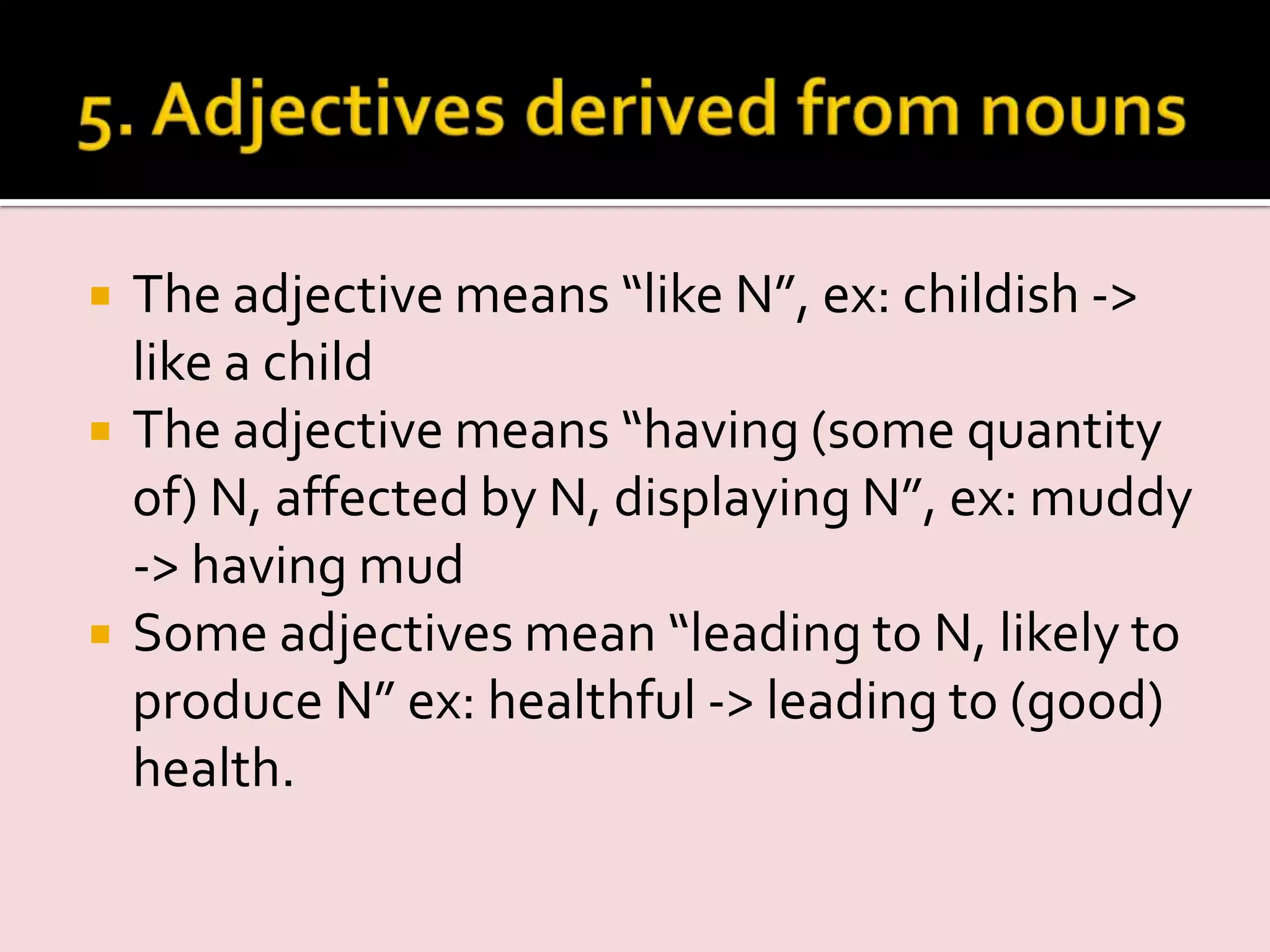
 The adjective means “like N”, ex: childish ->
like a child
 The adjective means “having (some quantity
of) N, affected by N, displaying N”, ex: muddy
-> having mud
 Some adjectives mean “leading to N, likely to
produce N” ex: healthful -> leading to (good)
health.
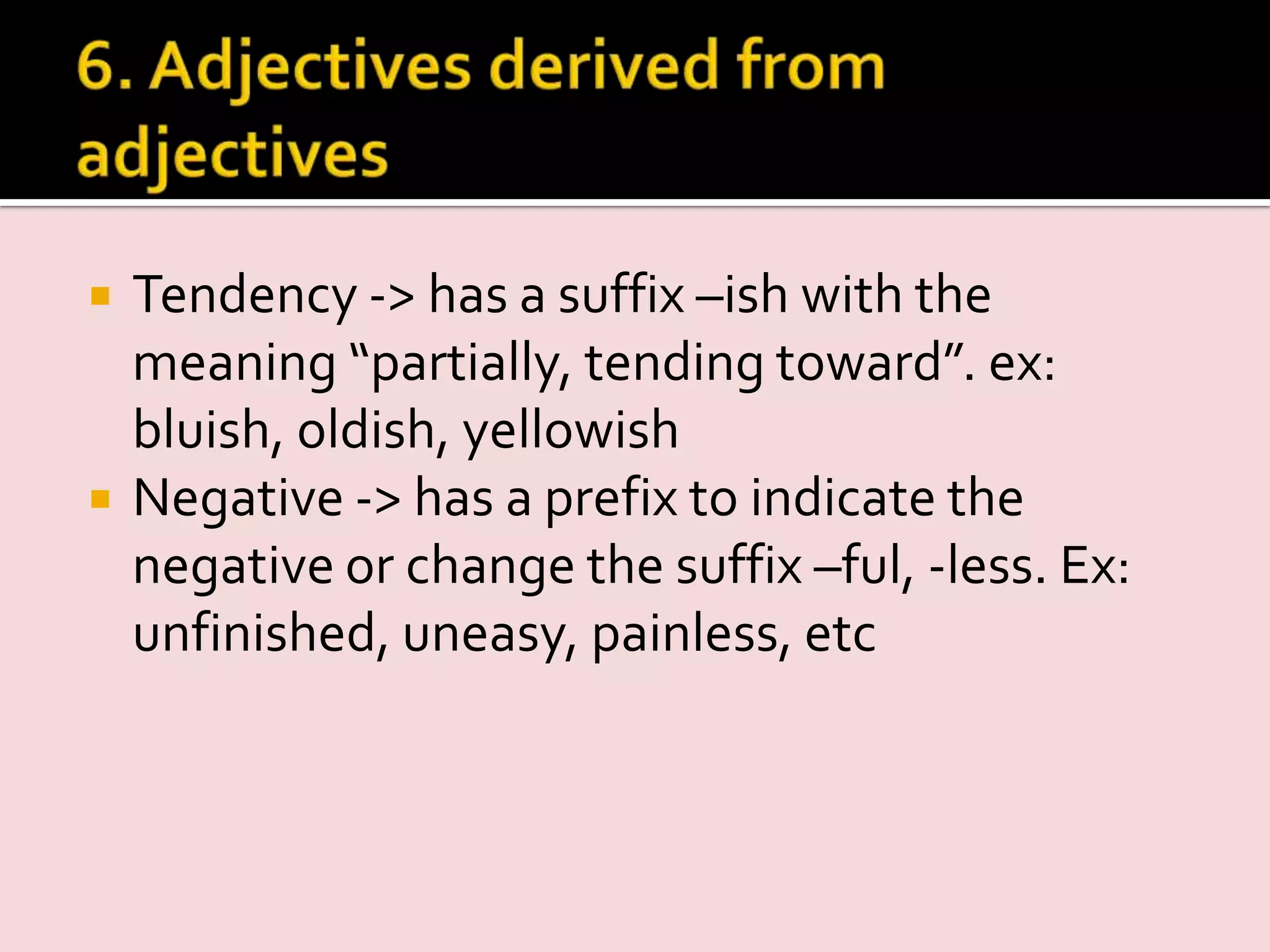
 Tendency -> has a suffix –ish with the
meaning “partially, tending toward”. ex:
bluish, oldish, yellowish
 Negative -> has a prefix to indicate the
negative or change the suffix –ful, -less. Ex:
unfinished, uneasy, painless, etc
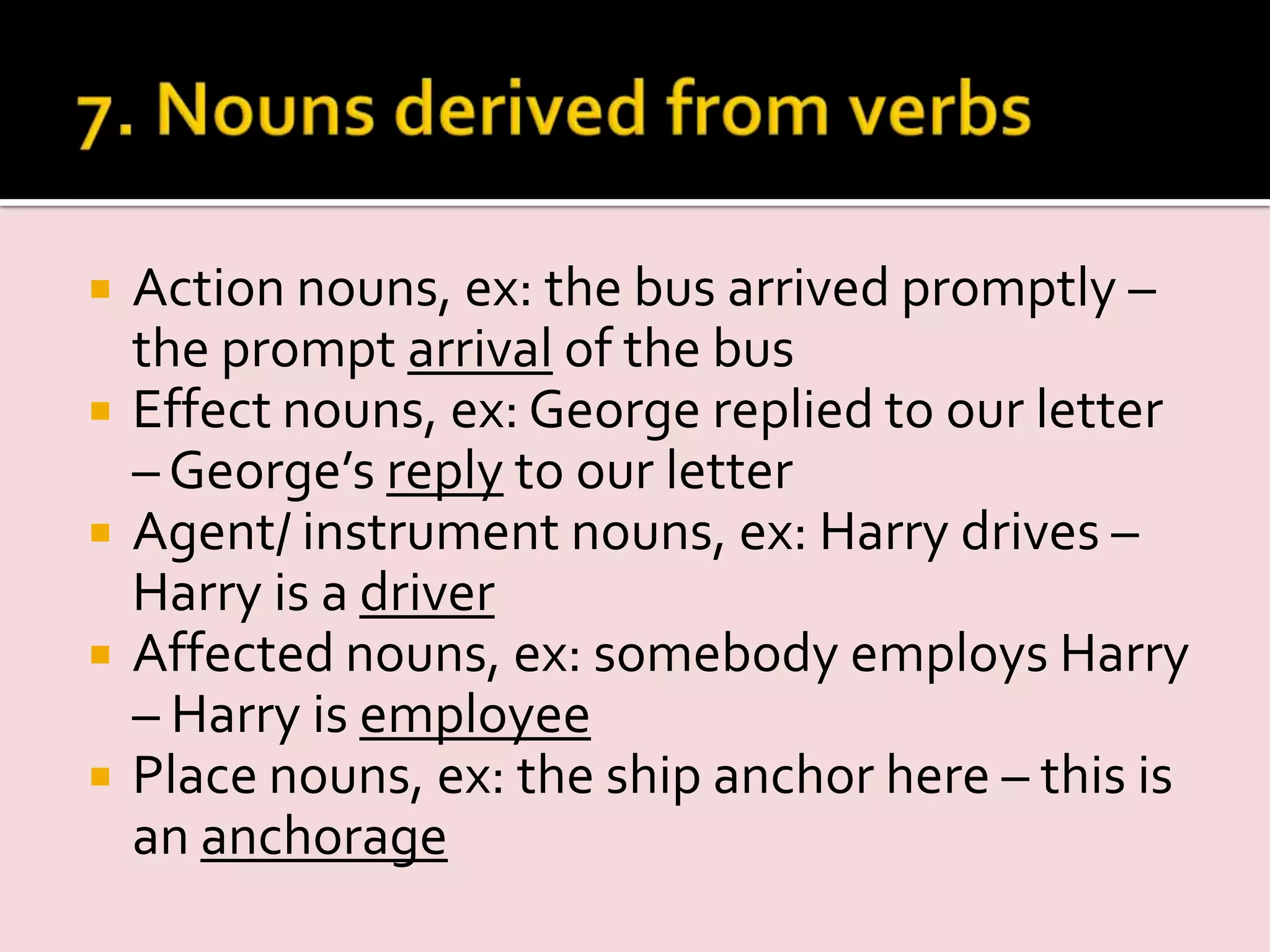
 Action nouns, ex: the bus arrived promptly –
the prompt arrival of the bus
 Effect nouns, ex: George replied to our letter
– George’s reply to our letter
 Agent/ instrument nouns, ex: Harry drives –
Harry is a driver
 Affected nouns, ex: somebody employs Harry
– Harry is employee
 Place nouns, ex: the ship anchor here – this is
an anchorage
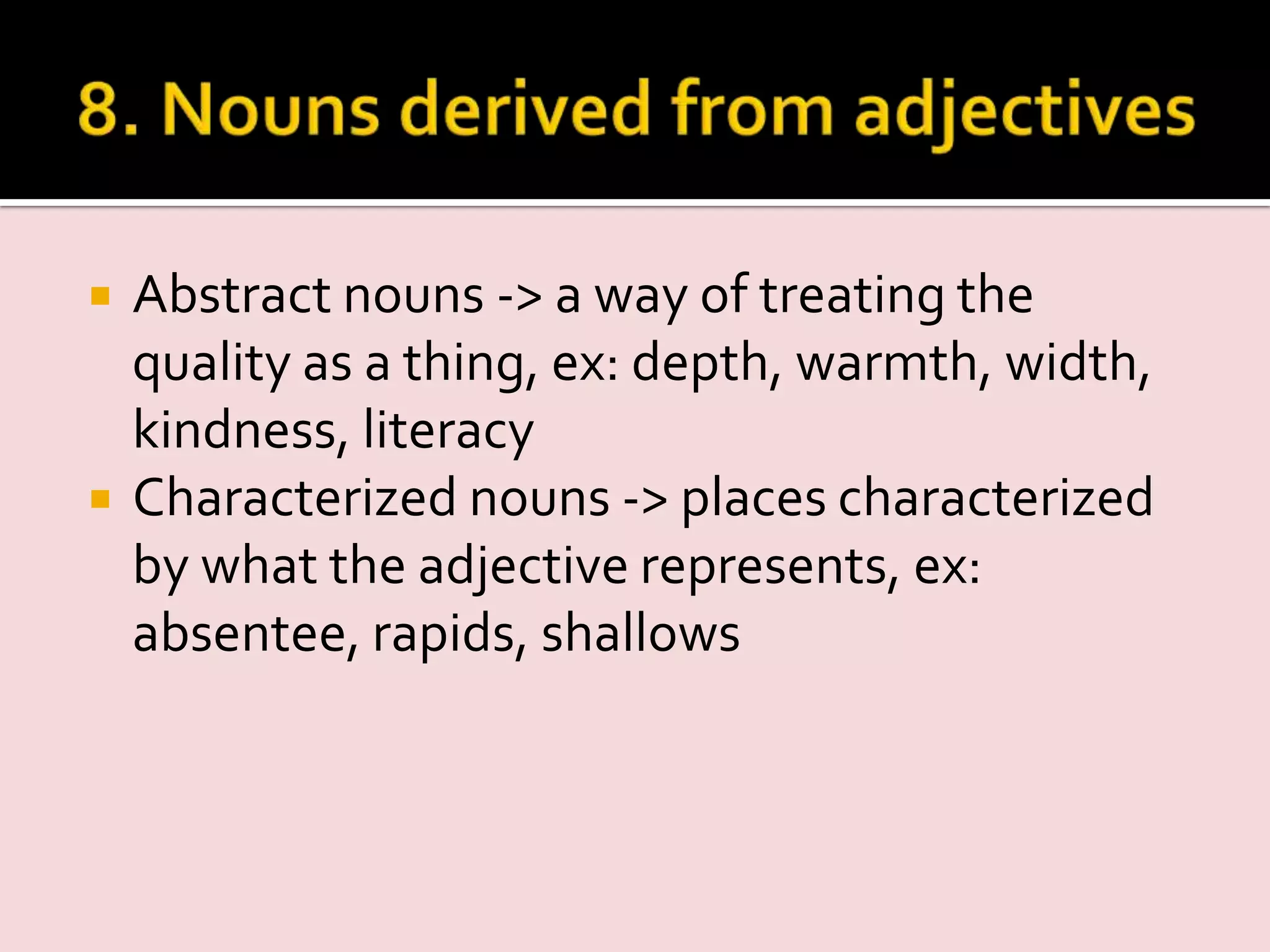
 Abstract nouns -> a way of treating the
quality as a thing, ex: depth, warmth, width,
kindness, literacy
 Characterized nouns -> places characterized
by what the adjective represents, ex:
absentee, rapids, shallows
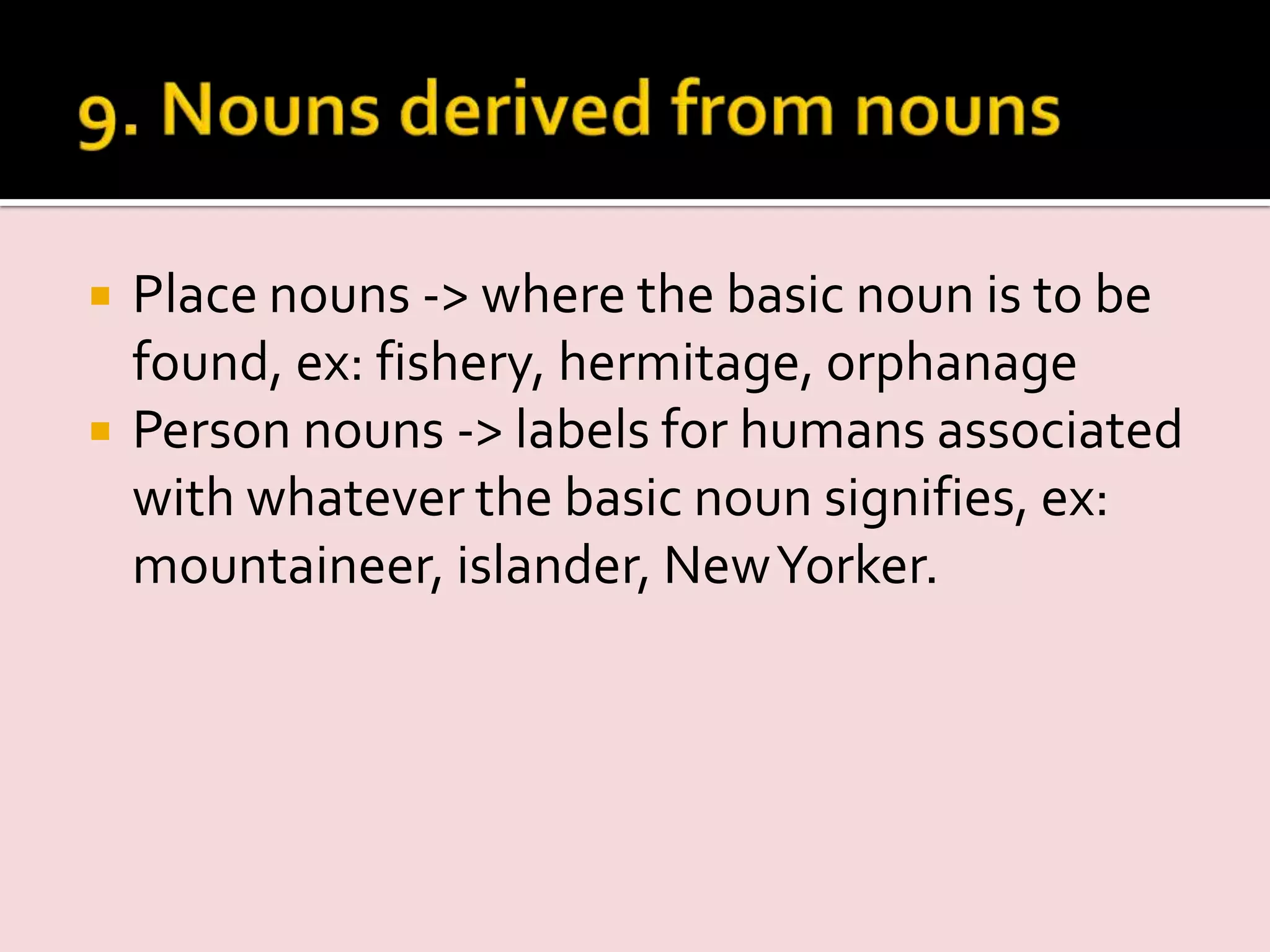
 Place nouns -> where the basic noun is to be
found, ex: fishery, hermitage, orphanage
 Person nouns -> labels for humans associated
with whatever the basic noun signifies, ex:
mountaineer, islander, NewYorker.

The semantic of morphological relations

  • 1.
    By : Pristya RiefcaSari (1105085031) Rustiah (1105085048) Yunita Bone (1105085041)
  • 2.
     Addition :some lexemes are formed by combining morphemes, ex : armchair, busybody  Mutation :change of vowel, change of consonant, or both and by change of stress. Ex: proud -> pride, believe -> belief, choose -> choice, insult -> insύlt  Conversion or zero change : the simple change of a word of one class to another with no formal alliteration. Ex: clean, dry, equal (adjective, also verb)  Subtraction (or reduction) : by removing parts of certain lexemes new lexemes are formed (acronym and clipping)
  • 3.
     Nouns represententities ; verb represents activities ; adjective represents qualities or characteristic.  When a verb converted to a noun, the noun may refer to concrete entity – a person, object or place associated with what the verb signifies.
  • 4.
     When averb is derived from a noun, an entity becomes a predicate an entity or status- losing its quantifiable nature but becoming part of a tense – aspect system  A noun or verb converted to an adjective gives a word that names a quality associated with some entity.
  • 5.
    a.Transfer meanings  Rogerpainted the wall -> put paint on the wall  Susan peeled an apple -> remove the peel from an apple  We’re bottling wine -> putting wine in bottle  They’re mining coal -> removing coal from mine
  • 6.
     The accidentcrippled my friend -> cause him to be a cripple  She babies her husband -> make him like a baby.
  • 7.
     Harry lockedthe door -> use the lock with respect to the door  Lucy penned the note -> use a pen to write a note
  • 8.
     Sandra isskating from here to the corner -> move (oneself) on skate  The company is trucking from the mine to the factory -> move (something) by truck
  • 9.
     Causative ex :Ella dried the dishes -> Ella caused the dishes to be dry.  Inchoative ex:The towels dried ->The towels become dry.
  • 10.
     Repetitive (prefix re- ) ex: re-write, re-capture, re-tell  Reversive ( ‘undoing’ prefix, namely un-,de- or dis-) ex: fold – unfold, lock – unlock  Privative (remove or detach N) ex: arm – disarm, cover – uncover , load – unload
  • 11.
     Active –subjective (-ing) ex: amusing, charming, interesting ex: this book is boring (to me)  Passive – objective (-ed, -en) ex: amused, broken, interested ex: I am bored (with / by this book)
  • 12.
     The adjectivemeans “like N”, ex: childish -> like a child  The adjective means “having (some quantity of) N, affected by N, displaying N”, ex: muddy -> having mud  Some adjectives mean “leading to N, likely to produce N” ex: healthful -> leading to (good) health.
  • 13.
     Tendency ->has a suffix –ish with the meaning “partially, tending toward”. ex: bluish, oldish, yellowish  Negative -> has a prefix to indicate the negative or change the suffix –ful, -less. Ex: unfinished, uneasy, painless, etc
  • 14.
     Action nouns,ex: the bus arrived promptly – the prompt arrival of the bus  Effect nouns, ex: George replied to our letter – George’s reply to our letter  Agent/ instrument nouns, ex: Harry drives – Harry is a driver  Affected nouns, ex: somebody employs Harry – Harry is employee  Place nouns, ex: the ship anchor here – this is an anchorage
  • 15.
     Abstract nouns-> a way of treating the quality as a thing, ex: depth, warmth, width, kindness, literacy  Characterized nouns -> places characterized by what the adjective represents, ex: absentee, rapids, shallows
  • 16.
     Place nouns-> where the basic noun is to be found, ex: fishery, hermitage, orphanage  Person nouns -> labels for humans associated with whatever the basic noun signifies, ex: mountaineer, islander, NewYorker.