Prose – written/spoken language that is arranged into sentences and paragraphsWritten/spoken language artistically arranged into lines instead of sentences, and stanzas instead of paragraphsPOETRY
 2 purposes1. To express emotionsLYRIC POETRY2. To tell a storyNarrative poetry
Example of Lyric Poetry“I’m Nobody” by Emily DickensonPg. 672Disc 7, track 32
Example of Narrative Poetry“How I Learned English” By Gregory DjanikianPg. 637Disc 7 track 24
MeterThe rhythm created by the words in a poemRhyme schemeA regular pattern of rhyming words in a poem
Limerick by Edward Learhttp://www.poetry-online.org/limericks.htmThere was a young lady whose chin	 AResembled the point of a pin;			 AShe had it made sharp,				 BAnd purchased a harp,				 BAnd played several tunes with her chin. A
2 Types of Poetry based on Arrangement of Rhythm & RhymePoetry that has meter and may have rhyme schemeTRADITIONAL2. Poetry that has no meter or rhyme scheme FREE VERSE
Example of Traditional Poetry“Sarah Cynthia Sylvia Stout Would Not Take the Garbage Out”By Shel Silversteinpg. 650
Example of Free Verse Poetry“One” by James Berrypg. 652disc 7 track 25
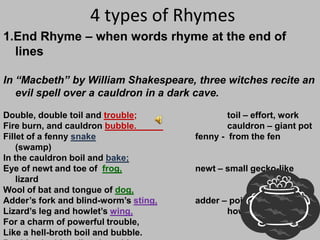
4 types of Rhymes1.End Rhyme – when words rhyme at the end of linesIn “Macbeth” by William Shakespeare, three witches recite an evil spell over a cauldron in a dark cave. Double, double toil and trouble;			toil – effort, workFire burn, and cauldron bubble.			cauldron – giant potFillet of a fenny snake                       		fenny -  from the fen (swamp)In the cauldron boil and bake;Eye of newt and toe of  frog,		newt – small gecko-like lizardWool of bat and tongue of dog,Adder’s fork and blind-worm’s sting,		adder – poisonous snakeLizard’s leg and howlet’swing,howlet – owlFor a charm of powerful trouble,Like a hell-broth boil and bubble.Double, double toil and trouble;Fire burn, and cauldron bubble.
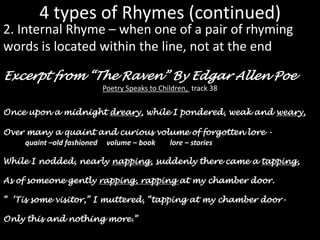
4 types of Rhymes (continued)2. Internal Rhyme – when one of a pair of rhyming words is located within the line, not at the endExcerpt from “The Raven” By Edgar Allen PoePoetry Speaks to Children,  track 38Once upon a midnight dreary, while I pondered, weak and weary,Over many a quaint and curious volume of forgotten lore - quaint –old fashioned     volume – book        lore – storiesWhile I nodded, nearly napping, suddenly there came a tapping,As of someone gently rapping, rapping at my chamber door.“  ‘Tis some visitor,” I muttered, “tapping at my chamber door-Only this and nothing more.”
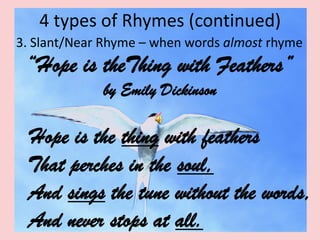
4 types of Rhymes (continued)    3. Slant/Near Rhyme – when words almost rhyme“Hope is theThing with Feathers” by Emily DickinsonHope is the thing with feathers     That perches in the soul,    And sings the tune without the words,    And never stops at all.
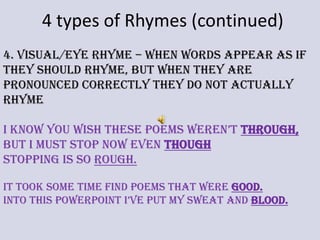
4 types of Rhymes (continued)4. Visual/Eye Rhyme – when words appear as if they should rhyme, but when they are pronounced correctly they do not actually  rhymeI know you wish these poems weren’t through,But I must stop now even thoughStopping is so rough. It took some time find poems that were good.Into this PowerPoint I’ve put my sweat and blood.
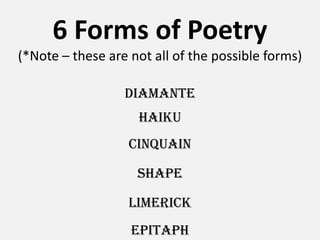
6 Forms of Poetry(*Note – these are not all of the possible forms)DIAMANTEHAIKUCINQUAINSHAPELIMERICKEPITAPH
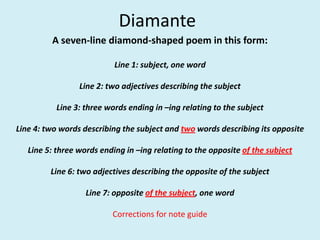
DiamanteA seven-line diamond-shaped poem in this form:Line 1: subject, one wordLine 2: two adjectives describing the subjectLine 3: three words ending in –ing relating to the subjectLine 4: two words describing the subject and two words describing its oppositeLine 5: three words ending in –ing relating to the opposite of the subjectLine 6: two adjectives describing the opposite of the subjectLine 7: opposite of the subject, one wordCorrections for note guide
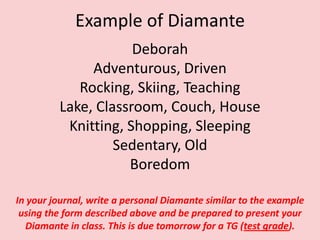
Example of DiamanteDeborahAdventurous, DrivenRocking, Skiing, TeachingLake, Classroom, Couch, HouseKnitting, Shopping, SleepingSedentary, OldBoredomIn your journal, write a personal Diamante similar to the example using the form described above and be prepared to present your Diamante in class. This is due tomorrow for a TG (test grade).
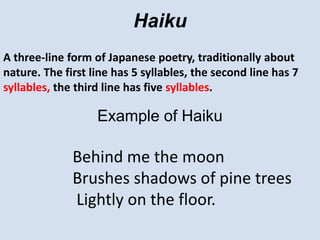
HaikuA three-line form of Japanese poetry, traditionally about nature. The first line has 5 syllables, the second line has 7 syllables, the third line has five syllables.Example of HaikuBehind me the moonBrushes shadows of pine trees Lightly on the floor.
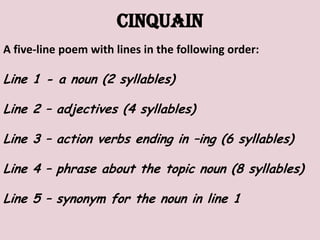
CinquainA five-line poem with lines in the following order:Line 1 - a noun (2 syllables)Line 2 – adjectives (4 syllables)Line 3 – action verbs ending in –ing (6 syllables)Line 4 – phrase about the topic noun (8 syllables)Line 5 – synonym for the noun in line 1
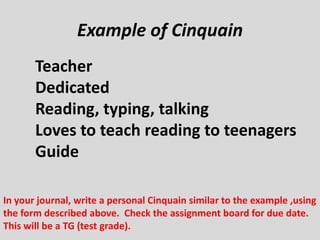
Example of CinquainTeacherDedicatedReading, typing, talkingLoves to teach reading to teenagersGuideIn your journal, write a personal Cinquain similar to the example ,using the form described above.  Check the assignment board for due date. This will be a TG (test grade).
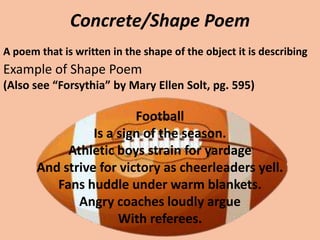
Concrete/Shape PoemA poem that is written in the shape of the object it is describingExample of Shape Poem(Also see “Forsythia” by Mary Ellen Solt, pg. 595)FootballIs a sign of the season. Athletic boys strain for yardageAnd strive for victory as cheerleaders yell.Fans huddle under warm blankets.Angry coaches loudly argueWith referees.
LimerickA humorous poem with five lines where lines one, two, and five rhyme with each other, and lines three and four rhyme with each otherExample of LimerickThere once was a teacher named Deb,Who came dressed one day late from her bed,Her boss got so madHe said, “Enough I have had!”So he fired that teacher named Deb.
EpitaphA brief, memorial statement for a dead person, often inscribed on a tombstone
Film director Alfred Hitchcock suggested this epitaph for himself.I’m involved in a plot.
From an anonymous tombstone…Poorly lived,And poorly died. Poorly buried, And no one cried.
From the tombstone of Milla GaylordSoon ripe,Soon rotten,Soon gone,But not forgotten.
UnknownI told you I was sick.
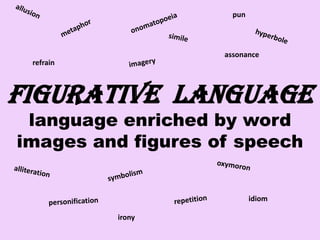
punonomatopoeiaallusionmetaphorsimilehyperboleassonanceimageryFigurative  language language enriched by word images and figures of speechrefrainoxymoronalliterationsymbolismrepetitionidiompersonificationirony
Simile – comparison of two things that are essentially different, usually using the word like or asHer serve came over the net like a bullet from a gun!He ran down the field as fast and graceful as a gazelle.
Metaphor – a comparison in which the author describes a person or thing using words that are not meant to be taken literally without (not)using the words like  or asHer serve was a bullet coming over the net. He was a gazelle running down the field.
Personification – representing non-human things or abstractions  (ideas, concepts) as having human qualitiesThe wind whispered through the trees. The rock stood stubbornly in our path.
Repetition – the act of repeating for emphasis or effectI walked slowly out the door, slowly down the street, slowly away from home.
Hyperbole – an intentionally exaggerated figure of speech used for emphasis or effect“If she doesn’t go with me to the dance, I’m going to die!” he said.
Idiom – an expression particular to a given language that has a different meaning from the literal/denotative meaning of its individual words,a figure of speechI have to take my hat off to her; she really did a great job!
Refrain – a group of words repeated at key intervals in poetry, similar to the chorus of the songWill you eat them with a mouse?Will you eat them in a house?I will not eat them with a mouse.I will not eat them in a house. I will not eat them Sam I am. I will not eat green eggs and ham!
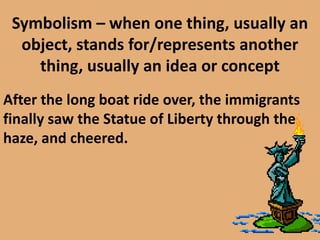
Symbolism – when one thing, usually an object, stands for/represents another thing, usually an idea or conceptAfter the long boat ride over, the immigrants finally saw the Statue of Liberty through the haze, and cheered.
Imagery – writing that appeals to one of the five senses to create a vivid (intense, life-like) image in the reader’s mindWhen he opened his locker after three months of summer he was knocked back by a mixed cloud composed of a rancid tuna fish sandwich, sweaty gym socks, and mold.The baby’s hair was like the silky, soft fur on a new born puppy.
Dialect – the idioms, pronunciations, and connotations associated with a language spoken by people in a particular region or by a particular group of people“Son, you and your buddies ain’t got not reason to talk to your mamas like that! I’m fixin’ to set y’all straight!My peeps be diggin’ on my kicks, homes.
Alliteration – the repetition of beginning consonant sounds to draw the reader’s attention to specific words or to create a sense of imageryHe drudged through the deep, dark, damp forest.
Assonance – the repetition of vowel sounds to draw the reader’s attention to specific words or to create a sense of imageryThe wind swished and whispered through the willows.
Onomatopoeia – the use of words that imitate soundsThe bees buzz, the snakes hiss, the dogs bark, and the cats meow in the busy meadow.
Oxymoron – combination of two seemingly contradictory (they do not go together) words/termsShe was pretty ugly!When you go into the interview just act natural.
Pun – a play on words, sometimes using multiple-meaning words and sometimes using homophones (two words that sound the same but are spelled differently)Did you hear about the guy that got his whole left side cut off? He’s alright now. My friend crashed his luxury car into a tree. He really found out how the Mercedes bends!
Irony – the opposite of what was expectedThe health food guru died of a heart attack. She walked into the dark, still house and crept across the room. Chills ran up her back as she flipped the switch and heard voices say…”Surprise! Happy Birthday!”
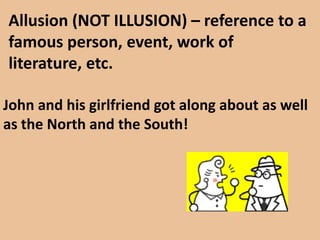
Allusion (NOT ILLUSION) – reference to a famous person, event, work of literature, etc.John and his girlfriend got along about as well as the North and the South!
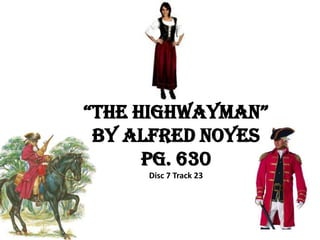
“The Highwayman” by Alfred Noyespg. 630Disc 7 Track 23

Poetry pp

  • 1.
    Prose – written/spokenlanguage that is arranged into sentences and paragraphsWritten/spoken language artistically arranged into lines instead of sentences, and stanzas instead of paragraphsPOETRY
  • 2.
    2 purposes1.To express emotionsLYRIC POETRY2. To tell a storyNarrative poetry
  • 3.
    Example of LyricPoetry“I’m Nobody” by Emily DickensonPg. 672Disc 7, track 32
  • 4.
    Example of NarrativePoetry“How I Learned English” By Gregory DjanikianPg. 637Disc 7 track 24
  • 5.
    MeterThe rhythm createdby the words in a poemRhyme schemeA regular pattern of rhyming words in a poem
  • 6.
    Limerick by EdwardLearhttp://www.poetry-online.org/limericks.htmThere was a young lady whose chin AResembled the point of a pin; AShe had it made sharp, BAnd purchased a harp, BAnd played several tunes with her chin. A
  • 7.
    2 Types ofPoetry based on Arrangement of Rhythm & RhymePoetry that has meter and may have rhyme schemeTRADITIONAL2. Poetry that has no meter or rhyme scheme FREE VERSE
  • 8.
    Example of TraditionalPoetry“Sarah Cynthia Sylvia Stout Would Not Take the Garbage Out”By Shel Silversteinpg. 650
  • 9.
    Example of FreeVerse Poetry“One” by James Berrypg. 652disc 7 track 25
  • 10.
    4 types ofRhymes1.End Rhyme – when words rhyme at the end of linesIn “Macbeth” by William Shakespeare, three witches recite an evil spell over a cauldron in a dark cave. Double, double toil and trouble; toil – effort, workFire burn, and cauldron bubble. cauldron – giant potFillet of a fenny snake fenny - from the fen (swamp)In the cauldron boil and bake;Eye of newt and toe of frog, newt – small gecko-like lizardWool of bat and tongue of dog,Adder’s fork and blind-worm’s sting, adder – poisonous snakeLizard’s leg and howlet’swing,howlet – owlFor a charm of powerful trouble,Like a hell-broth boil and bubble.Double, double toil and trouble;Fire burn, and cauldron bubble.
  • 11.
    4 types ofRhymes (continued)2. Internal Rhyme – when one of a pair of rhyming words is located within the line, not at the endExcerpt from “The Raven” By Edgar Allen PoePoetry Speaks to Children, track 38Once upon a midnight dreary, while I pondered, weak and weary,Over many a quaint and curious volume of forgotten lore - quaint –old fashioned volume – book lore – storiesWhile I nodded, nearly napping, suddenly there came a tapping,As of someone gently rapping, rapping at my chamber door.“ ‘Tis some visitor,” I muttered, “tapping at my chamber door-Only this and nothing more.”
  • 12.
    4 types ofRhymes (continued) 3. Slant/Near Rhyme – when words almost rhyme“Hope is theThing with Feathers” by Emily DickinsonHope is the thing with feathers That perches in the soul, And sings the tune without the words, And never stops at all.
  • 13.
    4 types ofRhymes (continued)4. Visual/Eye Rhyme – when words appear as if they should rhyme, but when they are pronounced correctly they do not actually rhymeI know you wish these poems weren’t through,But I must stop now even thoughStopping is so rough. It took some time find poems that were good.Into this PowerPoint I’ve put my sweat and blood.
  • 14.
    6 Forms ofPoetry(*Note – these are not all of the possible forms)DIAMANTEHAIKUCINQUAINSHAPELIMERICKEPITAPH
  • 15.
    DiamanteA seven-line diamond-shapedpoem in this form:Line 1: subject, one wordLine 2: two adjectives describing the subjectLine 3: three words ending in –ing relating to the subjectLine 4: two words describing the subject and two words describing its oppositeLine 5: three words ending in –ing relating to the opposite of the subjectLine 6: two adjectives describing the opposite of the subjectLine 7: opposite of the subject, one wordCorrections for note guide
  • 16.
    Example of DiamanteDeborahAdventurous,DrivenRocking, Skiing, TeachingLake, Classroom, Couch, HouseKnitting, Shopping, SleepingSedentary, OldBoredomIn your journal, write a personal Diamante similar to the example using the form described above and be prepared to present your Diamante in class. This is due tomorrow for a TG (test grade).
  • 17.
    HaikuA three-line formof Japanese poetry, traditionally about nature. The first line has 5 syllables, the second line has 7 syllables, the third line has five syllables.Example of HaikuBehind me the moonBrushes shadows of pine trees Lightly on the floor.
  • 18.
    CinquainA five-line poemwith lines in the following order:Line 1 - a noun (2 syllables)Line 2 – adjectives (4 syllables)Line 3 – action verbs ending in –ing (6 syllables)Line 4 – phrase about the topic noun (8 syllables)Line 5 – synonym for the noun in line 1
  • 19.
    Example of CinquainTeacherDedicatedReading,typing, talkingLoves to teach reading to teenagersGuideIn your journal, write a personal Cinquain similar to the example ,using the form described above. Check the assignment board for due date. This will be a TG (test grade).
  • 20.
    Concrete/Shape PoemA poemthat is written in the shape of the object it is describingExample of Shape Poem(Also see “Forsythia” by Mary Ellen Solt, pg. 595)FootballIs a sign of the season. Athletic boys strain for yardageAnd strive for victory as cheerleaders yell.Fans huddle under warm blankets.Angry coaches loudly argueWith referees.
  • 21.
    LimerickA humorous poemwith five lines where lines one, two, and five rhyme with each other, and lines three and four rhyme with each otherExample of LimerickThere once was a teacher named Deb,Who came dressed one day late from her bed,Her boss got so madHe said, “Enough I have had!”So he fired that teacher named Deb.
  • 22.
    EpitaphA brief, memorialstatement for a dead person, often inscribed on a tombstone
  • 23.
    Film director AlfredHitchcock suggested this epitaph for himself.I’m involved in a plot.
  • 24.
    From an anonymoustombstone…Poorly lived,And poorly died. Poorly buried, And no one cried.
  • 25.
    From the tombstoneof Milla GaylordSoon ripe,Soon rotten,Soon gone,But not forgotten.
  • 26.
    UnknownI told youI was sick.
  • 27.
    punonomatopoeiaallusionmetaphorsimilehyperboleassonanceimageryFigurative languagelanguage enriched by word images and figures of speechrefrainoxymoronalliterationsymbolismrepetitionidiompersonificationirony
  • 28.
    Simile – comparisonof two things that are essentially different, usually using the word like or asHer serve came over the net like a bullet from a gun!He ran down the field as fast and graceful as a gazelle.
  • 29.
    Metaphor – acomparison in which the author describes a person or thing using words that are not meant to be taken literally without (not)using the words like or asHer serve was a bullet coming over the net. He was a gazelle running down the field.
  • 30.
    Personification – representingnon-human things or abstractions (ideas, concepts) as having human qualitiesThe wind whispered through the trees. The rock stood stubbornly in our path.
  • 31.
    Repetition – theact of repeating for emphasis or effectI walked slowly out the door, slowly down the street, slowly away from home.
  • 32.
    Hyperbole – anintentionally exaggerated figure of speech used for emphasis or effect“If she doesn’t go with me to the dance, I’m going to die!” he said.
  • 33.
    Idiom – anexpression particular to a given language that has a different meaning from the literal/denotative meaning of its individual words,a figure of speechI have to take my hat off to her; she really did a great job!
  • 34.
    Refrain – agroup of words repeated at key intervals in poetry, similar to the chorus of the songWill you eat them with a mouse?Will you eat them in a house?I will not eat them with a mouse.I will not eat them in a house. I will not eat them Sam I am. I will not eat green eggs and ham!
  • 35.
    Symbolism – whenone thing, usually an object, stands for/represents another thing, usually an idea or conceptAfter the long boat ride over, the immigrants finally saw the Statue of Liberty through the haze, and cheered.
  • 36.
    Imagery – writingthat appeals to one of the five senses to create a vivid (intense, life-like) image in the reader’s mindWhen he opened his locker after three months of summer he was knocked back by a mixed cloud composed of a rancid tuna fish sandwich, sweaty gym socks, and mold.The baby’s hair was like the silky, soft fur on a new born puppy.
  • 37.
    Dialect – theidioms, pronunciations, and connotations associated with a language spoken by people in a particular region or by a particular group of people“Son, you and your buddies ain’t got not reason to talk to your mamas like that! I’m fixin’ to set y’all straight!My peeps be diggin’ on my kicks, homes.
  • 38.
    Alliteration – therepetition of beginning consonant sounds to draw the reader’s attention to specific words or to create a sense of imageryHe drudged through the deep, dark, damp forest.
  • 39.
    Assonance – therepetition of vowel sounds to draw the reader’s attention to specific words or to create a sense of imageryThe wind swished and whispered through the willows.
  • 40.
    Onomatopoeia – theuse of words that imitate soundsThe bees buzz, the snakes hiss, the dogs bark, and the cats meow in the busy meadow.
  • 41.
    Oxymoron – combinationof two seemingly contradictory (they do not go together) words/termsShe was pretty ugly!When you go into the interview just act natural.
  • 42.
    Pun – aplay on words, sometimes using multiple-meaning words and sometimes using homophones (two words that sound the same but are spelled differently)Did you hear about the guy that got his whole left side cut off? He’s alright now. My friend crashed his luxury car into a tree. He really found out how the Mercedes bends!
  • 43.
    Irony – theopposite of what was expectedThe health food guru died of a heart attack. She walked into the dark, still house and crept across the room. Chills ran up her back as she flipped the switch and heard voices say…”Surprise! Happy Birthday!”
  • 44.
    Allusion (NOT ILLUSION)– reference to a famous person, event, work of literature, etc.John and his girlfriend got along about as well as the North and the South!
  • 45.
    “The Highwayman” byAlfred Noyespg. 630Disc 7 Track 23