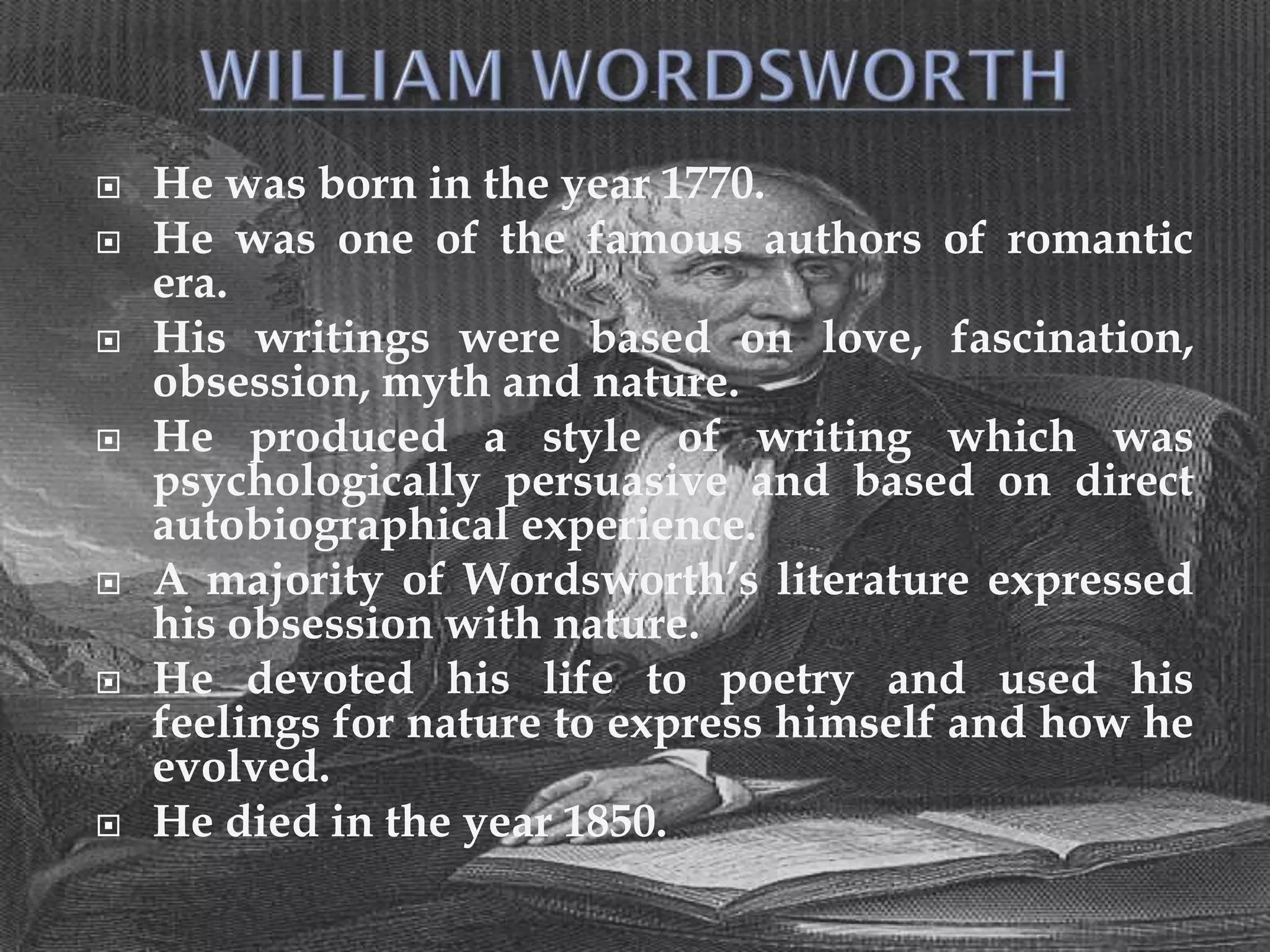
   He was born in the year 1770.
   He was one of the famous authors of romantic
    era.
   His writings were based on love, fascination,
    obsession, myth and nature.
   He produced a style of writing which was
    psychologically persuasive and based on direct
    autobiographical experience.
   A majority of Wordsworth‟s literature expressed
    his obsession with nature.
   He devoted his life to poetry and used his
    feelings for nature to express himself and how he
    evolved.
   He died in the year 1850.
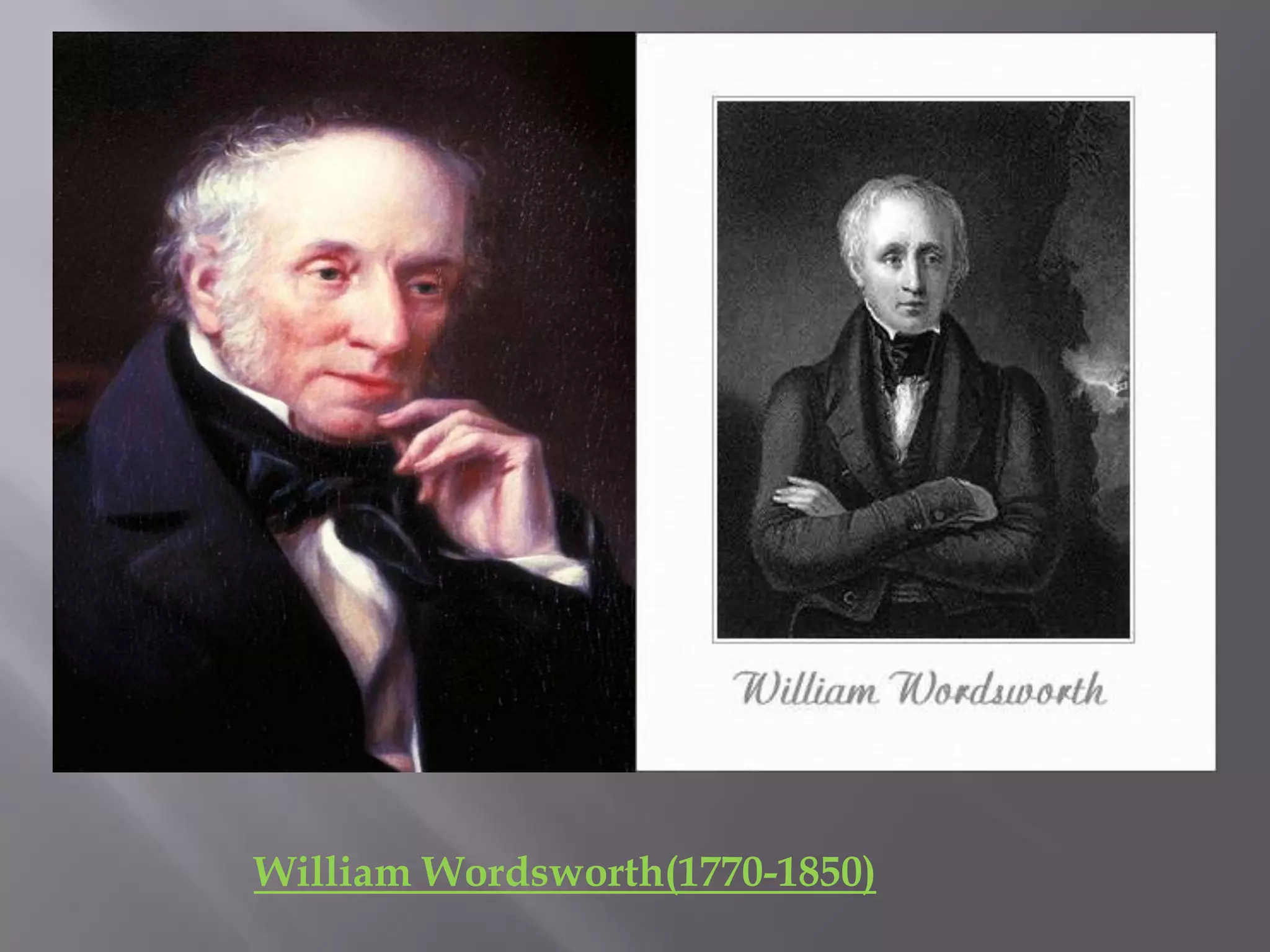
William Wordsworth(1770-1850)
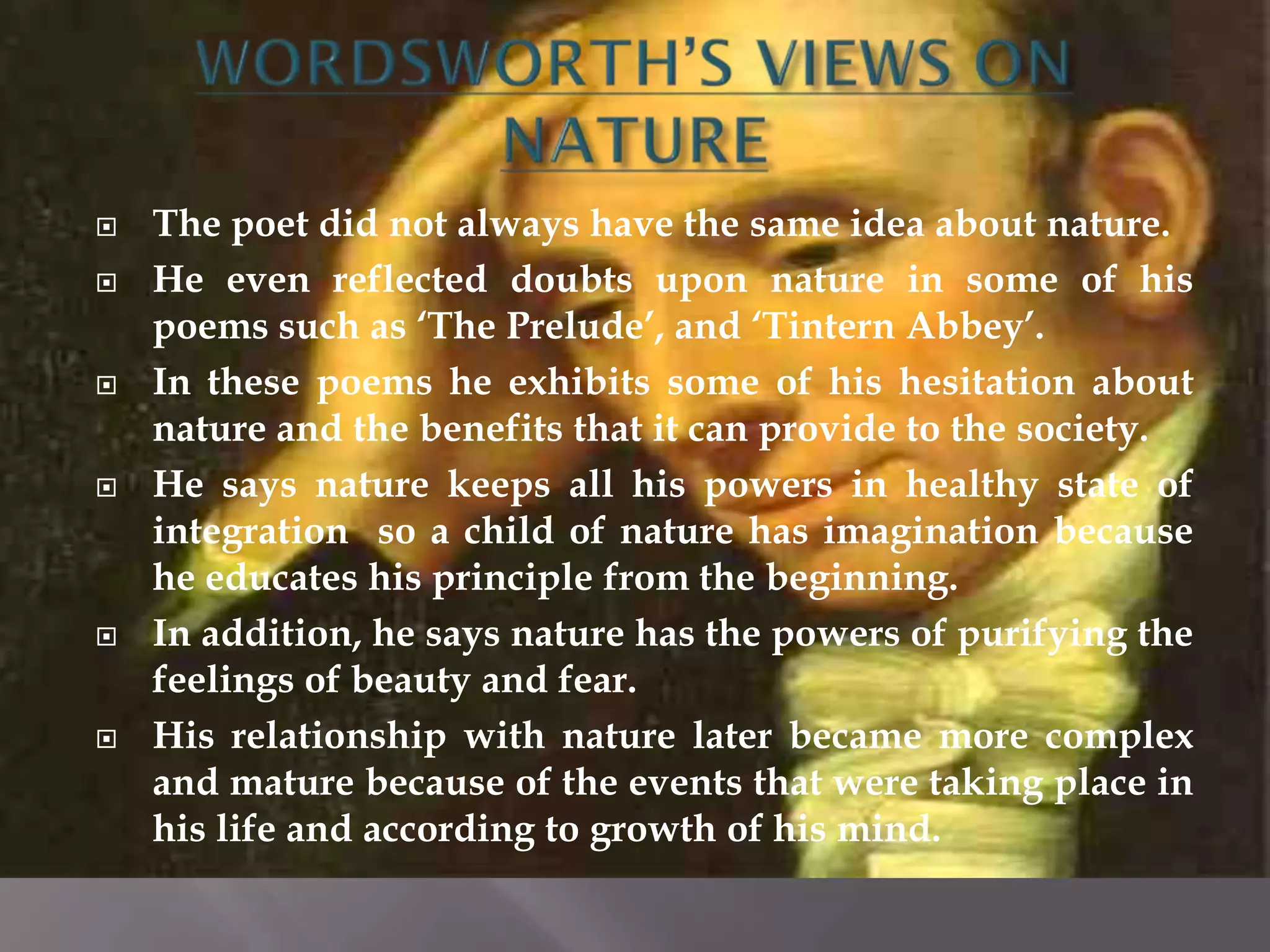
   The poet did not always have the same idea about nature.
   He even reflected doubts upon nature in some of his
    poems such as „The Prelude‟, and „Tintern Abbey‟.
   In these poems he exhibits some of his hesitation about
    nature and the benefits that it can provide to the society.
   He says nature keeps all his powers in healthy state of
    integration so a child of nature has imagination because
    he educates his principle from the beginning.
   In addition, he says nature has the powers of purifying the
    feelings of beauty and fear.
   His relationship with nature later became more complex
    and mature because of the events that were taking place in
    his life and according to growth of his mind.
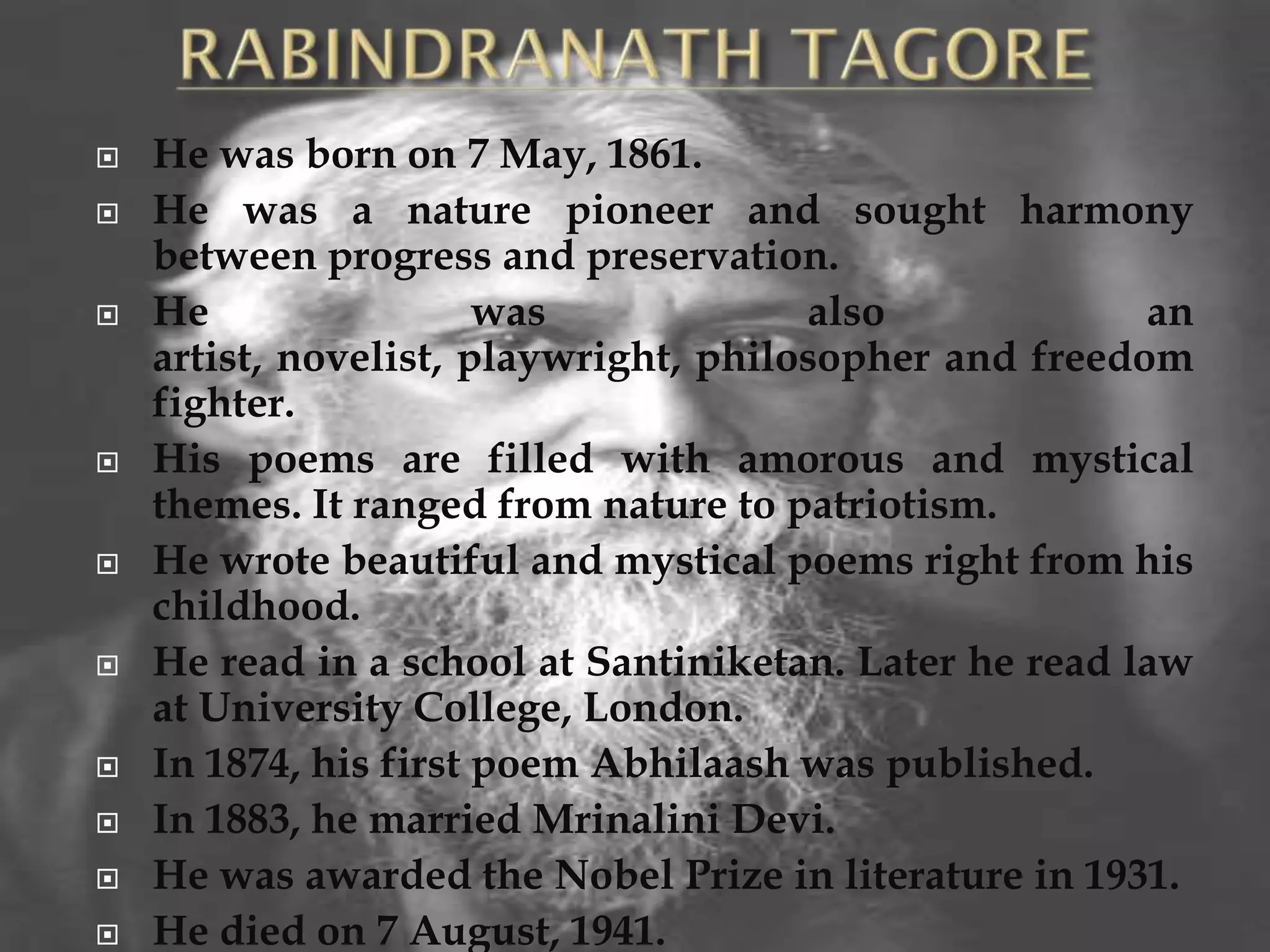
   He was born on 7 May, 1861.
   He was a nature pioneer and sought harmony
    between progress and preservation.
   He                 was             also             an
    artist, novelist, playwright, philosopher and freedom
    fighter.
   His poems are filled with amorous and mystical
    themes. It ranged from nature to patriotism.
   He wrote beautiful and mystical poems right from his
    childhood.
   He read in a school at Santiniketan. Later he read law
    at University College, London.
   In 1874, his first poem Abhilaash was published.
   In 1883, he married Mrinalini Devi.
   He was awarded the Nobel Prize in literature in 1931.
   He died on 7 August, 1941.
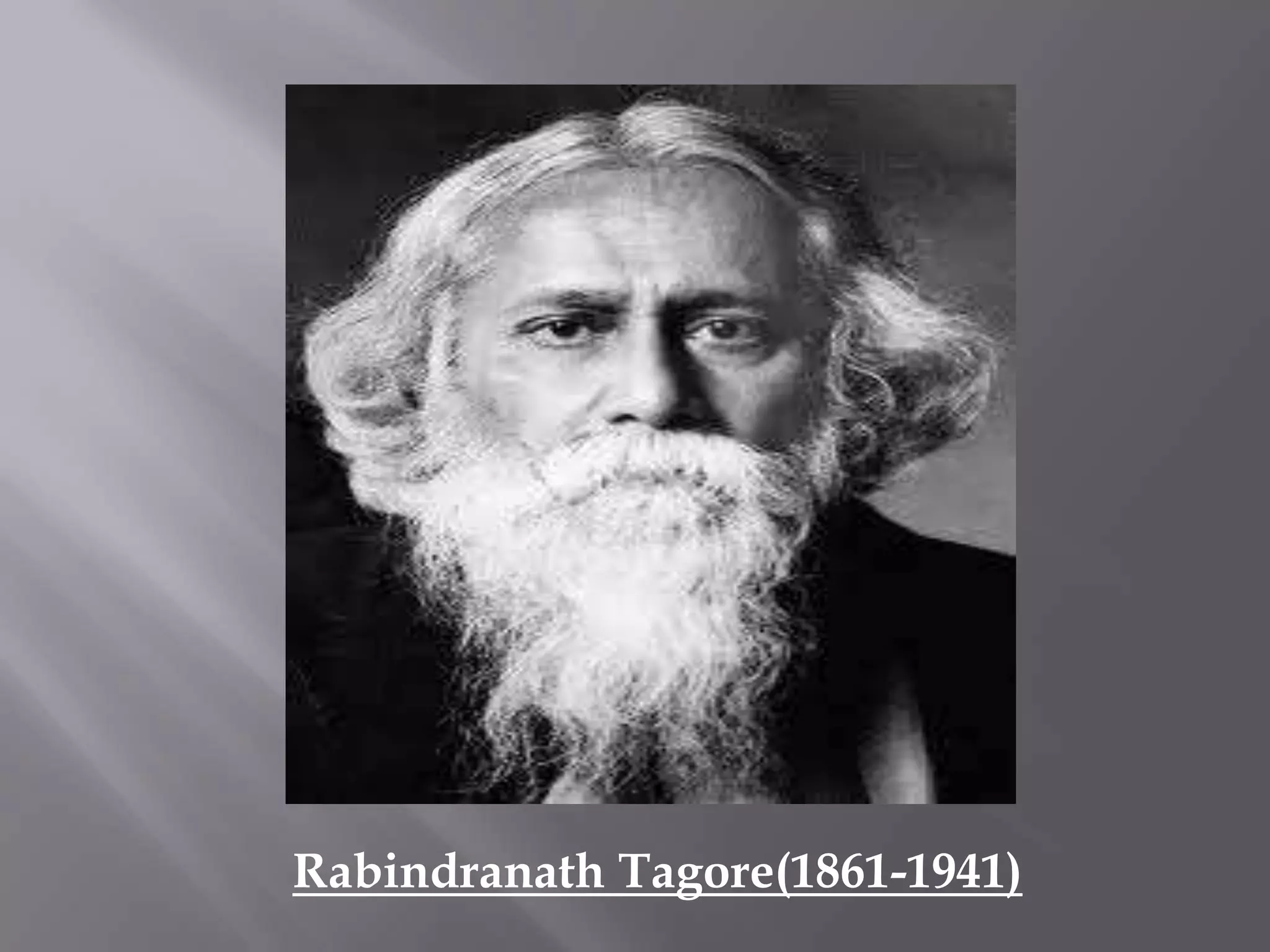
Rabindranath Tagore(1861-1941)
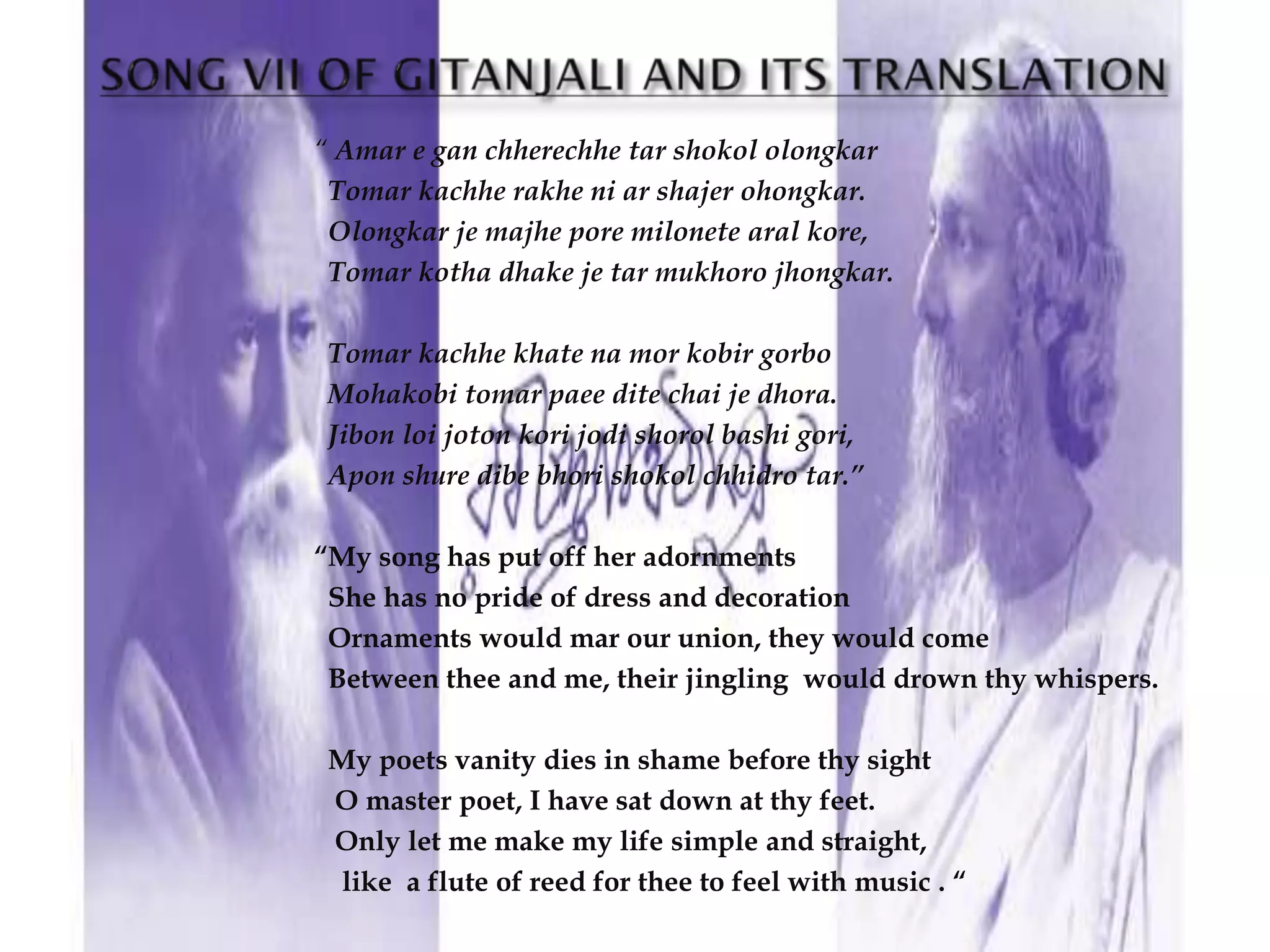
“ Amar e gan chherechhe tar shokol olongkar
 Tomar kachhe rakhe ni ar shajer ohongkar.
 Olongkar je majhe pore milonete aral kore,
 Tomar kotha dhake je tar mukhoro jhongkar.

 Tomar kachhe khate na mor kobir gorbo
 Mohakobi tomar paee dite chai je dhora.
 Jibon loi joton kori jodi shorol bashi gori,
 Apon shure dibe bhori shokol chhidro tar.”

“My song has put off her adornments
 She has no pride of dress and decoration
 Ornaments would mar our union, they would come
 Between thee and me, their jingling would drown thy whispers.

 My poets vanity dies in shame before thy sight
 O master poet, I have sat down at thy feet.
 Only let me make my life simple and straight,
  like a flute of reed for thee to feel with music . “
“The earth paints a portrait of the sun at dawn
      with sunflowers in bloom.
      Unhappy with the portrait,
      she erases it and paints it again and again.”
                                 --Rabindranath Tagore


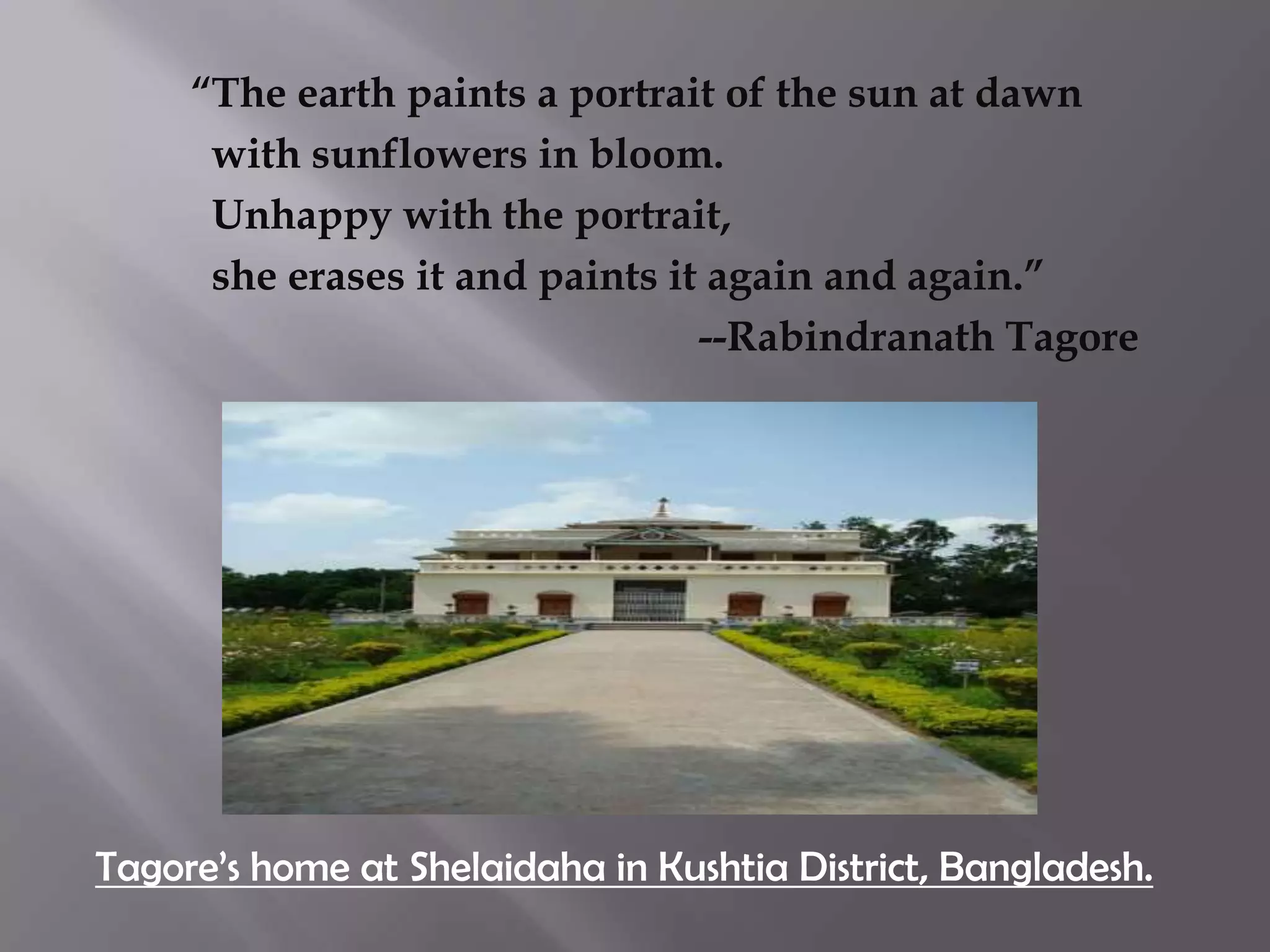
Tagore’s home at Shelaidaha in Kushtia District, Bangladesh.
   He was a nature pioneer and sought harmony
    between progress and preservation.
   Nature with its colours, perfume, and beauty
    enchanted Tagore.
   However this feeling of enchantment did not
    change him, rather it freed him.
   It gave him the chance to expand to step outside
    himself.
   To him, the essence of his freedom was his love for
    the universe and nature.
   He was born in a small village at Laopara,in Kamrup
    district of Assam in 1879.
   He got high school education in Guwahati. Later, he
    worked as a teacher for few days and then went back to
    cultivation.
   During this time, he started poetic creations.
   He contributed many poems to Assamese literature.
   Raghunath had a poetic bend of mind since his early
    days.
   His poems were based on love of nature, human love
    and affection, spiritualism, devotion to knowledge and
    renunciation, etc.
   Some of his famous poems are Keteki, Karbala,
    Dahikatara, Sadari, Navamallika, etc.
   He died on 5 November, 1967.
Raghunath Choudhry (1879-1967)
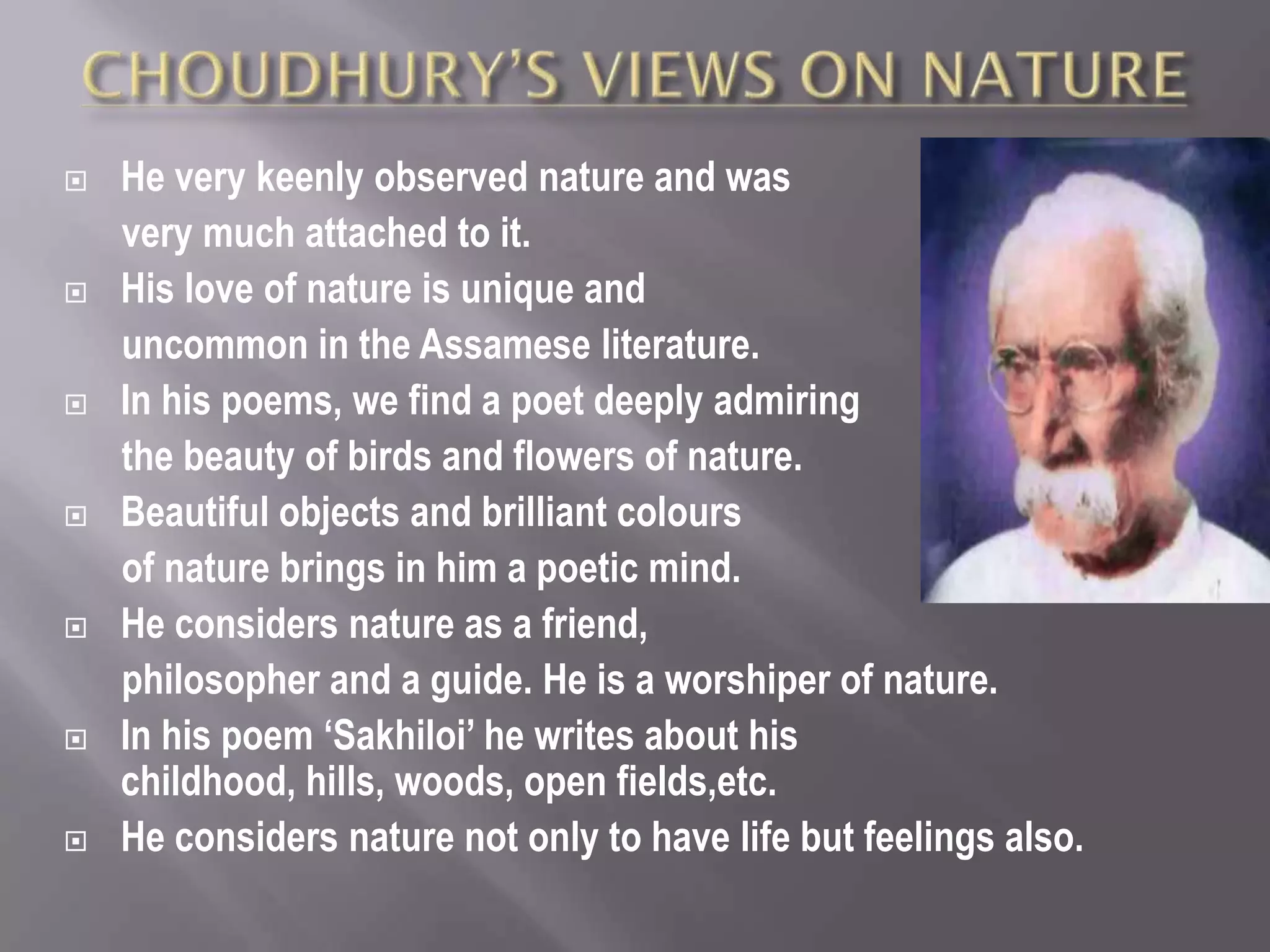
   He very keenly observed nature and was
    very much attached to it.
   His love of nature is unique and
    uncommon in the Assamese literature.
   In his poems, we find a poet deeply admiring
    the beauty of birds and flowers of nature.
   Beautiful objects and brilliant colours
    of nature brings in him a poetic mind.
   He considers nature as a friend,
    philosopher and a guide. He is a worshiper of nature.
   In his poem ‘Sakhiloi’ he writes about his
    childhood, hills, woods, open fields,etc.
   He considers nature not only to have life but feelings also.
Both    Raghunath     Choudhry    and    William
Wordsworth were worshippers of nature. The two
poets were of different ages. They believe that
nature is the guiding principle and the best
teacher for man. Both of them inspired the
thoughts of man and awakened their love for
nature with noble ideas of life. Raghunath
Choudhry explored the potential of Assamese
romantic poetry that worked as an inspiration for
younger poets to write poems with new
confidence and spirit. Both of them belonged to
different age and culture but their poems
regarding nature were completely extraordinary
and unique.
“I have travelled around the world
 to see the tallest mountains and the deepest oceans.
 But I never took a few steps from my own doorsteps
 to see the beauty in dewdrops of a blade of grass.”
                             --- Rabindranath Tagore


 The main interest of Rabindranath Tagore was the impact
 of nature on men. So he wrote a lot of poems related to
 nature and men. Tagore had deep sense of feeling for
 nature from his childhood. He feels special when he is
 among the trees and clouds. He can even feel the tune
 with the musical touch of the slogans in air.

 Tagore’s poems had also inspired a lot of younger poets
 and made them realise about the love of nature.
Tagore’s poems are somewhat similar to those of
Wordsworth’s. In Tagore’s poems we can deeply
feel the relation between men and nature.

  Similarly, in Wordsworth’s and Choudhry’s
poems we find love towards nature, the feelings
when they see flowers blooming in the green
field, birds flying in the sky and the beauty of
hills and mountains. All the three poets have
already known the real happiness to be a part of
this beautiful nature and so they have praised
this God’s creation wholeheartedly through their
writings. All these three poets can be truly

considered as lovers of nature.
Powerpoint presentation on poetry

Powerpoint presentation on poetry

  • 2.
    He was born in the year 1770.  He was one of the famous authors of romantic era.  His writings were based on love, fascination, obsession, myth and nature.  He produced a style of writing which was psychologically persuasive and based on direct autobiographical experience.  A majority of Wordsworth‟s literature expressed his obsession with nature.  He devoted his life to poetry and used his feelings for nature to express himself and how he evolved.  He died in the year 1850.
  • 3.
  • 4.
    The poet did not always have the same idea about nature.  He even reflected doubts upon nature in some of his poems such as „The Prelude‟, and „Tintern Abbey‟.  In these poems he exhibits some of his hesitation about nature and the benefits that it can provide to the society.  He says nature keeps all his powers in healthy state of integration so a child of nature has imagination because he educates his principle from the beginning.  In addition, he says nature has the powers of purifying the feelings of beauty and fear.  His relationship with nature later became more complex and mature because of the events that were taking place in his life and according to growth of his mind.
  • 5.
    He was born on 7 May, 1861.  He was a nature pioneer and sought harmony between progress and preservation.  He was also an artist, novelist, playwright, philosopher and freedom fighter.  His poems are filled with amorous and mystical themes. It ranged from nature to patriotism.  He wrote beautiful and mystical poems right from his childhood.  He read in a school at Santiniketan. Later he read law at University College, London.  In 1874, his first poem Abhilaash was published.  In 1883, he married Mrinalini Devi.  He was awarded the Nobel Prize in literature in 1931.  He died on 7 August, 1941.
  • 6.
  • 7.
    “ Amar egan chherechhe tar shokol olongkar Tomar kachhe rakhe ni ar shajer ohongkar. Olongkar je majhe pore milonete aral kore, Tomar kotha dhake je tar mukhoro jhongkar. Tomar kachhe khate na mor kobir gorbo Mohakobi tomar paee dite chai je dhora. Jibon loi joton kori jodi shorol bashi gori, Apon shure dibe bhori shokol chhidro tar.” “My song has put off her adornments She has no pride of dress and decoration Ornaments would mar our union, they would come Between thee and me, their jingling would drown thy whispers. My poets vanity dies in shame before thy sight O master poet, I have sat down at thy feet. Only let me make my life simple and straight, like a flute of reed for thee to feel with music . “
  • 8.
    “The earth paintsa portrait of the sun at dawn with sunflowers in bloom. Unhappy with the portrait, she erases it and paints it again and again.” --Rabindranath Tagore Tagore’s home at Shelaidaha in Kushtia District, Bangladesh.
  • 9.
    He was a nature pioneer and sought harmony between progress and preservation.  Nature with its colours, perfume, and beauty enchanted Tagore.  However this feeling of enchantment did not change him, rather it freed him.  It gave him the chance to expand to step outside himself.  To him, the essence of his freedom was his love for the universe and nature.
  • 10.
    He was born in a small village at Laopara,in Kamrup district of Assam in 1879.  He got high school education in Guwahati. Later, he worked as a teacher for few days and then went back to cultivation.  During this time, he started poetic creations.  He contributed many poems to Assamese literature.  Raghunath had a poetic bend of mind since his early days.  His poems were based on love of nature, human love and affection, spiritualism, devotion to knowledge and renunciation, etc.  Some of his famous poems are Keteki, Karbala, Dahikatara, Sadari, Navamallika, etc.  He died on 5 November, 1967.
  • 11.
  • 12.
    He very keenly observed nature and was very much attached to it.  His love of nature is unique and uncommon in the Assamese literature.  In his poems, we find a poet deeply admiring the beauty of birds and flowers of nature.  Beautiful objects and brilliant colours of nature brings in him a poetic mind.  He considers nature as a friend, philosopher and a guide. He is a worshiper of nature.  In his poem ‘Sakhiloi’ he writes about his childhood, hills, woods, open fields,etc.  He considers nature not only to have life but feelings also.
  • 13.
    Both Raghunath Choudhry and William Wordsworth were worshippers of nature. The two poets were of different ages. They believe that nature is the guiding principle and the best teacher for man. Both of them inspired the thoughts of man and awakened their love for nature with noble ideas of life. Raghunath Choudhry explored the potential of Assamese romantic poetry that worked as an inspiration for younger poets to write poems with new confidence and spirit. Both of them belonged to different age and culture but their poems regarding nature were completely extraordinary and unique.
  • 14.
    “I have travelledaround the world to see the tallest mountains and the deepest oceans. But I never took a few steps from my own doorsteps to see the beauty in dewdrops of a blade of grass.” --- Rabindranath Tagore The main interest of Rabindranath Tagore was the impact of nature on men. So he wrote a lot of poems related to nature and men. Tagore had deep sense of feeling for nature from his childhood. He feels special when he is among the trees and clouds. He can even feel the tune with the musical touch of the slogans in air. Tagore’s poems had also inspired a lot of younger poets and made them realise about the love of nature.
  • 15.
    Tagore’s poems aresomewhat similar to those of Wordsworth’s. In Tagore’s poems we can deeply feel the relation between men and nature. Similarly, in Wordsworth’s and Choudhry’s poems we find love towards nature, the feelings when they see flowers blooming in the green field, birds flying in the sky and the beauty of hills and mountains. All the three poets have already known the real happiness to be a part of this beautiful nature and so they have praised this God’s creation wholeheartedly through their writings. All these three poets can be truly considered as lovers of nature.