
Personal Narrative


Think of a time in your life that was particularly influential. Maybe you’ve
been on an amazing vacation or adventure. Maybe you learned a life
lesson from an unexpected source. Events from our life and the stories we
tell make us who we are and shape aspects of our personality. List a few
events from your life that have had an impact (changed the way you
see the world or yourself) either positively or negatively.
Characteristics of a Narrative
    Essay
   involves readers in the story.
   relates events in sequence.
    includes detailed observations of
    people, places, and events.
   presents important changes, contrasts, or
    conflicts and creates tension.
   is told from a point of view--usually the author's
    point of view. Focuses on connection between
    past events, people, or places and the present.
   makes a point, communicates a main idea or
    dominant impression.
More characteristics

 Generally written in the first person, that
  is, using I.
 Rely on concrete, sensory details to
  convey their point. These details should
  create a unified, forceful effect, a
  dominant impression.
 Include these story conventions: a plot,
  including setting and characters; a climax;
  and an ending.
Planning

 first, select an incident worthy of
  writing about
 second, find relevance in that incident

  (writers might ask themselves what
  about the incident provided new
  insights or awareness)
 finally, dredge up details which will
  make the incident real for readers.
Suggestions for essay
   Did you ever have a long-held belief or assumption shattered?
   Can you trace the change to one event or a series of events?
   Is there a particular experience that you observed that has had
    a profound influence on your life?
   Is there a person that who has greatly influenced you?
   Is there a decision that you had to make, or a challenge or an
    obstacle that you faced?
   Was there ever a moment in your life when you decided to
    reform, to adopt a whole new outlook?
   How would you characterize your attempt? (Successful?
    Unsuccessful? Laughable? Painful?)
Features of
Narrative Writing
Develop a Personal Voice when Writing
VOICE shows your personality when writing. The writing has a sound different from
everyone else's. It has feeling and emotion so that it does not sound boring. The reader
should be able to tell if you are happy or sad. The writer should be writing from the heart
and bring the topic to life for the reader.


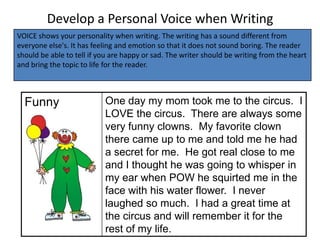
  Funny                    One day my mom took me to the circus. I
                           LOVE the circus. There are always some
                           very funny clowns. My favorite clown
                           there came up to me and told me he had
                           a secret for me. He got real close to me
                           and I thought he was going to whisper in
                           my ear when POW he squirted me in the
                           face with his water flower. I never
                           laughed so much. I had a great time at
                           the circus and will remember it for the
                           rest of my life.
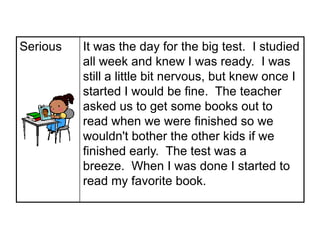
Serious   It was the day for the big test. I studied
          all week and knew I was ready. I was
          still a little bit nervous, but knew once I
          started I would be fine. The teacher
          asked us to get some books out to
          read when we were finished so we
          wouldn't bother the other kids if we
          finished early. The test was a
          breeze. When I was done I started to
          read my favorite book.
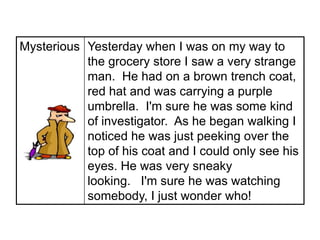
Mysterious Yesterday when I was on my way to
           the grocery store I saw a very strange
           man. He had on a brown trench coat,
           red hat and was carrying a purple
           umbrella. I'm sure he was some kind
           of investigator. As he began walking I
           noticed he was just peeking over the
           top of his coat and I could only see his
           eyes. He was very sneaky
           looking. I'm sure he was watching
           somebody, I just wonder who!
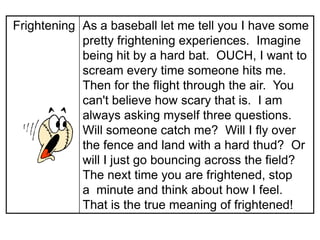
Frightening As a baseball let me tell you I have some
            pretty frightening experiences. Imagine
            being hit by a hard bat. OUCH, I want to
            scream every time someone hits me.
            Then for the flight through the air. You
            can't believe how scary that is. I am
            always asking myself three questions.
            Will someone catch me? Will I fly over
            the fence and land with a hard thud? Or
            will I just go bouncing across the field?
            The next time you are frightened, stop
            a minute and think about how I feel.
            That is the true meaning of frightened!
Opening Sentences
The Opening Sentence
To write an opening sentence which will grab the reader’s attention.
Stories can start using the following ways:
Dialogue:                    “Hands in the air this is a stick up!” he hollered roughly.
A statement:                 The school principal had to collect the boy from the roof.
Problem:                     David didn’t know what to do: the school bully, Ted was
                             expecting him to hand over five dollars and all he had
                             was fifty cents.
Action:                      Without a moments hesitation, Maude Drinkwater lifted
                             the revolver and fired.
Description of people:       Mr Sherman looked ordinary for someone who had just
                             solved one of the world’s most difficult maths problems.
Description of place:        The sky was the colour of dish water.
Description of time:         As the clock struck twelve it echoed around the hall.
Active Beginings
In order to capture your reader’s attention, the beginning of your story must be
interesting and lively enough to make your reader want to keep reading. One way to do
this is to begin with an action.
Directions: Revise each story beginning. Put your main character in the setting, and have
the character do something relevant to the story.
Example: One rainy day I went to the mall.
Revision: I splashed across the parking lot, yanked open the tall glass
          door, dripping wet, stepped into the mall.

1. Hi. My name is Kate. This is a story about the time I went to the zoo.
    Put Kate at the zoo doing something
2. This is a story about the time I built a robort in my basement.
    Put yourself in the basement doing something
3. I will tell you about my adventure swimming at the lake
    Put yourself at the lake doing something
Write an opening sentence for one of these stories using
the different ways to start a story:
   • A mysterious stranger
   • An accident
   • An act of bravery
   • The arrival of a new pet
   • A win
   • A loss
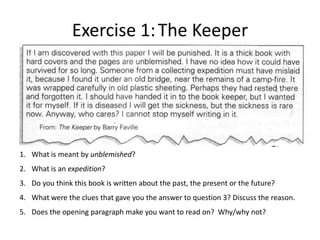
Exercise 1: The Keeper


1. What is meant by unblemished?
2. What is an expedition?
3. Do you think this book is written about the past, the present or the future?
4. What were the clues that gave you the answer to question 3? Discuss the reason.
5. Does the opening paragraph make you want to read on? Why/why not?
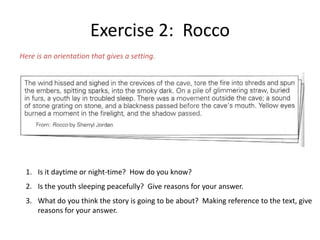
Exercise 2: Rocco
Here is an orientation that gives a setting.


  1. Is it daytime or night-time? How do you know?
  2. Is the youth sleeping peacefully? Give reasons for your answer.
  3. What do you think the story is going to be about? Making reference to the text, give
     reasons for your answer.
Improve your Plot
Who are your story’s main characters?
What are their main needs?(motives)
Who or what tries to stop or thwart them from
achieving their needs? (conflict)
Do the characters succeed or fail in achieving their
goals?
How do they succeed or fail? (resolution)
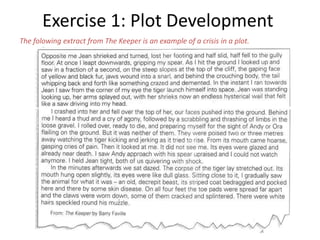
Exercise 1: Plot Development
The folowing extract from The Keeper is an example of a crisis in a plot.
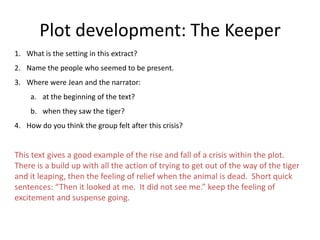
Plot development: The Keeper
1. What is the setting in this extract?
2. Name the people who seemed to be present.
3. Where were Jean and the narrator:
     a. at the beginning of the text?
     b. when they saw the tiger?
4. How do you think the group felt after this crisis?


This text gives a good example of the rise and fall of a crisis within the plot.
There is a build up with all the action of trying to get out of the way of the tiger
and it leaping, then the feeling of relief when the animal is dead. Short quick
sentences: “Then it looked at me. It did not see me.” keep the feeling of
excitement and suspense going.
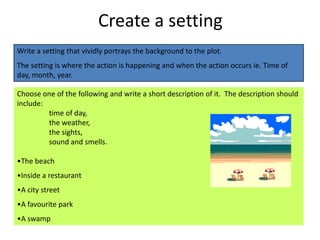
Create a setting
Write a setting that vividly portrays the background to the plot.
The setting is where the action is happening and when the action occurs ie. Time of
day, month, year.

Choose one of the following and write a short description of it. The description should
include:
         time of day,
         the weather,
         the sights,
         sound and smells.

•The beach
•Inside a restaurant
•A city street
•A favourite park
•A swamp
Add Phrases
Phrases add information and interest to short, dull sentences.
To add an adjectival phrase, you can ask questions like ‘how’, ‘when’, or ‘where’.
Adjectival phrases: The boy was a culprit.
                               The boy with a cheeky grin was a culprit.
Adverbial phrases: We skipped.
                               We skipped across the playground.
                                We skipped across the playground with great abandon
                      after our win in soccer.

 Add phrases to:
 1. The girl cried.
 2. The door opened.
 3. They killed his parents.
 4. We worked.
Join Short Sentences
Sometimes short sentences can be combined to create longer, more interesting sentences.
Example
First Draft:        The rosella was feeding in the tree. It was attacked by
           another bird. It flew away
Revised: Attacked by another bird as it fed in the tree, the rosella
         flew away.


Rewrite the following examples to turn each example into one interesting sentence.
1. It was Sunday. The cricket match was cancelled. The pitch had been ruined by rain
2. I was not pleased with my sister Natalie. She scribbled on my homework. I told mom.
3. I’ve been working all day. I’m tired. I think I’ll take a rest.
4. Every night for dinner we have boiled rice. I don’t like boiled rice. It is my least
   favourite food.
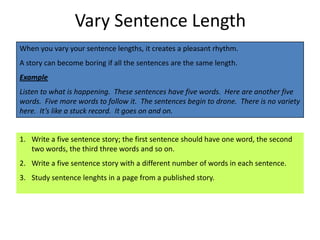
Vary Sentence Length
When you vary your sentence lengths, it creates a pleasant rhythm.
A story can become boring if all the sentences are the same length.
Example
Listen to what is happening. These sentences have five words. Here are another five
words. Five more words to follow it. The sentences begin to drone. There is no variety
here. It’s like a stuck record. It goes on and on.


1. Write a five sentence story; the first sentence should have one word, the second
   two words, the third three words and so on.
2. Write a five sentence story with a different number of words in each sentence.
3. Study sentence lenghts in a page from a published story.
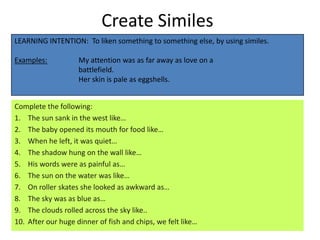
Create Similes
LEARNING INTENTION: To liken something to something else, by using similes.

Examples:           My attention was as far away as love on a
                    battlefield.
                    Her skin is pale as eggshells.


Complete the following:
1. The sun sank in the west like…
2. The baby opened its mouth for food like…
3. When he left, it was quiet…
4. The shadow hung on the wall like…
5. His words were as painful as…
6. The sun on the water was like…
7. On roller skates she looked as awkward as…
8. The sky was as blue as…
9. The clouds rolled across the sky like..
10. After our huge dinner of fish and chips, we felt like…
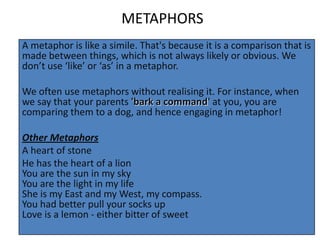
METAPHORS
A metaphor is like a simile. That's because it is a comparison that is
made between things, which is not always likely or obvious. We
don’t use ‘like’ or ‘as’ in a metaphor.

We often use metaphors without realising it. For instance, when
we say that your parents 'bark a command' at you, you are
comparing them to a dog, and hence engaging in metaphor!

Other Metaphors
A heart of stone
He has the heart of a lion
You are the sun in my sky
You are the light in my life
She is my East and my West, my compass.
You had better pull your socks up
Love is a lemon - either bitter of sweet
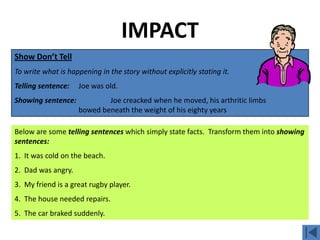
IMPACT
Show Don’t Tell
To write what is happening in the story without explicitly stating it.
Telling sentence:   Joe was old.
Showing sentence:           Joe creacked when he moved, his arthritic limbs
                    bowed beneath the weight of his eighty years

Below are some telling sentences which simply state facts. Transform them into showing
sentences:
1. It was cold on the beach.
2. Dad was angry.
3. My friend is a great rugby player.
4. The house needed repairs.
5. The car braked suddenly.
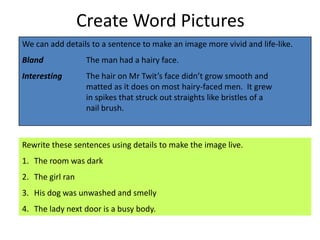
Create Word Pictures
We can add details to a sentence to make an image more vivid and life-like.
Bland              The man had a hairy face.
Interesting        The hair on Mr Twit’s face didn’t grow smooth and
                   matted as it does on most hairy-faced men. It grew
                   in spikes that struck out straights like bristles of a
                   nail brush.


Rewrite these sentences using details to make the image live.
1. The room was dark
2. The girl ran
3. His dog was unwashed and smelly
4. The lady next door is a busy body.
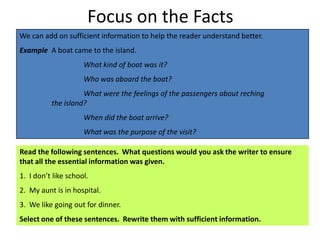
Focus on the Facts
We can add on sufficient information to help the reader understand better.
Example A boat came to the island.
                     What kind of boat was it?
                     Who was aboard the boat?
                    What were the feelings of the passengers about reching
          the island?
                     When did the boat arrive?
                     What was the purpose of the visit?

Read the following sentences. What questions would you ask the writer to ensure
that all the essential information was given.
1. I don’t like school.
2. My aunt is in hospital.
3. We like going out for dinner.
Select one of these sentences. Rewrite them with sufficient information.
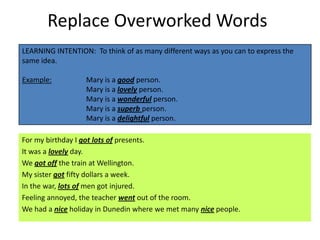
Replace Overworked Words
LEARNING INTENTION: To think of as many different ways as you can to express the
same idea.

Example:          Mary is a good person.
                  Mary is a lovely person.
                  Mary is a wonderful person.
                  Mary is a superb person.
                  Mary is a delightful person.

For my birthday I got lots of presents.
It was a lovely day.
We got off the train at Wellington.
My sister got fifty dollars a week.
In the war, lots of men got injured.
Feeling annoyed, the teacher went out of the room.
We had a nice holiday in Dunedin where we met many nice people.
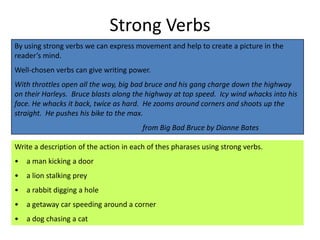
Strong Verbs
By using strong verbs we can express movement and help to create a picture in the
reader’s mind.
Well-chosen verbs can give writing power.
With throttles open all the way, big bad bruce and his gang charge down the highway
on their Harleys. Bruce blasts along the highway at top speed. Icy wind whacks into his
face. He whacks it back, twice as hard. He zooms around corners and shoots up the
straight. He pushes his bike to the max.
                                        from Big Bad Bruce by Dianne Bates

Write a description of the action in each of thes pharases using strong verbs.
•   a man kicking a door
•   a lion stalking prey
•   a rabbit digging a hole
•   a getaway car speeding around a corner
•   a dog chasing a cat

Narrative Writing

  • 1.
    Personal Narrative Think ofa time in your life that was particularly influential. Maybe you’ve been on an amazing vacation or adventure. Maybe you learned a life lesson from an unexpected source. Events from our life and the stories we tell make us who we are and shape aspects of our personality. List a few events from your life that have had an impact (changed the way you see the world or yourself) either positively or negatively.
  • 2.
    Characteristics of aNarrative Essay  involves readers in the story.  relates events in sequence.  includes detailed observations of people, places, and events.  presents important changes, contrasts, or conflicts and creates tension.  is told from a point of view--usually the author's point of view. Focuses on connection between past events, people, or places and the present.  makes a point, communicates a main idea or dominant impression.
  • 3.
    More characteristics  Generallywritten in the first person, that is, using I.  Rely on concrete, sensory details to convey their point. These details should create a unified, forceful effect, a dominant impression.  Include these story conventions: a plot, including setting and characters; a climax; and an ending.
  • 4.
    Planning  first, selectan incident worthy of writing about  second, find relevance in that incident (writers might ask themselves what about the incident provided new insights or awareness)  finally, dredge up details which will make the incident real for readers.
  • 5.
    Suggestions for essay  Did you ever have a long-held belief or assumption shattered?  Can you trace the change to one event or a series of events?  Is there a particular experience that you observed that has had a profound influence on your life?  Is there a person that who has greatly influenced you?  Is there a decision that you had to make, or a challenge or an obstacle that you faced?  Was there ever a moment in your life when you decided to reform, to adopt a whole new outlook?  How would you characterize your attempt? (Successful? Unsuccessful? Laughable? Painful?)
  • 6.
  • 7.
    Develop a PersonalVoice when Writing VOICE shows your personality when writing. The writing has a sound different from everyone else's. It has feeling and emotion so that it does not sound boring. The reader should be able to tell if you are happy or sad. The writer should be writing from the heart and bring the topic to life for the reader. Funny One day my mom took me to the circus. I LOVE the circus. There are always some very funny clowns. My favorite clown there came up to me and told me he had a secret for me. He got real close to me and I thought he was going to whisper in my ear when POW he squirted me in the face with his water flower. I never laughed so much. I had a great time at the circus and will remember it for the rest of my life.
  • 8.
    Serious It was the day for the big test. I studied all week and knew I was ready. I was still a little bit nervous, but knew once I started I would be fine. The teacher asked us to get some books out to read when we were finished so we wouldn't bother the other kids if we finished early. The test was a breeze. When I was done I started to read my favorite book.
  • 9.
    Mysterious Yesterday whenI was on my way to the grocery store I saw a very strange man. He had on a brown trench coat, red hat and was carrying a purple umbrella. I'm sure he was some kind of investigator. As he began walking I noticed he was just peeking over the top of his coat and I could only see his eyes. He was very sneaky looking. I'm sure he was watching somebody, I just wonder who!
  • 10.
    Frightening As abaseball let me tell you I have some pretty frightening experiences. Imagine being hit by a hard bat. OUCH, I want to scream every time someone hits me. Then for the flight through the air. You can't believe how scary that is. I am always asking myself three questions. Will someone catch me? Will I fly over the fence and land with a hard thud? Or will I just go bouncing across the field? The next time you are frightened, stop a minute and think about how I feel. That is the true meaning of frightened!
  • 11.
    Opening Sentences The OpeningSentence To write an opening sentence which will grab the reader’s attention. Stories can start using the following ways: Dialogue: “Hands in the air this is a stick up!” he hollered roughly. A statement: The school principal had to collect the boy from the roof. Problem: David didn’t know what to do: the school bully, Ted was expecting him to hand over five dollars and all he had was fifty cents. Action: Without a moments hesitation, Maude Drinkwater lifted the revolver and fired. Description of people: Mr Sherman looked ordinary for someone who had just solved one of the world’s most difficult maths problems. Description of place: The sky was the colour of dish water. Description of time: As the clock struck twelve it echoed around the hall.
  • 12.
    Active Beginings In orderto capture your reader’s attention, the beginning of your story must be interesting and lively enough to make your reader want to keep reading. One way to do this is to begin with an action. Directions: Revise each story beginning. Put your main character in the setting, and have the character do something relevant to the story. Example: One rainy day I went to the mall. Revision: I splashed across the parking lot, yanked open the tall glass door, dripping wet, stepped into the mall. 1. Hi. My name is Kate. This is a story about the time I went to the zoo. Put Kate at the zoo doing something 2. This is a story about the time I built a robort in my basement. Put yourself in the basement doing something 3. I will tell you about my adventure swimming at the lake Put yourself at the lake doing something
  • 13.
    Write an openingsentence for one of these stories using the different ways to start a story: • A mysterious stranger • An accident • An act of bravery • The arrival of a new pet • A win • A loss
  • 14.
    Exercise 1: TheKeeper 1. What is meant by unblemished? 2. What is an expedition? 3. Do you think this book is written about the past, the present or the future? 4. What were the clues that gave you the answer to question 3? Discuss the reason. 5. Does the opening paragraph make you want to read on? Why/why not?
  • 15.
    Exercise 2: Rocco Hereis an orientation that gives a setting. 1. Is it daytime or night-time? How do you know? 2. Is the youth sleeping peacefully? Give reasons for your answer. 3. What do you think the story is going to be about? Making reference to the text, give reasons for your answer.
  • 16.
    Improve your Plot Whoare your story’s main characters? What are their main needs?(motives) Who or what tries to stop or thwart them from achieving their needs? (conflict) Do the characters succeed or fail in achieving their goals? How do they succeed or fail? (resolution)
  • 17.
    Exercise 1: PlotDevelopment The folowing extract from The Keeper is an example of a crisis in a plot.
  • 18.
    Plot development: TheKeeper 1. What is the setting in this extract? 2. Name the people who seemed to be present. 3. Where were Jean and the narrator: a. at the beginning of the text? b. when they saw the tiger? 4. How do you think the group felt after this crisis? This text gives a good example of the rise and fall of a crisis within the plot. There is a build up with all the action of trying to get out of the way of the tiger and it leaping, then the feeling of relief when the animal is dead. Short quick sentences: “Then it looked at me. It did not see me.” keep the feeling of excitement and suspense going.
  • 19.
    Create a setting Writea setting that vividly portrays the background to the plot. The setting is where the action is happening and when the action occurs ie. Time of day, month, year. Choose one of the following and write a short description of it. The description should include: time of day, the weather, the sights, sound and smells. •The beach •Inside a restaurant •A city street •A favourite park •A swamp
  • 20.
    Add Phrases Phrases addinformation and interest to short, dull sentences. To add an adjectival phrase, you can ask questions like ‘how’, ‘when’, or ‘where’. Adjectival phrases: The boy was a culprit. The boy with a cheeky grin was a culprit. Adverbial phrases: We skipped. We skipped across the playground. We skipped across the playground with great abandon after our win in soccer. Add phrases to: 1. The girl cried. 2. The door opened. 3. They killed his parents. 4. We worked.
  • 21.
    Join Short Sentences Sometimesshort sentences can be combined to create longer, more interesting sentences. Example First Draft: The rosella was feeding in the tree. It was attacked by another bird. It flew away Revised: Attacked by another bird as it fed in the tree, the rosella flew away. Rewrite the following examples to turn each example into one interesting sentence. 1. It was Sunday. The cricket match was cancelled. The pitch had been ruined by rain 2. I was not pleased with my sister Natalie. She scribbled on my homework. I told mom. 3. I’ve been working all day. I’m tired. I think I’ll take a rest. 4. Every night for dinner we have boiled rice. I don’t like boiled rice. It is my least favourite food.
  • 22.
    Vary Sentence Length Whenyou vary your sentence lengths, it creates a pleasant rhythm. A story can become boring if all the sentences are the same length. Example Listen to what is happening. These sentences have five words. Here are another five words. Five more words to follow it. The sentences begin to drone. There is no variety here. It’s like a stuck record. It goes on and on. 1. Write a five sentence story; the first sentence should have one word, the second two words, the third three words and so on. 2. Write a five sentence story with a different number of words in each sentence. 3. Study sentence lenghts in a page from a published story.
  • 23.
    Create Similes LEARNING INTENTION:To liken something to something else, by using similes. Examples: My attention was as far away as love on a battlefield. Her skin is pale as eggshells. Complete the following: 1. The sun sank in the west like… 2. The baby opened its mouth for food like… 3. When he left, it was quiet… 4. The shadow hung on the wall like… 5. His words were as painful as… 6. The sun on the water was like… 7. On roller skates she looked as awkward as… 8. The sky was as blue as… 9. The clouds rolled across the sky like.. 10. After our huge dinner of fish and chips, we felt like…
  • 24.
    METAPHORS A metaphor islike a simile. That's because it is a comparison that is made between things, which is not always likely or obvious. We don’t use ‘like’ or ‘as’ in a metaphor. We often use metaphors without realising it. For instance, when we say that your parents 'bark a command' at you, you are comparing them to a dog, and hence engaging in metaphor! Other Metaphors A heart of stone He has the heart of a lion You are the sun in my sky You are the light in my life She is my East and my West, my compass. You had better pull your socks up Love is a lemon - either bitter of sweet
  • 25.
    IMPACT Show Don’t Tell Towrite what is happening in the story without explicitly stating it. Telling sentence: Joe was old. Showing sentence: Joe creacked when he moved, his arthritic limbs bowed beneath the weight of his eighty years Below are some telling sentences which simply state facts. Transform them into showing sentences: 1. It was cold on the beach. 2. Dad was angry. 3. My friend is a great rugby player. 4. The house needed repairs. 5. The car braked suddenly.
  • 26.
    Create Word Pictures Wecan add details to a sentence to make an image more vivid and life-like. Bland The man had a hairy face. Interesting The hair on Mr Twit’s face didn’t grow smooth and matted as it does on most hairy-faced men. It grew in spikes that struck out straights like bristles of a nail brush. Rewrite these sentences using details to make the image live. 1. The room was dark 2. The girl ran 3. His dog was unwashed and smelly 4. The lady next door is a busy body.
  • 27.
    Focus on theFacts We can add on sufficient information to help the reader understand better. Example A boat came to the island. What kind of boat was it? Who was aboard the boat? What were the feelings of the passengers about reching the island? When did the boat arrive? What was the purpose of the visit? Read the following sentences. What questions would you ask the writer to ensure that all the essential information was given. 1. I don’t like school. 2. My aunt is in hospital. 3. We like going out for dinner. Select one of these sentences. Rewrite them with sufficient information.
  • 28.
    Replace Overworked Words LEARNINGINTENTION: To think of as many different ways as you can to express the same idea. Example: Mary is a good person. Mary is a lovely person. Mary is a wonderful person. Mary is a superb person. Mary is a delightful person. For my birthday I got lots of presents. It was a lovely day. We got off the train at Wellington. My sister got fifty dollars a week. In the war, lots of men got injured. Feeling annoyed, the teacher went out of the room. We had a nice holiday in Dunedin where we met many nice people.
  • 29.
    Strong Verbs By usingstrong verbs we can express movement and help to create a picture in the reader’s mind. Well-chosen verbs can give writing power. With throttles open all the way, big bad bruce and his gang charge down the highway on their Harleys. Bruce blasts along the highway at top speed. Icy wind whacks into his face. He whacks it back, twice as hard. He zooms around corners and shoots up the straight. He pushes his bike to the max. from Big Bad Bruce by Dianne Bates Write a description of the action in each of thes pharases using strong verbs. • a man kicking a door • a lion stalking prey • a rabbit digging a hole • a getaway car speeding around a corner • a dog chasing a cat