Literary Devices:
Interesting when you read, useful when you write!
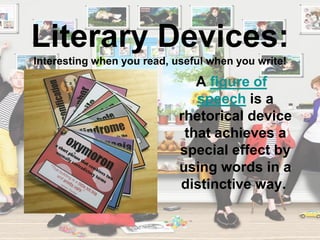
A figure of
speech is a
rhetorical device
that achieves a
special effect by
using words in a
distinctive way.
FIGURATIVE LANGUAGE
Language that has
meaning beyond the literal
meaning;also known as
“figures of speech.”
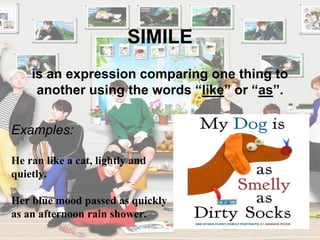
SIMILE
Examples:
He ran like a cat, lightly and
quietly.
Her blue mood passed as quickly
as an afternoon rain shower.
is an expression comparing one thing to
another using the words “like” or “as”.
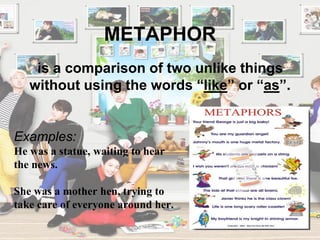
METAPHOR
Examples:
He was a statue, waiting to hear
the news.
She was a mother hen, trying to
take care of everyone around her.
is a comparison of two unlike things
without using the words “like” or “as”.
HYPERBOLE
Examples:
I’m so hungry I could eat a horse!
is an obvious exaggeration or
overstatement.
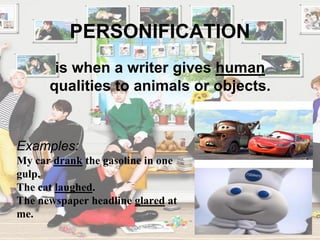
PERSONIFICATION
Examples:
My car drank the gasoline in one
gulp.
The cat laughed.
The newspaper headline glared at
me.
is when a writer gives human
qualities to animals or objects.
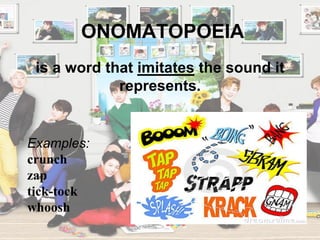
ONOMATOPOEIA
Examples:
crunch
zap
tick-tock
whoosh
is a word that imitates the sound it
represents.
IMAGERY
Examples:
The smell reminded him of rotting
tomatoes.
The fence was uneven, like baby
teeth growing awkwardly in. (also a
simile!)
is when a writer invokes the five
senses.
FORESHADOWING
Important hints that an author drops to
prepare the reader for what is to come,
and help the reader anticipate the
outcome
EXAMPLE
A pipe is going to burst, but before it does, the
author writes a scene where the family
notices a small dark spot on the ceiling, but
ignores it.
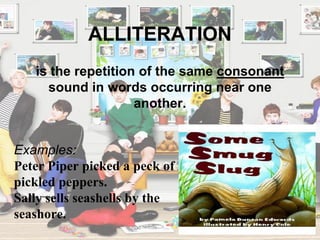
ALLITERATION
Examples:
Peter Piper picked a peck of
pickled peppers.
Sally sells seashells by the
seashore.
is the repetition of the same consonant
sound in words occurring near one
another.
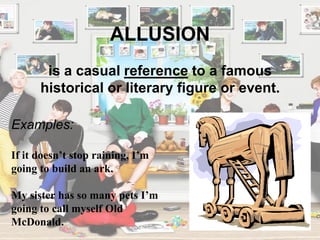
ALLUSION
Examples:
If it doesn’t stop raining, I’m
going to build an ark.
My sister has so many pets I’m
going to call myself Old
McDonald.
is a casual reference to a famous
historical or literary figure or event.
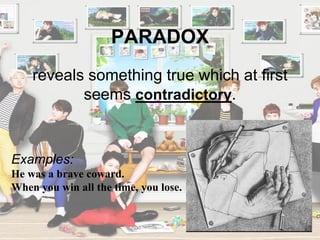
PARADOX
Examples:
He was a brave coward.
When you win all the time, you lose.
reveals something true which at first
seems contradictory.
SYMBOLISM
Examples:
Pink - the fight against breast
cancer
The Statue of Liberty - freedom
is using an object or action that means
something more than its literal
meaning.
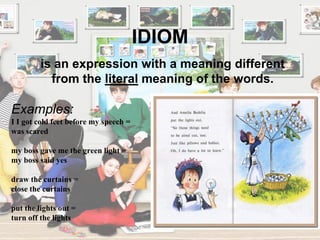
IDIOM
Examples:
I I got cold feet before my speech =
was scared
my boss gave me the green light =
my boss said yes
draw the curtains =
close the curtains
put the lights out =
turn off the lights
is an expression with a meaning different
from the literal meaning of the words.
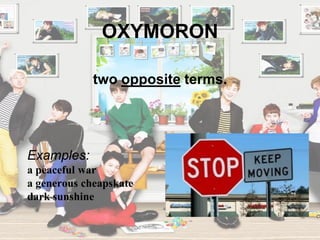
OXYMORON
Examples:
a peaceful war
a generous cheapskate
dark sunshine
two opposite terms.
EUPHEMISM
Examples:
pass away = die
vertically challenged = short
tooted = farted
let go = fired
pre-owned = used
is a polite word or phrase used in
place of one that may be too direct,
unpleasant, or embarrassing.
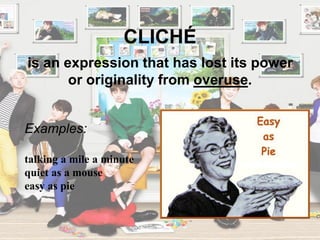
CLICHÉ
Examples:
talking a mile a minute
quiet as a mouse
easy as pie
is an expression that has lost its power
or originality from overuse.
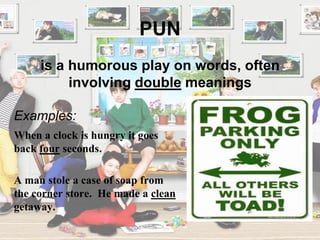
PUN
Examples:
When a clock is hungry it goes
back four seconds.
A man stole a case of soap from
the corner store. He made a clean
getaway.
is a humorous play on words, often
involving double meanings
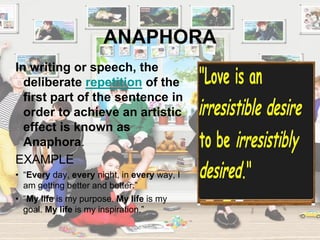
ANAPHORA
In writing or speech, the
deliberate repetition of the
first part of the sentence in
order to achieve an artistic
effect is known as
Anaphora.
EXAMPLE
• “Every day, every night, in every way, I
am getting better and better.”
• “My life is my purpose. My life is my
goal. My life is my inspiration.”
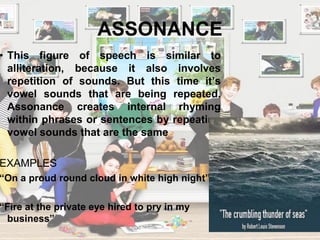
ASSONANCE
• This figure of speech is similar to
alliteration, because it also involves
repetition of sounds. But this time it’s
vowel sounds that are being repeated.
Assonance creates internal rhyming
within phrases or sentences by repeating
vowel sounds that are the same
EXAMPLES
“On a proud round cloud in white high night”
“Fire at the private eye hired to pry in my
business”
APOSTROPHE
In literature, apostrophe is a figure of
speech sometimes represented by an exclamation,
such as “Oh.” A writer or speaker, using apostrophe,
speaks directly to someone who is not present or is
dead, or speaks to an inanimate object.
EXAMPLE
“Is this a dagger which I see before me,
The handle toward my hand?
Come, let meclutch thee!
I have thee not, and yet I see thee still.”
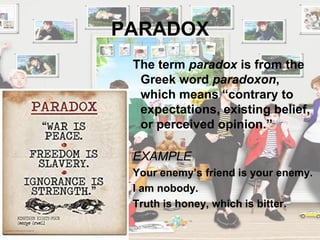
PARADOX
The term paradox is from the
Greek word paradoxon,
which means “contrary to
expectations, existing belief,
or perceived opinion.”
EXAMPLE
Your enemy’s friend is your enemy.
I am nobody.
Truth is honey, which is bitter.
Two goals:
• Identify • Use

LITERARY DEVICES

  • 1.
    Literary Devices: Interesting whenyou read, useful when you write! A figure of speech is a rhetorical device that achieves a special effect by using words in a distinctive way.
  • 2.
    FIGURATIVE LANGUAGE Language thathas meaning beyond the literal meaning;also known as “figures of speech.”
  • 3.
    SIMILE Examples: He ran likea cat, lightly and quietly. Her blue mood passed as quickly as an afternoon rain shower. is an expression comparing one thing to another using the words “like” or “as”.
  • 4.
    METAPHOR Examples: He was astatue, waiting to hear the news. She was a mother hen, trying to take care of everyone around her. is a comparison of two unlike things without using the words “like” or “as”.
  • 5.
    HYPERBOLE Examples: I’m so hungryI could eat a horse! is an obvious exaggeration or overstatement.
  • 6.
    PERSONIFICATION Examples: My car drankthe gasoline in one gulp. The cat laughed. The newspaper headline glared at me. is when a writer gives human qualities to animals or objects.
  • 7.
  • 8.
    IMAGERY Examples: The smell remindedhim of rotting tomatoes. The fence was uneven, like baby teeth growing awkwardly in. (also a simile!) is when a writer invokes the five senses.
  • 9.
    FORESHADOWING Important hints thatan author drops to prepare the reader for what is to come, and help the reader anticipate the outcome EXAMPLE A pipe is going to burst, but before it does, the author writes a scene where the family notices a small dark spot on the ceiling, but ignores it.
  • 10.
    ALLITERATION Examples: Peter Piper pickeda peck of pickled peppers. Sally sells seashells by the seashore. is the repetition of the same consonant sound in words occurring near one another.
  • 11.
    ALLUSION Examples: If it doesn’tstop raining, I’m going to build an ark. My sister has so many pets I’m going to call myself Old McDonald. is a casual reference to a famous historical or literary figure or event.
  • 12.
    PARADOX Examples: He was abrave coward. When you win all the time, you lose. reveals something true which at first seems contradictory.
  • 13.
    SYMBOLISM Examples: Pink - thefight against breast cancer The Statue of Liberty - freedom is using an object or action that means something more than its literal meaning.
  • 14.
    IDIOM Examples: I I gotcold feet before my speech = was scared my boss gave me the green light = my boss said yes draw the curtains = close the curtains put the lights out = turn off the lights is an expression with a meaning different from the literal meaning of the words.
  • 15.
    OXYMORON Examples: a peaceful war agenerous cheapskate dark sunshine two opposite terms.
  • 16.
    EUPHEMISM Examples: pass away =die vertically challenged = short tooted = farted let go = fired pre-owned = used is a polite word or phrase used in place of one that may be too direct, unpleasant, or embarrassing.
  • 17.
    CLICHÉ Examples: talking a milea minute quiet as a mouse easy as pie is an expression that has lost its power or originality from overuse.
  • 18.
    PUN Examples: When a clockis hungry it goes back four seconds. A man stole a case of soap from the corner store. He made a clean getaway. is a humorous play on words, often involving double meanings
  • 19.
    ANAPHORA In writing orspeech, the deliberate repetition of the first part of the sentence in order to achieve an artistic effect is known as Anaphora. EXAMPLE • “Every day, every night, in every way, I am getting better and better.” • “My life is my purpose. My life is my goal. My life is my inspiration.”
  • 20.
    ASSONANCE • This figureof speech is similar to alliteration, because it also involves repetition of sounds. But this time it’s vowel sounds that are being repeated. Assonance creates internal rhyming within phrases or sentences by repeating vowel sounds that are the same EXAMPLES “On a proud round cloud in white high night” “Fire at the private eye hired to pry in my business”
  • 21.
    APOSTROPHE In literature, apostropheis a figure of speech sometimes represented by an exclamation, such as “Oh.” A writer or speaker, using apostrophe, speaks directly to someone who is not present or is dead, or speaks to an inanimate object. EXAMPLE “Is this a dagger which I see before me, The handle toward my hand? Come, let meclutch thee! I have thee not, and yet I see thee still.”
  • 22.
    PARADOX The term paradoxis from the Greek word paradoxon, which means “contrary to expectations, existing belief, or perceived opinion.” EXAMPLE Your enemy’s friend is your enemy. I am nobody. Truth is honey, which is bitter.
  • 23.