What is Poetry?

         By Dominique Gerald Cimafranca
            dominique.cimafranca@gmail.com


 This work is licensed under the Creative Commons Attribution-Share Alike 3.0 Philippines License. To view a copy of this
 license, visit http://creativecommons.org/licenses/by-sa/3.0/ph/ or send a letter to Creative Commons, 171 Second Street,
 Suite 300, San Francisco, California, 94105, USA.
Starting exercise


Write a short poem, taking any topic and using any form.

  Then, let's compare it against the criteria for poetry.
Class discussion


Let's read out the poems. Which poems do we like most?

    What makes these poems especially appealing?
Four aspects of poetry
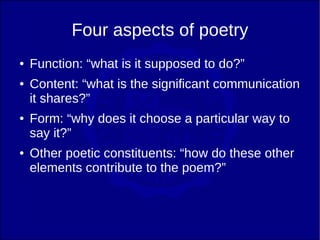
●   Function: “what is it supposed to do?”
●   Content: “what is the significant communication
    it shares?”
●   Form: “why does it choose a particular way to
    say it?”
●   Other poetic constituents: “how do these other
    elements contribute to the poem?”
Functions of poetry
●   To entertain

●   To render deep truths about the human being
    and the attributes of his reality


          “...to delight and to instruct...”
                                 --Horace
“Love Song”
Your little hands,
Your little feet,
Your little mouth –
Oh, God, how sweet!

Your little nose,
Your little ears,
Your eyes, that shed
Such little tears.

Your little voice,
So soft and kind;
Your little soul,
Your little mind!

   --Samuel Hoffenstein
Content of poetry
●   Everything is suitable poetic material.
●   The crucial substance of poetry is its human
    relevance and the philosophic truth it reveals.
●   The content of all poetry that is considered
    authentic is revealed from a point of view that is
    universal and enduring.
●   The content of poetry recognizes the
    paradoxical nature of man and the tensive
    forces under which he moves.
“The Dying Airman”
A handsome young airman lay dying,
As on the aerodrome he lay,
To the mechanics who round him came sighing,
These last words he did say:

“Take the cylinders out of my kidneys,
The connecting-rod out of my brain,
Take the cam-shaft from out of my backbone,
And assemble the engine again.”

                                   --Anonymous
“The Coming of Wisdom with Time”


    Though leaves are many, the root is one;
    Through all the lying days of my youth
    I swayed my leaves and flowers in the sun;
    Now I may wither into the truth.

                                --William Butler Yeats
Appreciating poetry at the basic level
●   The story being told by the poem.
●   The rhythm, rhyme, and other devices of sound
    that create a pleasant effect.
●   The evocative images and details that stir the
    senses and stimulate the imagination.
Appreciating poetry at the higher level
●   A poetic idea is best expressed not by statement that
    explains, but through a special use of image and situation
    that embody the idea.
●   Poetry is artistically projected by suggesting and
    condensing its insights and crucial ideas.
●   The conclusions projected by a poem are reached by a
    special use of its situations, details, and characters.
●   Some direct statements and factual details in a poem
    have a metaphysical function and are not to be
    considered merely as literal facts and assertions.
Key Point


Images and Metaphors!
Metaphor enhances
●   goes beyond the bare presentation of literal
    statement
●   allows and facilitates the reader's right to make
    his own creative response
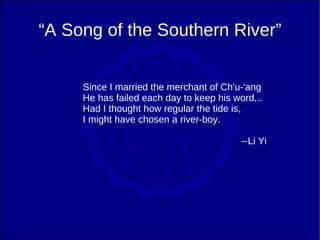
“A Song of the Southern River”


     Since I married the merchant of Ch'u-'ang
     He has failed each day to keep his word...
     Had I thought how regular the tide is,
     I might have chosen a river-boy.

                                          --Li Yi
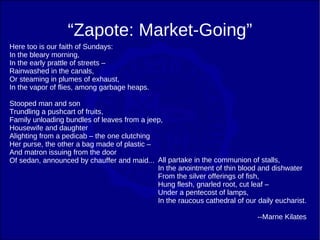
“Zapote: Market-Going”
Here too is our faith of Sundays:
In the bleary morning,
In the early prattle of streets –
Rainwashed in the canals,
Or steaming in plumes of exhaust,
In the vapor of flies, among garbage heaps.

Stooped man and son
Trundling a pushcart of fruits,
Family unloading bundles of leaves from a jeep,
Housewife and daughter
Alighting from a pedicab – the one clutching
Her purse, the other a bag made of plastic –
And matron issuing from the door
Of sedan, announced by chauffer and maid... All partake in the communion of stalls,
                                             In the anointment of thin blood and dishwater
                                             From the silver offerings of fish,
                                             Hung flesh, gnarled root, cut leaf –
                                             Under a pentecost of lamps,
                                             In the raucous cathedral of our daily eucharist.

                                                                             --Marne Kilates
Ambiguity
●   Ambiguity contributes complexity and richness
    of meaning to a poem
●   Anything ambiguous can be interpreted in two
    or more ways
Allusion
●   The special use of images and situation rather
    than statement.
●   Suggesting and condensing the use of
    ambiguous terms and positioning of certain
    components of the poem
How can we tell if it is really poetry?
●   subtlety
●   indirection
●   fresh insights
●   literary instruments
Characteristics of poetry
●   indirect, structure in metaphor
●   articulated in metaphor
●   manifested as image
●   "casting the material in metaphor or
    image...dramatic, suggestive image"
●   "without the structuring of metaphor, there is no
    poetry"
Other components of poetry
●   Theme – the core of      ●   The central symbol,
    poetry                       and the symbolic
●   Narrative base /             thread
    storyline                ●   Allusion
●   Sound as internal        ●   Varieties of diction
    device: rhythm,
    rhyme, euphony
●   Approach to the poetic
    meaning: tone or
    attitude
Technical Aspects of Poetry
External limits
●   length and formation of lines
●   meter
●   rhyme
●   rhythm
●   euphonic diction patterns
●   juxtaposition
●   typographical idiosyncracies
Internal limits
●   tone                  ●   contrast
●   nuances               ●   ellipses
●   understatement        ●   fresh stratagems and
                              insights
●   ambiguity
                          ●   inventive reproductive
●   suggestiveness
                              use of words
●   indirection           ●   internal rhyme and
●   thematic tension          alliteration
                          ●   symbolic details
Music-related attributes
●   rhythm              ●   onomatopoeia
●   metrical beat       ●   repetition
●   rhyme               ●   assonance
●   euphony             ●   dissonance
●   alliteration        ●   other sound effects
Lines
●   minimalist lines
●   long lines
●   stanzas
●   interludes
Questions?
References
●   “Introduction to Poetry”, Dr. Edith Tiempo
●   "Six Poetry Formats and the Transforming
    Image: A Monograph on Free Verse", Dr. Edith
    Tiempo
What is Poetry?

         By Dominique Gerald Cimafranca
            dominique.cimafranca@gmail.com


 This work is licensed under the Creative Commons Attribution-Share Alike 3.0 Philippines License. To view a copy of this
 license, visit http://creativecommons.org/licenses/by-sa/3.0/ph/ or send a letter to Creative Commons, 171 Second Street,
 Suite 300, San Francisco, California, 94105, USA.

Poetry

  • 1.
    What is Poetry? By Dominique Gerald Cimafranca dominique.cimafranca@gmail.com This work is licensed under the Creative Commons Attribution-Share Alike 3.0 Philippines License. To view a copy of this license, visit http://creativecommons.org/licenses/by-sa/3.0/ph/ or send a letter to Creative Commons, 171 Second Street, Suite 300, San Francisco, California, 94105, USA.
  • 2.
    Starting exercise Write ashort poem, taking any topic and using any form. Then, let's compare it against the criteria for poetry.
  • 3.
    Class discussion Let's readout the poems. Which poems do we like most? What makes these poems especially appealing?
  • 4.
    Four aspects ofpoetry ● Function: “what is it supposed to do?” ● Content: “what is the significant communication it shares?” ● Form: “why does it choose a particular way to say it?” ● Other poetic constituents: “how do these other elements contribute to the poem?”
  • 5.
    Functions of poetry ● To entertain ● To render deep truths about the human being and the attributes of his reality “...to delight and to instruct...” --Horace
  • 6.
    “Love Song” Your littlehands, Your little feet, Your little mouth – Oh, God, how sweet! Your little nose, Your little ears, Your eyes, that shed Such little tears. Your little voice, So soft and kind; Your little soul, Your little mind! --Samuel Hoffenstein
  • 7.
    Content of poetry ● Everything is suitable poetic material. ● The crucial substance of poetry is its human relevance and the philosophic truth it reveals. ● The content of all poetry that is considered authentic is revealed from a point of view that is universal and enduring. ● The content of poetry recognizes the paradoxical nature of man and the tensive forces under which he moves.
  • 8.
    “The Dying Airman” Ahandsome young airman lay dying, As on the aerodrome he lay, To the mechanics who round him came sighing, These last words he did say: “Take the cylinders out of my kidneys, The connecting-rod out of my brain, Take the cam-shaft from out of my backbone, And assemble the engine again.” --Anonymous
  • 9.
    “The Coming ofWisdom with Time” Though leaves are many, the root is one; Through all the lying days of my youth I swayed my leaves and flowers in the sun; Now I may wither into the truth. --William Butler Yeats
  • 10.
    Appreciating poetry atthe basic level ● The story being told by the poem. ● The rhythm, rhyme, and other devices of sound that create a pleasant effect. ● The evocative images and details that stir the senses and stimulate the imagination.
  • 11.
    Appreciating poetry atthe higher level ● A poetic idea is best expressed not by statement that explains, but through a special use of image and situation that embody the idea. ● Poetry is artistically projected by suggesting and condensing its insights and crucial ideas. ● The conclusions projected by a poem are reached by a special use of its situations, details, and characters. ● Some direct statements and factual details in a poem have a metaphysical function and are not to be considered merely as literal facts and assertions.
  • 12.
  • 13.
    Metaphor enhances ● goes beyond the bare presentation of literal statement ● allows and facilitates the reader's right to make his own creative response
  • 14.
    “A Song ofthe Southern River” Since I married the merchant of Ch'u-'ang He has failed each day to keep his word... Had I thought how regular the tide is, I might have chosen a river-boy. --Li Yi
  • 15.
    “Zapote: Market-Going” Here toois our faith of Sundays: In the bleary morning, In the early prattle of streets – Rainwashed in the canals, Or steaming in plumes of exhaust, In the vapor of flies, among garbage heaps. Stooped man and son Trundling a pushcart of fruits, Family unloading bundles of leaves from a jeep, Housewife and daughter Alighting from a pedicab – the one clutching Her purse, the other a bag made of plastic – And matron issuing from the door Of sedan, announced by chauffer and maid... All partake in the communion of stalls, In the anointment of thin blood and dishwater From the silver offerings of fish, Hung flesh, gnarled root, cut leaf – Under a pentecost of lamps, In the raucous cathedral of our daily eucharist. --Marne Kilates
  • 16.
    Ambiguity ● Ambiguity contributes complexity and richness of meaning to a poem ● Anything ambiguous can be interpreted in two or more ways
  • 17.
    Allusion ● The special use of images and situation rather than statement. ● Suggesting and condensing the use of ambiguous terms and positioning of certain components of the poem
  • 18.
    How can wetell if it is really poetry? ● subtlety ● indirection ● fresh insights ● literary instruments
  • 19.
    Characteristics of poetry ● indirect, structure in metaphor ● articulated in metaphor ● manifested as image ● "casting the material in metaphor or image...dramatic, suggestive image" ● "without the structuring of metaphor, there is no poetry"
  • 20.
    Other components ofpoetry ● Theme – the core of ● The central symbol, poetry and the symbolic ● Narrative base / thread storyline ● Allusion ● Sound as internal ● Varieties of diction device: rhythm, rhyme, euphony ● Approach to the poetic meaning: tone or attitude
  • 21.
  • 22.
    External limits ● length and formation of lines ● meter ● rhyme ● rhythm ● euphonic diction patterns ● juxtaposition ● typographical idiosyncracies
  • 23.
    Internal limits ● tone ● contrast ● nuances ● ellipses ● understatement ● fresh stratagems and insights ● ambiguity ● inventive reproductive ● suggestiveness use of words ● indirection ● internal rhyme and ● thematic tension alliteration ● symbolic details
  • 24.
    Music-related attributes ● rhythm ● onomatopoeia ● metrical beat ● repetition ● rhyme ● assonance ● euphony ● dissonance ● alliteration ● other sound effects
  • 25.
    Lines ● minimalist lines ● long lines ● stanzas ● interludes
  • 26.
  • 27.
    References ● “Introduction to Poetry”, Dr. Edith Tiempo ● "Six Poetry Formats and the Transforming Image: A Monograph on Free Verse", Dr. Edith Tiempo
  • 28.
    What is Poetry? By Dominique Gerald Cimafranca dominique.cimafranca@gmail.com This work is licensed under the Creative Commons Attribution-Share Alike 3.0 Philippines License. To view a copy of this license, visit http://creativecommons.org/licenses/by-sa/3.0/ph/ or send a letter to Creative Commons, 171 Second Street, Suite 300, San Francisco, California, 94105, USA.