Poetry Writing: 10 Tips
on How to Write a
Poem
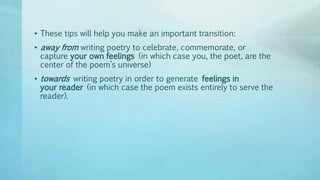
• These tips will help you make an important transition:
• away from writing poetry to celebrate, commemorate, or
capture your own feelings (in which case you, the poet, are the
center of the poem’s universe)
• towards writing poetry in order to generate feelings in
your reader (in which case the poem exists entirely to serve the
reader).
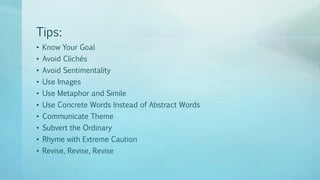
Tips:
• Know Your Goal
• Avoid Clichés
• Avoid Sentimentality
• Use Images
• Use Metaphor and Simile
• Use Concrete Words Instead of Abstract Words
• Communicate Theme
• Subvert the Ordinary
• Rhyme with Extreme Caution
• Revise, Revise, Revise
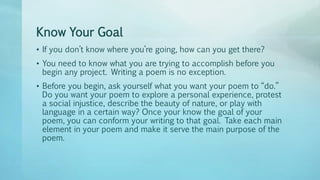
Know Your Goal
• If you don’t know where you’re going, how can you get there?
• You need to know what you are trying to accomplish before you
begin any project. Writing a poem is no exception.
• Before you begin, ask yourself what you want your poem to “do.”
Do you want your poem to explore a personal experience, protest
a social injustice, describe the beauty of nature, or play with
language in a certain way? Once your know the goal of your
poem, you can conform your writing to that goal. Take each main
element in your poem and make it serve the main purpose of the
poem.
Avoid Clichés
• Stephen Minot defines a cliché as: “A metaphor or simile that has
become so familiar from overuse that the vehicle … no longer
contributes any meaning whatever to the tenor. It provides neither
the vividness of a fresh metaphor nor the strength of a single
unmodified word….The word is also used to describe overused but
non metaphorical expressions such as ‘tried and true’ and ‘each
and every'” (Three Genres: The Writing of Poetry, Fiction and
Drama, 405).
• Cliché also describes other overused literary elements. “Familiar
plot patterns and stock characters are clichés on a big scale”
(Minot 148). Clichés can be overused themes, character types, or
plots. For example, the “Lone Ranger” cowboy is a cliché because
it has been used so many times that people no longer find it
original.
Avoid Sentimentality
• Sentimentality is “dominated by a blunt appeal to the emotions of
pity and love …. Popular subjects are puppies, grandparents, and
young lovers” “When readers have the feeling that emotions like
rage or indignation have been pushed artificially for their own
sake, they will not take the poem seriously”
• Minot says that the problem with sentimentality is that it detracts
from the literary quality of your work . If your poetry is mushy or
teary-eyed, your readers may openly rebel against your effort to
invoke emotional response in them. If that happens, they will stop
thinking about the issues you want to raise, and will instead spend
their energy trying to control their own gag reflex.
Use Images
• “BE A PAINTER IN WORDS,” says UWEC English professor emerita,
poet, and songwriter Peg Lauber. She says poetry should
stimulate six senses:
• sight
• hearing
• smell
• touch
• taste
• kinesiology (motion)
Use Metaphor and Simile
• Use metaphor and simile to bring imagery and concrete words into your
writing.
• Metaphor
– A metaphor is a statement that pretends one thing is really something else:
– Example: “The lead singer is an elusive salamander.”
– This phrase does not mean that the lead singer is literally a salamander. Rather, it
takes an abstract characteristic of a salamander (elusiveness) and projects it onto
the person. By using metaphor to describe the lead singer, the poet creates a much
more vivid picture of him/her than if the poet had simply said “The lead singer’s
voice is hard to pick out.”
• Simile
– A simile is a statement where you say one object is similar to another object.
Similes use the words “like” or “as.”
– Example: “He was curious as a caterpillar” or “He was curious, like a caterpillar”
– This phrase takes one quality of a caterpillar and projects it onto a person. It is an
easy way to attach concrete images to feelings and character traits that might
usually be described with abstract words.
Use Concrete Words Instead of Abstract
Words
• Concrete words describe things that people experience with their senses.
– orange
– warm
– cat
• A person can see orange, feel warm, or hear a cat.
• Poets use concrete words help the reader get a “picture” of what the poem is
talking about. When the reader has a “picture” of what the poem is talking
about, he/she can better understand what the poet is talking about.
• Abstract words refer to concepts or feelings.
– liberty
– happy
– love
• “Liberty” is a concept, “happy” is a feeling, and no one can agree on whether
“love” is a feeling, a concept or an action.
Communicate Theme
• Poetry always has a theme. Theme is not just a topic, but an idea with
an opinion.
• Theme = Idea + Opinion
• Topic: “The Vietnam War”
• This is not a theme. It is only a subject. It is just an event. There are no
ideas, opinions, or statements about life or of wisdom contained in this
sentence
• Theme: “History shows that despite our claims to be peace-loving,
unfortunately each person secretly dreams of gaining glory through
conflict.”
• This is a theme. It is not just an event, but a statement about an event.
It shows what the poet thinks about the event. The poet strives to show
the reader his/her theme during the entire poem, making use of literary
techniques.
Subvert the Ordinary
• Poets’ strength is the ability to see what other people see everyday in a
new way. You don’t have to be special or a literary genius to write good
poems–all you have to do is take an ordinary object, place, person, or
idea, and come up with a new perception of it.
• Example: People ride the bus everyday.
• Poets’ Interpretation: A poet looks at the people on the bus and
imagines scenes from their lives. A poet sees a sixty-year old woman
and imagines a grandmother who runs marathons. A poet sees a two-
year old boy and imagines him painting with ruby nail polish on the
toilet seat, and his mother struggling to not respond in anger.
• Take the ordinary and turn it on its head. (The word “subvert” literally
means “turn upside down”.)
Rhyme with Extreme Caution
• Rhyme and meter (the pattern of stressed and unstressed words)
can be dangerous if used the wrong way. Remember sing-song
nursery rhymes? If you choose a rhyme scheme that makes your
poem sound sing-song, it will detract from the quality of your
poem.
• I recommend that beginning poets stick to free verse. It is hard
enough to compose a poem without dealing with the intricacies of
rhyme and meter.
• If you feel ready to create a rhymed poem, refer to chapters 6-10
of Stephen Minot’s bookThree Genres: The Writing of Poetry,
Fiction, and Drama. 6th ed., for more help.
Revise, Revise, Revise
• The first completed draft of your poem is only the beginning. Poets
often go through several drafts of a poem before considering the work
“done.”
• To revise:
• Put your poem away for a few days, and then come back to it. When
you re-read it, does anything seem confusing? Hard to follow? Do you
see anything that needs improvement that you overlooked the first
time? Often, when you are in the act of writing, you may leave out
important details because you are so familiar with the topic. Re-reading
a poem helps you to see it from the “outsider’s perspective” of a
reader.
• Show your poem to others and ask for criticism. Don’t be content with a
response like, “That’s a nice poem.” You won’t learn anything from that
kind of response. Instead, find people who will tell you specific things
you need to improve in your poem.
Poetry classes Dubai
• Witty Learning Institute
• Unit 206, Goldcrest Executive Tower,
• Cluster C, Jumeirah Lake Towers – Dubai
• (+971) 4 557 9008
• info@wittylearning.ae

Poetry writing

  • 1.
    Poetry Writing: 10Tips on How to Write a Poem
  • 2.
    • These tipswill help you make an important transition: • away from writing poetry to celebrate, commemorate, or capture your own feelings (in which case you, the poet, are the center of the poem’s universe) • towards writing poetry in order to generate feelings in your reader (in which case the poem exists entirely to serve the reader).
  • 3.
    Tips: • Know YourGoal • Avoid Clichés • Avoid Sentimentality • Use Images • Use Metaphor and Simile • Use Concrete Words Instead of Abstract Words • Communicate Theme • Subvert the Ordinary • Rhyme with Extreme Caution • Revise, Revise, Revise
  • 4.
    Know Your Goal •If you don’t know where you’re going, how can you get there? • You need to know what you are trying to accomplish before you begin any project. Writing a poem is no exception. • Before you begin, ask yourself what you want your poem to “do.” Do you want your poem to explore a personal experience, protest a social injustice, describe the beauty of nature, or play with language in a certain way? Once your know the goal of your poem, you can conform your writing to that goal. Take each main element in your poem and make it serve the main purpose of the poem.
  • 5.
    Avoid Clichés • StephenMinot defines a cliché as: “A metaphor or simile that has become so familiar from overuse that the vehicle … no longer contributes any meaning whatever to the tenor. It provides neither the vividness of a fresh metaphor nor the strength of a single unmodified word….The word is also used to describe overused but non metaphorical expressions such as ‘tried and true’ and ‘each and every'” (Three Genres: The Writing of Poetry, Fiction and Drama, 405). • Cliché also describes other overused literary elements. “Familiar plot patterns and stock characters are clichés on a big scale” (Minot 148). Clichés can be overused themes, character types, or plots. For example, the “Lone Ranger” cowboy is a cliché because it has been used so many times that people no longer find it original.
  • 6.
    Avoid Sentimentality • Sentimentalityis “dominated by a blunt appeal to the emotions of pity and love …. Popular subjects are puppies, grandparents, and young lovers” “When readers have the feeling that emotions like rage or indignation have been pushed artificially for their own sake, they will not take the poem seriously” • Minot says that the problem with sentimentality is that it detracts from the literary quality of your work . If your poetry is mushy or teary-eyed, your readers may openly rebel against your effort to invoke emotional response in them. If that happens, they will stop thinking about the issues you want to raise, and will instead spend their energy trying to control their own gag reflex.
  • 7.
    Use Images • “BEA PAINTER IN WORDS,” says UWEC English professor emerita, poet, and songwriter Peg Lauber. She says poetry should stimulate six senses: • sight • hearing • smell • touch • taste • kinesiology (motion)
  • 8.
    Use Metaphor andSimile • Use metaphor and simile to bring imagery and concrete words into your writing. • Metaphor – A metaphor is a statement that pretends one thing is really something else: – Example: “The lead singer is an elusive salamander.” – This phrase does not mean that the lead singer is literally a salamander. Rather, it takes an abstract characteristic of a salamander (elusiveness) and projects it onto the person. By using metaphor to describe the lead singer, the poet creates a much more vivid picture of him/her than if the poet had simply said “The lead singer’s voice is hard to pick out.” • Simile – A simile is a statement where you say one object is similar to another object. Similes use the words “like” or “as.” – Example: “He was curious as a caterpillar” or “He was curious, like a caterpillar” – This phrase takes one quality of a caterpillar and projects it onto a person. It is an easy way to attach concrete images to feelings and character traits that might usually be described with abstract words.
  • 9.
    Use Concrete WordsInstead of Abstract Words • Concrete words describe things that people experience with their senses. – orange – warm – cat • A person can see orange, feel warm, or hear a cat. • Poets use concrete words help the reader get a “picture” of what the poem is talking about. When the reader has a “picture” of what the poem is talking about, he/she can better understand what the poet is talking about. • Abstract words refer to concepts or feelings. – liberty – happy – love • “Liberty” is a concept, “happy” is a feeling, and no one can agree on whether “love” is a feeling, a concept or an action.
  • 10.
    Communicate Theme • Poetryalways has a theme. Theme is not just a topic, but an idea with an opinion. • Theme = Idea + Opinion • Topic: “The Vietnam War” • This is not a theme. It is only a subject. It is just an event. There are no ideas, opinions, or statements about life or of wisdom contained in this sentence • Theme: “History shows that despite our claims to be peace-loving, unfortunately each person secretly dreams of gaining glory through conflict.” • This is a theme. It is not just an event, but a statement about an event. It shows what the poet thinks about the event. The poet strives to show the reader his/her theme during the entire poem, making use of literary techniques.
  • 11.
    Subvert the Ordinary •Poets’ strength is the ability to see what other people see everyday in a new way. You don’t have to be special or a literary genius to write good poems–all you have to do is take an ordinary object, place, person, or idea, and come up with a new perception of it. • Example: People ride the bus everyday. • Poets’ Interpretation: A poet looks at the people on the bus and imagines scenes from their lives. A poet sees a sixty-year old woman and imagines a grandmother who runs marathons. A poet sees a two- year old boy and imagines him painting with ruby nail polish on the toilet seat, and his mother struggling to not respond in anger. • Take the ordinary and turn it on its head. (The word “subvert” literally means “turn upside down”.)
  • 12.
    Rhyme with ExtremeCaution • Rhyme and meter (the pattern of stressed and unstressed words) can be dangerous if used the wrong way. Remember sing-song nursery rhymes? If you choose a rhyme scheme that makes your poem sound sing-song, it will detract from the quality of your poem. • I recommend that beginning poets stick to free verse. It is hard enough to compose a poem without dealing with the intricacies of rhyme and meter. • If you feel ready to create a rhymed poem, refer to chapters 6-10 of Stephen Minot’s bookThree Genres: The Writing of Poetry, Fiction, and Drama. 6th ed., for more help.
  • 13.
    Revise, Revise, Revise •The first completed draft of your poem is only the beginning. Poets often go through several drafts of a poem before considering the work “done.” • To revise: • Put your poem away for a few days, and then come back to it. When you re-read it, does anything seem confusing? Hard to follow? Do you see anything that needs improvement that you overlooked the first time? Often, when you are in the act of writing, you may leave out important details because you are so familiar with the topic. Re-reading a poem helps you to see it from the “outsider’s perspective” of a reader. • Show your poem to others and ask for criticism. Don’t be content with a response like, “That’s a nice poem.” You won’t learn anything from that kind of response. Instead, find people who will tell you specific things you need to improve in your poem.
  • 14.
    Poetry classes Dubai •Witty Learning Institute • Unit 206, Goldcrest Executive Tower, • Cluster C, Jumeirah Lake Towers – Dubai • (+971) 4 557 9008 • info@wittylearning.ae