Poetry
POETRY A type of literature that expresses ideas, feelings, or tells a story  in a specific form (usually using lines and stanzas)
Poetry consists of Figurative language Verses Colorful words
Differs from prose by More expressive diction Punctuation More CONCISE/PRECISE language and syntax Stanzas not paragraphs Implements the use of poetic devices and figurative language more prevalently
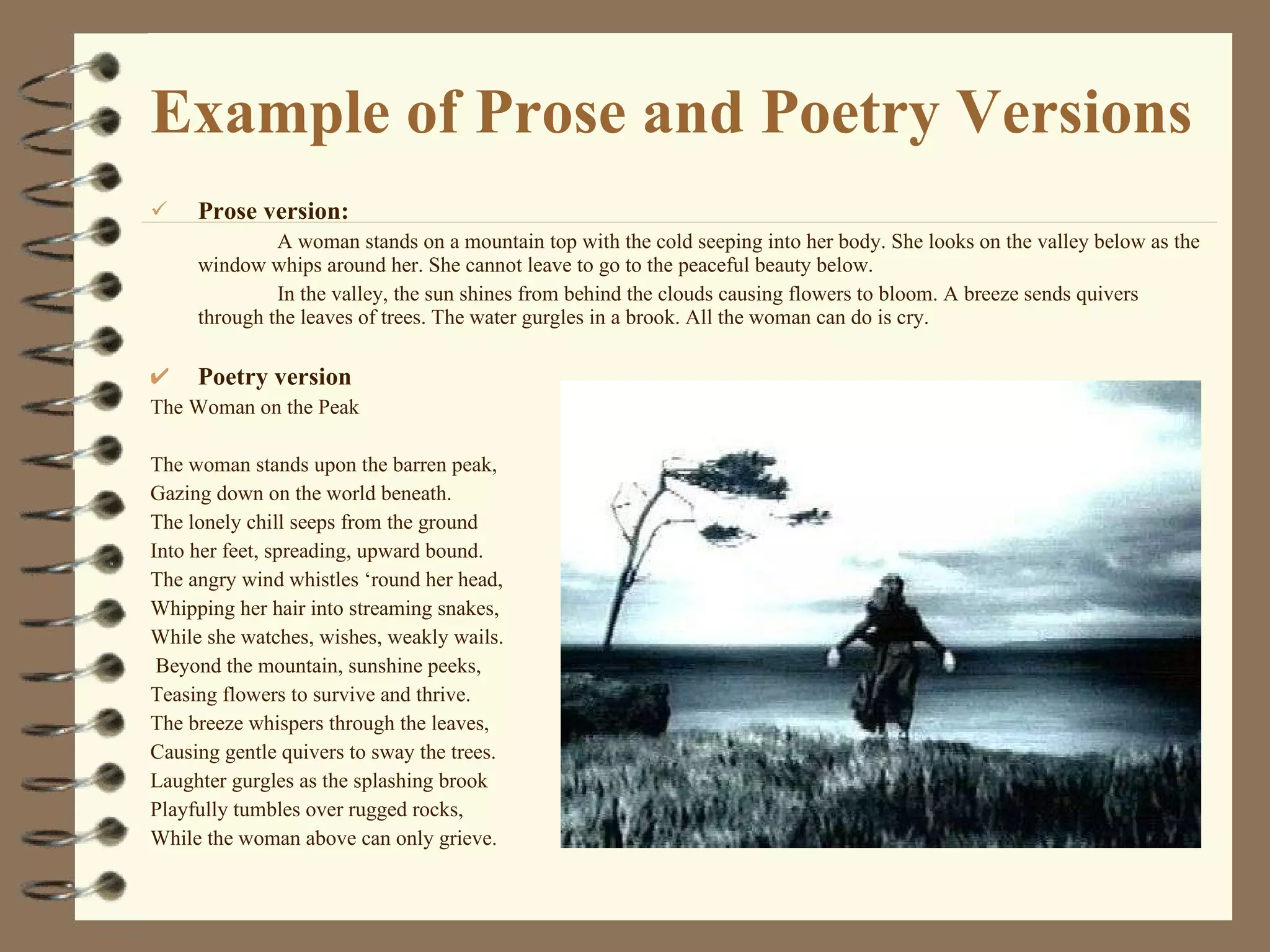
Example of Prose and Poetry Versions Prose version:           A woman stands on a mountain top with the cold seeping into her body. She looks on the valley below as the window whips around her. She cannot leave to go to the peaceful beauty below.  In the valley, the sun shines from behind the clouds causing flowers to bloom. A breeze sends quivers through the leaves of trees. The water gurgles in a brook. All the woman can do is cry. Poetry version              The Woman on the Peak          The woman stands upon the barren peak,          Gazing down on the world beneath.          The lonely chill seeps from the ground          Into her feet, spreading, upward bound.          The angry wind whistles ‘round her head,          Whipping her hair into streaming snakes,          While she watches, wishes, weakly wails.           Beyond the mountain, sunshine peeks,          Teasing flowers to survive and thrive.          The breeze whispers through the leaves,          Causing gentle quivers to sway the trees.          Laughter gurgles as the splashing brook          Playfully tumbles over rugged rocks,          While the woman above can only grieve.
POINT OF VIEW IN POETRY POET The poet is the author of the poem. SPEAKER The speaker of the poem is the “narrator” of the poem.
POETRY FORM FORM - the appearance of the words on the page LINE -  a group of words together on one line of the poem STANZA - a group of lines arranged together A word is dead When it is said, Some say. I say it just Begins to live That day.
KINDS OF STANZAS Couplet = a two line stanza Triplet (Tercet) = a three line stanza Quatrain = a four line stanza Quintet = a five line stanza Sestet (Sextet) = a six line stanza Septet = a seven line stanza Octave = an eight line stanza
Types of Poems Ballad Elegy Ode Lyric Sonnet Epic Heroic Limerick Haiku Concrete Cinquain Diamante Free Style Blank verse
 
RHYTHM The beat created by the sounds of the words in a poem Rhythm can be created by meter, rhyme, alliteration and refrain.
METER A pattern of stressed and unstressed syllables. Meter occurs when the stressed (strong) and unstressed (weak) syllables of the words in a poem are arranged in a repeating pattern throughout the poem.
METER cont. FOOT - unit of meter. A foot can have two or three syllables. Usually consists of one stressed and one or more unstressed syllables. TYPES OF FEET The types of feet are determined by the arrangement of stressed and unstressed syllables. (cont.)
METER cont. TYPES OF FEET (cont.) Iambic  - unstressed, stressed  Trochaic - stressed, unstressed Anapestic - unstressed, unstressed, stressed Dactylic - stressed, unstressed, unstressed
METER cont. Kinds of Metrical Lines monometer = one foot on a line dimeter = two feet on a line trimeter  = three feet on a line tetrameter = four feet on a line pentameter = five feet on a line hexameter = six feet on a line heptameter = seven feet on a line octameter = eight feet on a line
RHYME Words sound alike because they share the same ending vowel and consonant sounds. (A word always rhymes with itself.) LAMP STAMP Share the short “a” vowel sound Share the combined “mp” consonant sound
END RHYME A word at the end of one line rhymes with a word at the end of another line Hector the Collector Collected bits of  string . Collected dolls with broken heads And rusty bells that would not  ring .
INTERNAL RHYME A word inside a line rhymes with another word on the same line. Once upon a midnight  dreary , while I pondered weak and  weary . From “The Raven”  by Edgar Allan Poe
NEAR RHYME a.k.a  imperfect rhyme, close rhyme The words share EITHER the same vowel or consonant sound BUT NOT BOTH ROSE LOSE Different vowel sounds (long “o” and “oo” sound) Share the same consonant sound
RHYME SCHEME A rhyme scheme is a pattern of rhyme (usually end rhyme, but not always). Use the letters of the alphabet to represent sounds to be able to visually “see” the pattern.  (See next slide for an example.)
SAMPLE RHYME SCHEME The Germ  by Ogden Nash A mighty creature is the g erm , Though smaller than the pachyd erm . His customary dwelling pl ace Is deep within the human r ace . His childish pride he often pl eases By giving people strange dis eases . Do you, my poppet, feel inf irm ? You probably contain a g erm . a a b b c c a a
ONOMATOPOEIA Words that imitate the sound they are naming
ONOMATOPEOIA continued OR sounds that imitate another sound “ The  s ilken,  s ad, un c ertain, ru s tling of  each purple curtain . . .”
ALLITERATION Consonant sounds repeated at close intervals at the beginnings of words If  P eter  P iper  p icked a  p eck of  p ickled  p eppers, how many  p ickled  p eppers did  P eter  P iper  p ick?
CONSONANCE Similar to alliteration EXCEPT . . . The repeated consonant sounds can be anywhere in the words I dropped the lo ck et in the thi ck  mud
ASSONANCE Repeated VOWEL sounds in a line or lines of poetry. (Often creates near rhyme.) Lake Fate Base Fade (All share the long “a” sound.)
ASSONANCE cont. Examples of ASSONANCE: “ Slow the low gradual moan came in the snowing.” John Masefield “ Shall ever medicine thee to that sweet sleep.” - William Shakespeare
FIGURATIVE LANGUAGE
SIMILE A comparison of two things using “like, as than,” or “resembles.” “ She is as beautiful as a sunrise.”
METAPHOR A direct comparison of two unlike things “ All the world’s a stage, and all the men and women merely players.” - William Shakespeare
EXTENDED METAPHOR A metaphor that continues through several lines or possibly the entire length of a work.
IMPLIED METAPHOR The comparison is hinted at but not clearly stated. Implied metaphor is an indirect metaphor where an implication to the whole is made. Shut your trap. He ruffled his feathers. No bird and no mouth, just  feathers and trap. Yeah, that’s implied.
Hyperbole Exaggeration often used for emphasis.
Litotes Understatement - basically the opposite of hyperbole.  Often it is ironic.
Apostrophe A figure of speech in which some absent or nonexistent person or thing is addressed as if present and capable of understanding. Ex. “O, Love, why can’t you let me go?”
Idiom An expression where the literal meaning of the words is not the meaning of the expression.  It means something other than what it actually says. Ex.  It’s raining cats and dogs.
PERSONIFICATION An animal given human-like qualities or an object given life-like qualities. Ex:  Earth felt the wound; and Nature from her seat, Sighing, through all her works, gave signs of woe.  - John Milton
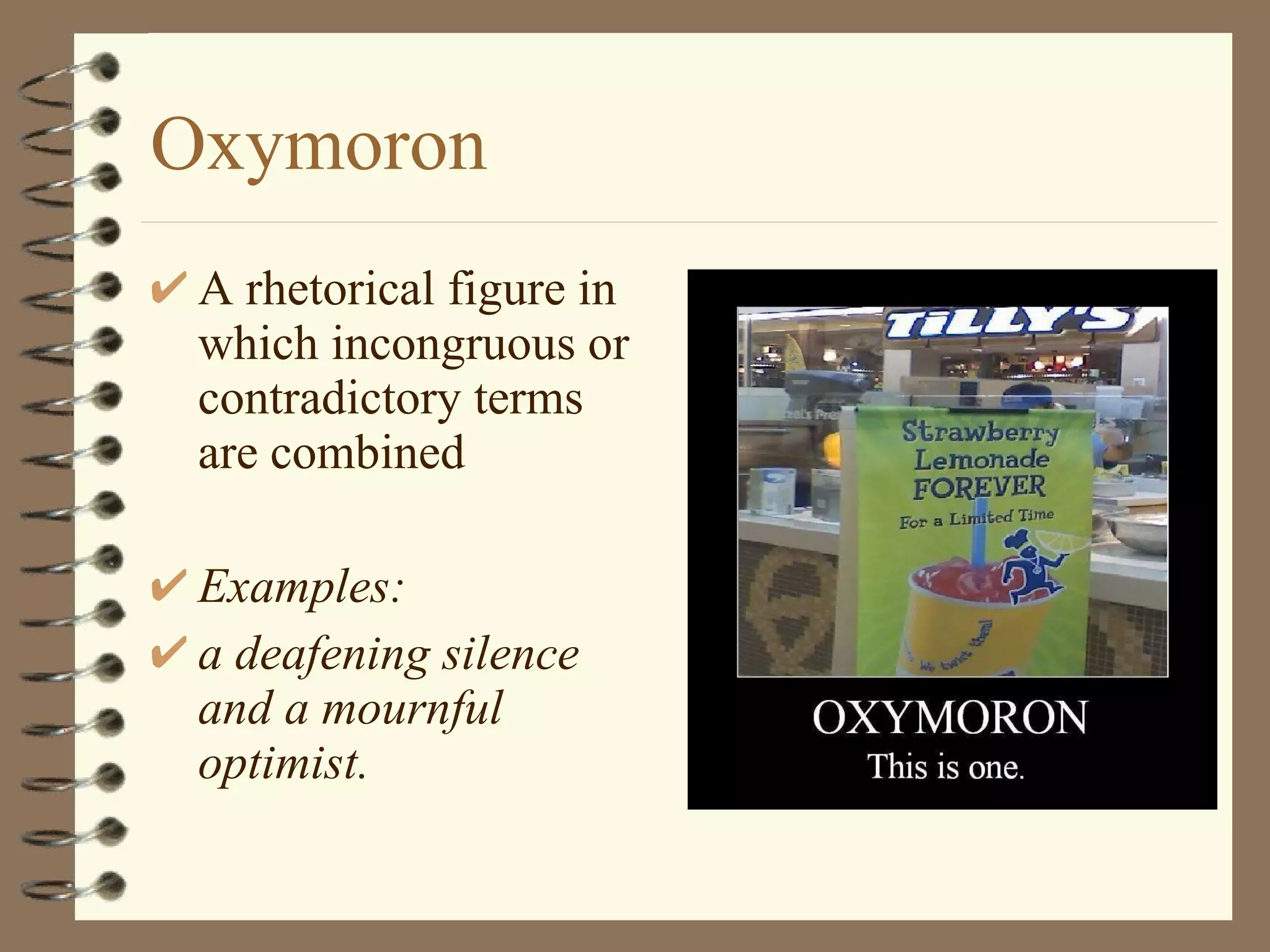
Oxymoron A rhetorical figure in which incongruous or contradictory terms are combined  Examples: a deafening silence and a mournful optimist.
Mood The atmosphere that pervades a literary work with the intention of evoking a certain emotion or feeling from the audience. In drama, mood may be created by sets and music as well as words; in poetry and prose, mood may be created by a combination of such elements as SETTING, VOICE, TONE and THEME. The moods evoked by the more popular short stories of Edgar Allen Poe, for example, tend to be gloomy, horrific, and desperate.
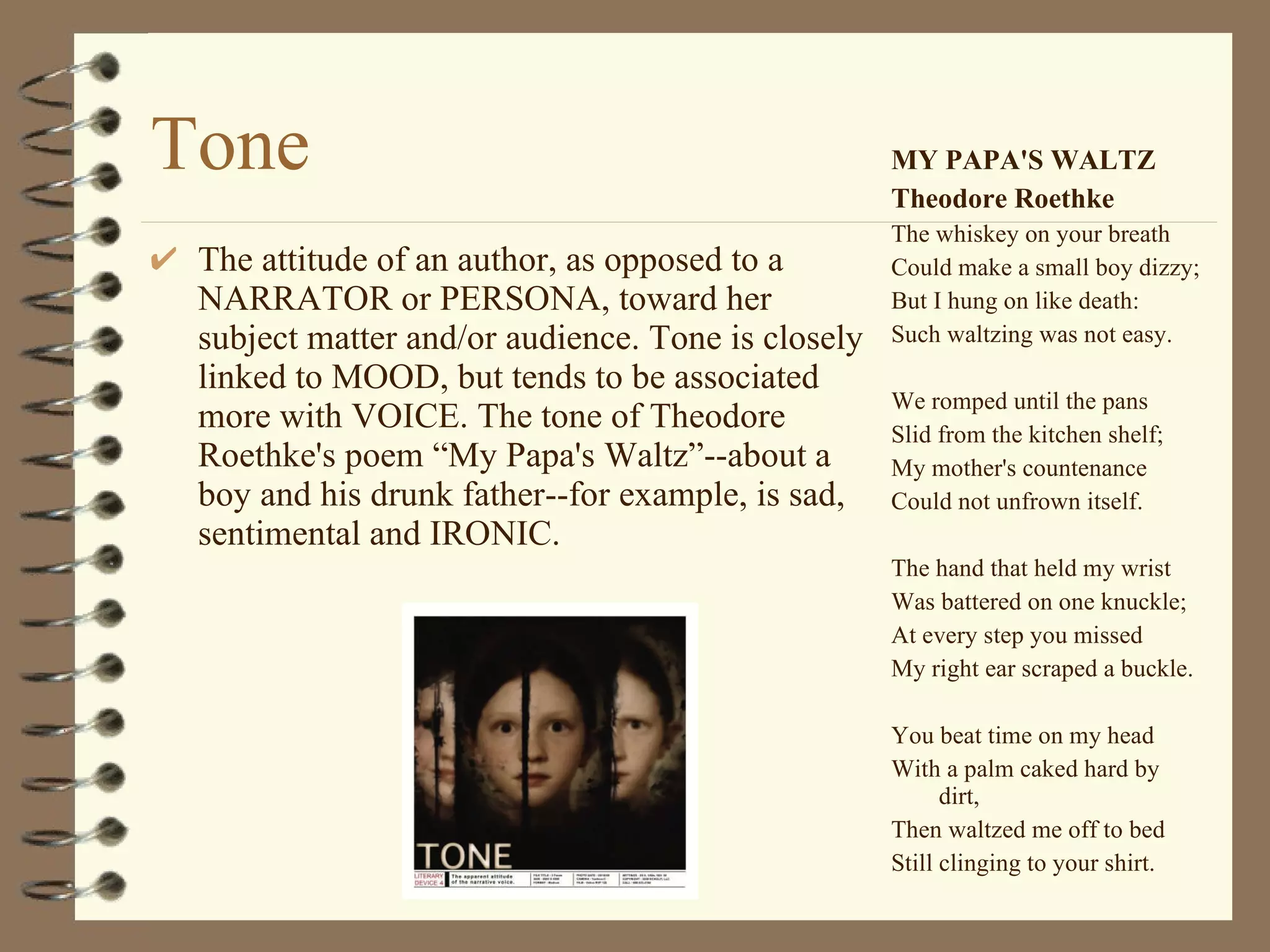
Tone The attitude of an author, as opposed to a NARRATOR or PERSONA, toward her subject matter and/or audience. Tone is closely linked to MOOD, but tends to be associated more with VOICE. The tone of Theodore Roethke's poem “My Papa's Waltz”--about a boy and his drunk father--for example, is sad, sentimental and IRONIC. MY PAPA'S WALTZ  Theodore Roethke  The whiskey on your breath  Could make a small boy dizzy;  But I hung on like death:  Such waltzing was not easy.  We romped until the pans  Slid from the kitchen shelf;  My mother's countenance  Could not unfrown itself.  The hand that held my wrist  Was battered on one knuckle;  At every step you missed  My right ear scraped a buckle.  You beat time on my head  With a palm caked hard by dirt,  Then waltzed me off to bed  Still clinging to your shirt.
OTHER POETIC DEVICES
SYMBOLISM When a person, place, thing, or event that has meaning in itself also represents, or stands for, something else. =  Innocence  =  America  =  Peace
Allusion Allusion comes from the verb “allude” which means “to refer to” An allusion is a reference to something famous. A tunnel walled and overlaid With dazzling crystal:  we had read  Of rare Aladdin’s wondrous cave, And to our own his name we gave. From “Snowbound” John Greenleaf Whittier
IMAGERY Language that appeals to the senses. Most images are visual, but they can also appeal to the senses of sound, touch, taste, or smell. “ then with cracked hands that ached from labor in the weekday weather . . .” from  “Those Winter Sundays”
REFRAIN A sound, word, phrase or line repeated regularly in a poem. “ Quoth the raven, ‘Nevermore.’”
SOME TYPES OF POETRY WE WILL BE STUDYING AND COMPOSING
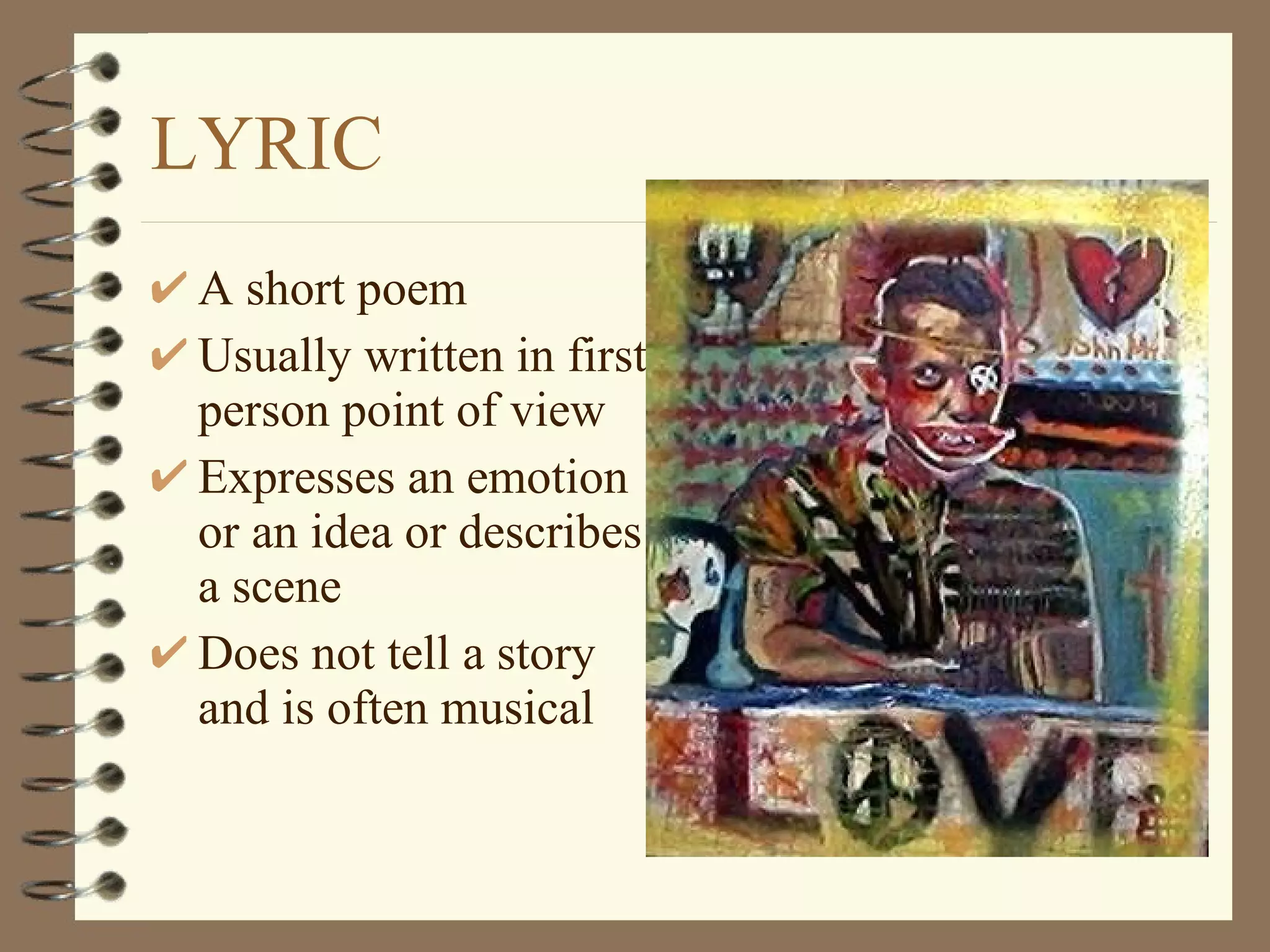
LYRIC A short poem Usually written in first person point of view Expresses an emotion or an idea or describes a scene Does not tell a story and is often musical
Types of Lyric Poetry Ode  - A lyric poem of some length, usually of a serious or meditative nature and having an elevated style and formal stanzaic structure. Elegy  - A poem or song composed especially as a lament for a deceased person. Villanelle  - a verse form of French origin consisting of 19 lines arranged in five tercets and a quatrain. The first and third lines of the first tercet recur alternately at the end of each subsequent tercet and both together at the end of the quatrain Polyhymnia: The Muse of Lyric Poetry
HAIKU: Lyric Poem A Japanese poem written in three lines Five Syllables Seven Syllables Five Syllables An old silent pond . . . A frog jumps into the pond. Splash!  Silence again.
SHAKESPEAREAN SONNETS (Lyric Poems) A fourteen line poem with a specific rhyme scheme. The poem is written in three quatrains and ends with a couplet. The rhyme scheme is abab  cdcd  efef  gg Sonnet 116 –  Let me not to the marriage of true minds
Admit impediments. Love is not love
Which alters when it alteration finds, Or bends with the remover to remove: 
 O no! it is an ever-fixèd mark
That looks on tempests and is never shaken;
It is the star to every wandering bark, Whose worth’s unknown, although his height be taken. 
 Love’s not Time’s fool, though rosy lips and cheeks
Within his bending sickle’s compass come:
Love alters not with his brief hours and weeks,
But bears it out even to the edge of doom. 
 If this be error and upon me proved,
I never writ, nor no man ever loved.
CONCRETE POEMS In concrete poems, the words are arranged to create a picture that relates to the content of the poem. Poetry Is like  Flames, Which are Swift and elusive Dodging realization Sparks, like words on the Paper, leap and dance in the Flickering firelight.  The fiery Tongues, formless and shifting Shapes, tease the imiagination. Yet for those who see, Through their mind’s Eye, they burn Up the page.
CINQUAIN A five line poem containing 22 syllables Two Syllables Four Syllables Six Syllables Eight Syllables Two Syllables   How frail Above the bulk Of crashing water hangs Autumnal, evanescent, wan The moon.
Diamante poems Poem that begins with one word and ends with its opposite. When completed, it will look like a diamond (diamante = diamond)
Diamante pattern Line 1 = Word/opposite of line 7 Line 2 = Description of line one (generally 2 words) Line 3 = Action that line one does (generally 3 words) Line 4 = Two words (usually nouns) about line 1 and two words (usually nouns about line 7 Line 5 = Action that line 7 does (generally 3 words) Line 6 = Description of line 7 (usually 2 words) Line 7 = Word/opposite of line 1
Diamante examples Love Bright, Passionate Charming, Drifting, Growing Cherish, Infatuation,  Antipathy, Uncaring Animosity, Falling, Dead Dark, Disgust Hate Try to make sure that words and descriptions about line 7/line 1 are parallel
Diamante examples DREAMS SUBJECTIVE, IMAGINARY SLEEPING, WISHING,THINKING FANTASY, VISION,  ACTUALITY, CONSCIOUSNESS,  BEING, SEEING, KNOWING,  AUTHENTIC, FACTUAL REALITY
NARRATIVE POEMS A poem that tells a story. Generally longer than the lyric styles of poetry because the poet needs to establish characters and a plot. Examples of Narrative Poems “ The Raven” “ The Highwayman” “ Casey at the Bat” “ The Walrus and the Carpenter”
Types of Narrative Poems Ballad  - A narrative poem, often of folk origin and intended to be sung, consisting of simple stanzas and usually having a refrain. Epic  - An extended narrative poem in elevated or dignified language, celebrating the feats of a legendary or traditional hero.
FREE VERSE POETRY Unlike metered poetry, free verse poetry does NOT have any repeating patterns of stressed and unstressed syllables. Does NOT have rhyme. Free verse poetry is very conversational - sounds like someone talking with you. A more modern type of poetry.
BLANK VERSE POETRY Written in lines of iambic pentameter, but does NOT use end rhyme. From  The Tragedy of Julius Caesar Cowards die many times before their deaths; The valiant never taste of death but once. Of all the wonders that I yet have heard, It seems to me most strange that men should fear; Seeing that death, a necessary end, Will come when it will come.

Poetry and figurative language

  • 1.
  • 2.
    POETRY A typeof literature that expresses ideas, feelings, or tells a story in a specific form (usually using lines and stanzas)
  • 3.
    Poetry consists ofFigurative language Verses Colorful words
  • 4.
    Differs from proseby More expressive diction Punctuation More CONCISE/PRECISE language and syntax Stanzas not paragraphs Implements the use of poetic devices and figurative language more prevalently
  • 5.
    Example of Proseand Poetry Versions Prose version:          A woman stands on a mountain top with the cold seeping into her body. She looks on the valley below as the window whips around her. She cannot leave to go to the peaceful beauty below. In the valley, the sun shines from behind the clouds causing flowers to bloom. A breeze sends quivers through the leaves of trees. The water gurgles in a brook. All the woman can do is cry. Poetry version             The Woman on the Peak          The woman stands upon the barren peak,          Gazing down on the world beneath.          The lonely chill seeps from the ground          Into her feet, spreading, upward bound.          The angry wind whistles ‘round her head,          Whipping her hair into streaming snakes,          While she watches, wishes, weakly wails.          Beyond the mountain, sunshine peeks,          Teasing flowers to survive and thrive.          The breeze whispers through the leaves,          Causing gentle quivers to sway the trees.          Laughter gurgles as the splashing brook          Playfully tumbles over rugged rocks,          While the woman above can only grieve.
  • 6.
    POINT OF VIEWIN POETRY POET The poet is the author of the poem. SPEAKER The speaker of the poem is the “narrator” of the poem.
  • 7.
    POETRY FORM FORM- the appearance of the words on the page LINE - a group of words together on one line of the poem STANZA - a group of lines arranged together A word is dead When it is said, Some say. I say it just Begins to live That day.
  • 8.
    KINDS OF STANZASCouplet = a two line stanza Triplet (Tercet) = a three line stanza Quatrain = a four line stanza Quintet = a five line stanza Sestet (Sextet) = a six line stanza Septet = a seven line stanza Octave = an eight line stanza
  • 9.
    Types of PoemsBallad Elegy Ode Lyric Sonnet Epic Heroic Limerick Haiku Concrete Cinquain Diamante Free Style Blank verse
  • 10.
  • 11.
    RHYTHM The beatcreated by the sounds of the words in a poem Rhythm can be created by meter, rhyme, alliteration and refrain.
  • 12.
    METER A patternof stressed and unstressed syllables. Meter occurs when the stressed (strong) and unstressed (weak) syllables of the words in a poem are arranged in a repeating pattern throughout the poem.
  • 13.
    METER cont. FOOT- unit of meter. A foot can have two or three syllables. Usually consists of one stressed and one or more unstressed syllables. TYPES OF FEET The types of feet are determined by the arrangement of stressed and unstressed syllables. (cont.)
  • 14.
    METER cont. TYPESOF FEET (cont.) Iambic - unstressed, stressed Trochaic - stressed, unstressed Anapestic - unstressed, unstressed, stressed Dactylic - stressed, unstressed, unstressed
  • 15.
    METER cont. Kindsof Metrical Lines monometer = one foot on a line dimeter = two feet on a line trimeter = three feet on a line tetrameter = four feet on a line pentameter = five feet on a line hexameter = six feet on a line heptameter = seven feet on a line octameter = eight feet on a line
  • 16.
    RHYME Words soundalike because they share the same ending vowel and consonant sounds. (A word always rhymes with itself.) LAMP STAMP Share the short “a” vowel sound Share the combined “mp” consonant sound
  • 17.
    END RHYME Aword at the end of one line rhymes with a word at the end of another line Hector the Collector Collected bits of string . Collected dolls with broken heads And rusty bells that would not ring .
  • 18.
    INTERNAL RHYME Aword inside a line rhymes with another word on the same line. Once upon a midnight dreary , while I pondered weak and weary . From “The Raven” by Edgar Allan Poe
  • 19.
    NEAR RHYME a.k.a imperfect rhyme, close rhyme The words share EITHER the same vowel or consonant sound BUT NOT BOTH ROSE LOSE Different vowel sounds (long “o” and “oo” sound) Share the same consonant sound
  • 20.
    RHYME SCHEME Arhyme scheme is a pattern of rhyme (usually end rhyme, but not always). Use the letters of the alphabet to represent sounds to be able to visually “see” the pattern. (See next slide for an example.)
  • 21.
    SAMPLE RHYME SCHEMEThe Germ by Ogden Nash A mighty creature is the g erm , Though smaller than the pachyd erm . His customary dwelling pl ace Is deep within the human r ace . His childish pride he often pl eases By giving people strange dis eases . Do you, my poppet, feel inf irm ? You probably contain a g erm . a a b b c c a a
  • 22.
    ONOMATOPOEIA Words thatimitate the sound they are naming
  • 23.
    ONOMATOPEOIA continued ORsounds that imitate another sound “ The s ilken, s ad, un c ertain, ru s tling of each purple curtain . . .”
  • 24.
    ALLITERATION Consonant soundsrepeated at close intervals at the beginnings of words If P eter P iper p icked a p eck of p ickled p eppers, how many p ickled p eppers did P eter P iper p ick?
  • 25.
    CONSONANCE Similar toalliteration EXCEPT . . . The repeated consonant sounds can be anywhere in the words I dropped the lo ck et in the thi ck mud
  • 26.
    ASSONANCE Repeated VOWELsounds in a line or lines of poetry. (Often creates near rhyme.) Lake Fate Base Fade (All share the long “a” sound.)
  • 27.
    ASSONANCE cont. Examplesof ASSONANCE: “ Slow the low gradual moan came in the snowing.” John Masefield “ Shall ever medicine thee to that sweet sleep.” - William Shakespeare
  • 28.
  • 29.
    SIMILE A comparisonof two things using “like, as than,” or “resembles.” “ She is as beautiful as a sunrise.”
  • 30.
    METAPHOR A directcomparison of two unlike things “ All the world’s a stage, and all the men and women merely players.” - William Shakespeare
  • 31.
    EXTENDED METAPHOR Ametaphor that continues through several lines or possibly the entire length of a work.
  • 32.
    IMPLIED METAPHOR Thecomparison is hinted at but not clearly stated. Implied metaphor is an indirect metaphor where an implication to the whole is made. Shut your trap. He ruffled his feathers. No bird and no mouth, just feathers and trap. Yeah, that’s implied.
  • 33.
    Hyperbole Exaggeration oftenused for emphasis.
  • 34.
    Litotes Understatement -basically the opposite of hyperbole. Often it is ironic.
  • 35.
    Apostrophe A figureof speech in which some absent or nonexistent person or thing is addressed as if present and capable of understanding. Ex. “O, Love, why can’t you let me go?”
  • 36.
    Idiom An expressionwhere the literal meaning of the words is not the meaning of the expression. It means something other than what it actually says. Ex. It’s raining cats and dogs.
  • 37.
    PERSONIFICATION An animalgiven human-like qualities or an object given life-like qualities. Ex: Earth felt the wound; and Nature from her seat, Sighing, through all her works, gave signs of woe. - John Milton
  • 38.
    Oxymoron A rhetoricalfigure in which incongruous or contradictory terms are combined Examples: a deafening silence and a mournful optimist.
  • 39.
    Mood The atmospherethat pervades a literary work with the intention of evoking a certain emotion or feeling from the audience. In drama, mood may be created by sets and music as well as words; in poetry and prose, mood may be created by a combination of such elements as SETTING, VOICE, TONE and THEME. The moods evoked by the more popular short stories of Edgar Allen Poe, for example, tend to be gloomy, horrific, and desperate.
  • 40.
    Tone The attitudeof an author, as opposed to a NARRATOR or PERSONA, toward her subject matter and/or audience. Tone is closely linked to MOOD, but tends to be associated more with VOICE. The tone of Theodore Roethke's poem “My Papa's Waltz”--about a boy and his drunk father--for example, is sad, sentimental and IRONIC. MY PAPA'S WALTZ Theodore Roethke The whiskey on your breath Could make a small boy dizzy; But I hung on like death: Such waltzing was not easy. We romped until the pans Slid from the kitchen shelf; My mother's countenance Could not unfrown itself. The hand that held my wrist Was battered on one knuckle; At every step you missed My right ear scraped a buckle. You beat time on my head With a palm caked hard by dirt, Then waltzed me off to bed Still clinging to your shirt.
  • 41.
  • 42.
    SYMBOLISM When aperson, place, thing, or event that has meaning in itself also represents, or stands for, something else. = Innocence = America = Peace
  • 43.
    Allusion Allusion comesfrom the verb “allude” which means “to refer to” An allusion is a reference to something famous. A tunnel walled and overlaid With dazzling crystal: we had read Of rare Aladdin’s wondrous cave, And to our own his name we gave. From “Snowbound” John Greenleaf Whittier
  • 44.
    IMAGERY Language thatappeals to the senses. Most images are visual, but they can also appeal to the senses of sound, touch, taste, or smell. “ then with cracked hands that ached from labor in the weekday weather . . .” from “Those Winter Sundays”
  • 45.
    REFRAIN A sound,word, phrase or line repeated regularly in a poem. “ Quoth the raven, ‘Nevermore.’”
  • 46.
    SOME TYPES OFPOETRY WE WILL BE STUDYING AND COMPOSING
  • 47.
    LYRIC A shortpoem Usually written in first person point of view Expresses an emotion or an idea or describes a scene Does not tell a story and is often musical
  • 48.
    Types of LyricPoetry Ode - A lyric poem of some length, usually of a serious or meditative nature and having an elevated style and formal stanzaic structure. Elegy - A poem or song composed especially as a lament for a deceased person. Villanelle - a verse form of French origin consisting of 19 lines arranged in five tercets and a quatrain. The first and third lines of the first tercet recur alternately at the end of each subsequent tercet and both together at the end of the quatrain Polyhymnia: The Muse of Lyric Poetry
  • 49.
    HAIKU: Lyric PoemA Japanese poem written in three lines Five Syllables Seven Syllables Five Syllables An old silent pond . . . A frog jumps into the pond. Splash! Silence again.
  • 50.
    SHAKESPEAREAN SONNETS (LyricPoems) A fourteen line poem with a specific rhyme scheme. The poem is written in three quatrains and ends with a couplet. The rhyme scheme is abab cdcd efef gg Sonnet 116 – Let me not to the marriage of true minds
Admit impediments. Love is not love
Which alters when it alteration finds, Or bends with the remover to remove: 
 O no! it is an ever-fixèd mark
That looks on tempests and is never shaken;
It is the star to every wandering bark, Whose worth’s unknown, although his height be taken. 
 Love’s not Time’s fool, though rosy lips and cheeks
Within his bending sickle’s compass come:
Love alters not with his brief hours and weeks,
But bears it out even to the edge of doom. 
 If this be error and upon me proved,
I never writ, nor no man ever loved.
  • 51.
    CONCRETE POEMS Inconcrete poems, the words are arranged to create a picture that relates to the content of the poem. Poetry Is like Flames, Which are Swift and elusive Dodging realization Sparks, like words on the Paper, leap and dance in the Flickering firelight. The fiery Tongues, formless and shifting Shapes, tease the imiagination. Yet for those who see, Through their mind’s Eye, they burn Up the page.
  • 52.
    CINQUAIN A fiveline poem containing 22 syllables Two Syllables Four Syllables Six Syllables Eight Syllables Two Syllables How frail Above the bulk Of crashing water hangs Autumnal, evanescent, wan The moon.
  • 53.
    Diamante poems Poemthat begins with one word and ends with its opposite. When completed, it will look like a diamond (diamante = diamond)
  • 54.
    Diamante pattern Line1 = Word/opposite of line 7 Line 2 = Description of line one (generally 2 words) Line 3 = Action that line one does (generally 3 words) Line 4 = Two words (usually nouns) about line 1 and two words (usually nouns about line 7 Line 5 = Action that line 7 does (generally 3 words) Line 6 = Description of line 7 (usually 2 words) Line 7 = Word/opposite of line 1
  • 55.
    Diamante examples LoveBright, Passionate Charming, Drifting, Growing Cherish, Infatuation, Antipathy, Uncaring Animosity, Falling, Dead Dark, Disgust Hate Try to make sure that words and descriptions about line 7/line 1 are parallel
  • 56.
    Diamante examples DREAMSSUBJECTIVE, IMAGINARY SLEEPING, WISHING,THINKING FANTASY, VISION, ACTUALITY, CONSCIOUSNESS, BEING, SEEING, KNOWING, AUTHENTIC, FACTUAL REALITY
  • 57.
    NARRATIVE POEMS Apoem that tells a story. Generally longer than the lyric styles of poetry because the poet needs to establish characters and a plot. Examples of Narrative Poems “ The Raven” “ The Highwayman” “ Casey at the Bat” “ The Walrus and the Carpenter”
  • 58.
    Types of NarrativePoems Ballad - A narrative poem, often of folk origin and intended to be sung, consisting of simple stanzas and usually having a refrain. Epic - An extended narrative poem in elevated or dignified language, celebrating the feats of a legendary or traditional hero.
  • 59.
    FREE VERSE POETRYUnlike metered poetry, free verse poetry does NOT have any repeating patterns of stressed and unstressed syllables. Does NOT have rhyme. Free verse poetry is very conversational - sounds like someone talking with you. A more modern type of poetry.
  • 60.
    BLANK VERSE POETRYWritten in lines of iambic pentameter, but does NOT use end rhyme. From The Tragedy of Julius Caesar Cowards die many times before their deaths; The valiant never taste of death but once. Of all the wonders that I yet have heard, It seems to me most strange that men should fear; Seeing that death, a necessary end, Will come when it will come.

Editor's Notes

  • #17 Activity: Rhyme group game
  • #21 Activity: Rhyme Scheme group game
  • #25 Activity: Alliteration group game