The imaginative response to experience reflecting a keen awareness of language. Poetry
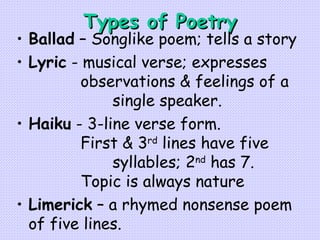
Types of Poetry Ballad  – Songlike poem; tells a story Lyric  -  musical verse; expresses  observations & feelings of a  single speaker.   Haiku  -  3-line verse form.  First & 3 rd  lines have five  syllables; 2 nd  has 7.  Topic is always nature   Limerick  – a rhymed nonsense poem of five lines.
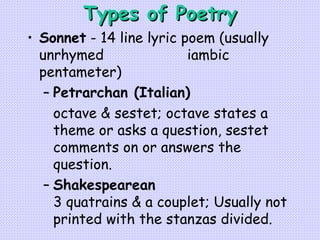
Types of Poetry Sonnet  -  14 line lyric poem (usually unrhymed  iambic pentameter) Petrarchan (Italian) octave & sestet; octave states a theme or asks a question, sestet comments on or answers the question.   Shakespearean  3 quatrains & a couplet; Usually not printed with the stanzas divided.
Verse Free Verse  –  poetry not written in a regular rhythmical pattern or meter   Blank Verse  –  poetry written in unrhymed iambic pentameter   Refrain –  phrase or verse repeated at intervals in a song or poem .
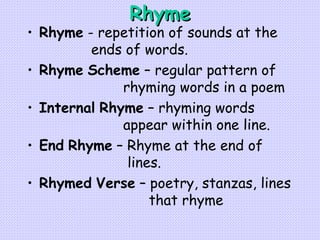
Rhyme Rhyme  -  repetition of sounds at the  ends of words. Rhyme   Scheme  – regular pattern of  rhyming words in a poem  Internal   Rhyme  – rhyming words  appear within one line. End   Rhyme  – Rhyme at the end of   lines. Rhymed   Verse  – poetry, stanzas, lines    that rhyme
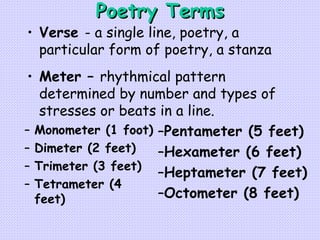
Poetry Terms Verse  -  a single line, poetry, a particular form of poetry, a stanza   Meter –  rhythmical pattern determined by number and types of stresses or beats in a line.   Monometer (1 foot) Dimeter (2 feet) Trimeter (3 feet) Tetrameter (4 feet) Pentameter (5 feet) Hexameter (6 feet) Heptameter (7 feet) Octometer (8 feet)
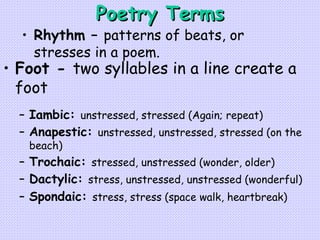
Poetry Terms Foot -  two syllables in a line create a foot Iambic:  unstressed, stressed (Again; repeat) Anapestic:  unstressed, unstressed, stressed (on the beach)   Trochaic:  stressed, unstressed (wonder, older)   Dactylic:  stress, unstressed, unstressed (wonderful)   Spondaic:  stress, stress (space walk, heartbreak) Rhythm –  patterns of beats, or stresses in a poem.
Poetry Terms Stanza:  formal division of lines in a  poem (paragraph)   Couplet (2 lines) Triplet (3 lines) Quatrain (4 lines) Quintet (5 lines) Sestet (6 lines) Septet (7 lines) Octave (8 lines)
Poetry Terms Imagery –  descriptive language used to create word pictures using the senses.   Symbolism –  anything that stands for or represents something else Allusion –  reference to literature, history or the  bible
Poetry Terms Tone  -  writer’s attitude toward his or her audience and subject matter. Mood –  (Atmosphere) feeling created in the reader by the literary work   Diction  – word choice (including vocabulary used, appropriateness of words & vividness of language.)
Figurative Language Simile –  comparison using like or as Metaphor –  figure of speech in which one thing is compared to something else (no like or as) Personification –  giving human characteristics to a nonhuman subject   Oxymoron –  contradictory terms are combined, as in  a deafening silence (Figures of Speech) –  not meant to be interpreted literally
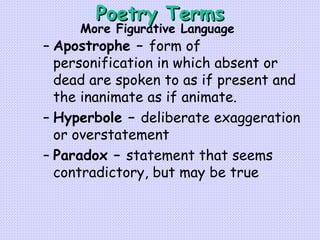
Poetry Terms Apostrophe –  form of personification in which absent or dead are spoken to as if present and the inanimate as if animate. Hyperbole –  deliberate exaggeration or overstatement Paradox –  statement that seems contradictory, but may be true More Figurative Language
Poetry Terms Alliteration:  Repetition of initial consonant sounds. Assonance –  repetition of vowel sounds followed by different consonants in two or more stressed syllables.   (“weak & weary”) Onomatopoeia –  words in which sounds seem to resemble their meaning.   use of words that imitate sounds (whirr, buzz, sizzle)
Poetry Terms Verbal Pun (play on words) Sarcasm Situational Dramatic Types of IRONY
Reading A Poem First Reading: Read the poem all the way through. Get an overall first impression of the poem. Write a sentence or two response stating your immediate reaction to the poem. (These are your first thoughts and feelings)
Second Reading: Read the poem again – out loud. Read slowly, word by word, watching punctuation, spacing and special treatment of words and syllables. Notes the usage of sound devices- alliteration, rhyme, etc.. Attempt to guess what the poem is trying to say. Reading A Poem
Reading A Poem Third Reading: Identify the type of poem. What is the literal sense of the poem?  What is it about?  What does the poem say about its subject? Look for figurative devices: metaphors, similes, personification, symbols, etc.
Analyzing A Poem Using the hand out given to you, (“How to Explicate a Poem”)  answer the questions  about the following two poems:
Nothing Gold Can Stay Nature’s first green is gold, Her hardest hue to hold. Her early leaf’s a flower; But only so an hour. Then leaf subsides to leaf, So Eden sank to grief,  So dawn goes down to day. Nothing gold can stay.   -- Robert Frost
Wish You Were Here They kissed goodbye at the  terminal gate She said you’re gonna be late if you don’t go He held her tight, said I’ll be alright I’ll call you tonight to let you know He bought a postcard, on the front it just said heaven With a picture of the ocean and the beach And the simple words that he wrote her Said he loved her and they told her How he’d hold her if his arms would reach   Wish you were here, wish you could see this place Wish you were near, wish I could touch your face the weather’s nice, its paradise It’s summertime all year and there’s some folks we know They say, “Hello, I miss you so, wish you were here.”  
Wish You Were Here She got a call that night, but it wasn’t from him It didn’t sink in right away, Ma’am the plane went down Our crews searched the ground No survivors found she heard him say But somehow she got a postcard in the mail That just said heaven with a picture of the ocean and the beach And the simple words he wrote her Said he loves her and they told her How he’d love her if his arms would reach   Wish you were here, wish you could see this place Wish you were near, wish I could touch your face The weather’s nice, its paradise It’s summertime all year and there’s some folks we know They say, “Hello, I miss you so, wish you were here.” -- Mark Wills
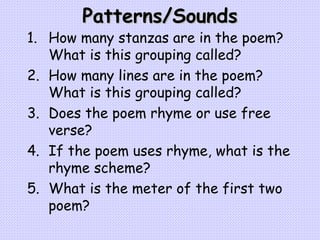
Patterns/Sounds How many stanzas are in the poem?  What is this grouping called? How many lines are in the poem?  What is this grouping called? Does the poem rhyme or use free verse? If the poem uses rhyme, what is the rhyme scheme? What is the meter of the first two poem?
Imagery What sensory details does the poet provide? 2. Give examples of any sensory images used in the poem: sight, sound, touch, taste, smell.
Language Are there any “plays on words?”  (Writer uses words to make puns or riddles; Uses two different meanings for the same word.) Does the writer use any figures of speech: metaphors, personification, similes? Give examples of these. Are there any inferences in the poem? (Words or lines where the reader has to figure out what the writer is talking about without directly stating it.)
Language Does the poet use irony in the poem?  Give an example. Does the poem have onomatopoeia, internal rhyme, end rhyme, alliteration or assonance? Provide examples of the above.
SUBJECT/MEANING   What is the subject of the poem? How do you know what the subject is? What are the themes of the poem? What is the poem trying to tell us? What is the setting or mood of the poem? Give an example that shows the mood.
SPEAKER Who is the speaker in the poem? Who is the speaker addressing?  How can you tell who the speaker is addressing? Do we learn anything about the speaker?
Your Response How does the poem make you feel? What is your opinion of the writers use of subject, words and imagery? What would you change about the poem? What is the most important image in the poem?  Why? What is the post important word or phrase in the poem?  Why?

DeWeese poetry notes_ppt[1]

  • 1.
    The imaginative responseto experience reflecting a keen awareness of language. Poetry
  • 2.
    Types of PoetryBallad – Songlike poem; tells a story Lyric - musical verse; expresses observations & feelings of a single speaker. Haiku - 3-line verse form. First & 3 rd lines have five syllables; 2 nd has 7. Topic is always nature Limerick – a rhymed nonsense poem of five lines.
  • 3.
    Types of PoetrySonnet - 14 line lyric poem (usually unrhymed iambic pentameter) Petrarchan (Italian) octave & sestet; octave states a theme or asks a question, sestet comments on or answers the question. Shakespearean 3 quatrains & a couplet; Usually not printed with the stanzas divided.
  • 4.
    Verse Free Verse – poetry not written in a regular rhythmical pattern or meter Blank Verse – poetry written in unrhymed iambic pentameter Refrain – phrase or verse repeated at intervals in a song or poem .
  • 5.
    Rhyme Rhyme - repetition of sounds at the ends of words. Rhyme Scheme – regular pattern of rhyming words in a poem Internal Rhyme – rhyming words appear within one line. End Rhyme – Rhyme at the end of lines. Rhymed Verse – poetry, stanzas, lines that rhyme
  • 6.
    Poetry Terms Verse - a single line, poetry, a particular form of poetry, a stanza Meter – rhythmical pattern determined by number and types of stresses or beats in a line. Monometer (1 foot) Dimeter (2 feet) Trimeter (3 feet) Tetrameter (4 feet) Pentameter (5 feet) Hexameter (6 feet) Heptameter (7 feet) Octometer (8 feet)
  • 7.
    Poetry Terms Foot- two syllables in a line create a foot Iambic: unstressed, stressed (Again; repeat) Anapestic: unstressed, unstressed, stressed (on the beach) Trochaic: stressed, unstressed (wonder, older) Dactylic: stress, unstressed, unstressed (wonderful) Spondaic: stress, stress (space walk, heartbreak) Rhythm – patterns of beats, or stresses in a poem.
  • 8.
    Poetry Terms Stanza: formal division of lines in a poem (paragraph) Couplet (2 lines) Triplet (3 lines) Quatrain (4 lines) Quintet (5 lines) Sestet (6 lines) Septet (7 lines) Octave (8 lines)
  • 9.
    Poetry Terms Imagery– descriptive language used to create word pictures using the senses. Symbolism – anything that stands for or represents something else Allusion – reference to literature, history or the bible
  • 10.
    Poetry Terms Tone - writer’s attitude toward his or her audience and subject matter. Mood – (Atmosphere) feeling created in the reader by the literary work Diction – word choice (including vocabulary used, appropriateness of words & vividness of language.)
  • 11.
    Figurative Language Simile– comparison using like or as Metaphor – figure of speech in which one thing is compared to something else (no like or as) Personification – giving human characteristics to a nonhuman subject Oxymoron – contradictory terms are combined, as in a deafening silence (Figures of Speech) – not meant to be interpreted literally
  • 12.
    Poetry Terms Apostrophe– form of personification in which absent or dead are spoken to as if present and the inanimate as if animate. Hyperbole – deliberate exaggeration or overstatement Paradox – statement that seems contradictory, but may be true More Figurative Language
  • 13.
    Poetry Terms Alliteration: Repetition of initial consonant sounds. Assonance – repetition of vowel sounds followed by different consonants in two or more stressed syllables. (“weak & weary”) Onomatopoeia – words in which sounds seem to resemble their meaning. use of words that imitate sounds (whirr, buzz, sizzle)
  • 14.
    Poetry Terms VerbalPun (play on words) Sarcasm Situational Dramatic Types of IRONY
  • 15.
    Reading A PoemFirst Reading: Read the poem all the way through. Get an overall first impression of the poem. Write a sentence or two response stating your immediate reaction to the poem. (These are your first thoughts and feelings)
  • 16.
    Second Reading: Readthe poem again – out loud. Read slowly, word by word, watching punctuation, spacing and special treatment of words and syllables. Notes the usage of sound devices- alliteration, rhyme, etc.. Attempt to guess what the poem is trying to say. Reading A Poem
  • 17.
    Reading A PoemThird Reading: Identify the type of poem. What is the literal sense of the poem? What is it about? What does the poem say about its subject? Look for figurative devices: metaphors, similes, personification, symbols, etc.
  • 18.
    Analyzing A PoemUsing the hand out given to you, (“How to Explicate a Poem”) answer the questions about the following two poems:
  • 19.
    Nothing Gold CanStay Nature’s first green is gold, Her hardest hue to hold. Her early leaf’s a flower; But only so an hour. Then leaf subsides to leaf, So Eden sank to grief, So dawn goes down to day. Nothing gold can stay. -- Robert Frost
  • 20.
    Wish You WereHere They kissed goodbye at the terminal gate She said you’re gonna be late if you don’t go He held her tight, said I’ll be alright I’ll call you tonight to let you know He bought a postcard, on the front it just said heaven With a picture of the ocean and the beach And the simple words that he wrote her Said he loved her and they told her How he’d hold her if his arms would reach   Wish you were here, wish you could see this place Wish you were near, wish I could touch your face the weather’s nice, its paradise It’s summertime all year and there’s some folks we know They say, “Hello, I miss you so, wish you were here.”  
  • 21.
    Wish You WereHere She got a call that night, but it wasn’t from him It didn’t sink in right away, Ma’am the plane went down Our crews searched the ground No survivors found she heard him say But somehow she got a postcard in the mail That just said heaven with a picture of the ocean and the beach And the simple words he wrote her Said he loves her and they told her How he’d love her if his arms would reach   Wish you were here, wish you could see this place Wish you were near, wish I could touch your face The weather’s nice, its paradise It’s summertime all year and there’s some folks we know They say, “Hello, I miss you so, wish you were here.” -- Mark Wills
  • 22.
    Patterns/Sounds How manystanzas are in the poem? What is this grouping called? How many lines are in the poem? What is this grouping called? Does the poem rhyme or use free verse? If the poem uses rhyme, what is the rhyme scheme? What is the meter of the first two poem?
  • 23.
    Imagery What sensorydetails does the poet provide? 2. Give examples of any sensory images used in the poem: sight, sound, touch, taste, smell.
  • 24.
    Language Are thereany “plays on words?” (Writer uses words to make puns or riddles; Uses two different meanings for the same word.) Does the writer use any figures of speech: metaphors, personification, similes? Give examples of these. Are there any inferences in the poem? (Words or lines where the reader has to figure out what the writer is talking about without directly stating it.)
  • 25.
    Language Does thepoet use irony in the poem? Give an example. Does the poem have onomatopoeia, internal rhyme, end rhyme, alliteration or assonance? Provide examples of the above.
  • 26.
    SUBJECT/MEANING What is the subject of the poem? How do you know what the subject is? What are the themes of the poem? What is the poem trying to tell us? What is the setting or mood of the poem? Give an example that shows the mood.
  • 27.
    SPEAKER Who isthe speaker in the poem? Who is the speaker addressing? How can you tell who the speaker is addressing? Do we learn anything about the speaker?
  • 28.
    Your Response Howdoes the poem make you feel? What is your opinion of the writers use of subject, words and imagery? What would you change about the poem? What is the most important image in the poem? Why? What is the post important word or phrase in the poem? Why?