Poetry
Meter
Stanza rhyme Figure of Speech
Line Break
By: Sr.Farrah B.Partol , RFSA
Poetry Devices
Lyric Poetry
Narrative Poetry
Dramatic Poetry
Lyric Poetry
refers to the kind of poetry meant to be sung
accompanied by a lyre. Usually short, simple, and
easy to understand.
Ex.
1. Elegy – expresses feeling of grief, melancholy;
revolves around the theme of death.
2. Epigram – is a short and satirical poem with a witty
or ingenious ending. It is often for
remembrance, in epitaphs or
dedication.
3. Epithalamium – is a song or poem featuring a
wedding celebration. In most epithalamiums,
nymphs, shepherds, and mythical figures
often take part in the event.
4. Haiku – is a traditional Japanese poem of
seventeen syllables in three lines of five,
seven, and five. (The autumn wind blows,
Calling the leaves on the ground
To join him in dance.)
)
5. Limerick – is a humorous five-line poem with a rhyme
scheme of aabba. Sometimes nonsensical, it
generally deals with everyday affairs like
marriage and love.
6. Ode – is a lyric poem written in a dignified
tone to idealize objects, qualities, or
ideas.
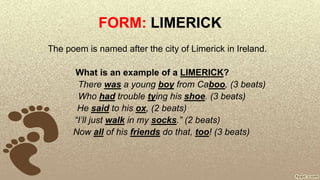
FORM: LIMERICK
The poem is named after the city of Limerick in Ireland.
What is an example of a LIMERICK?
There was a young boy from Caboo, (3 beats)
Who had trouble tying his shoe. (3 beats)
He said to his ox, (2 beats)
“I’ll just walk in my socks.” (2 beats)
Now all of his friends do that, too! (3 beats)
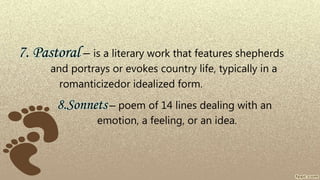
7. Pastoral – is a literary work that features shepherds
and portrays or evokes country life, typically in a
romanticizedor idealized form.
8.Sonnets – poem of 14 lines dealing with an
emotion, a feeling, or an idea.
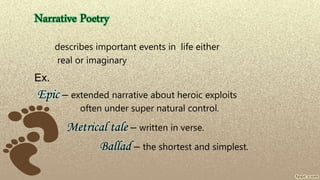
Narrative Poetry
describes important events in life either
real or imaginary
Ex.
Epic – extended narrative about heroic exploits
often under super natural control.
Metrical tale – written in verse.
Ballad – the shortest and simplest.
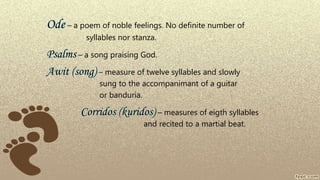
Ode – a poem of noble feelings. No definite number of
syllables nor stanza.
Psalms – a song praising God.
Awit (song) – measure of twelve syllables and slowly
sung to the accompanimant of a guitar
or banduria.
Corridos (kuridos) – measures of eigth syllables
and recited to a martial beat.
Dramatic Poetry
Comedy – usually has a happy ending
Melodrama – used in musical plays with the opera.
Tragedy – involves the hero struggling mightily against
dynamic forces.
Farce – exaggerated comedy.
Social poems – either purely comic or tragic.
FreeVerse
 A Free Verse Poem does not follow any rules. Their creation is
completely in the hands of the author.
 Rhyming, syllable count, punctuation, number of lines, number of
stanzas, and line formation can be done however the author wants in
order to convey the idea.
There is no right or wrong way to create a Free Verse poem.
BlankVerse
is a poem with no rhyme but does have iambic
pentameter. This means it consists of lines of five
feet, each foot being iambic.
FOOTPRINTS IN THE SAND
•Carolyn Carty, 1963
•Margaret Fishback Powers, 1964
•Mary Stevenson, 1936
CarolynCarty
 American Poet
 First experienced reading & writing at age four.
 At age six she became a published author. Carolyn
credits her family's history of authors and publishers
as her influences.
 Carrie is best known for using the tag author
ANONYMOUS when she wrote her Footprints poem
in 1963.
FOOTPRINTS IN THE SAND
One night a man had a dream.
He dreamed He was walking along the beach with the LORD.
Across the sky flashed scenes from His life.
For each scene He noticed two sets of footprints in the sand.
One belonging to Him and the other to the LORD.
When the last scene of His life flashed before Him,
he looked back at the footprints in the sand. He
noticed that many times along the path of His life
there was only one set of footprints.
He also noticed that it happened at the very lowest
and saddest times of His life.
This really bothered Him and He questioned the LORD
about it.
LORD you said that once I decided to follow you, you'd
walk with me all the way.
But I have noticed that during the most troublesome
times in my life there is only one set of footprints.
I don't understand why when I needed you most you
would leave me.
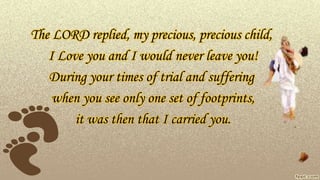
The LORD replied, my precious, precious child,
I Love you and I would never leave you!
During your times of trial and suffering
when you see only one set of footprints,
it was then that I carried you.
Thank you

Poetry

  • 1.
    Poetry Meter Stanza rhyme Figureof Speech Line Break By: Sr.Farrah B.Partol , RFSA
  • 2.
  • 3.
    Lyric Poetry refers tothe kind of poetry meant to be sung accompanied by a lyre. Usually short, simple, and easy to understand. Ex. 1. Elegy – expresses feeling of grief, melancholy; revolves around the theme of death. 2. Epigram – is a short and satirical poem with a witty or ingenious ending. It is often for remembrance, in epitaphs or dedication.
  • 4.
    3. Epithalamium –is a song or poem featuring a wedding celebration. In most epithalamiums, nymphs, shepherds, and mythical figures often take part in the event. 4. Haiku – is a traditional Japanese poem of seventeen syllables in three lines of five, seven, and five. (The autumn wind blows, Calling the leaves on the ground To join him in dance.) )
  • 5.
    5. Limerick –is a humorous five-line poem with a rhyme scheme of aabba. Sometimes nonsensical, it generally deals with everyday affairs like marriage and love. 6. Ode – is a lyric poem written in a dignified tone to idealize objects, qualities, or ideas.
  • 6.
    FORM: LIMERICK The poemis named after the city of Limerick in Ireland. What is an example of a LIMERICK? There was a young boy from Caboo, (3 beats) Who had trouble tying his shoe. (3 beats) He said to his ox, (2 beats) “I’ll just walk in my socks.” (2 beats) Now all of his friends do that, too! (3 beats)
  • 7.
    7. Pastoral –is a literary work that features shepherds and portrays or evokes country life, typically in a romanticizedor idealized form. 8.Sonnets – poem of 14 lines dealing with an emotion, a feeling, or an idea.
  • 8.
    Narrative Poetry describes importantevents in life either real or imaginary Ex. Epic – extended narrative about heroic exploits often under super natural control. Metrical tale – written in verse. Ballad – the shortest and simplest.
  • 9.
    Ode – apoem of noble feelings. No definite number of syllables nor stanza. Psalms – a song praising God. Awit (song) – measure of twelve syllables and slowly sung to the accompanimant of a guitar or banduria. Corridos (kuridos) – measures of eigth syllables and recited to a martial beat.
  • 10.
    Dramatic Poetry Comedy –usually has a happy ending Melodrama – used in musical plays with the opera. Tragedy – involves the hero struggling mightily against dynamic forces. Farce – exaggerated comedy. Social poems – either purely comic or tragic.
  • 11.
    FreeVerse  A FreeVerse Poem does not follow any rules. Their creation is completely in the hands of the author.  Rhyming, syllable count, punctuation, number of lines, number of stanzas, and line formation can be done however the author wants in order to convey the idea. There is no right or wrong way to create a Free Verse poem.
  • 12.
    BlankVerse is a poemwith no rhyme but does have iambic pentameter. This means it consists of lines of five feet, each foot being iambic.
  • 13.
    FOOTPRINTS IN THESAND •Carolyn Carty, 1963 •Margaret Fishback Powers, 1964 •Mary Stevenson, 1936
  • 14.
    CarolynCarty  American Poet First experienced reading & writing at age four.  At age six she became a published author. Carolyn credits her family's history of authors and publishers as her influences.  Carrie is best known for using the tag author ANONYMOUS when she wrote her Footprints poem in 1963.
  • 15.
    FOOTPRINTS IN THESAND One night a man had a dream. He dreamed He was walking along the beach with the LORD. Across the sky flashed scenes from His life. For each scene He noticed two sets of footprints in the sand. One belonging to Him and the other to the LORD.
  • 16.
    When the lastscene of His life flashed before Him, he looked back at the footprints in the sand. He noticed that many times along the path of His life there was only one set of footprints. He also noticed that it happened at the very lowest and saddest times of His life.
  • 17.
    This really botheredHim and He questioned the LORD about it. LORD you said that once I decided to follow you, you'd walk with me all the way. But I have noticed that during the most troublesome times in my life there is only one set of footprints. I don't understand why when I needed you most you would leave me.
  • 18.
    The LORD replied,my precious, precious child, I Love you and I would never leave you! During your times of trial and suffering when you see only one set of footprints, it was then that I carried you.
  • 19.