WORK BREAK DOWN STRUCTURE IN
ERP IMPLEMENTATION PROJECTS
A Presentation by BHARGAV S SEERAM, 121202079
INTRODUCTION
 ERP has been referred to as a business operating system that enables better
resource planning and improved delivery of value-added products and services to
customers
 Although ERP applications have been widely adopted by a variety of industries
worldwide, the challenges faced during and post-implementation remain a
growing concern.
 Based on the Risk Factors of ERP, one of the risks identified in project
management and control, is a lack of effective project management methodology
INTRODUCTION (CONTD..)
 In order to achieve a successful implementation, this paper proposes the use of a
Work Breakdown Structure (WBS) to guide an ERP project
 It is defined as an enumeration of all work activities in hierarchic refinement of
detail which organizes work to be done into short manageable tasks with
quantifiable inputs, outputs, schedules, and assigned responsibilities.
 Dividing complex projects to simpler and manageable tasks is the process
identified asWork Breakdown Structure (WBS)
 AWBS is also used for project costing.This paper discusses using aWBS to
organize an ERP project
ASAP PROJECT METHODOLOGY
 SAP introduced the ASAP implementation methodology with the goal of
speeding up SAP implementation projects
 ASAP implementation is a structured implementation approach that can help
managers achieve a faster implementation with quicker user acceptance, well-
defined roadmaps, and efficient documentation at various phases
 The ASAP Methodology phases are:
 Project Preparation
 Business Blueprint
 Realization
 Final Preparation
 Go Live & Support
ASAP METHODOLOGY PHASES
Project Preparation
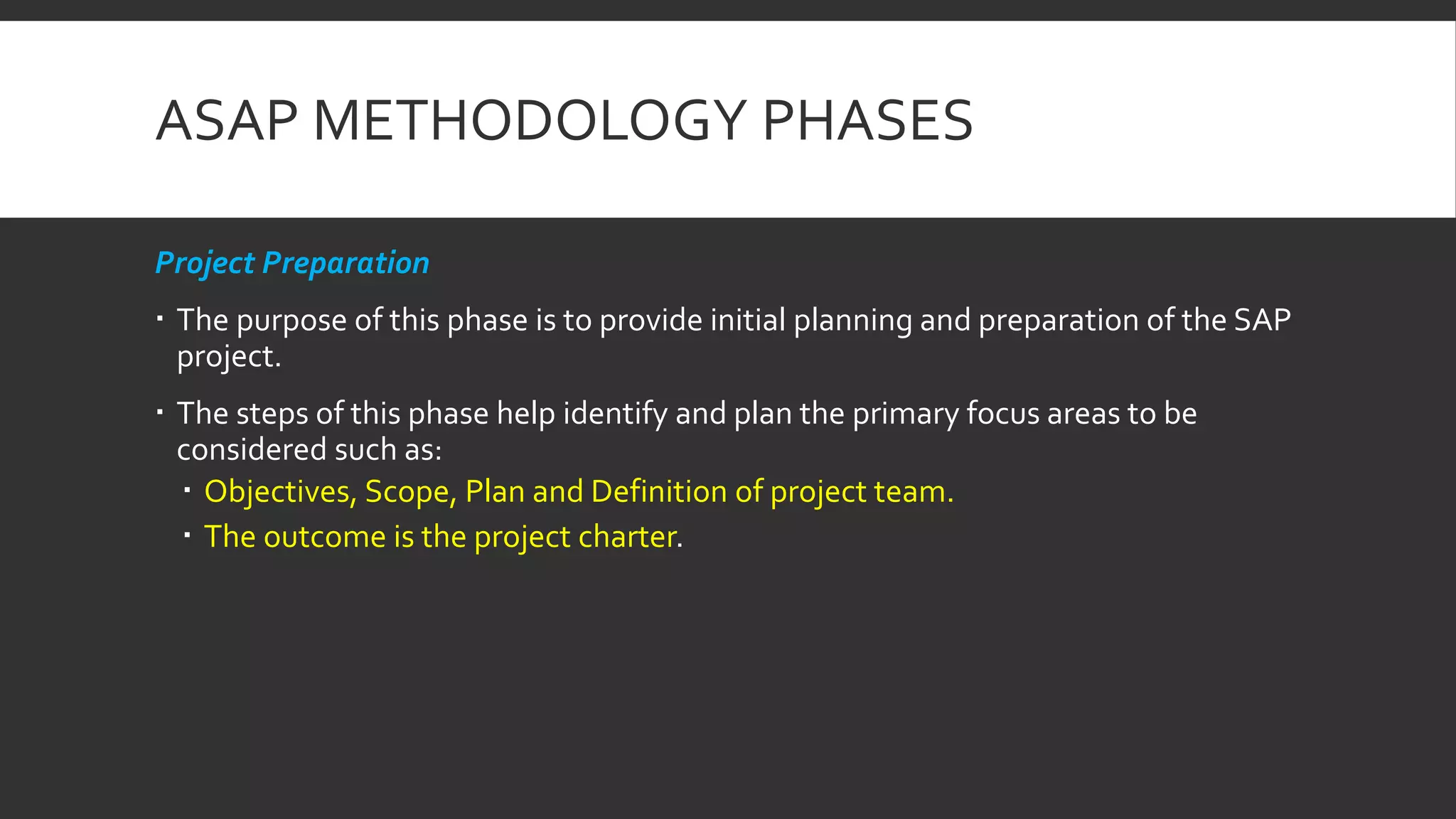
 The purpose of this phase is to provide initial planning and preparation of the SAP
project.
 The steps of this phase help identify and plan the primary focus areas to be
considered such as:
 Objectives, Scope, Plan and Definition of project team.
 The outcome is the project charter.
ASAP METHODOLOGY PHASES (CONTD..)
Business Blueprint
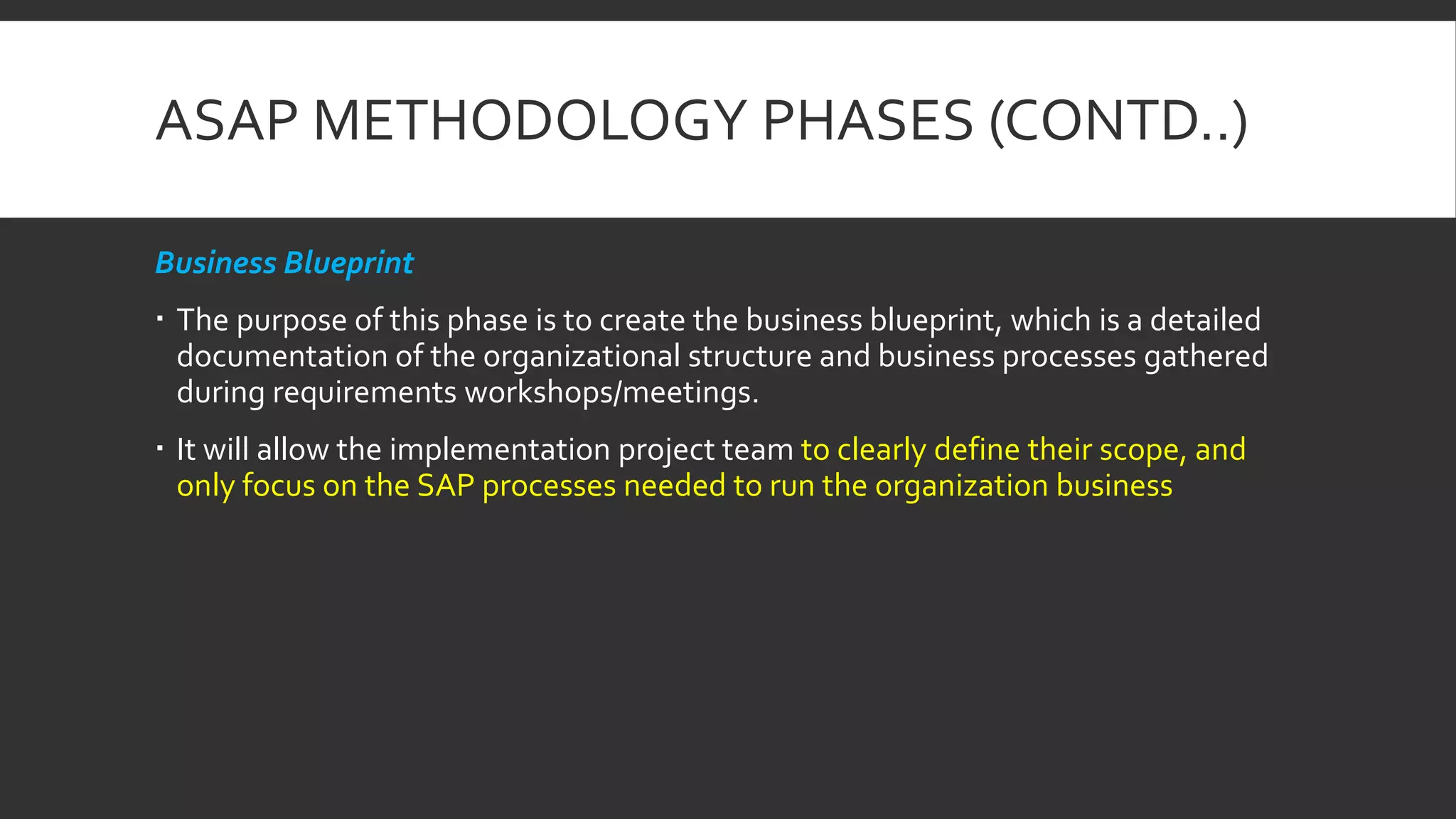
 The purpose of this phase is to create the business blueprint, which is a detailed
documentation of the organizational structure and business processes gathered
during requirements workshops/meetings.
 It will allow the implementation project team to clearly define their scope, and
only focus on the SAP processes needed to run the organization business
ASAP METHODOLOGY PHASES (CONTD..)
Realization
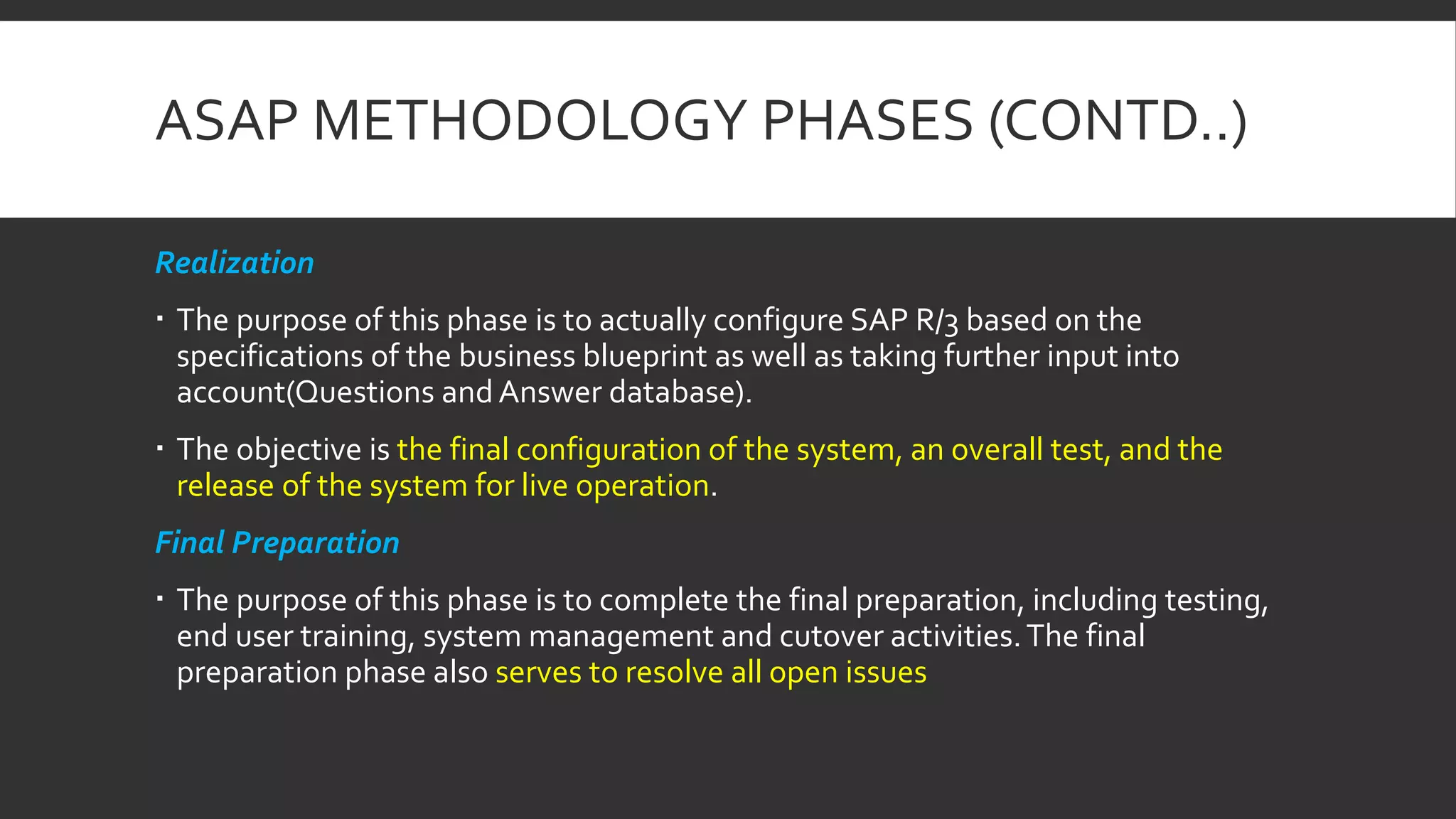
 The purpose of this phase is to actually configure SAP R/3 based on the
specifications of the business blueprint as well as taking further input into
account(Questions and Answer database).
 The objective is the final configuration of the system, an overall test, and the
release of the system for live operation.
Final Preparation
 The purpose of this phase is to complete the final preparation, including testing,
end user training, system management and cutover activities.The final
preparation phase also serves to resolve all open issues
ASAP METHODOLOGY PHASES (CONTD..)
Go Live & Support
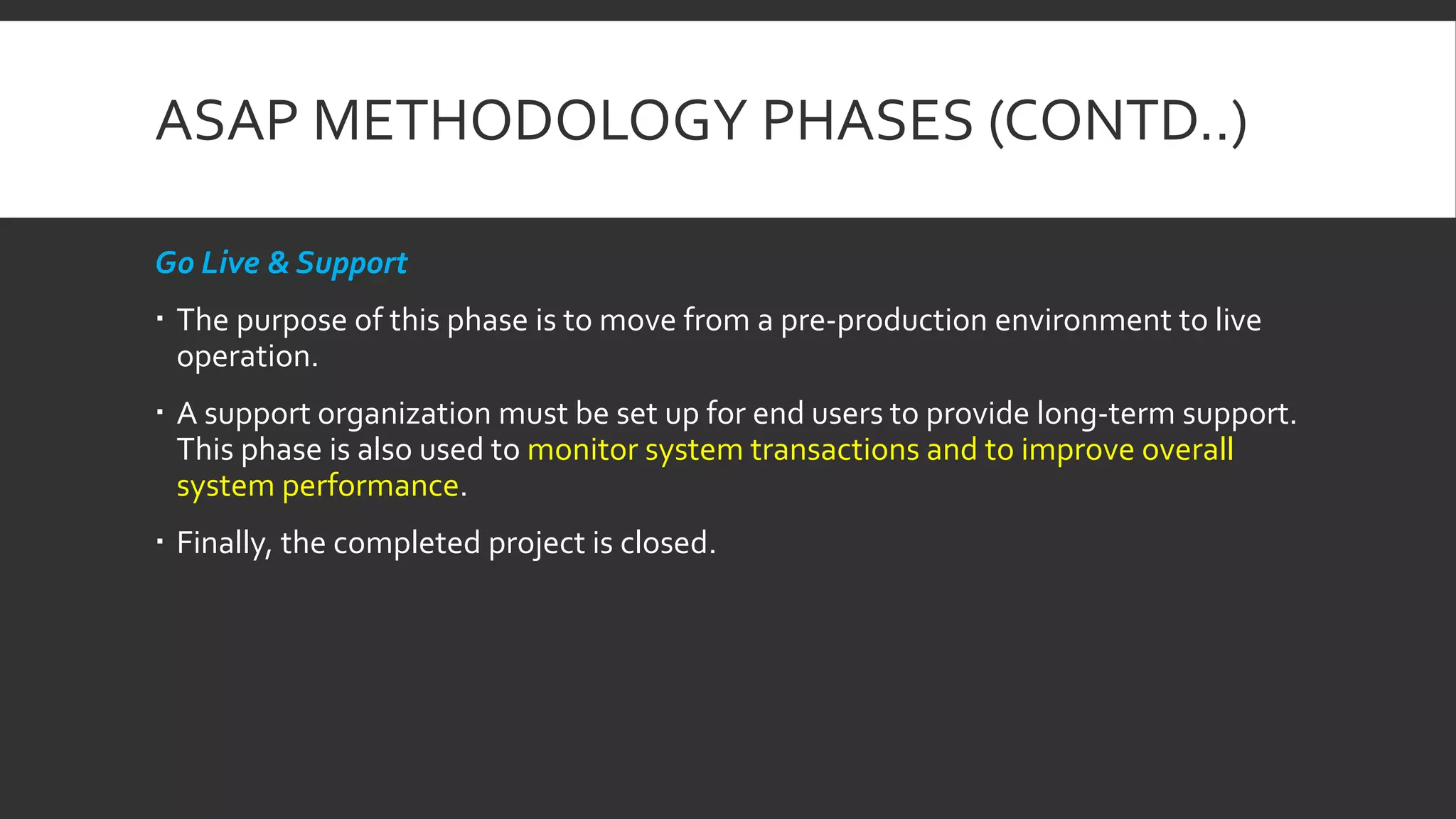
 The purpose of this phase is to move from a pre-production environment to live
operation.
 A support organization must be set up for end users to provide long-term support.
This phase is also used to monitor system transactions and to improve overall
system performance.
 Finally, the completed project is closed.
ASAP PROJECT METHODOLOGY (CONTD..)
 Each phase is composed of a group of work packages.
 These work packages are structured in activities, and each activity is composed of
a group of tasks.
 For each task, a definition, a set of procedures, results and roles are provided in
the ASAP methodology documentation.
 Implementations where ASAP or Powered by SAP methodologies were used
averaged only 8 months, compared to 15 months for standard implementations
WORK BREAKDOWN STRUCTURE FOR ERP
IMPLEMENTATION
 A complex project is made manageable by first breaking it into individual
components in a hierarchical structure, known asWork Breakdown Structure.
 Such a structure defines tasks that can be completed independently of other
tasks, facilitating resource allocation, assignment of responsibilities, and
measurement and control of the project
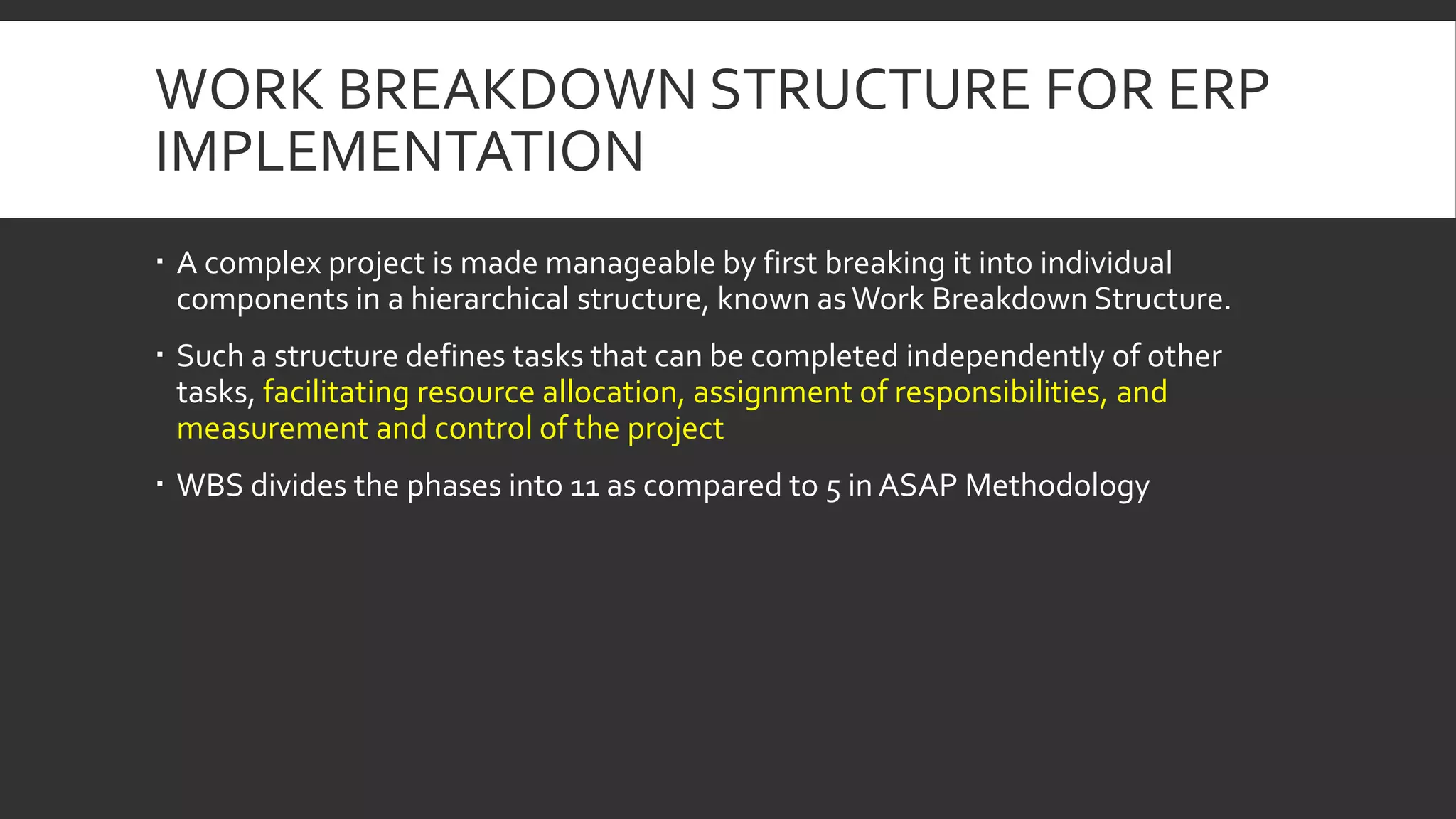
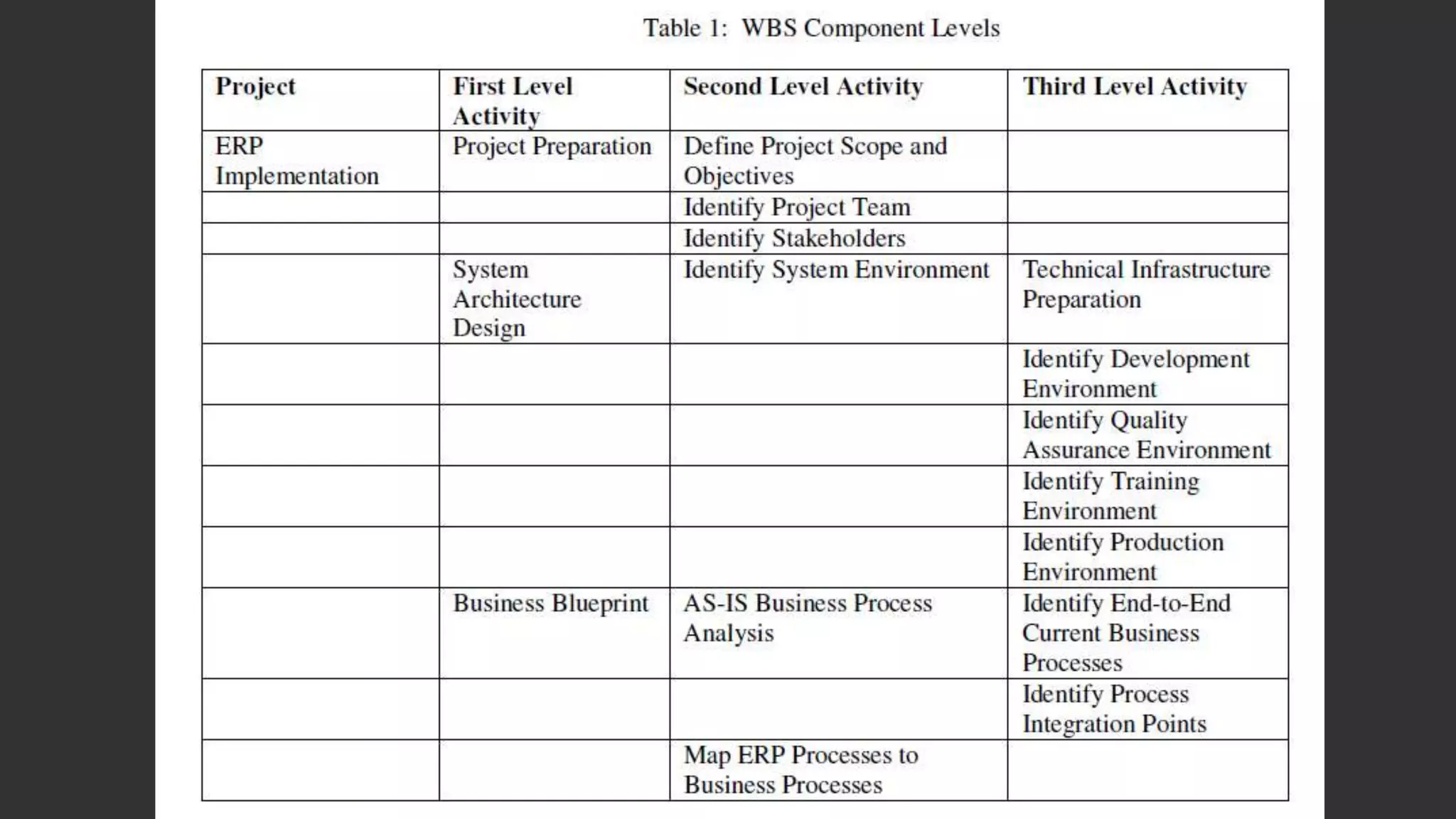
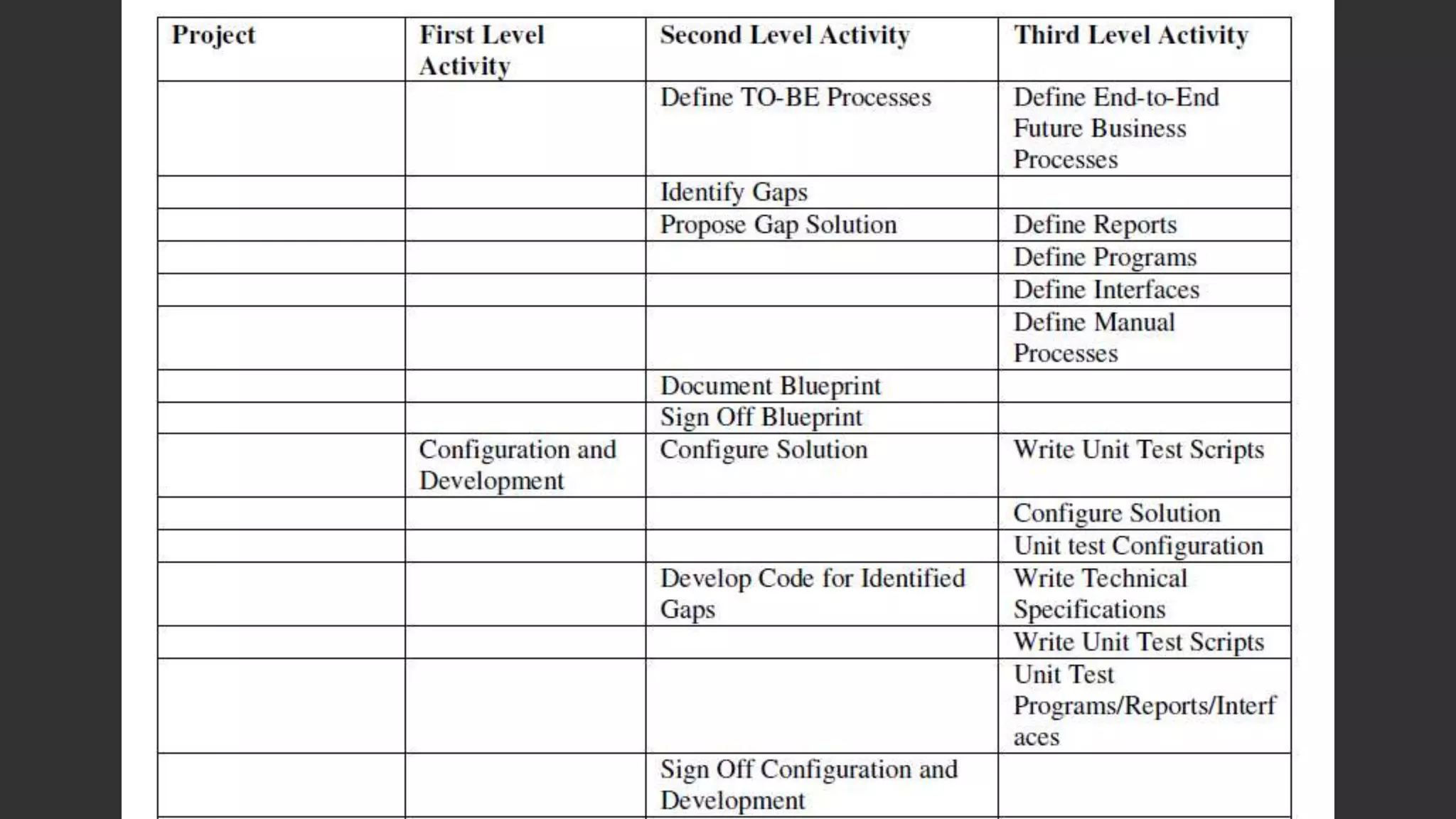
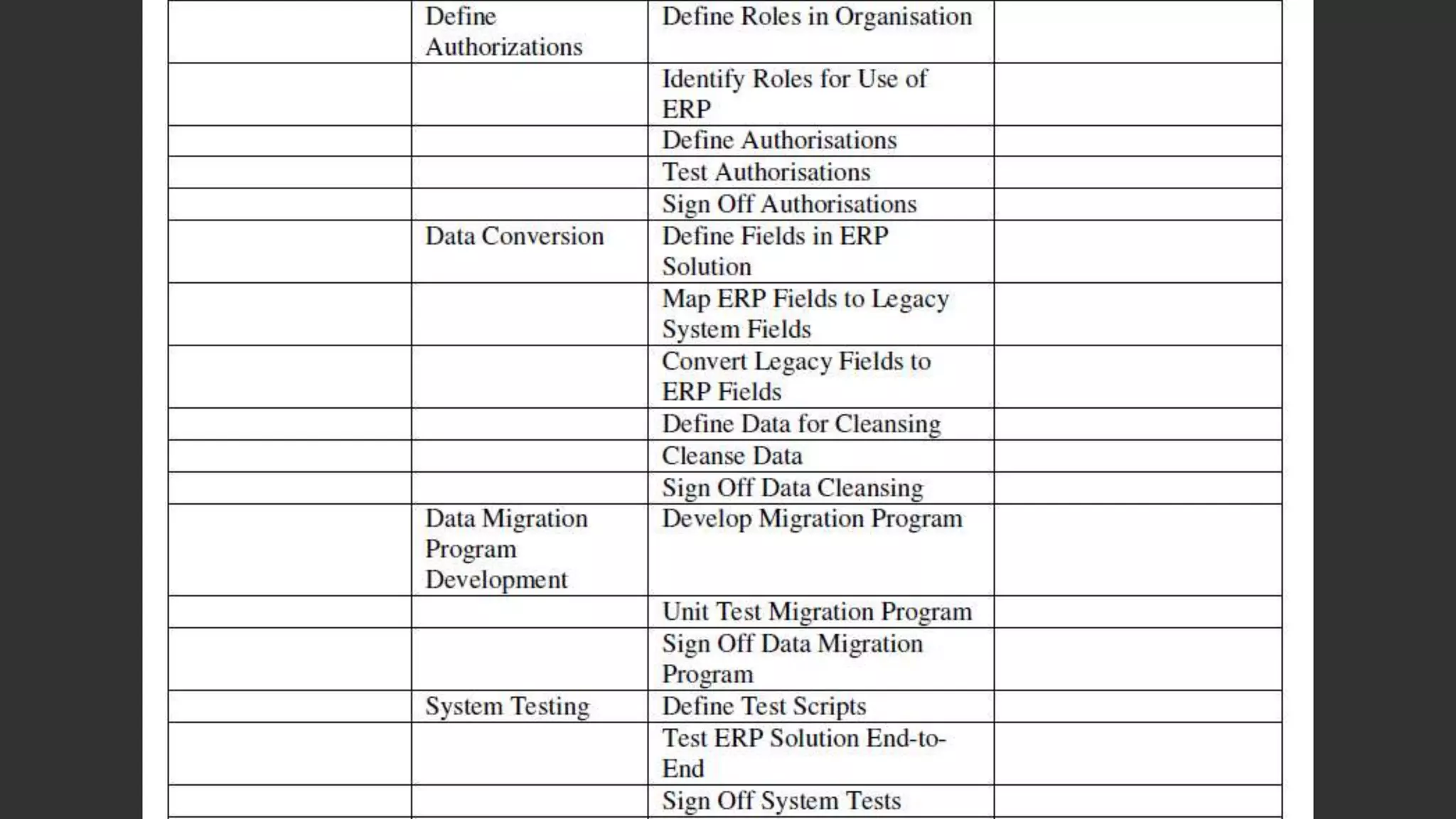
 WBS divides the phases into 11 as compared to 5 in ASAP Methodology
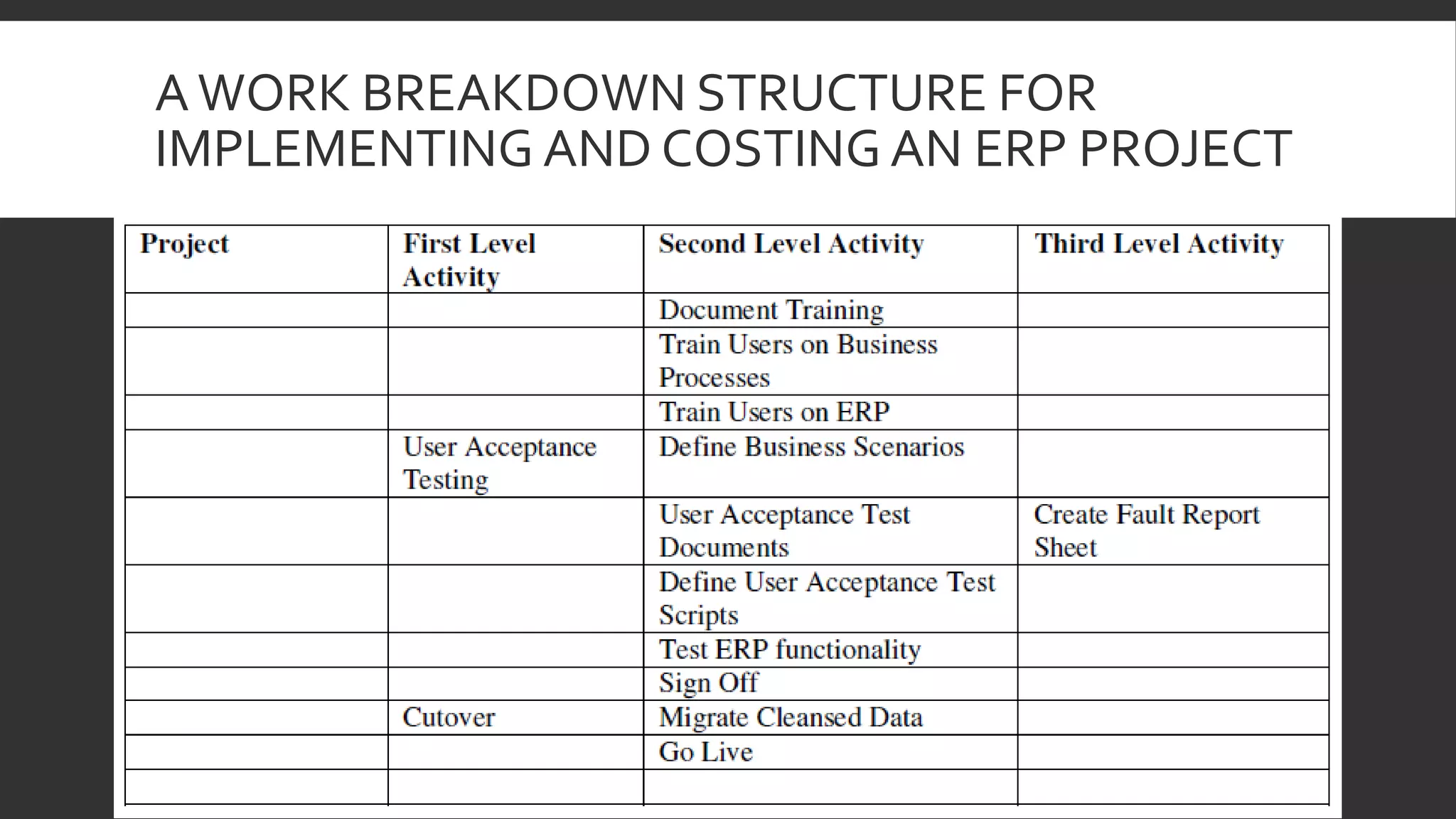
AWORK BREAKDOWN STRUCTURE FOR
IMPLEMENTING AND COSTING AN ERP PROJECT
WBS ACTIVITIES AND POTENTIAL
CHALLENGES
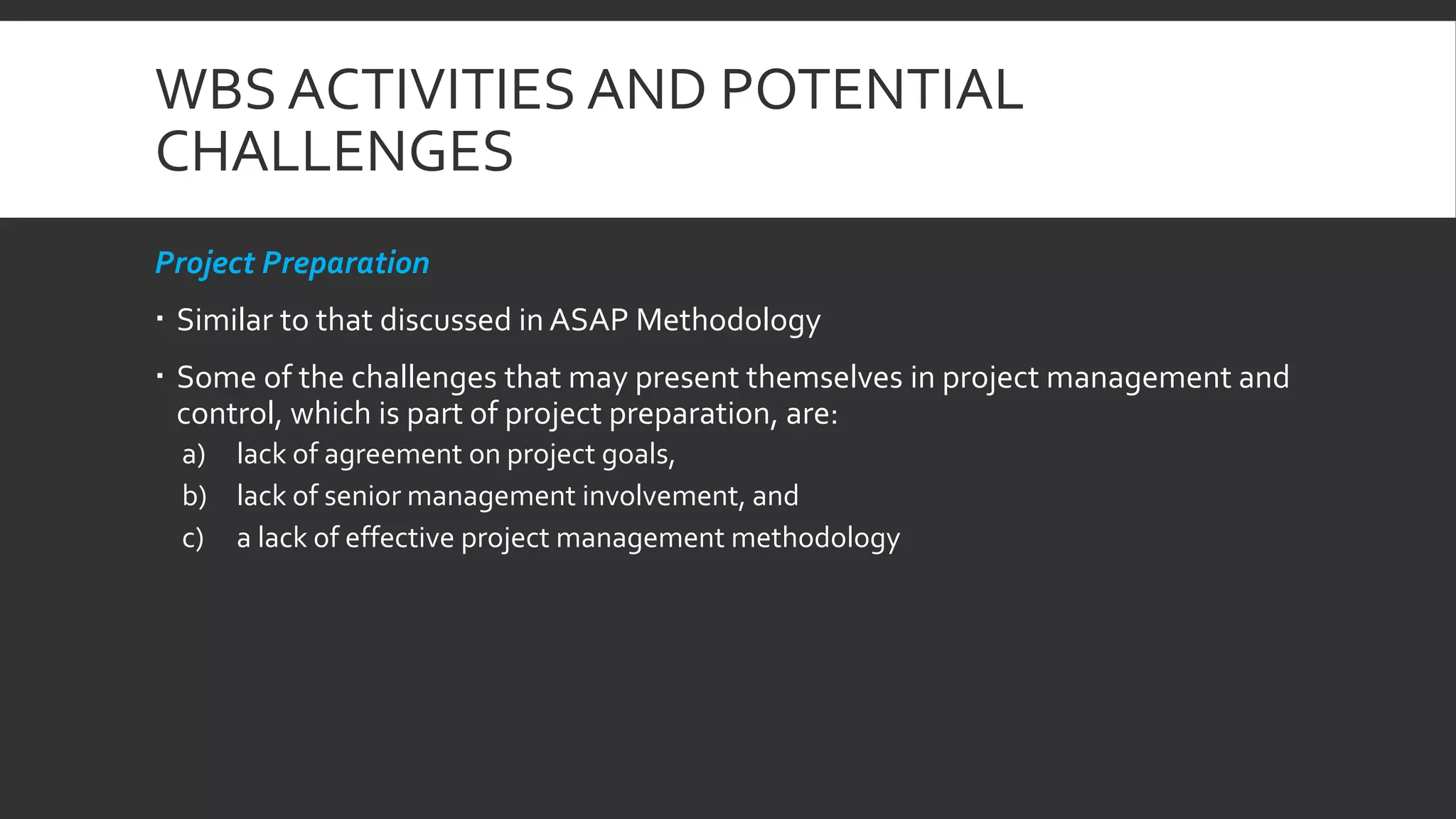
Project Preparation
 Similar to that discussed in ASAP Methodology
 Some of the challenges that may present themselves in project management and
control, which is part of project preparation, are:
a) lack of agreement on project goals,
b) lack of senior management involvement, and
c) a lack of effective project management methodology
WBS ACTIVITIES AND POTENTIAL
CHALLENGES (CONTD..)
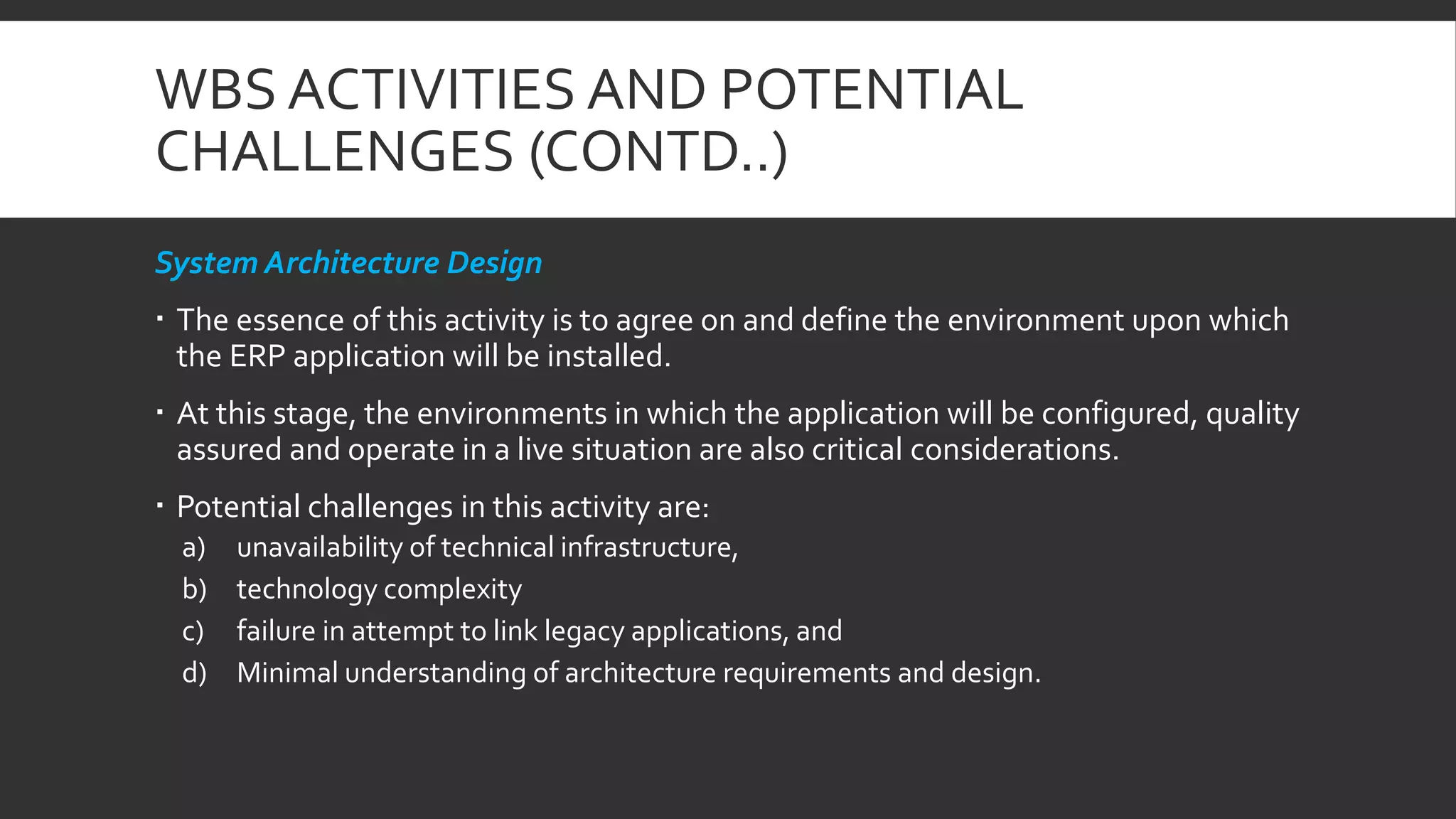
System Architecture Design
 The essence of this activity is to agree on and define the environment upon which
the ERP application will be installed.
 At this stage, the environments in which the application will be configured, quality
assured and operate in a live situation are also critical considerations.
 Potential challenges in this activity are:
a) unavailability of technical infrastructure,
b) technology complexity
c) failure in attempt to link legacy applications, and
d) Minimal understanding of architecture requirements and design.
WBS ACTIVITIES AND POTENTIAL
CHALLENGES (CONTD..)
Business Blueprint
 Similar to that discussed in ASAP Methodology
 Potential challenges during the execution of this activity are:
a) Minimal understanding of business processes,
b) Business requirements to customize the ERP application beyond its standard
functionality,
c) lack of business process reengineering,
d) Employee resistance to change,
e) Use of inexperienced consultants, and
f) Minimal understanding of the ERP application functionality.
WORK BREAKDOWN STRUCTURE
ACTIVITIES (CONTD..)
Configuration and Development
 This activity is equivalent to the Realisation part of the ASAP methodology. It
involves configuring the ERP application based on the business blueprint.
 It is essential the application is configured using to the standard functionality in
the system.
 Other activities under the umbrella of this main activity are the development of
reports, interfaces and additional programs.
WORK BREAKDOWN STRUCTURE
ACTIVITIES (CONTD..)
Define Authorizations
 The purpose of this activity is to define the roles of the respective ERP application
users once the application has gone live.
 These roles will be used to define access rights for each of the users.
 This way, unauthorized users will not be allowed access to information in the ERP
application that is not within their jurisdiction.
Data Conversion
 This activity involves converting the format of the data in the legacy system to
suit the data format of the ERP system.
 This process also entails cleansing the data in the legacy system.
WORK BREAKDOWN STRUCTURE
ACTIVITIES (CONTD..)
Data Migration Program Development
 Involves coding the program that will transfer the data from the legacy system to
the ERP application.
SystemTesting
 SystemTesting entails the consultants that implemented the ERP application
ensuring that the system works end-to-end.
 The entire system is tested, process by process across all functions of the system.
WORK BREAKDOWN STRUCTURE
ACTIVITIES (CONTD..)
Training
 Training involves imparting knowledge of the implemented solution to the users
before the system goes into live operation.
 This activity entails defining business processes for the respective roles and
defining business scenarios to suit these processes.
 These scenarios enable the users to understand the system functionality better.
User AcceptanceTesting (UAT)
 This activity involves the users who will utilize the ERP application in a live
environment, ensuring that all the business requirements are met in the system
and are functional.
WORK BREAKDOWN STRUCTURE
ACTIVITIES (CONTD..)
Cutover
 This activity means going live by migrating from the legacy system to the ERP
application.
 This application becomes operational in a live environment.
 It involves migrating live data from the legacy system to the new system.
CONCLUSION
 A good project methodology known as ASAP, which is used in SAP
implementations, was studied.
 However, in order to ensure that all aspects of an ERP implementation are
addressed, it is advisable to extend ASAP and other methodologies into aWBS.
 The WBS will be used to define the ERP project activities so that the lowest level
of activity is accounted for.
 This paper illustrated the use of aWBS in defining project activities.

PM_WBS

  • 1.
    WORK BREAK DOWNSTRUCTURE IN ERP IMPLEMENTATION PROJECTS A Presentation by BHARGAV S SEERAM, 121202079
  • 2.
    INTRODUCTION  ERP hasbeen referred to as a business operating system that enables better resource planning and improved delivery of value-added products and services to customers  Although ERP applications have been widely adopted by a variety of industries worldwide, the challenges faced during and post-implementation remain a growing concern.  Based on the Risk Factors of ERP, one of the risks identified in project management and control, is a lack of effective project management methodology
  • 3.
    INTRODUCTION (CONTD..)  Inorder to achieve a successful implementation, this paper proposes the use of a Work Breakdown Structure (WBS) to guide an ERP project  It is defined as an enumeration of all work activities in hierarchic refinement of detail which organizes work to be done into short manageable tasks with quantifiable inputs, outputs, schedules, and assigned responsibilities.  Dividing complex projects to simpler and manageable tasks is the process identified asWork Breakdown Structure (WBS)  AWBS is also used for project costing.This paper discusses using aWBS to organize an ERP project
  • 4.
    ASAP PROJECT METHODOLOGY SAP introduced the ASAP implementation methodology with the goal of speeding up SAP implementation projects  ASAP implementation is a structured implementation approach that can help managers achieve a faster implementation with quicker user acceptance, well- defined roadmaps, and efficient documentation at various phases  The ASAP Methodology phases are:  Project Preparation  Business Blueprint  Realization  Final Preparation  Go Live & Support
  • 5.
    ASAP METHODOLOGY PHASES ProjectPreparation  The purpose of this phase is to provide initial planning and preparation of the SAP project.  The steps of this phase help identify and plan the primary focus areas to be considered such as:  Objectives, Scope, Plan and Definition of project team.  The outcome is the project charter.
  • 6.
    ASAP METHODOLOGY PHASES(CONTD..) Business Blueprint  The purpose of this phase is to create the business blueprint, which is a detailed documentation of the organizational structure and business processes gathered during requirements workshops/meetings.  It will allow the implementation project team to clearly define their scope, and only focus on the SAP processes needed to run the organization business
  • 7.
    ASAP METHODOLOGY PHASES(CONTD..) Realization  The purpose of this phase is to actually configure SAP R/3 based on the specifications of the business blueprint as well as taking further input into account(Questions and Answer database).  The objective is the final configuration of the system, an overall test, and the release of the system for live operation. Final Preparation  The purpose of this phase is to complete the final preparation, including testing, end user training, system management and cutover activities.The final preparation phase also serves to resolve all open issues
  • 8.
    ASAP METHODOLOGY PHASES(CONTD..) Go Live & Support  The purpose of this phase is to move from a pre-production environment to live operation.  A support organization must be set up for end users to provide long-term support. This phase is also used to monitor system transactions and to improve overall system performance.  Finally, the completed project is closed.
  • 9.
    ASAP PROJECT METHODOLOGY(CONTD..)  Each phase is composed of a group of work packages.  These work packages are structured in activities, and each activity is composed of a group of tasks.  For each task, a definition, a set of procedures, results and roles are provided in the ASAP methodology documentation.  Implementations where ASAP or Powered by SAP methodologies were used averaged only 8 months, compared to 15 months for standard implementations
  • 10.
    WORK BREAKDOWN STRUCTUREFOR ERP IMPLEMENTATION  A complex project is made manageable by first breaking it into individual components in a hierarchical structure, known asWork Breakdown Structure.  Such a structure defines tasks that can be completed independently of other tasks, facilitating resource allocation, assignment of responsibilities, and measurement and control of the project  WBS divides the phases into 11 as compared to 5 in ASAP Methodology
  • 14.
    AWORK BREAKDOWN STRUCTUREFOR IMPLEMENTING AND COSTING AN ERP PROJECT
  • 15.
    WBS ACTIVITIES ANDPOTENTIAL CHALLENGES Project Preparation  Similar to that discussed in ASAP Methodology  Some of the challenges that may present themselves in project management and control, which is part of project preparation, are: a) lack of agreement on project goals, b) lack of senior management involvement, and c) a lack of effective project management methodology
  • 16.
    WBS ACTIVITIES ANDPOTENTIAL CHALLENGES (CONTD..) System Architecture Design  The essence of this activity is to agree on and define the environment upon which the ERP application will be installed.  At this stage, the environments in which the application will be configured, quality assured and operate in a live situation are also critical considerations.  Potential challenges in this activity are: a) unavailability of technical infrastructure, b) technology complexity c) failure in attempt to link legacy applications, and d) Minimal understanding of architecture requirements and design.
  • 17.
    WBS ACTIVITIES ANDPOTENTIAL CHALLENGES (CONTD..) Business Blueprint  Similar to that discussed in ASAP Methodology  Potential challenges during the execution of this activity are: a) Minimal understanding of business processes, b) Business requirements to customize the ERP application beyond its standard functionality, c) lack of business process reengineering, d) Employee resistance to change, e) Use of inexperienced consultants, and f) Minimal understanding of the ERP application functionality.
  • 18.
    WORK BREAKDOWN STRUCTURE ACTIVITIES(CONTD..) Configuration and Development  This activity is equivalent to the Realisation part of the ASAP methodology. It involves configuring the ERP application based on the business blueprint.  It is essential the application is configured using to the standard functionality in the system.  Other activities under the umbrella of this main activity are the development of reports, interfaces and additional programs.
  • 19.
    WORK BREAKDOWN STRUCTURE ACTIVITIES(CONTD..) Define Authorizations  The purpose of this activity is to define the roles of the respective ERP application users once the application has gone live.  These roles will be used to define access rights for each of the users.  This way, unauthorized users will not be allowed access to information in the ERP application that is not within their jurisdiction. Data Conversion  This activity involves converting the format of the data in the legacy system to suit the data format of the ERP system.  This process also entails cleansing the data in the legacy system.
  • 20.
    WORK BREAKDOWN STRUCTURE ACTIVITIES(CONTD..) Data Migration Program Development  Involves coding the program that will transfer the data from the legacy system to the ERP application. SystemTesting  SystemTesting entails the consultants that implemented the ERP application ensuring that the system works end-to-end.  The entire system is tested, process by process across all functions of the system.
  • 21.
    WORK BREAKDOWN STRUCTURE ACTIVITIES(CONTD..) Training  Training involves imparting knowledge of the implemented solution to the users before the system goes into live operation.  This activity entails defining business processes for the respective roles and defining business scenarios to suit these processes.  These scenarios enable the users to understand the system functionality better. User AcceptanceTesting (UAT)  This activity involves the users who will utilize the ERP application in a live environment, ensuring that all the business requirements are met in the system and are functional.
  • 22.
    WORK BREAKDOWN STRUCTURE ACTIVITIES(CONTD..) Cutover  This activity means going live by migrating from the legacy system to the ERP application.  This application becomes operational in a live environment.  It involves migrating live data from the legacy system to the new system.
  • 23.
    CONCLUSION  A goodproject methodology known as ASAP, which is used in SAP implementations, was studied.  However, in order to ensure that all aspects of an ERP implementation are addressed, it is advisable to extend ASAP and other methodologies into aWBS.  The WBS will be used to define the ERP project activities so that the lowest level of activity is accounted for.  This paper illustrated the use of aWBS in defining project activities.