PM World Journal PMO & the Tollgate Process
Vol. II, Issue V – May 2013 by Bob Prieto
www.pmworldjournal.net Featured Paper
© 2013 Bob Prieto www.pmworldlibrary.net Page 1 of 7
PMO & the Tollgate Process
Bob Prieto
Fluor
In enterprise-wide roles the PMO (Project Management Office or Program Management
Office) will have responsibility for management and implementation of a tollgate or
stage gate process for program and project approval. The purpose of this process is to
ensure that investment decisions are made on a sound basis, that project portfolios
have been rationalized and optimized, and that solid baseline foundations exist.
This paper we will take a closer look at the tollgate process and its oversight by the
PMO.
Tollgates and Stage Gates
Tollgates or stage gates represent approval points before proceeding to the next stage
of program or project development. The PMO will have defined standards and
requirements to have been met before approval can be gained to proceed to the next
stage and review of the readiness of each project at the “gate” ensures that the basis for
additional capital commitments exists.
The various “gate” reviews are formal processes with responsibilities, accountabilities
and authorities well defined. The impact of proceeding through the “gate” must be
understood across the organization. In simplest terms the PMO is the gatekeeper.
Organizational terminology and “gate” requirements will vary but in general terms
include:
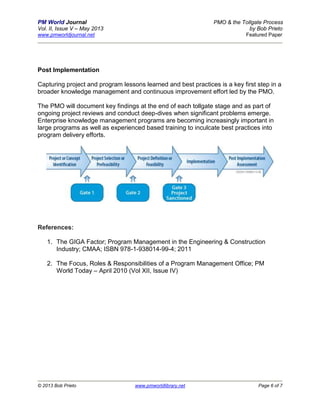
 Project or concept identification
 Project selection or pre-feasibility
 Project definition or feasibility
 Implementation
A well implemented tollgate process has the opportunity to significantly influence
program and project success. The best opportunities to influence project outcomes are
the earliest possible stages. Getting the first steps right is key to controlling the
impactful cost of change at later stages. Decision processes at each gate must be
robust.
It is at each stage gate that the program’s risk register is built and further refined. The
stage gate process drives risk management front and center in the overall program
definition process.
PM World Journal PMO & the Tollgate Process
Vol. II, Issue V – May 2013 by Bob Prieto
www.pmworldjournal.net Featured Paper
© 2013 Bob Prieto www.pmworldlibrary.net Page 2 of 7
PMO Role in Capital Management
As gatekeeper, the PMO’s effectiveness has a huge influence on enterprise wide capital
management. The tollgate process has the ability to:
 Manage demand for capital
 Drive capital efficiency in projects as they advance through the tollgate
process
 Enhance project execution by providing a disciplined project development
framework and enforcing standards on management evaluation of
alternatives
 Influence acceptable risk frameworks commensurate with the investments
being undertaken and the risks the programs will face.
At each stage the PMO can lever the tollgate process to create value.
Project or Concept Identification
During the project identification or concept stage, program and project teams will:
 Defines outcomes to be achieved (Strategic Business Objectives or
SBOs)
 Identify minimum scope required to achieve the SBOs
 Define candidate projects or project portfolios
 Initially engage stakeholders
 Screen candidate projects and options
 Test recommendations against policies, financial hurdle rates and other
constraints that may act upon their success
 Ensure that an initial risk register has been assembled and that large
areas of uncertainty have been identified together with the strategies to
reduce these uncertainties in the next stage
 Define resource allocations in terms of time, money and management
 Confirm that adequate managerial and other resources exist to undertake
the program
Inputs considered during this stage may include:
 Market or Demand Forecasts
 Sales/Capacity Reconciliation (matching supply to contractual
commitments)
 Competitor Intelligence or Other Competitive Studies
 Legal Constraints and Challenges
 Environmental Constraints and Regulations
PM World Journal PMO & the Tollgate Process
Vol. II, Issue V – May 2013 by Bob Prieto
www.pmworldjournal.net Featured Paper
© 2013 Bob Prieto www.pmworldlibrary.net Page 3 of 7
 Value Added Assessments
 Technology Assessments including Required R&D
 Estimates by Others
 Stakeholder Surveys and Other Assessments
 Program or Product Development
 Business Objectives
Project Selection or Pre-Feasibility
Projects that have cleared the initial gate represented by the project or concept
identification stage discussed above will then undertake a series of activities to improve
project definition and confidence in order to meet the requirements of the project
selection or pre-feasibility gate. Selection frameworks and ultimate selection
justifications will be developed.
Activities during this stage will include:
 Comprehensive portfolio and option evaluations at both the program and
project levels. At the program level identification of the efficient frontier will
be a major objective. At the project level, cost-benefit analyses are
undertaken on a risk weighted basis.
 Projects comprising the selected portfolio better defined
 Project level risks, resource requirements, constraints and interactions
with other projects comprising the program defined
 Structured opportunity analysis and implementation of a range of value
improving programs
 Refinement of cost analysis
 More rigorous risk identification and assessment
 Benchmarking analysis against other projects or programs
 Development of a preliminary program execution strategy and plan
Specific items developed at this stage include:
 Identification of Non Process Infrastructure (NPI); Offsites & Utilities (O&U); or
other auxiliary program or project needs
 Hazards Reviews (HAZOP)
 Conceptual Engineering or FEL 2
 Economic Evaluation of Alternatives Including Scenario Analysis
 Site Selection Based on Established Selection Criteria and Methodology
 Process Flow Sheets or the Equivalent for Other Industries (Highway Right of
Way (ROW); Rail Alignment; Single Line Network Diagrams)
 Budget Estimates including Risk Based Provisions for Uncertainties and
Unknowns
PM World Journal PMO & the Tollgate Process
Vol. II, Issue V – May 2013 by Bob Prieto
www.pmworldjournal.net Featured Paper
© 2013 Bob Prieto www.pmworldlibrary.net Page 4 of 7
 Project Objectives, Linked to Programmatic Strategic Business Objectives
Project Definition or Feasibility
Having cleared the pre-feasibility stage, programs move to the feasibility stage.
Principle objectives at this stage include rigorously assessing the financial justification
for a particular project using pre-established and consistently applied methodology and
criteria.
Projects will undergo structured processes that allow all projects to be evaluated on a
consistent basis. In effect projects are competing for the same scarce resources.
Projects which clear this gate are “sanctioned” and full capital resources for
implementation are released to the project.
Specific items developed to support this stage, and which will be reviewed by the PMO,
include:
 Piping & Instrumentation Drawings (P&IDs)
 Equipment Specifications and as Appropriate Materials Specifications
 Procurement Plan including Use of Strategic Sourcing
 Execution Plan, Consistent with the Standards Established by the PMO
 General or Preliminary Arrangements
 Scope(s)of Work
 Baseline Schedule and Associated Analysis
 Baseline Estimate for “Sanction”
 Sign-offs from all Required Parties
In addition to leading evaluation of the various programs and projects, the PMO will be
looking at the enterprise’s overall portfolio, identifying portfolio risks and opportunities.
Project portfolio management is a key PMO responsibility.
Project portfolio management seeks to ensure that:
 The right projects are selected to achieve the strategic outcomes represented by
the organization’s Strategic Business Objectives
 Resources, financial and management, are optimally deployed
 Projects are monitored against key performance indicators which are developed
through the tollgate process and linked to key outcomes, critical success factors
or key results areas as appropriate
 Projects are executed in a well defined and comprehensive manner benefiting
from lessons learned on earlier efforts.
As part of its project portfolio management efforts the PMO will:
PM World Journal PMO & the Tollgate Process
Vol. II, Issue V – May 2013 by Bob Prieto
www.pmworldjournal.net Featured Paper
© 2013 Bob Prieto www.pmworldlibrary.net Page 5 of 7
 Establish project portfolio evaluation criteria and methodologies
 Establish project evaluation methodologies to ensure consistent evaluation of
projects
 Monitor alignment of Strategic Business Objectives, strategy and program and
project definition
 Ensure that top level KPIs have been appropriately cascaded down
 Confirm that selected portfolios and projects are consistent with the
organization’s risk appetite
 Confirm that changes in the external or internal environments have not altered
the viability of selected programs or projects
 Asses program, project and enterprise portfolio risks paying particular attention to
cross enterprise systemic risks; constraint coupling and assumption migration
 Define key strategic risks that must be considered in program and project
evaluations at each gate.
 Assess program resiliency and identify inherent complexity and flexibility
 Review dynamic factors impacting project delivery
 Assess adequacy of enterprise risk management and mitigation efforts including
required insurance programs
 Model cash flows under a range of scenarios and develop contingency strategies
 Model project and program hurdle rates recognizing that low performing projects
may be enablers for higher program performance.
 Assess adequacy of management and other human resources including overall
availability, competition for resources and possession of requisite skill levels
 Identify financial risk mitigation strategies and implement as tasked
 Ongoing project validation
 Top level stakeholder communication
 Implement project and program governance policies and practices
Implementation
The PMO will establish program and project execution standards and prepare go-by
documents for these execution plans. Execution requirements will be further supported
by policies, procedures and standards as required meeting the organization’s needs for
consistent program and project execution and performance.
Change control is a major focus area of the PMO recognizing the costly and disruptive
impacts of change. Reviews will include all affected stakeholders and occur in a timely
manner before each major construction activity.
Cross project and cross program impacts will be closely monitored by the PMO.
Opportunities for cost reduction, synergy capture, opportunity exploitation, and schedule
compression will also represent a major focus for the PMO.
PM World Journal PMO & the Tollgate Process
Vol. II, Issue V – May 2013 by Bob Prieto
www.pmworldjournal.net Featured Paper
© 2013 Bob Prieto www.pmworldlibrary.net Page 6 of 7
Post Implementation
Capturing project and program lessons learned and best practices is a key first step in a
broader knowledge management and continuous improvement effort led by the PMO.
The PMO will document key findings at the end of each tollgate stage and as part of
ongoing project reviews and conduct deep-dives when significant problems emerge.
Enterprise knowledge management programs are becoming increasingly important in
large programs as well as experienced based training to inculcate best practices into
program delivery efforts.
References:
1. The GIGA Factor; Program Management in the Engineering & Construction
Industry; CMAA; ISBN 978-1-938014-99-4; 2011
2. The Focus, Roles & Responsibilities of a Program Management Office; PM
World Today – April 2010 (Vol XII, Issue IV)
PM World Journal PMO & the Tollgate Process
Vol. II, Issue V – May 2013 by Bob Prieto
www.pmworldjournal.net Featured Paper
© 2013 Bob Prieto www.pmworldlibrary.net Page 7 of 7
About the Author
Bob Prieto
Senior Vice President
Fluor
Bob Prieto is a senior vice president of Fluor, one of the largest,
publicly traded engineering and construction companies in the world. He is responsible
for strategy for the firm’s Industrial & Infrastructure group which focuses on the
development and delivery of large, complex projects worldwide. The group
encompasses three major business lines including Infrastructure, with an emphasis on
Public Private Partnerships; Mining; and Industrial Services. Bob consults with owner’s
of large engineering & construction capital construction programs across all market
sectors in the development of programmatic delivery strategies encompassing planning,
engineering, procurement, construction and financing. He is author of “Strategic
Program Management” and “The Giga Factor: Program Management in the Engineering
and Construction Industry” published by the Construction Management Association of
America (CMAA) and “Topics in Strategic Program Management” as well as over 400
other papers and presentations.
Bob is a member of the ASCE Industry Leaders Council, National Academy of
Construction and a Fellow of the Construction Management Association of America.
Bob served until 2006 as one of three U.S. presidential appointees to the Asia Pacific
Economic Cooperation (APEC) Business Advisory Council (ABAC), working with U.S.
and Asia-Pacific business leaders to shape the framework for trade and economic
growth and had previously served as both as Chairman of the Engineering and
Construction Governors of the World Economic Forum and co-chair of the infrastructure
task force formed after September 11th by the New York City Chamber of Commerce.
Previously, he served as Chairman at Parsons Brinckerhoff (PB), one of the world’s
leading engineering companies. Bob Prieto can be contacted at Bob.Prieto@fluor.com.

PMO and Tollgate Process

  • 1.
    PM World JournalPMO & the Tollgate Process Vol. II, Issue V – May 2013 by Bob Prieto www.pmworldjournal.net Featured Paper © 2013 Bob Prieto www.pmworldlibrary.net Page 1 of 7 PMO & the Tollgate Process Bob Prieto Fluor In enterprise-wide roles the PMO (Project Management Office or Program Management Office) will have responsibility for management and implementation of a tollgate or stage gate process for program and project approval. The purpose of this process is to ensure that investment decisions are made on a sound basis, that project portfolios have been rationalized and optimized, and that solid baseline foundations exist. This paper we will take a closer look at the tollgate process and its oversight by the PMO. Tollgates and Stage Gates Tollgates or stage gates represent approval points before proceeding to the next stage of program or project development. The PMO will have defined standards and requirements to have been met before approval can be gained to proceed to the next stage and review of the readiness of each project at the “gate” ensures that the basis for additional capital commitments exists. The various “gate” reviews are formal processes with responsibilities, accountabilities and authorities well defined. The impact of proceeding through the “gate” must be understood across the organization. In simplest terms the PMO is the gatekeeper. Organizational terminology and “gate” requirements will vary but in general terms include:  Project or concept identification  Project selection or pre-feasibility  Project definition or feasibility  Implementation A well implemented tollgate process has the opportunity to significantly influence program and project success. The best opportunities to influence project outcomes are the earliest possible stages. Getting the first steps right is key to controlling the impactful cost of change at later stages. Decision processes at each gate must be robust. It is at each stage gate that the program’s risk register is built and further refined. The stage gate process drives risk management front and center in the overall program definition process.
  • 2.
    PM World JournalPMO & the Tollgate Process Vol. II, Issue V – May 2013 by Bob Prieto www.pmworldjournal.net Featured Paper © 2013 Bob Prieto www.pmworldlibrary.net Page 2 of 7 PMO Role in Capital Management As gatekeeper, the PMO’s effectiveness has a huge influence on enterprise wide capital management. The tollgate process has the ability to:  Manage demand for capital  Drive capital efficiency in projects as they advance through the tollgate process  Enhance project execution by providing a disciplined project development framework and enforcing standards on management evaluation of alternatives  Influence acceptable risk frameworks commensurate with the investments being undertaken and the risks the programs will face. At each stage the PMO can lever the tollgate process to create value. Project or Concept Identification During the project identification or concept stage, program and project teams will:  Defines outcomes to be achieved (Strategic Business Objectives or SBOs)  Identify minimum scope required to achieve the SBOs  Define candidate projects or project portfolios  Initially engage stakeholders  Screen candidate projects and options  Test recommendations against policies, financial hurdle rates and other constraints that may act upon their success  Ensure that an initial risk register has been assembled and that large areas of uncertainty have been identified together with the strategies to reduce these uncertainties in the next stage  Define resource allocations in terms of time, money and management  Confirm that adequate managerial and other resources exist to undertake the program Inputs considered during this stage may include:  Market or Demand Forecasts  Sales/Capacity Reconciliation (matching supply to contractual commitments)  Competitor Intelligence or Other Competitive Studies  Legal Constraints and Challenges  Environmental Constraints and Regulations
  • 3.
    PM World JournalPMO & the Tollgate Process Vol. II, Issue V – May 2013 by Bob Prieto www.pmworldjournal.net Featured Paper © 2013 Bob Prieto www.pmworldlibrary.net Page 3 of 7  Value Added Assessments  Technology Assessments including Required R&D  Estimates by Others  Stakeholder Surveys and Other Assessments  Program or Product Development  Business Objectives Project Selection or Pre-Feasibility Projects that have cleared the initial gate represented by the project or concept identification stage discussed above will then undertake a series of activities to improve project definition and confidence in order to meet the requirements of the project selection or pre-feasibility gate. Selection frameworks and ultimate selection justifications will be developed. Activities during this stage will include:  Comprehensive portfolio and option evaluations at both the program and project levels. At the program level identification of the efficient frontier will be a major objective. At the project level, cost-benefit analyses are undertaken on a risk weighted basis.  Projects comprising the selected portfolio better defined  Project level risks, resource requirements, constraints and interactions with other projects comprising the program defined  Structured opportunity analysis and implementation of a range of value improving programs  Refinement of cost analysis  More rigorous risk identification and assessment  Benchmarking analysis against other projects or programs  Development of a preliminary program execution strategy and plan Specific items developed at this stage include:  Identification of Non Process Infrastructure (NPI); Offsites & Utilities (O&U); or other auxiliary program or project needs  Hazards Reviews (HAZOP)  Conceptual Engineering or FEL 2  Economic Evaluation of Alternatives Including Scenario Analysis  Site Selection Based on Established Selection Criteria and Methodology  Process Flow Sheets or the Equivalent for Other Industries (Highway Right of Way (ROW); Rail Alignment; Single Line Network Diagrams)  Budget Estimates including Risk Based Provisions for Uncertainties and Unknowns
  • 4.
    PM World JournalPMO & the Tollgate Process Vol. II, Issue V – May 2013 by Bob Prieto www.pmworldjournal.net Featured Paper © 2013 Bob Prieto www.pmworldlibrary.net Page 4 of 7  Project Objectives, Linked to Programmatic Strategic Business Objectives Project Definition or Feasibility Having cleared the pre-feasibility stage, programs move to the feasibility stage. Principle objectives at this stage include rigorously assessing the financial justification for a particular project using pre-established and consistently applied methodology and criteria. Projects will undergo structured processes that allow all projects to be evaluated on a consistent basis. In effect projects are competing for the same scarce resources. Projects which clear this gate are “sanctioned” and full capital resources for implementation are released to the project. Specific items developed to support this stage, and which will be reviewed by the PMO, include:  Piping & Instrumentation Drawings (P&IDs)  Equipment Specifications and as Appropriate Materials Specifications  Procurement Plan including Use of Strategic Sourcing  Execution Plan, Consistent with the Standards Established by the PMO  General or Preliminary Arrangements  Scope(s)of Work  Baseline Schedule and Associated Analysis  Baseline Estimate for “Sanction”  Sign-offs from all Required Parties In addition to leading evaluation of the various programs and projects, the PMO will be looking at the enterprise’s overall portfolio, identifying portfolio risks and opportunities. Project portfolio management is a key PMO responsibility. Project portfolio management seeks to ensure that:  The right projects are selected to achieve the strategic outcomes represented by the organization’s Strategic Business Objectives  Resources, financial and management, are optimally deployed  Projects are monitored against key performance indicators which are developed through the tollgate process and linked to key outcomes, critical success factors or key results areas as appropriate  Projects are executed in a well defined and comprehensive manner benefiting from lessons learned on earlier efforts. As part of its project portfolio management efforts the PMO will:
  • 5.
    PM World JournalPMO & the Tollgate Process Vol. II, Issue V – May 2013 by Bob Prieto www.pmworldjournal.net Featured Paper © 2013 Bob Prieto www.pmworldlibrary.net Page 5 of 7  Establish project portfolio evaluation criteria and methodologies  Establish project evaluation methodologies to ensure consistent evaluation of projects  Monitor alignment of Strategic Business Objectives, strategy and program and project definition  Ensure that top level KPIs have been appropriately cascaded down  Confirm that selected portfolios and projects are consistent with the organization’s risk appetite  Confirm that changes in the external or internal environments have not altered the viability of selected programs or projects  Asses program, project and enterprise portfolio risks paying particular attention to cross enterprise systemic risks; constraint coupling and assumption migration  Define key strategic risks that must be considered in program and project evaluations at each gate.  Assess program resiliency and identify inherent complexity and flexibility  Review dynamic factors impacting project delivery  Assess adequacy of enterprise risk management and mitigation efforts including required insurance programs  Model cash flows under a range of scenarios and develop contingency strategies  Model project and program hurdle rates recognizing that low performing projects may be enablers for higher program performance.  Assess adequacy of management and other human resources including overall availability, competition for resources and possession of requisite skill levels  Identify financial risk mitigation strategies and implement as tasked  Ongoing project validation  Top level stakeholder communication  Implement project and program governance policies and practices Implementation The PMO will establish program and project execution standards and prepare go-by documents for these execution plans. Execution requirements will be further supported by policies, procedures and standards as required meeting the organization’s needs for consistent program and project execution and performance. Change control is a major focus area of the PMO recognizing the costly and disruptive impacts of change. Reviews will include all affected stakeholders and occur in a timely manner before each major construction activity. Cross project and cross program impacts will be closely monitored by the PMO. Opportunities for cost reduction, synergy capture, opportunity exploitation, and schedule compression will also represent a major focus for the PMO.
  • 6.
    PM World JournalPMO & the Tollgate Process Vol. II, Issue V – May 2013 by Bob Prieto www.pmworldjournal.net Featured Paper © 2013 Bob Prieto www.pmworldlibrary.net Page 6 of 7 Post Implementation Capturing project and program lessons learned and best practices is a key first step in a broader knowledge management and continuous improvement effort led by the PMO. The PMO will document key findings at the end of each tollgate stage and as part of ongoing project reviews and conduct deep-dives when significant problems emerge. Enterprise knowledge management programs are becoming increasingly important in large programs as well as experienced based training to inculcate best practices into program delivery efforts. References: 1. The GIGA Factor; Program Management in the Engineering & Construction Industry; CMAA; ISBN 978-1-938014-99-4; 2011 2. The Focus, Roles & Responsibilities of a Program Management Office; PM World Today – April 2010 (Vol XII, Issue IV)
  • 7.
    PM World JournalPMO & the Tollgate Process Vol. II, Issue V – May 2013 by Bob Prieto www.pmworldjournal.net Featured Paper © 2013 Bob Prieto www.pmworldlibrary.net Page 7 of 7 About the Author Bob Prieto Senior Vice President Fluor Bob Prieto is a senior vice president of Fluor, one of the largest, publicly traded engineering and construction companies in the world. He is responsible for strategy for the firm’s Industrial & Infrastructure group which focuses on the development and delivery of large, complex projects worldwide. The group encompasses three major business lines including Infrastructure, with an emphasis on Public Private Partnerships; Mining; and Industrial Services. Bob consults with owner’s of large engineering & construction capital construction programs across all market sectors in the development of programmatic delivery strategies encompassing planning, engineering, procurement, construction and financing. He is author of “Strategic Program Management” and “The Giga Factor: Program Management in the Engineering and Construction Industry” published by the Construction Management Association of America (CMAA) and “Topics in Strategic Program Management” as well as over 400 other papers and presentations. Bob is a member of the ASCE Industry Leaders Council, National Academy of Construction and a Fellow of the Construction Management Association of America. Bob served until 2006 as one of three U.S. presidential appointees to the Asia Pacific Economic Cooperation (APEC) Business Advisory Council (ABAC), working with U.S. and Asia-Pacific business leaders to shape the framework for trade and economic growth and had previously served as both as Chairman of the Engineering and Construction Governors of the World Economic Forum and co-chair of the infrastructure task force formed after September 11th by the New York City Chamber of Commerce. Previously, he served as Chairman at Parsons Brinckerhoff (PB), one of the world’s leading engineering companies. Bob Prieto can be contacted at Bob.Prieto@fluor.com.