Theory of Management
of
Large Complex Projects
Bob Prieto
© 2015 by Bob Prieto
All rights reserved. No part of this publication may be reproduced or
distributed in any form or by any means, or stored in a data base or
retrieval system, except as permitted by Sections 107 or 108 of the
1976 United States Copyright Act, without the prior written
permission of the copyright holder.
Printed in the United States of America
ISBN 580-0-111776-07-9
131
Chapter 9
It’s Complicated!
We have looked at the evolution of general management
theory as well as project management theory as part of our
examination of the Theory of Management. We have identified
some elements of general management theory not yet fully
incorporated into project management theory that may be
useful in dealing with the world of large complex projects.
Subsequently we have considered the Theory of Projects,
looking at classical project theory and some of the recent
extensions to it.
We have identified attributes of large complex projects that
we do not find in the classical theory of projects but which are
core to describing the various aspects we encounter on these
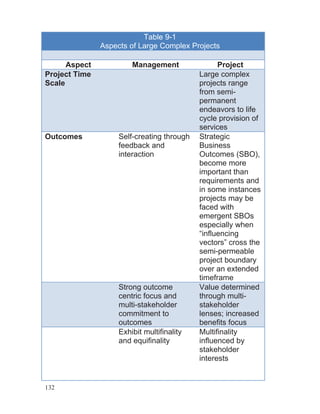
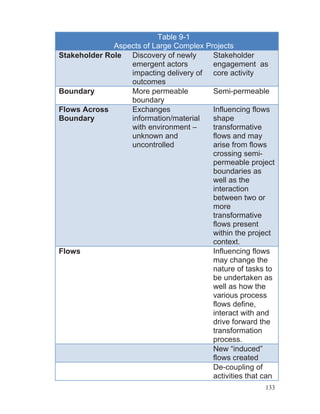
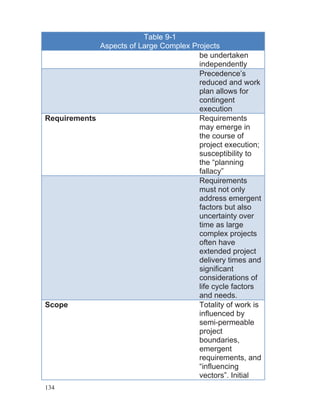
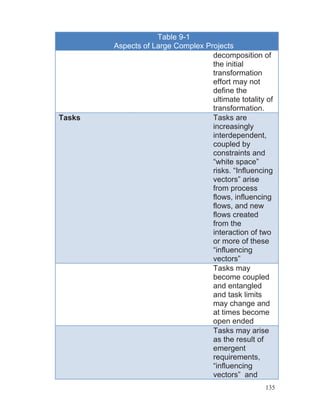
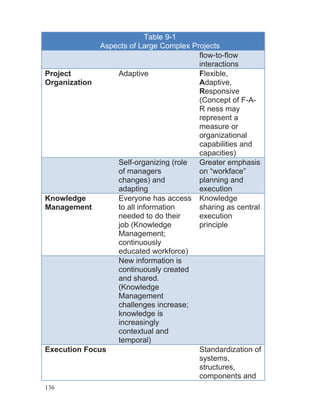
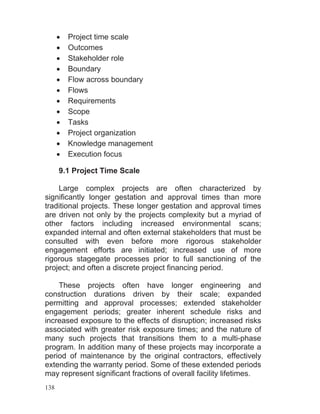
projects. Table 9-1 summarizes these various aspects of large
projects and provides a foundation to consider what a new
Theory of Project Management for large complex projects may
look like.
132
Table 9-1
Aspects of Large Complex Projects
Aspect Management Project
Project Time
Scale
Large complex
projects range
from semi-
permanent
endeavors to life
cycle provision of
services
Outcomes Self-creating through
feedback and
interaction
Strategic
Business
Outcomes (SBO),
become more
important than
requirements and
in some instances
projects may be
faced with
emergent SBOs
especially when
“influencing
vectors” cross the
semi-permeable
project boundary
over an extended
timeframe
Strong outcome
centric focus and
multi-stakeholder
commitment to
outcomes
Value determined
through multi-
stakeholder
lenses; increased
benefits focus
Exhibit multifinality
and equifinality
Multifinality
influenced by
stakeholder
interests
133
Table 9-1
Aspects of Large Complex Projects
Stakeholder Role Discovery of newly
emergent actors
impacting delivery of
outcomes
Stakeholder
engagement as
core activity
Boundary More permeable
boundary
Semi-permeable
Flows Across
Boundary
Exchanges
information/material
with environment –
unknown and
uncontrolled
Influencing flows
shape
transformative
flows and may
arise from flows
crossing semi-
permeable project
boundaries as
well as the
interaction
between two or
more
transformative
flows present
within the project
context.
Flows Influencing flows
may change the
nature of tasks to
be undertaken as
well as how the
various process
flows define,
interact with and
drive forward the
transformation
process.
New “induced”
flows created
De-coupling of
activities that can
134
Table 9-1
Aspects of Large Complex Projects
be undertaken
independently
Precedence’s
reduced and work
plan allows for
contingent
execution
Requirements Requirements
may emerge in
the course of
project execution;
susceptibility to
the “planning
fallacy”
Requirements
must not only
address emergent
factors but also
uncertainty over
time as large
complex projects
often have
extended project
delivery times and
significant
considerations of
life cycle factors
and needs.
Scope Totality of work is
influenced by
semi-permeable
project
boundaries,
emergent
requirements, and
“influencing
vectors”. Initial
135
Table 9-1
Aspects of Large Complex Projects
decomposition of
the initial
transformation
effort may not
define the
ultimate totality of
transformation.
Tasks Tasks are
increasingly
interdependent,
coupled by
constraints and
“white space”
risks. “Influencing
vectors” arise
from process
flows, influencing
flows, and new
flows created
from the
interaction of two
or more of these
“influencing
vectors”
Tasks may
become coupled
and entangled
and task limits
may change and
at times become
open ended
Tasks may arise
as the result of
emergent
requirements,
“influencing
vectors” and
136
Table 9-1
Aspects of Large Complex Projects
flow-to-flow
interactions
Project
Organization
Adaptive Flexible,
Adaptive,
Responsive
(Concept of F-A-
R ness may
represent a
measure or
organizational
capabilities and
capacities)
Self-organizing (role
of managers
changes) and
adapting
Greater emphasis
on “workface”
planning and
execution
Knowledge
Management
Everyone has access
to all information
needed to do their
job (Knowledge
Management;
continuously
educated workforce)
Knowledge
sharing as central
execution
principle
New information is
continuously created
and shared.
(Knowledge
Management
challenges increase;
knowledge is
increasingly
contextual and
temporal)
Execution Focus Standardization of
systems,
structures,
components and
137
Table 9-1
Aspects of Large Complex Projects
work processes;
de-coupling of
activities that can
be undertaken
independently
Expanded basis
of design together
with tight supply
chain linkages
and a strong
emphasis on the
value of time
Increased
emphasis on
standardization,
fabrication,
modularization
Strong work face
planning enabled
with knowledge
assemblies; RFI
reduction through
an expanded
basis of design
The various aspects detailed are intended to be illustrative
of key attributes of a Theory of Large Complex Project
Management. They focus on some key differentiators and are
incomplete without select elements associated with both
chaotic and complex projects, especially those that focus on
the non-deterministic nature of complex projects.
Let’s explore the highlighted differences further to lay the
theoretical foundations for large complex projects, covering
each aspect in turn:
138
Project time scale
Outcomes
Stakeholder role
Boundary
Flow across boundary
Flows
Requirements
Scope
Tasks
Project organization
Knowledge management
Execution focus
9.1 Project Time Scale
Large complex projects are often characterized by
significantly longer gestation and approval times than more
traditional projects. These longer gestation and approval times
are driven not only by the projects complexity but a myriad of
other factors including increased environmental scans;
expanded internal and often external stakeholders that must be
consulted with even before more rigorous stakeholder
engagement efforts are initiated; increased use of more
rigorous stagegate processes prior to full sanctioning of the
project; and often a discrete project financing period.
These projects often have longer engineering and
construction durations driven by their scale; expanded
permitting and approval processes; extended stakeholder
engagement periods; greater inherent schedule risks and
increased exposure to the effects of disruption; increased risks
associated with greater risk exposure times; and the nature of
many such projects that transitions them to a multi-phase
program. In addition many of these projects may incorporate a
period of maintenance by the original contractors, effectively
extending the warranty period. Some of these extended periods
may represent significant fractions of overall facility lifetimes.
139
These extended gestation, initiation, execution and
effective contract timeframes often result in project
organizations for large complex projects that range from semi-
permanent endeavors to life cycle provision of services. This
changed management context is suggestive of the need to
adopt general management practices that are associated with
complex endeavors. These practices differ from more
traditional project management practices but become critical as
we move into the world of large complex projects.
9.2 Outcomes
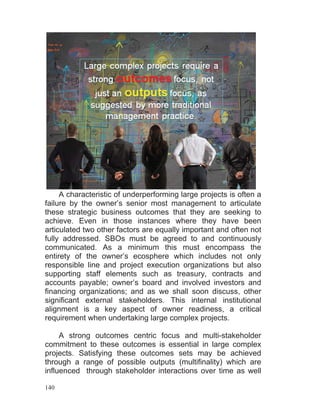
Large complex projects require a strong outcomes focus
not just an outputs focus as suggested by more traditional
management practice. This outcomes focus is critical since
large complex projects often are associated with ultimate
project outputs which are to some extent self-defining and self-
creating through extensive feedback mechanisms which are
driven by a multiplicity of actors over relatively longer
timeframes.
140
A characteristic of underperforming large projects is often a
failure by the owner’s senior most management to articulate
these strategic business outcomes that they are seeking to
achieve. Even in those instances where they have been
articulated two other factors are equally important and often not
fully addressed. SBOs must be agreed to and continuously
communicated. As a minimum this must encompass the
entirety of the owner’s ecosphere which includes not only
responsible line and project execution organizations but also
supporting staff elements such as treasury, contracts and
accounts payable; owner’s board and involved investors and
financing organizations; and as we shall soon discuss, other
significant external stakeholders. This internal institutional
alignment is a key aspect of owner readiness, a critical
requirement when undertaking large complex projects.
A strong outcomes centric focus and multi-stakeholder
commitment to these outcomes is essential in large complex
projects. Satisfying these outcomes sets may be achieved
through a range of possible outputs (multifinality) which are
influenced through stakeholder interactions over time as well
141
as evolution and changes within the project organization and
more importantly, externally.
Strategic Business Outcomes (SBO) become more
important than requirements in achieving ultimate success. In
some instances projects may be faced with emergent SBOs
especially when “influencing flows” cross what is in reality a
semi-permeable project boundary over an extended project
timeframe. These influencing flows are discussed later but are
an important characteristic when we consider large complex
projects and their management.
Value in large complex projects is determined through
multi-stakeholder lenses and an increased benefits focus.
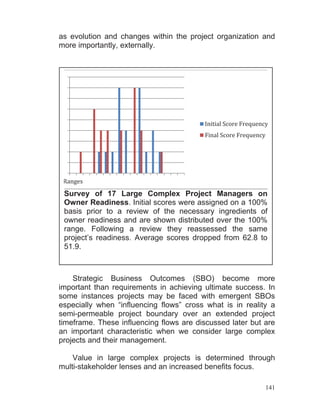
Survey of 17 Large Complex Project Managers on
Owner Readiness. Initial scores were assigned on a 100%
basis prior to a review of the necessary ingredients of
owner readiness and are shown distributed over the 100%
range. Following a review they reassessed the same
project’s readiness. Average scores dropped from 62.8 to
51.9.
142
9.3 Stakeholder Role
Large complex projects by their very nature require the
project design and outcomes to satisfy not just the outcomes
desired by the owner (a key and driving stakeholder but not the
exclusive stakeholder required for project success) but also
many of the outcomes desired by a network of enabling and
blocking stakeholders114
. This multi-stakeholder context is a
simple reality of large complex project delivery. Stakeholders in
many instances have an ability to determine the success or
failure of a project and in many extractive industries a social
license to operate may carry more value than many other
project strategies and optimizations115
. Stakeholder
engagement is a core activity and can serve to reduce
opportunistic delays from emergent actors. It is important that
we have identified and characterized potential stakeholders at
an early stage, always cognizant of possible new actors. Table
9-2 provides a construct for stakeholder identification and
strategy alignment must consider the stakeholder type in
addition to the specific issues and concerns raised.
114
Stakeholder Management in Large Engineering & Construction Programs; Bob Prieto; PM
World Today; 2011
115
Spinning Gold: The Financial returns to Stakeholder Engagement; Witold Henisz;
Sinziana Dorobantu; Lite Nartey; Strategic Management Journal; 2014
143
Table 9-2
ESPRIT Framework of Stakeholder Types
Stakeholder Type Examples
Economic Owner; investors; directly
affected economic interests
Social Local populations; various
“bound and aligned”
subgroups
Political Partisan interests; local,
national, global interests
seeking to leverage project
circumstances for otherwise
independent agenda
Religious/Cultural Gender; community;
denominational interests
Ideas Driven Ideas driven organizations
ranging from NIMBY to global
agenda such as “Save the
Planet”
Technical Technical preferences or
technology denial (anti-
fracking)
Stakeholder’s desires and context in turn are influenced by
the project itself, which acts to shape and deform the context in
which it is set. In addition, stakeholder-stakeholder interactions
become important and it is not unusual to find competing or
144
even diametrically opposed stakeholder interests among the
web of stakeholders that may influence the project.
As the project proceeds and new issues arise or as context
becomes fixed through engagement and agreement with one or
more influencing stakeholders, we may see new actors
emerge, further impacting delivery of outcomes. This concept of
emergence is commonplace on large complex projects and
may be regarded as both a core characteristic as well as a
central management challenge.
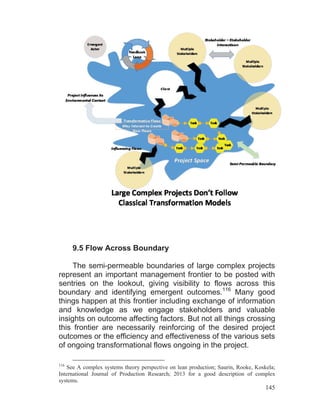
The following figure illustrates the multi-stakeholder
context; associated influencing flows; and stakeholder-
stakeholder interaction.
9.4 Boundary
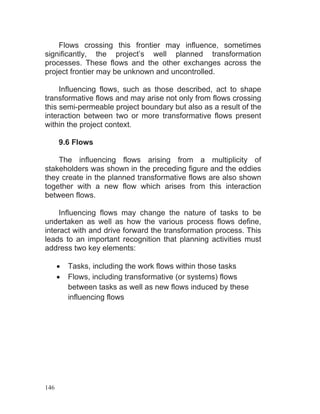
Large complex projects are not well bounded. Large
stakeholder influences; emergence of new outcomes and
stakeholders over extended delivery timeframes and lifetimes;
and the sheer number of ex-project inputs and assumption
drivers, all act to create a semi-permeable boundary across
which there are many informational and influencing flows. This
porous project limit combined with the self-defining and
emergent nature of the project characterizes the non-
deterministic system which best describes large complex
projects.
This emerging or evolving project is depicted in the
following figure.
145
9.5 Flow Across Boundary
The semi-permeable boundaries of large complex projects
represent an important management frontier to be posted with
sentries on the lookout, giving visibility to flows across this
boundary and identifying emergent outcomes.116
Many good
things happen at this frontier including exchange of information
and knowledge as we engage stakeholders and valuable
insights on outcome affecting factors. But not all things crossing
this frontier are necessarily reinforcing of the desired project
outcomes or the efficiency and effectiveness of the various sets
of ongoing transformational flows ongoing in the project.
116
See A complex systems theory perspective on lean production; Saurin, Rooke, Koskela;
International Journal of Production Research; 2013 for a good description of complex
systems.
146
Flows crossing this frontier may influence, sometimes
significantly, the project’s well planned transformation
processes. These flows and the other exchanges across the
project frontier may be unknown and uncontrolled.
Influencing flows, such as those described, act to shape
transformative flows and may arise not only from flows crossing
this semi-permeable project boundary but also as a result of the
interaction between two or more transformative flows present
within the project context.
9.6 Flows
The influencing flows arising from a multiplicity of
stakeholders was shown in the preceding figure and the eddies
they create in the planned transformative flows are also shown
together with a new flow which arises from this interaction
between flows.
Influencing flows may change the nature of tasks to be
undertaken as well as how the various process flows define,
interact with and drive forward the transformation process. This
leads to an important recognition that planning activities must
address two key elements:
Tasks, including the work flows within those tasks
Flows, including transformative (or systems) flows
between tasks as well as new flows induced by these
influencing flows
147
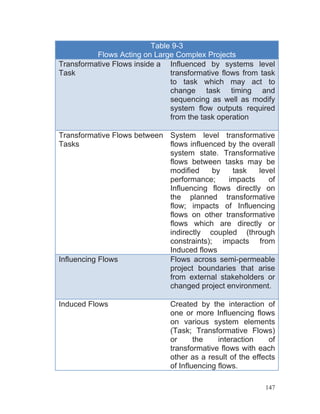
Table 9-3
Flows Acting on Large Complex Projects
Transformative Flows inside a
Task
Influenced by systems level
transformative flows from task
to task which may act to
change task timing and
sequencing as well as modify
system flow outputs required
from the task operation
Transformative Flows between
Tasks
System level transformative
flows influenced by the overall
system state. Transformative
flows between tasks may be
modified by task level
performance; impacts of
Influencing flows directly on
the planned transformative
flow; impacts of Influencing
flows on other transformative
flows which are directly or
indirectly coupled (through
constraints); impacts from
Induced flows
Influencing Flows Flows across semi-permeable
project boundaries that arise
from external stakeholders or
changed project environment.
Induced Flows Created by the interaction of
one or more Influencing flows
on various system elements
(Task; Transformative Flows)
or the interaction of
transformative flows with each
other as a result of the effects
of Influencing flows.
148
Task level planning will involve a more classical approach
focused on transforming inputs to outputs. Management
information however must now include information on how the
output of a preceding task will flow to the subsequent task and
how outputs will flow onwards. These flows have characteristics
with respect whether they are planned or contingent; when they
will actually occur and whether there are any buffering
mechanisms to optimize overall project flows. The nature and
timing of these flows will be shaped increasingly on a dynamic
basis and as such project execution must include a contingent
capability to redirect and retime various flows or act to restore
already influenced flows to an optimal state, recognizing this
may be significantly different than the original transformative
plan.
This contingent execution requires increased awareness of
actual or potential direct or indirect coupling such as what can
happen when flows are coupled by second or third order
constraints.
A key strategy to manage this inherent complexity is
through a systematic de-coupling of activities that can be
undertaken independently. On one large complex project,
overall schedule was improved by 20% through a conscious
decoupling of major elements of work that had previously been
bundled to “simplify” project execution. The law of unintended
consequences was clearly evident.
This decoupling of major elements should also consider
careful elimination of precedence’s to increase the opportunity
for contingent execution which is a reality of large project
execution.
149
9.7 Requirements
An owner’s project requirements (OPR) are often
memorialized directly in contract documents or scopes of work
shaped by earlier conducted planning studies. In large complex
projects these requirements documents subsequently prove to
be optimistic or incomplete. There are three principal causes
each of which requires special attention in the world of large
projects:
Owner’s Project Requirements (OPR) are too narrowly
defined and often drive optimization around the wrong
criteria
Planning fallacy leads to an optimistic view of an
uncertain future
Emergence of new requirements during project
execution, which is a characteristic of long duration
complex systems
Let’s look at each of these in turn.
Owner’s project requirements, OPR, are often developed
by engineering organizations to define the technical
characteristics of the final desired facility. These are
subsequently converted into a basis of design by engineering
elements of the implementing contractor resulting in what in
reality is simply an engineering basis of design. Described
differently, it is the output of the last task of the CAPEX phase
of a project. But as we have seen earlier, large complex
projects require us to focus not only on task inputs and outputs,
but importantly, on the transformative flows between tasks.
During the CAPEX phase of a project these flows are
representative of the construction process itself and selected
means and methods. To improve overall execution in the
CAPEX phase, therefore, it is necessary to expand our basis of
design (BOD) to include not only the traditional engineering
basis of design but also what we may call a construction basis
of design (CBOD).
150
But in the world of large complex projects, traditional time
boundaries associated with initial delivery, may be extended to
include initial or even life cycle operation and maintenance. In
these instances we must extend our basis of design even
further, incorporating an O&M basis of design (O&MBOD)
element. Taken together we have now created an expanded
basis of design117
or BODX
.
It is important to highlight that incorporation of CBOD and
O&MBOD at the outset is fundamentally different than
conducting constructability or maintainability reviews at a later
design stage. The former shapes what is to be designed and
acts to expand the requirements as defined in the OPR, while
the later merely confirms or improves at the margin what has
already been designed to some level.
Generalizing, in large complex projects, project
requirements must reflect not just final “task” states but also the
coupling transformative flows. Additionally, the more
unbounded timeframes of large complex projects, requires a
more life cycle consciousness than we often experience in
more traditional projects.
Turning now to the planning fallacy which large complex
projects appear to be particularly susceptible to118
, we are
drawn to the work of Kahnemann and Tversky119
which defined
the planning fallacy as the tendency of people and
organizations to underestimate how long a task will take even
when they have experience of similar tasks overrunning.
Perhaps the poster children for the planning fallacy are
large scale public works projects. In a 2006 paper in the Project
117
Addressing Project Capital Efficiency through a Business Basis of Design; Bob Prieto;
PM World Journal; 2014
118
Managing the Planning Fallacy in Large, Complex Infrastructure Programs; Bob Prieto;
PM World Journal; 2013
119
"Prospect theory: An analysis of decisions under risk". Econometrica; Kahneman and
Tversky; 1979
151
Management Journal120
, Bent Flyvbjerg describes
transportation projects “inaccuracy in cost forecasts in constant
prices is on average 44.7% for rail, 33.8% for bridges and
tunnels, and 20.4% for roads.”
Work by Kahneman, Tversky, Flyvbjerg and others shows
that errors of judgment are:
systematic and predictable
reflect bias
persist even when we are aware of, and
require corrective measures that reflect recognition of
this bias
These natural tendencies are further exacerbated when
“motivated” individuals, which may include both internal and
external stakeholders, frame questions in such a way as to
constrain the range of possible answers.
Large complex projects demand extra care in dealing with
the planning fallacy. First is to test initial assumption
reasonableness employing techniques such as reference class
forecasting and conducting a thorough review of modeled
confidence levels (P50 vs P80) and of the distributions
employed in the models themselves121
. A diversity of
perspectives further aids this step. Second, given the long term
nature of many of these projects, periodically reconfirm the
assumptions used in the planning basis. Assumption
migration122
is a key challenge in the world of large
complex projects.
Large complex projects move into the ranges of non-linear
behavior and traditional project estimation may not adequately
120
From Nobel Prize To Project Management: Getting Risks Right; Bent Flyvbjerg; Aalborg
University, Denmark; Project Management Journal; August, 2006.
121
Improbability of Large Project Success; Bob Prieto; PM World Journal; 2015
122
Is it Time to Rethink Project Management Theory?; Bob Prieto; PM World Journal; 2015
152
account for this factor.123
Traditional project management
theory falls short and perhaps our high project “failure” rates
are more reflective of fundamental planning and estimation
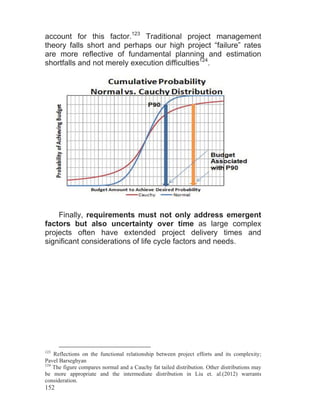
shortfalls and not merely execution difficulties124
.
Finally, requirements must not only address emergent
factors but also uncertainty over time as large complex
projects often have extended project delivery times and
significant considerations of life cycle factors and needs.
123
Reflections on the functional relationship between project efforts and its complexity;
Pavel Barseghyan
124
The figure compares normal and a Cauchy fat tailed distribution. Other distributions may
be more appropriate and the intermediate distribution in Liu et. al.(2012) warrants
consideration.
153
9.8 Scope
The scope of a large complex project defines the nature of
the facility asset, its intended purpose and use, and the
business context within which it is intended to operate. In large
complex projects scope must go beyond just the project’s
technical requirements and explicitly include a:
broader set of owner’s requirements, including the
strategic business outcomes the owner is trying to
achieve
mandatory and quasi-mandatory requirements from
external stakeholders
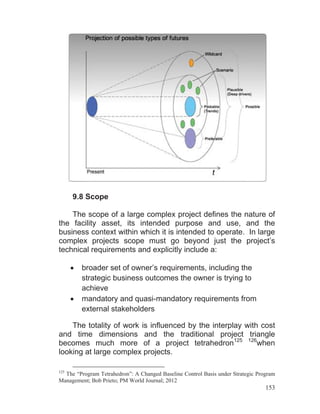
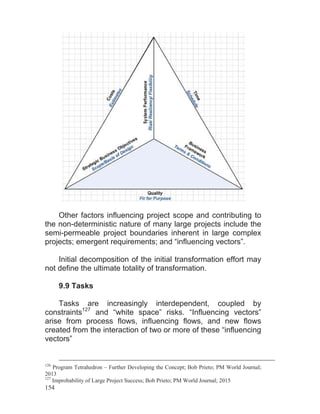
The totality of work is influenced by the interplay with cost
and time dimensions and the traditional project triangle
becomes much more of a project tetrahedron125 126
when
looking at large complex projects.
125
The “Program Tetrahedron”: A Changed Baseline Control Basis under Strategic Program
Management; Bob Prieto; PM World Journal; 2012
154
Other factors influencing project scope and contributing to
the non-deterministic nature of many large projects include the
semi-permeable project boundaries inherent in large complex
projects; emergent requirements; and “influencing vectors”.
Initial decomposition of the initial transformation effort may
not define the ultimate totality of transformation.
9.9 Tasks
Tasks are increasingly interdependent, coupled by
constraints127
and “white space” risks. “Influencing vectors”
arise from process flows, influencing flows, and new flows
created from the interaction of two or more of these “influencing
vectors”
126
Program Tetrahedron – Further Developing the Concept; Bob Prieto; PM World Journal;
2013
127
Improbability of Large Project Success; Bob Prieto; PM World Journal; 2015
155
Tasks may become coupled and entangled and task limits
may change and at times become open ended
Tasks may arise as the result of emergent requirements,
“influencing vectors” and flow-to-flow interactions as previously
discussed. As a result task inputs and outputs must consider
and pass along information related to transformational flows
from one task to the other.
9.10 Project Organization
Large complex projects require an organizational design
that reflects the complexity of the tasks at hand; the dynamic
environment in which the project is set128
, subject to both a
multiplicity of influencing flows and extended project
128
This dynamic environment introduces variability
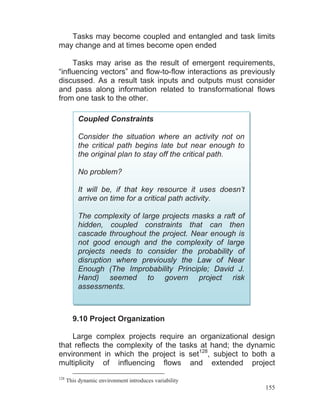
Coupled Constraints
Consider the situation where an activity not on
the critical path begins late but near enough to
the original plan to stay off the critical path.
No problem?
It will be, if that key resource it uses doesn’t
arrive on time for a critical path activity.
The complexity of large projects masks a raft of
hidden, coupled constraints that can then
cascade throughout the project. Near enough is
not good enough and the complexity of large
projects needs to consider the probability of
disruption where previously the Law of Near
Enough (The Improbability Principle; David J.
Hand) seemed to govern project risk
assessments.
156
timeframes; and the emergent nature of project outcomes in
such project types. These organizations must be adaptive,
flexible, self-renewing, resilient and learning. They must be
capable of responding intelligently to change, recognizing that
change is the only project constant.
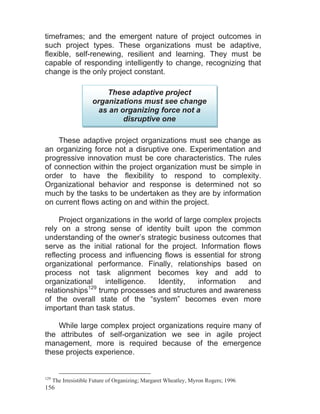
These adaptive project organizations must see change as
an organizing force not a disruptive one. Experimentation and
progressive innovation must be core characteristics. The rules
of connection within the project organization must be simple in
order to have the flexibility to respond to complexity.
Organizational behavior and response is determined not so
much by the tasks to be undertaken as they are by information
on current flows acting on and within the project.
Project organizations in the world of large complex projects
rely on a strong sense of identity built upon the common
understanding of the owner’s strategic business outcomes that
serve as the initial rational for the project. Information flows
reflecting process and influencing flows is essential for strong
organizational performance. Finally, relationships based on
process not task alignment becomes key and add to
organizational intelligence. Identity, information and
relationships129
trump processes and structures and awareness
of the overall state of the “system” becomes even more
important than task status.
While large complex project organizations require many of
the attributes of self-organization we see in agile project
management, more is required because of the emergence
these projects experience.
129
The Irresistible Future of Organizing; Margaret Wheatley, Myron Rogers; 1996
These adaptive project
organizations must see change
as an organizing force not a
disruptive one
157
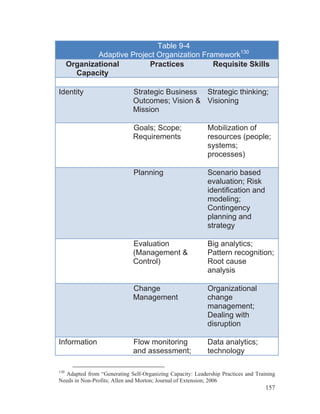
Table 9-4
Adaptive Project Organization Framework130
Organizational
Capacity
Practices Requisite Skills
Identity Strategic Business
Outcomes; Vision &
Mission
Strategic thinking;
Visioning
Goals; Scope;
Requirements
Mobilization of
resources (people;
systems;
processes)
Planning Scenario based
evaluation; Risk
identification and
modeling;
Contingency
planning and
strategy
Evaluation
(Management &
Control)
Big analytics;
Pattern recognition;
Root cause
analysis
Change
Management
Organizational
change
management;
Dealing with
disruption
Information Flow monitoring
and assessment;
Data analytics;
technology
130
Adapted from “Generating Self-Organizing Capacity: Leadership Practices and Training
Needs in Non-Profits; Allen and Morton; Journal of Extension; 2006
158
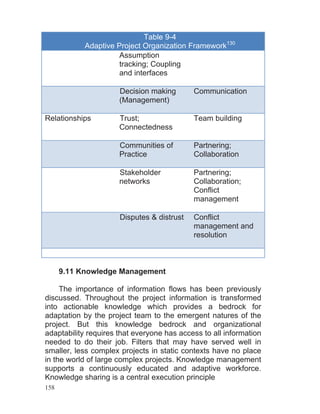
Table 9-4
Adaptive Project Organization Framework130
Assumption
tracking; Coupling
and interfaces
Decision making
(Management)
Communication
Relationships Trust;
Connectedness
Team building
Communities of
Practice
Partnering;
Collaboration
Stakeholder
networks
Partnering;
Collaboration;
Conflict
management
Disputes & distrust Conflict
management and
resolution
9.11 Knowledge Management
The importance of information flows has been previously
discussed. Throughout the project information is transformed
into actionable knowledge which provides a bedrock for
adaptation by the project team to the emergent natures of the
project. But this knowledge bedrock and organizational
adaptability requires that everyone has access to all information
needed to do their job. Filters that may have served well in
smaller, less complex projects in static contexts have no place
in the world of large complex projects. Knowledge management
supports a continuously educated and adaptive workforce.
Knowledge sharing is a central execution principle
159
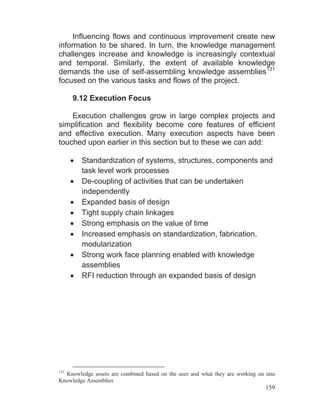
Influencing flows and continuous improvement create new
information to be shared. In turn, the knowledge management
challenges increase and knowledge is increasingly contextual
and temporal. Similarly, the extent of available knowledge
demands the use of self-assembling knowledge assemblies131
focused on the various tasks and flows of the project.
9.12 Execution Focus
Execution challenges grow in large complex projects and
simplification and flexibility become core features of efficient
and effective execution. Many execution aspects have been
touched upon earlier in this section but to these we can add:
Standardization of systems, structures, components and
task level work processes
De-coupling of activities that can be undertaken
independently
Expanded basis of design
Tight supply chain linkages
Strong emphasis on the value of time
Increased emphasis on standardization, fabrication,
modularization
Strong work face planning enabled with knowledge
assemblies
RFI reduction through an expanded basis of design
131
Knowledge assets are combined based on the user and what they are working on into
Knowledge Assemblies
160

Chapter 9

  • 1.
    Theory of Management of LargeComplex Projects Bob Prieto
  • 2.
    © 2015 byBob Prieto All rights reserved. No part of this publication may be reproduced or distributed in any form or by any means, or stored in a data base or retrieval system, except as permitted by Sections 107 or 108 of the 1976 United States Copyright Act, without the prior written permission of the copyright holder. Printed in the United States of America ISBN 580-0-111776-07-9
  • 3.
    131 Chapter 9 It’s Complicated! Wehave looked at the evolution of general management theory as well as project management theory as part of our examination of the Theory of Management. We have identified some elements of general management theory not yet fully incorporated into project management theory that may be useful in dealing with the world of large complex projects. Subsequently we have considered the Theory of Projects, looking at classical project theory and some of the recent extensions to it. We have identified attributes of large complex projects that we do not find in the classical theory of projects but which are core to describing the various aspects we encounter on these projects. Table 9-1 summarizes these various aspects of large projects and provides a foundation to consider what a new Theory of Project Management for large complex projects may look like.
  • 4.
    132 Table 9-1 Aspects ofLarge Complex Projects Aspect Management Project Project Time Scale Large complex projects range from semi- permanent endeavors to life cycle provision of services Outcomes Self-creating through feedback and interaction Strategic Business Outcomes (SBO), become more important than requirements and in some instances projects may be faced with emergent SBOs especially when “influencing vectors” cross the semi-permeable project boundary over an extended timeframe Strong outcome centric focus and multi-stakeholder commitment to outcomes Value determined through multi- stakeholder lenses; increased benefits focus Exhibit multifinality and equifinality Multifinality influenced by stakeholder interests
  • 5.
    133 Table 9-1 Aspects ofLarge Complex Projects Stakeholder Role Discovery of newly emergent actors impacting delivery of outcomes Stakeholder engagement as core activity Boundary More permeable boundary Semi-permeable Flows Across Boundary Exchanges information/material with environment – unknown and uncontrolled Influencing flows shape transformative flows and may arise from flows crossing semi- permeable project boundaries as well as the interaction between two or more transformative flows present within the project context. Flows Influencing flows may change the nature of tasks to be undertaken as well as how the various process flows define, interact with and drive forward the transformation process. New “induced” flows created De-coupling of activities that can
  • 6.
    134 Table 9-1 Aspects ofLarge Complex Projects be undertaken independently Precedence’s reduced and work plan allows for contingent execution Requirements Requirements may emerge in the course of project execution; susceptibility to the “planning fallacy” Requirements must not only address emergent factors but also uncertainty over time as large complex projects often have extended project delivery times and significant considerations of life cycle factors and needs. Scope Totality of work is influenced by semi-permeable project boundaries, emergent requirements, and “influencing vectors”. Initial
  • 7.
    135 Table 9-1 Aspects ofLarge Complex Projects decomposition of the initial transformation effort may not define the ultimate totality of transformation. Tasks Tasks are increasingly interdependent, coupled by constraints and “white space” risks. “Influencing vectors” arise from process flows, influencing flows, and new flows created from the interaction of two or more of these “influencing vectors” Tasks may become coupled and entangled and task limits may change and at times become open ended Tasks may arise as the result of emergent requirements, “influencing vectors” and
  • 8.
    136 Table 9-1 Aspects ofLarge Complex Projects flow-to-flow interactions Project Organization Adaptive Flexible, Adaptive, Responsive (Concept of F-A- R ness may represent a measure or organizational capabilities and capacities) Self-organizing (role of managers changes) and adapting Greater emphasis on “workface” planning and execution Knowledge Management Everyone has access to all information needed to do their job (Knowledge Management; continuously educated workforce) Knowledge sharing as central execution principle New information is continuously created and shared. (Knowledge Management challenges increase; knowledge is increasingly contextual and temporal) Execution Focus Standardization of systems, structures, components and
  • 9.
    137 Table 9-1 Aspects ofLarge Complex Projects work processes; de-coupling of activities that can be undertaken independently Expanded basis of design together with tight supply chain linkages and a strong emphasis on the value of time Increased emphasis on standardization, fabrication, modularization Strong work face planning enabled with knowledge assemblies; RFI reduction through an expanded basis of design The various aspects detailed are intended to be illustrative of key attributes of a Theory of Large Complex Project Management. They focus on some key differentiators and are incomplete without select elements associated with both chaotic and complex projects, especially those that focus on the non-deterministic nature of complex projects. Let’s explore the highlighted differences further to lay the theoretical foundations for large complex projects, covering each aspect in turn:
  • 10.
    138 Project time scale Outcomes Stakeholderrole Boundary Flow across boundary Flows Requirements Scope Tasks Project organization Knowledge management Execution focus 9.1 Project Time Scale Large complex projects are often characterized by significantly longer gestation and approval times than more traditional projects. These longer gestation and approval times are driven not only by the projects complexity but a myriad of other factors including increased environmental scans; expanded internal and often external stakeholders that must be consulted with even before more rigorous stakeholder engagement efforts are initiated; increased use of more rigorous stagegate processes prior to full sanctioning of the project; and often a discrete project financing period. These projects often have longer engineering and construction durations driven by their scale; expanded permitting and approval processes; extended stakeholder engagement periods; greater inherent schedule risks and increased exposure to the effects of disruption; increased risks associated with greater risk exposure times; and the nature of many such projects that transitions them to a multi-phase program. In addition many of these projects may incorporate a period of maintenance by the original contractors, effectively extending the warranty period. Some of these extended periods may represent significant fractions of overall facility lifetimes.
  • 11.
    139 These extended gestation,initiation, execution and effective contract timeframes often result in project organizations for large complex projects that range from semi- permanent endeavors to life cycle provision of services. This changed management context is suggestive of the need to adopt general management practices that are associated with complex endeavors. These practices differ from more traditional project management practices but become critical as we move into the world of large complex projects. 9.2 Outcomes Large complex projects require a strong outcomes focus not just an outputs focus as suggested by more traditional management practice. This outcomes focus is critical since large complex projects often are associated with ultimate project outputs which are to some extent self-defining and self- creating through extensive feedback mechanisms which are driven by a multiplicity of actors over relatively longer timeframes.
  • 12.
    140 A characteristic ofunderperforming large projects is often a failure by the owner’s senior most management to articulate these strategic business outcomes that they are seeking to achieve. Even in those instances where they have been articulated two other factors are equally important and often not fully addressed. SBOs must be agreed to and continuously communicated. As a minimum this must encompass the entirety of the owner’s ecosphere which includes not only responsible line and project execution organizations but also supporting staff elements such as treasury, contracts and accounts payable; owner’s board and involved investors and financing organizations; and as we shall soon discuss, other significant external stakeholders. This internal institutional alignment is a key aspect of owner readiness, a critical requirement when undertaking large complex projects. A strong outcomes centric focus and multi-stakeholder commitment to these outcomes is essential in large complex projects. Satisfying these outcomes sets may be achieved through a range of possible outputs (multifinality) which are influenced through stakeholder interactions over time as well
  • 13.
    141 as evolution andchanges within the project organization and more importantly, externally. Strategic Business Outcomes (SBO) become more important than requirements in achieving ultimate success. In some instances projects may be faced with emergent SBOs especially when “influencing flows” cross what is in reality a semi-permeable project boundary over an extended project timeframe. These influencing flows are discussed later but are an important characteristic when we consider large complex projects and their management. Value in large complex projects is determined through multi-stakeholder lenses and an increased benefits focus. Survey of 17 Large Complex Project Managers on Owner Readiness. Initial scores were assigned on a 100% basis prior to a review of the necessary ingredients of owner readiness and are shown distributed over the 100% range. Following a review they reassessed the same project’s readiness. Average scores dropped from 62.8 to 51.9.
  • 14.
    142 9.3 Stakeholder Role Largecomplex projects by their very nature require the project design and outcomes to satisfy not just the outcomes desired by the owner (a key and driving stakeholder but not the exclusive stakeholder required for project success) but also many of the outcomes desired by a network of enabling and blocking stakeholders114 . This multi-stakeholder context is a simple reality of large complex project delivery. Stakeholders in many instances have an ability to determine the success or failure of a project and in many extractive industries a social license to operate may carry more value than many other project strategies and optimizations115 . Stakeholder engagement is a core activity and can serve to reduce opportunistic delays from emergent actors. It is important that we have identified and characterized potential stakeholders at an early stage, always cognizant of possible new actors. Table 9-2 provides a construct for stakeholder identification and strategy alignment must consider the stakeholder type in addition to the specific issues and concerns raised. 114 Stakeholder Management in Large Engineering & Construction Programs; Bob Prieto; PM World Today; 2011 115 Spinning Gold: The Financial returns to Stakeholder Engagement; Witold Henisz; Sinziana Dorobantu; Lite Nartey; Strategic Management Journal; 2014
  • 15.
    143 Table 9-2 ESPRIT Frameworkof Stakeholder Types Stakeholder Type Examples Economic Owner; investors; directly affected economic interests Social Local populations; various “bound and aligned” subgroups Political Partisan interests; local, national, global interests seeking to leverage project circumstances for otherwise independent agenda Religious/Cultural Gender; community; denominational interests Ideas Driven Ideas driven organizations ranging from NIMBY to global agenda such as “Save the Planet” Technical Technical preferences or technology denial (anti- fracking) Stakeholder’s desires and context in turn are influenced by the project itself, which acts to shape and deform the context in which it is set. In addition, stakeholder-stakeholder interactions become important and it is not unusual to find competing or
  • 16.
    144 even diametrically opposedstakeholder interests among the web of stakeholders that may influence the project. As the project proceeds and new issues arise or as context becomes fixed through engagement and agreement with one or more influencing stakeholders, we may see new actors emerge, further impacting delivery of outcomes. This concept of emergence is commonplace on large complex projects and may be regarded as both a core characteristic as well as a central management challenge. The following figure illustrates the multi-stakeholder context; associated influencing flows; and stakeholder- stakeholder interaction. 9.4 Boundary Large complex projects are not well bounded. Large stakeholder influences; emergence of new outcomes and stakeholders over extended delivery timeframes and lifetimes; and the sheer number of ex-project inputs and assumption drivers, all act to create a semi-permeable boundary across which there are many informational and influencing flows. This porous project limit combined with the self-defining and emergent nature of the project characterizes the non- deterministic system which best describes large complex projects. This emerging or evolving project is depicted in the following figure.
  • 17.
    145 9.5 Flow AcrossBoundary The semi-permeable boundaries of large complex projects represent an important management frontier to be posted with sentries on the lookout, giving visibility to flows across this boundary and identifying emergent outcomes.116 Many good things happen at this frontier including exchange of information and knowledge as we engage stakeholders and valuable insights on outcome affecting factors. But not all things crossing this frontier are necessarily reinforcing of the desired project outcomes or the efficiency and effectiveness of the various sets of ongoing transformational flows ongoing in the project. 116 See A complex systems theory perspective on lean production; Saurin, Rooke, Koskela; International Journal of Production Research; 2013 for a good description of complex systems.
  • 18.
    146 Flows crossing thisfrontier may influence, sometimes significantly, the project’s well planned transformation processes. These flows and the other exchanges across the project frontier may be unknown and uncontrolled. Influencing flows, such as those described, act to shape transformative flows and may arise not only from flows crossing this semi-permeable project boundary but also as a result of the interaction between two or more transformative flows present within the project context. 9.6 Flows The influencing flows arising from a multiplicity of stakeholders was shown in the preceding figure and the eddies they create in the planned transformative flows are also shown together with a new flow which arises from this interaction between flows. Influencing flows may change the nature of tasks to be undertaken as well as how the various process flows define, interact with and drive forward the transformation process. This leads to an important recognition that planning activities must address two key elements: Tasks, including the work flows within those tasks Flows, including transformative (or systems) flows between tasks as well as new flows induced by these influencing flows
  • 19.
    147 Table 9-3 Flows Actingon Large Complex Projects Transformative Flows inside a Task Influenced by systems level transformative flows from task to task which may act to change task timing and sequencing as well as modify system flow outputs required from the task operation Transformative Flows between Tasks System level transformative flows influenced by the overall system state. Transformative flows between tasks may be modified by task level performance; impacts of Influencing flows directly on the planned transformative flow; impacts of Influencing flows on other transformative flows which are directly or indirectly coupled (through constraints); impacts from Induced flows Influencing Flows Flows across semi-permeable project boundaries that arise from external stakeholders or changed project environment. Induced Flows Created by the interaction of one or more Influencing flows on various system elements (Task; Transformative Flows) or the interaction of transformative flows with each other as a result of the effects of Influencing flows.
  • 20.
    148 Task level planningwill involve a more classical approach focused on transforming inputs to outputs. Management information however must now include information on how the output of a preceding task will flow to the subsequent task and how outputs will flow onwards. These flows have characteristics with respect whether they are planned or contingent; when they will actually occur and whether there are any buffering mechanisms to optimize overall project flows. The nature and timing of these flows will be shaped increasingly on a dynamic basis and as such project execution must include a contingent capability to redirect and retime various flows or act to restore already influenced flows to an optimal state, recognizing this may be significantly different than the original transformative plan. This contingent execution requires increased awareness of actual or potential direct or indirect coupling such as what can happen when flows are coupled by second or third order constraints. A key strategy to manage this inherent complexity is through a systematic de-coupling of activities that can be undertaken independently. On one large complex project, overall schedule was improved by 20% through a conscious decoupling of major elements of work that had previously been bundled to “simplify” project execution. The law of unintended consequences was clearly evident. This decoupling of major elements should also consider careful elimination of precedence’s to increase the opportunity for contingent execution which is a reality of large project execution.
  • 21.
    149 9.7 Requirements An owner’sproject requirements (OPR) are often memorialized directly in contract documents or scopes of work shaped by earlier conducted planning studies. In large complex projects these requirements documents subsequently prove to be optimistic or incomplete. There are three principal causes each of which requires special attention in the world of large projects: Owner’s Project Requirements (OPR) are too narrowly defined and often drive optimization around the wrong criteria Planning fallacy leads to an optimistic view of an uncertain future Emergence of new requirements during project execution, which is a characteristic of long duration complex systems Let’s look at each of these in turn. Owner’s project requirements, OPR, are often developed by engineering organizations to define the technical characteristics of the final desired facility. These are subsequently converted into a basis of design by engineering elements of the implementing contractor resulting in what in reality is simply an engineering basis of design. Described differently, it is the output of the last task of the CAPEX phase of a project. But as we have seen earlier, large complex projects require us to focus not only on task inputs and outputs, but importantly, on the transformative flows between tasks. During the CAPEX phase of a project these flows are representative of the construction process itself and selected means and methods. To improve overall execution in the CAPEX phase, therefore, it is necessary to expand our basis of design (BOD) to include not only the traditional engineering basis of design but also what we may call a construction basis of design (CBOD).
  • 22.
    150 But in theworld of large complex projects, traditional time boundaries associated with initial delivery, may be extended to include initial or even life cycle operation and maintenance. In these instances we must extend our basis of design even further, incorporating an O&M basis of design (O&MBOD) element. Taken together we have now created an expanded basis of design117 or BODX . It is important to highlight that incorporation of CBOD and O&MBOD at the outset is fundamentally different than conducting constructability or maintainability reviews at a later design stage. The former shapes what is to be designed and acts to expand the requirements as defined in the OPR, while the later merely confirms or improves at the margin what has already been designed to some level. Generalizing, in large complex projects, project requirements must reflect not just final “task” states but also the coupling transformative flows. Additionally, the more unbounded timeframes of large complex projects, requires a more life cycle consciousness than we often experience in more traditional projects. Turning now to the planning fallacy which large complex projects appear to be particularly susceptible to118 , we are drawn to the work of Kahnemann and Tversky119 which defined the planning fallacy as the tendency of people and organizations to underestimate how long a task will take even when they have experience of similar tasks overrunning. Perhaps the poster children for the planning fallacy are large scale public works projects. In a 2006 paper in the Project 117 Addressing Project Capital Efficiency through a Business Basis of Design; Bob Prieto; PM World Journal; 2014 118 Managing the Planning Fallacy in Large, Complex Infrastructure Programs; Bob Prieto; PM World Journal; 2013 119 "Prospect theory: An analysis of decisions under risk". Econometrica; Kahneman and Tversky; 1979
  • 23.
    151 Management Journal120 , BentFlyvbjerg describes transportation projects “inaccuracy in cost forecasts in constant prices is on average 44.7% for rail, 33.8% for bridges and tunnels, and 20.4% for roads.” Work by Kahneman, Tversky, Flyvbjerg and others shows that errors of judgment are: systematic and predictable reflect bias persist even when we are aware of, and require corrective measures that reflect recognition of this bias These natural tendencies are further exacerbated when “motivated” individuals, which may include both internal and external stakeholders, frame questions in such a way as to constrain the range of possible answers. Large complex projects demand extra care in dealing with the planning fallacy. First is to test initial assumption reasonableness employing techniques such as reference class forecasting and conducting a thorough review of modeled confidence levels (P50 vs P80) and of the distributions employed in the models themselves121 . A diversity of perspectives further aids this step. Second, given the long term nature of many of these projects, periodically reconfirm the assumptions used in the planning basis. Assumption migration122 is a key challenge in the world of large complex projects. Large complex projects move into the ranges of non-linear behavior and traditional project estimation may not adequately 120 From Nobel Prize To Project Management: Getting Risks Right; Bent Flyvbjerg; Aalborg University, Denmark; Project Management Journal; August, 2006. 121 Improbability of Large Project Success; Bob Prieto; PM World Journal; 2015 122 Is it Time to Rethink Project Management Theory?; Bob Prieto; PM World Journal; 2015
  • 24.
    152 account for thisfactor.123 Traditional project management theory falls short and perhaps our high project “failure” rates are more reflective of fundamental planning and estimation shortfalls and not merely execution difficulties124 . Finally, requirements must not only address emergent factors but also uncertainty over time as large complex projects often have extended project delivery times and significant considerations of life cycle factors and needs. 123 Reflections on the functional relationship between project efforts and its complexity; Pavel Barseghyan 124 The figure compares normal and a Cauchy fat tailed distribution. Other distributions may be more appropriate and the intermediate distribution in Liu et. al.(2012) warrants consideration.
  • 25.
    153 9.8 Scope The scopeof a large complex project defines the nature of the facility asset, its intended purpose and use, and the business context within which it is intended to operate. In large complex projects scope must go beyond just the project’s technical requirements and explicitly include a: broader set of owner’s requirements, including the strategic business outcomes the owner is trying to achieve mandatory and quasi-mandatory requirements from external stakeholders The totality of work is influenced by the interplay with cost and time dimensions and the traditional project triangle becomes much more of a project tetrahedron125 126 when looking at large complex projects. 125 The “Program Tetrahedron”: A Changed Baseline Control Basis under Strategic Program Management; Bob Prieto; PM World Journal; 2012
  • 26.
    154 Other factors influencingproject scope and contributing to the non-deterministic nature of many large projects include the semi-permeable project boundaries inherent in large complex projects; emergent requirements; and “influencing vectors”. Initial decomposition of the initial transformation effort may not define the ultimate totality of transformation. 9.9 Tasks Tasks are increasingly interdependent, coupled by constraints127 and “white space” risks. “Influencing vectors” arise from process flows, influencing flows, and new flows created from the interaction of two or more of these “influencing vectors” 126 Program Tetrahedron – Further Developing the Concept; Bob Prieto; PM World Journal; 2013 127 Improbability of Large Project Success; Bob Prieto; PM World Journal; 2015
  • 27.
    155 Tasks may becomecoupled and entangled and task limits may change and at times become open ended Tasks may arise as the result of emergent requirements, “influencing vectors” and flow-to-flow interactions as previously discussed. As a result task inputs and outputs must consider and pass along information related to transformational flows from one task to the other. 9.10 Project Organization Large complex projects require an organizational design that reflects the complexity of the tasks at hand; the dynamic environment in which the project is set128 , subject to both a multiplicity of influencing flows and extended project 128 This dynamic environment introduces variability Coupled Constraints Consider the situation where an activity not on the critical path begins late but near enough to the original plan to stay off the critical path. No problem? It will be, if that key resource it uses doesn’t arrive on time for a critical path activity. The complexity of large projects masks a raft of hidden, coupled constraints that can then cascade throughout the project. Near enough is not good enough and the complexity of large projects needs to consider the probability of disruption where previously the Law of Near Enough (The Improbability Principle; David J. Hand) seemed to govern project risk assessments.
  • 28.
    156 timeframes; and theemergent nature of project outcomes in such project types. These organizations must be adaptive, flexible, self-renewing, resilient and learning. They must be capable of responding intelligently to change, recognizing that change is the only project constant. These adaptive project organizations must see change as an organizing force not a disruptive one. Experimentation and progressive innovation must be core characteristics. The rules of connection within the project organization must be simple in order to have the flexibility to respond to complexity. Organizational behavior and response is determined not so much by the tasks to be undertaken as they are by information on current flows acting on and within the project. Project organizations in the world of large complex projects rely on a strong sense of identity built upon the common understanding of the owner’s strategic business outcomes that serve as the initial rational for the project. Information flows reflecting process and influencing flows is essential for strong organizational performance. Finally, relationships based on process not task alignment becomes key and add to organizational intelligence. Identity, information and relationships129 trump processes and structures and awareness of the overall state of the “system” becomes even more important than task status. While large complex project organizations require many of the attributes of self-organization we see in agile project management, more is required because of the emergence these projects experience. 129 The Irresistible Future of Organizing; Margaret Wheatley, Myron Rogers; 1996 These adaptive project organizations must see change as an organizing force not a disruptive one
  • 29.
    157 Table 9-4 Adaptive ProjectOrganization Framework130 Organizational Capacity Practices Requisite Skills Identity Strategic Business Outcomes; Vision & Mission Strategic thinking; Visioning Goals; Scope; Requirements Mobilization of resources (people; systems; processes) Planning Scenario based evaluation; Risk identification and modeling; Contingency planning and strategy Evaluation (Management & Control) Big analytics; Pattern recognition; Root cause analysis Change Management Organizational change management; Dealing with disruption Information Flow monitoring and assessment; Data analytics; technology 130 Adapted from “Generating Self-Organizing Capacity: Leadership Practices and Training Needs in Non-Profits; Allen and Morton; Journal of Extension; 2006
  • 30.
    158 Table 9-4 Adaptive ProjectOrganization Framework130 Assumption tracking; Coupling and interfaces Decision making (Management) Communication Relationships Trust; Connectedness Team building Communities of Practice Partnering; Collaboration Stakeholder networks Partnering; Collaboration; Conflict management Disputes & distrust Conflict management and resolution 9.11 Knowledge Management The importance of information flows has been previously discussed. Throughout the project information is transformed into actionable knowledge which provides a bedrock for adaptation by the project team to the emergent natures of the project. But this knowledge bedrock and organizational adaptability requires that everyone has access to all information needed to do their job. Filters that may have served well in smaller, less complex projects in static contexts have no place in the world of large complex projects. Knowledge management supports a continuously educated and adaptive workforce. Knowledge sharing is a central execution principle
  • 31.
    159 Influencing flows andcontinuous improvement create new information to be shared. In turn, the knowledge management challenges increase and knowledge is increasingly contextual and temporal. Similarly, the extent of available knowledge demands the use of self-assembling knowledge assemblies131 focused on the various tasks and flows of the project. 9.12 Execution Focus Execution challenges grow in large complex projects and simplification and flexibility become core features of efficient and effective execution. Many execution aspects have been touched upon earlier in this section but to these we can add: Standardization of systems, structures, components and task level work processes De-coupling of activities that can be undertaken independently Expanded basis of design Tight supply chain linkages Strong emphasis on the value of time Increased emphasis on standardization, fabrication, modularization Strong work face planning enabled with knowledge assemblies RFI reduction through an expanded basis of design 131 Knowledge assets are combined based on the user and what they are working on into Knowledge Assemblies
  • 32.