1
Post Dorian Engineering & Construction in the Bahamas
Bob Prieto
As the task of recovery and rebuilding in the Bahamas post hurricane Dorian begins, it is
important to understand that it cannot be business as usual. The increasing frequency and
severity of hurricanes, driven by global climate change, cannot be ignored. Building codes
will have to be further strengthened and development in coastal areas rethought.
Similarly, how we engineer and construct in a post-disaster environment needs to be refreshed
and rethought. The post-disaster environment changes both engineering and construction
requirements as well as the framework within which it is undertaken. These changes drive post-
disaster program and project managers to address different considerations than those
encountered on a more traditional global scale program while simultaneously dealing with the
added constraints imposed by an evolving logistical situation.
Simplified Engineering & Construction Project Model
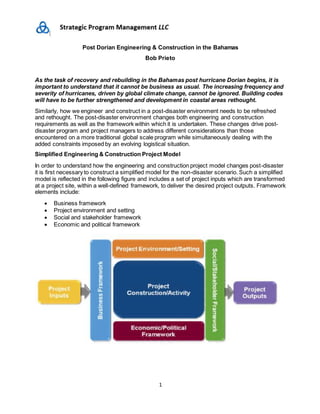
In order to understand how the engineering and construction project model changes post-disaster
it is first necessary to construct a simplified model for the non-disaster scenario. Such a simplified
model is reflected in the following figure and includes a set of project inputs which are transformed
at a project site, within a well-defined framework, to deliver the desired project outputs. Framework
elements include:
 Business framework
 Project environment and setting
 Social and stakeholder framework
 Economic and political framework
2
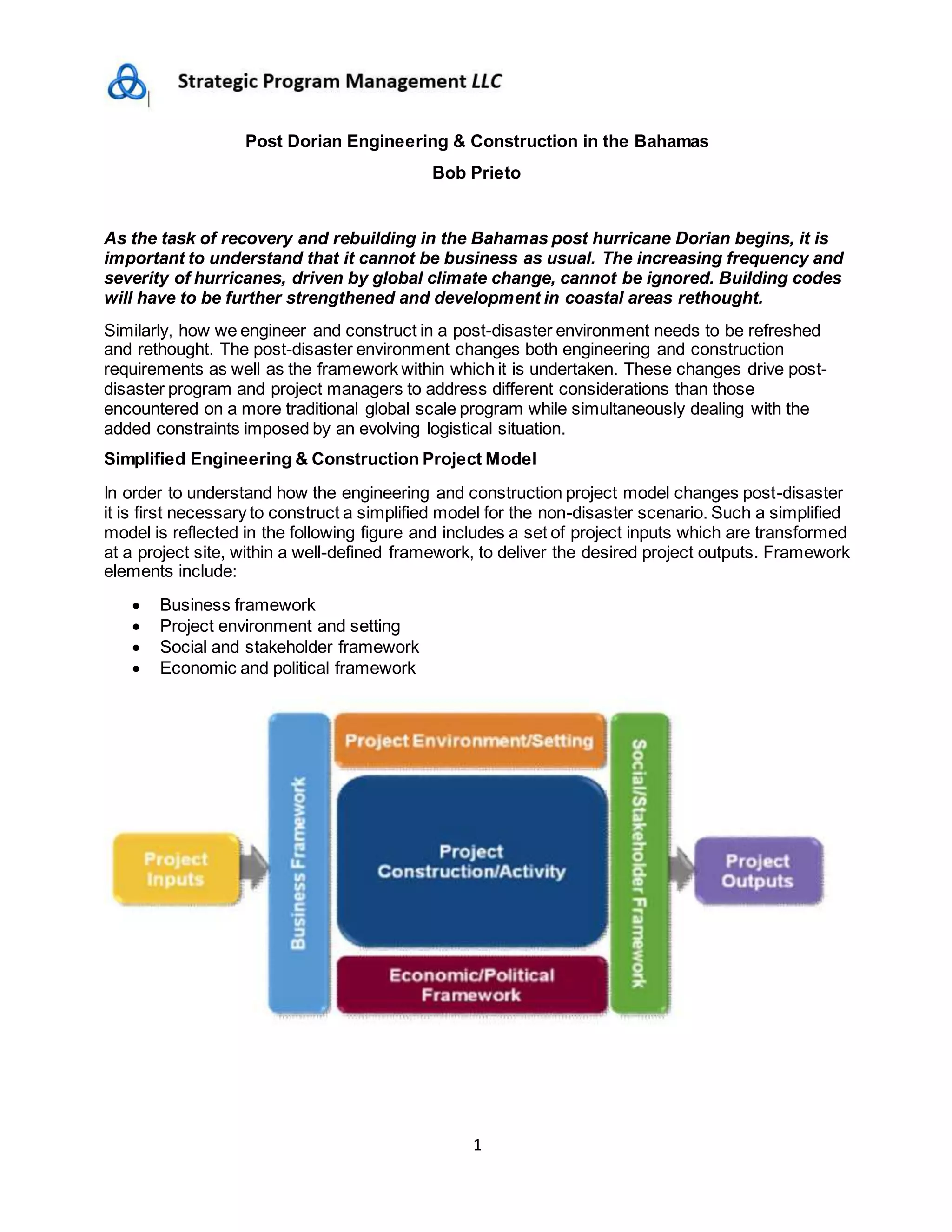
In the non-disaster scenario project inputs simplistically include:
 Labor
 Materials
 Equipment
Outputs from the engineering and construction process include not only the completed project
but also a significant amount of construction waste (25% of construction inputs).
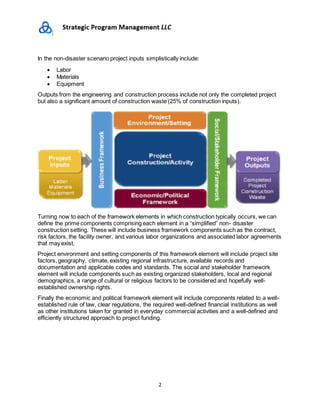
Turning now to each of the framework elements in which construction typically occurs, we can
define the prime components comprising each element in a “simplified” non- disaster
construction setting. These will include business framework components such as the contract,
risk factors, the facility owner, and various labor organizations and associated labor agreements
that may exist.
Project environment and setting components of this framework element will include project site
factors, geography, climate, existing regional infrastructure, available records and
documentation and applicable codes and standards. The social and stakeholder framework
element will include components such as existing organized stakeholders, local and regional
demographics, a range of cultural or religious factors to be considered and hopefully well-
established ownership rights.
Finally the economic and political framework element will include components related to a well-
established rule of law, clear regulations, the required well-defined financial institutions as well
as other institutions taken for granted in everyday commercial activities and a well-defined and
efficiently structured approach to project funding.
3
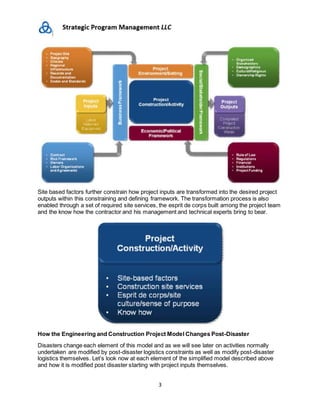
Site based factors further constrain how project inputs are transformed into the desired project
outputs within this constraining and defining framework. The transformation process is also
enabled through a set of required site services, the esprit de corps built among the project team
and the know how the contractor and his management and technical experts bring to bear.
How the Engineering and Construction Project Model Changes Post-Disaster
Disasters change each element of this model and as we will see later on activities normally
undertaken are modified by post-disaster logistics constraints as well as modify post-disaster
logistics themselves. Let’s look now at each element of the simplified model described above
and how it is modified post disaster starting with project inputs themselves.
4
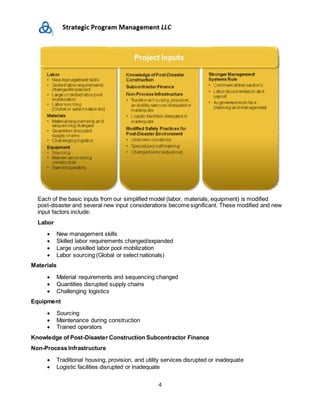
Each of the basic inputs from our simplified model (labor, materials, equipment) is modified
post-disaster and several new input considerations become significant. These modified and new
input factors include:
Labor
 New management skills
 Skilled labor requirements changed/expanded
 Large unskilled labor pool mobilization
 Labor sourcing (Global or select nationals)
Materials
 Material requirements and sequencing changed
 Quantities disrupted supply chains
 Challenging logistics
Equipment
 Sourcing
 Maintenance during construction
 Trained operators
Knowledge of Post-Disaster Construction Subcontractor Finance
Non-Process Infrastructure
 Traditional housing, provision, and utility services disrupted or inadequate
 Logistic facilities disrupted or inadequate
5
Modified Safety Practices for Post-Disaster Environment
 Unknown conditions
 Specialized craft training
 Changed work sequences
Stronger Management Systems Role
 Commercial transactions
 Labor documentation and payroll
 Augmented work face planning and management
Similarly the various framework elements are subject to modified or added components which
act to shape post disaster project management in ways not encountered in non- disaster
scenarios. Let’s look at each of the framework elements in turn and how the various
components are modified post-disaster.
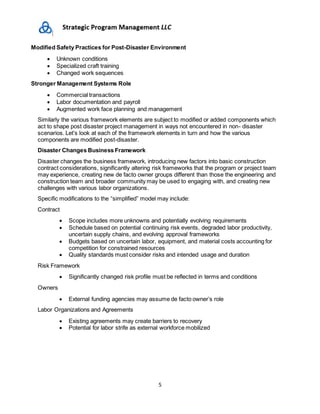
Disaster Changes Business Framework
Disaster changes the business framework, introducing new factors into basic construction
contract considerations, significantly altering risk frameworks that the program or project team
may experience, creating new de facto owner groups different than those the engineering and
construction team and broader community may be used to engaging with, and creating new
challenges with various labor organizations.
Specific modifications to the “simplified” model may include:
Contract
 Scope includes more unknowns and potentially evolving requirements
 Schedule based on potential continuing risk events, degraded labor productivity,
uncertain supply chains, and evolving approval frameworks
 Budgets based on uncertain labor, equipment, and material costs accounting for
competition for constrained resources
 Quality standards must consider risks and intended usage and duration
Risk Framework
 Significantly changed risk profile must be reflected in terms and conditions
Owners
 External funding agencies may assume de facto owner’s role
Labor Organizations and Agreements
 Existing agreements may create barriers to recovery
 Potential for labor strife as external workforce mobilized
6
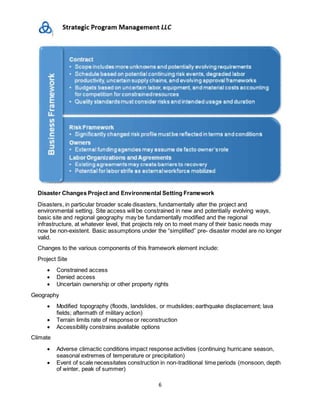
Disaster Changes Project and Environmental Setting Framework
Disasters, in particular broader scale disasters, fundamentally alter the project and
environmental setting. Site access will be constrained in new and potentially evolving ways,
basic site and regional geography may be fundamentally modified and the regional
infrastructure, at whatever level, that projects rely on to meet many of their basic needs may
now be non-existent. Basic assumptions under the “simplified” pre- disaster model are no longer
valid.
Changes to the various components of this framework element include:
Project Site
 Constrained access
 Denied access
 Uncertain ownership or other property rights
Geography
 Modified topography (floods, landslides, or mudslides; earthquake displacement; lava
fields; aftermath of military action)
 Terrain limits rate of response or reconstruction
 Accessibility constrains available options
Climate
 Adverse climactic conditions impact response activities (continuing hurricane season,
seasonal extremes of temperature or precipitation)
 Event of scale necessitates construction in non-traditional time periods (monsoon, depth
of winter, peak of summer)
7
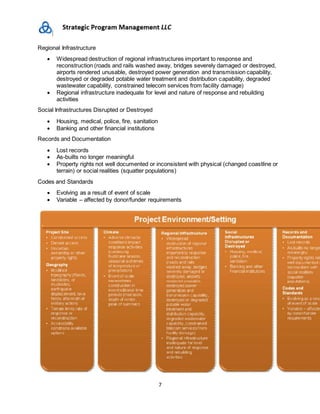
Regional Infrastructure
 Widespread destruction of regional infrastructures important to response and
reconstruction (roads and rails washed away, bridges severely damaged or destroyed,
airports rendered unusable, destroyed power generation and transmission capability,
destroyed or degraded potable water treatment and distribution capability, degraded
wastewater capability, constrained telecom services from facility damage)
 Regional infrastructure inadequate for level and nature of response and rebuilding
activities
Social Infrastructures Disrupted or Destroyed
 Housing, medical, police, fire, sanitation
 Banking and other financial institutions
Records and Documentation
 Lost records
 As-builts no longer meaningful
 Property rights not well documented or inconsistent with physical (changed coastline or
terrain) or social realities (squatter populations)
Codes and Standards
 Evolving as a result of event of scale
 Variable – affected by donor/funder requirements
8
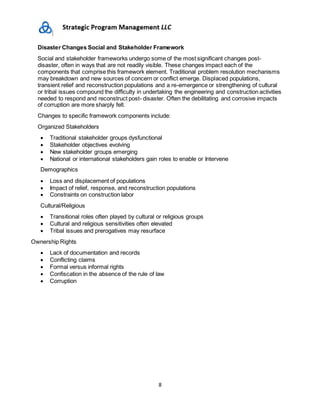
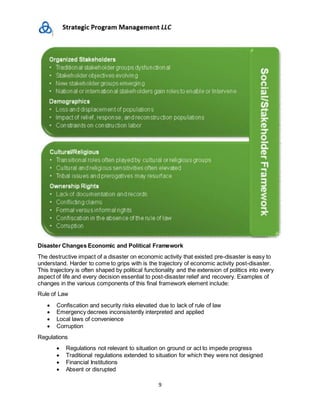
Disaster Changes Social and Stakeholder Framework
Social and stakeholder frameworks undergo some of the most significant changes post-
disaster, often in ways that are not readily visible. These changes impact each of the
components that comprise this framework element. Traditional problem resolution mechanisms
may breakdown and new sources of concern or conflict emerge. Displaced populations,
transient relief and reconstruction populations and a re-emergence or strengthening of cultural
or tribal issues compound the difficulty in undertaking the engineering and construction activities
needed to respond and reconstruct post- disaster. Often the debilitating and corrosive impacts
of corruption are more sharply felt.
Changes to specific framework components include:
Organized Stakeholders
 Traditional stakeholder groups dysfunctional
 Stakeholder objectives evolving
 New stakeholder groups emerging
 National or international stakeholders gain roles to enable or Intervene
Demographics
 Loss and displacement of populations
 Impact of relief, response, and reconstruction populations
 Constraints on construction labor
Cultural/Religious
 Transitional roles often played by cultural or religious groups
 Cultural and religious sensitivities often elevated
 Tribal issues and prerogatives may resurface
Ownership Rights
 Lack of documentation and records
 Conflicting claims
 Formal versus informal rights
 Confiscation in the absence of the rule of law
 Corruption
9
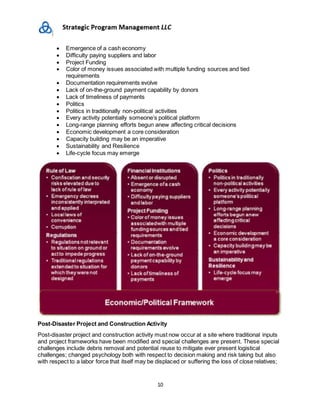
Disaster Changes Economic and Political Framework
The destructive impact of a disaster on economic activity that existed pre-disaster is easy to
understand. Harder to come to grips with is the trajectory of economic activity post-disaster.
This trajectory is often shaped by political functionality and the extension of politics into every
aspect of life and every decision essential to post-disaster relief and recovery. Examples of
changes in the various components of this final framework element include:
Rule of Law
 Confiscation and security risks elevated due to lack of rule of law
 Emergency decrees inconsistently interpreted and applied
 Local laws of convenience
 Corruption
Regulations
 Regulations not relevant to situation on ground or act to impede progress
 Traditional regulations extended to situation for which they were not designed
 Financial Institutions
 Absent or disrupted
10
 Emergence of a cash economy
 Difficulty paying suppliers and labor
 Project Funding
 Color of money issues associated with multiple funding sources and tied
requirements
 Documentation requirements evolve
 Lack of on-the-ground payment capability by donors
 Lack of timeliness of payments
 Politics
 Politics in traditionally non-political activities
 Every activity potentially someone’s political platform
 Long-range planning efforts begun anew affecting critical decisions
 Economic development a core consideration
 Capacity building may be an imperative
 Sustainability and Resilience
 Life-cycle focus may emerge
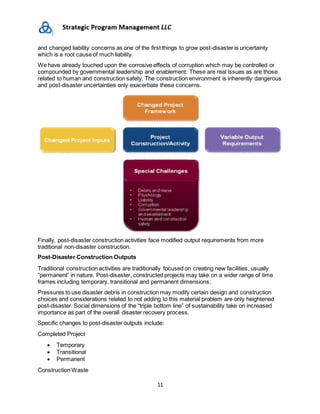
Post-Disaster Project and Construction Activity
Post-disaster project and construction activity must now occur at a site where traditional inputs
and project frameworks have been modified and special challenges are present. These special
challenges include debris removal and potential reuse to mitigate ever present logistical
challenges; changed psychology both with respect to decision making and risk taking but also
with respect to a labor force that itself may be displaced or suffering the loss of close relatives;
11
and changed liability concerns as one of the first things to grow post-disaster is uncertainty
which is a root cause of much liability.
We have already touched upon the corrosive effects of corruption which may be controlled or
compounded by governmental leadership and enablement. These are real issues as are those
related to human and construction safety. The construction environment is inherently dangerous
and post-disaster uncertainties only exacerbate these concerns.
Finally, post-disaster construction activities face modified output requirements from more
traditional non-disaster construction.
Post-Disaster Construction Outputs
Traditional construction activities are traditionally focused on creating new facilities, usually
“permanent” in nature. Post-disaster, constructed projects may take on a wider range of time
frames including temporary, transitional and permanent dimensions.
Pressures to use disaster debris in construction may modify certain design and construction
choices and considerations related to not adding to this material problem are only heightened
post-disaster. Social dimensions of the “triple bottom line” of sustainability take on increased
importance as part of the overall disaster recovery process.
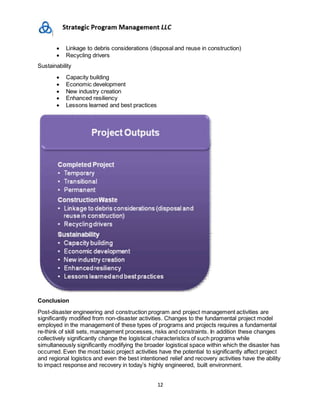
Specific changes to post-disaster outputs include:
Completed Project
 Temporary
 Transitional
 Permanent
Construction Waste
12
 Linkage to debris considerations (disposal and reuse in construction)
 Recycling drivers
Sustainability
 Capacity building
 Economic development
 New industry creation
 Enhanced resiliency
 Lessons learned and best practices
Conclusion
Post-disaster engineering and construction program and project management activities are
significantly modified from non-disaster activities. Changes to the fundamental project model
employed in the management of these types of programs and projects requires a fundamental
re-think of skill sets, management processes, risks and constraints. In addition these changes
collectively significantly change the logistical characteristics of such programs while
simultaneously significantly modifying the broader logistical space within which the disaster has
occurred. Even the most basic project activities have the potential to significantly affect project
and regional logistics and even the best intentioned relief and recovery activities have the ability
to impact response and recovery in today’s highly engineered, built environment.
13
The challenges of this changed environment can be met through concerted action by the
engineering, construction, government and NGO sectors.
In the Bahamas the international community and the engineering and construction
industry have an opportunity to build for the future and to prepare all of us to respond to
an increased frequencyof such devastating events.

Post Dorian Engineering & Construction in the Bahamas

  • 1.
    1 Post Dorian Engineering& Construction in the Bahamas Bob Prieto As the task of recovery and rebuilding in the Bahamas post hurricane Dorian begins, it is important to understand that it cannot be business as usual. The increasing frequency and severity of hurricanes, driven by global climate change, cannot be ignored. Building codes will have to be further strengthened and development in coastal areas rethought. Similarly, how we engineer and construct in a post-disaster environment needs to be refreshed and rethought. The post-disaster environment changes both engineering and construction requirements as well as the framework within which it is undertaken. These changes drive post- disaster program and project managers to address different considerations than those encountered on a more traditional global scale program while simultaneously dealing with the added constraints imposed by an evolving logistical situation. Simplified Engineering & Construction Project Model In order to understand how the engineering and construction project model changes post-disaster it is first necessary to construct a simplified model for the non-disaster scenario. Such a simplified model is reflected in the following figure and includes a set of project inputs which are transformed at a project site, within a well-defined framework, to deliver the desired project outputs. Framework elements include:  Business framework  Project environment and setting  Social and stakeholder framework  Economic and political framework
  • 2.
    2 In the non-disasterscenario project inputs simplistically include:  Labor  Materials  Equipment Outputs from the engineering and construction process include not only the completed project but also a significant amount of construction waste (25% of construction inputs). Turning now to each of the framework elements in which construction typically occurs, we can define the prime components comprising each element in a “simplified” non- disaster construction setting. These will include business framework components such as the contract, risk factors, the facility owner, and various labor organizations and associated labor agreements that may exist. Project environment and setting components of this framework element will include project site factors, geography, climate, existing regional infrastructure, available records and documentation and applicable codes and standards. The social and stakeholder framework element will include components such as existing organized stakeholders, local and regional demographics, a range of cultural or religious factors to be considered and hopefully well- established ownership rights. Finally the economic and political framework element will include components related to a well- established rule of law, clear regulations, the required well-defined financial institutions as well as other institutions taken for granted in everyday commercial activities and a well-defined and efficiently structured approach to project funding.
  • 3.
    3 Site based factorsfurther constrain how project inputs are transformed into the desired project outputs within this constraining and defining framework. The transformation process is also enabled through a set of required site services, the esprit de corps built among the project team and the know how the contractor and his management and technical experts bring to bear. How the Engineering and Construction Project Model Changes Post-Disaster Disasters change each element of this model and as we will see later on activities normally undertaken are modified by post-disaster logistics constraints as well as modify post-disaster logistics themselves. Let’s look now at each element of the simplified model described above and how it is modified post disaster starting with project inputs themselves.
  • 4.
    4 Each of thebasic inputs from our simplified model (labor, materials, equipment) is modified post-disaster and several new input considerations become significant. These modified and new input factors include: Labor  New management skills  Skilled labor requirements changed/expanded  Large unskilled labor pool mobilization  Labor sourcing (Global or select nationals) Materials  Material requirements and sequencing changed  Quantities disrupted supply chains  Challenging logistics Equipment  Sourcing  Maintenance during construction  Trained operators Knowledge of Post-Disaster Construction Subcontractor Finance Non-Process Infrastructure  Traditional housing, provision, and utility services disrupted or inadequate  Logistic facilities disrupted or inadequate
  • 5.
    5 Modified Safety Practicesfor Post-Disaster Environment  Unknown conditions  Specialized craft training  Changed work sequences Stronger Management Systems Role  Commercial transactions  Labor documentation and payroll  Augmented work face planning and management Similarly the various framework elements are subject to modified or added components which act to shape post disaster project management in ways not encountered in non- disaster scenarios. Let’s look at each of the framework elements in turn and how the various components are modified post-disaster. Disaster Changes Business Framework Disaster changes the business framework, introducing new factors into basic construction contract considerations, significantly altering risk frameworks that the program or project team may experience, creating new de facto owner groups different than those the engineering and construction team and broader community may be used to engaging with, and creating new challenges with various labor organizations. Specific modifications to the “simplified” model may include: Contract  Scope includes more unknowns and potentially evolving requirements  Schedule based on potential continuing risk events, degraded labor productivity, uncertain supply chains, and evolving approval frameworks  Budgets based on uncertain labor, equipment, and material costs accounting for competition for constrained resources  Quality standards must consider risks and intended usage and duration Risk Framework  Significantly changed risk profile must be reflected in terms and conditions Owners  External funding agencies may assume de facto owner’s role Labor Organizations and Agreements  Existing agreements may create barriers to recovery  Potential for labor strife as external workforce mobilized
  • 6.
    6 Disaster Changes Projectand Environmental Setting Framework Disasters, in particular broader scale disasters, fundamentally alter the project and environmental setting. Site access will be constrained in new and potentially evolving ways, basic site and regional geography may be fundamentally modified and the regional infrastructure, at whatever level, that projects rely on to meet many of their basic needs may now be non-existent. Basic assumptions under the “simplified” pre- disaster model are no longer valid. Changes to the various components of this framework element include: Project Site  Constrained access  Denied access  Uncertain ownership or other property rights Geography  Modified topography (floods, landslides, or mudslides; earthquake displacement; lava fields; aftermath of military action)  Terrain limits rate of response or reconstruction  Accessibility constrains available options Climate  Adverse climactic conditions impact response activities (continuing hurricane season, seasonal extremes of temperature or precipitation)  Event of scale necessitates construction in non-traditional time periods (monsoon, depth of winter, peak of summer)
  • 7.
    7 Regional Infrastructure  Widespreaddestruction of regional infrastructures important to response and reconstruction (roads and rails washed away, bridges severely damaged or destroyed, airports rendered unusable, destroyed power generation and transmission capability, destroyed or degraded potable water treatment and distribution capability, degraded wastewater capability, constrained telecom services from facility damage)  Regional infrastructure inadequate for level and nature of response and rebuilding activities Social Infrastructures Disrupted or Destroyed  Housing, medical, police, fire, sanitation  Banking and other financial institutions Records and Documentation  Lost records  As-builts no longer meaningful  Property rights not well documented or inconsistent with physical (changed coastline or terrain) or social realities (squatter populations) Codes and Standards  Evolving as a result of event of scale  Variable – affected by donor/funder requirements
  • 8.
    8 Disaster Changes Socialand Stakeholder Framework Social and stakeholder frameworks undergo some of the most significant changes post- disaster, often in ways that are not readily visible. These changes impact each of the components that comprise this framework element. Traditional problem resolution mechanisms may breakdown and new sources of concern or conflict emerge. Displaced populations, transient relief and reconstruction populations and a re-emergence or strengthening of cultural or tribal issues compound the difficulty in undertaking the engineering and construction activities needed to respond and reconstruct post- disaster. Often the debilitating and corrosive impacts of corruption are more sharply felt. Changes to specific framework components include: Organized Stakeholders  Traditional stakeholder groups dysfunctional  Stakeholder objectives evolving  New stakeholder groups emerging  National or international stakeholders gain roles to enable or Intervene Demographics  Loss and displacement of populations  Impact of relief, response, and reconstruction populations  Constraints on construction labor Cultural/Religious  Transitional roles often played by cultural or religious groups  Cultural and religious sensitivities often elevated  Tribal issues and prerogatives may resurface Ownership Rights  Lack of documentation and records  Conflicting claims  Formal versus informal rights  Confiscation in the absence of the rule of law  Corruption
  • 9.
    9 Disaster Changes Economicand Political Framework The destructive impact of a disaster on economic activity that existed pre-disaster is easy to understand. Harder to come to grips with is the trajectory of economic activity post-disaster. This trajectory is often shaped by political functionality and the extension of politics into every aspect of life and every decision essential to post-disaster relief and recovery. Examples of changes in the various components of this final framework element include: Rule of Law  Confiscation and security risks elevated due to lack of rule of law  Emergency decrees inconsistently interpreted and applied  Local laws of convenience  Corruption Regulations  Regulations not relevant to situation on ground or act to impede progress  Traditional regulations extended to situation for which they were not designed  Financial Institutions  Absent or disrupted
  • 10.
    10  Emergence ofa cash economy  Difficulty paying suppliers and labor  Project Funding  Color of money issues associated with multiple funding sources and tied requirements  Documentation requirements evolve  Lack of on-the-ground payment capability by donors  Lack of timeliness of payments  Politics  Politics in traditionally non-political activities  Every activity potentially someone’s political platform  Long-range planning efforts begun anew affecting critical decisions  Economic development a core consideration  Capacity building may be an imperative  Sustainability and Resilience  Life-cycle focus may emerge Post-Disaster Project and Construction Activity Post-disaster project and construction activity must now occur at a site where traditional inputs and project frameworks have been modified and special challenges are present. These special challenges include debris removal and potential reuse to mitigate ever present logistical challenges; changed psychology both with respect to decision making and risk taking but also with respect to a labor force that itself may be displaced or suffering the loss of close relatives;
  • 11.
    11 and changed liabilityconcerns as one of the first things to grow post-disaster is uncertainty which is a root cause of much liability. We have already touched upon the corrosive effects of corruption which may be controlled or compounded by governmental leadership and enablement. These are real issues as are those related to human and construction safety. The construction environment is inherently dangerous and post-disaster uncertainties only exacerbate these concerns. Finally, post-disaster construction activities face modified output requirements from more traditional non-disaster construction. Post-Disaster Construction Outputs Traditional construction activities are traditionally focused on creating new facilities, usually “permanent” in nature. Post-disaster, constructed projects may take on a wider range of time frames including temporary, transitional and permanent dimensions. Pressures to use disaster debris in construction may modify certain design and construction choices and considerations related to not adding to this material problem are only heightened post-disaster. Social dimensions of the “triple bottom line” of sustainability take on increased importance as part of the overall disaster recovery process. Specific changes to post-disaster outputs include: Completed Project  Temporary  Transitional  Permanent Construction Waste
  • 12.
    12  Linkage todebris considerations (disposal and reuse in construction)  Recycling drivers Sustainability  Capacity building  Economic development  New industry creation  Enhanced resiliency  Lessons learned and best practices Conclusion Post-disaster engineering and construction program and project management activities are significantly modified from non-disaster activities. Changes to the fundamental project model employed in the management of these types of programs and projects requires a fundamental re-think of skill sets, management processes, risks and constraints. In addition these changes collectively significantly change the logistical characteristics of such programs while simultaneously significantly modifying the broader logistical space within which the disaster has occurred. Even the most basic project activities have the potential to significantly affect project and regional logistics and even the best intentioned relief and recovery activities have the ability to impact response and recovery in today’s highly engineered, built environment.
  • 13.
    13 The challenges ofthis changed environment can be met through concerted action by the engineering, construction, government and NGO sectors. In the Bahamas the international community and the engineering and construction industry have an opportunity to build for the future and to prepare all of us to respond to an increased frequencyof such devastating events.