Overview of
Agile Methodology
Dhruv Kumar [Mercer : Correspondence Team]
A [really] short history of
Software development processes
to software development
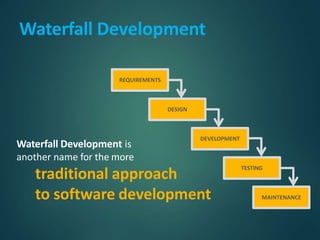
REQUIREMENTS
DESIGN
DEVELOPMENT
TESTING
MAINTENANCE
Waterfall Development is
another name for the more
traditional approach
Waterfall Development
(contd..)
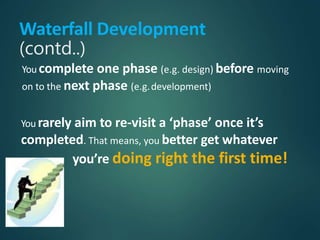
You complete one phase (e.g. design) before moving
on to the next phase (e.g.development)
You rarely aim to re-visit a ‘phase’ once it’s
completed. That means, you better get whatever
you’re doing right the first time!
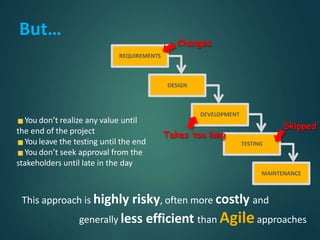
This approach is highly risky, often more costly and
generally less efficient than Agileapproaches
DESIGN
DEVELOPMENT
TESTING
MAINTENANCE
Takes too long
Changes
REQUIREMENTS
Skipped
You don’t realize any value until
the end of the project
You leave the testing until the end
You don’t seek approval from the
stakeholders until late in the day
But…
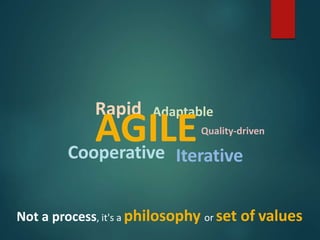
AdaptableRapid
AGILEQuality-driven
Cooperative Iterative
Not a process, it's a philosophy or set of values
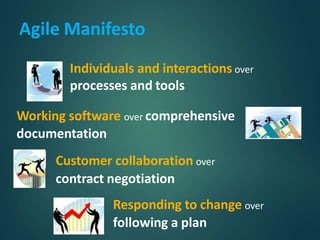
Individuals and interactions over
processes and tools
Working software over comprehensive
documentation
Customer collaboration over
contract negotiation
Responding to change over
following a plan
Agile Manifesto
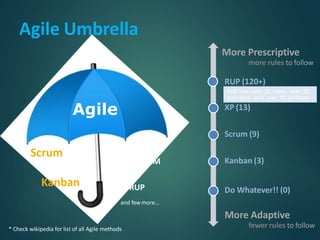
Agile Umbrella
Agile
XP
DSDM
FDD
Scrum
Crystal
Kanban
XP (13)
Scrum (9)
Kanban (3)
Do Whatever!! (0)RUP
and fewmore…
* Check wikipedia for list of all Agile methods
RUP has over 30 roles, over 20
activities, and over 70 artifacts
More Prescriptive
more rules to follow
RUP (120+)
More Adaptive
fewer rules to follow
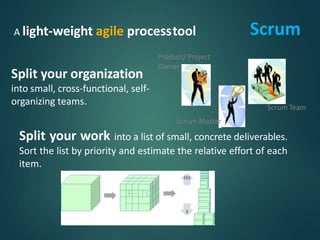
ScrumA light-weight agile processtool
Split your organization
into small, cross-functional, self-
organizing teams. Scrum Team
Scrum Master
Split your work into a list of small, concrete deliverables.
Sort the list by priority and estimate the relative effort of each
item.
Product/ Project
Owner
Scrum
(contd..)
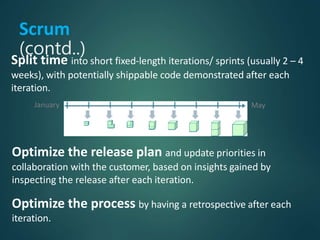
Split time into short fixed-length iterations/ sprints (usually 2 – 4
weeks), with potentially shippable code demonstrated after each
iteration.
January May
Optimize the release plan and update priorities in
collaboration with the customer, based on insights gained by
inspecting the release after each iteration.
Optimize the process by having a retrospective after each
iteration.
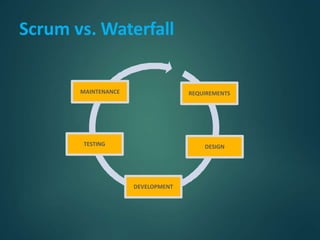
Scrum vs. Waterfall
REQUIREMENTS
DESIGN
DEVELOPMENT
TESTING
MAINTENANCE
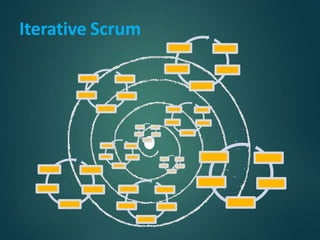
Iterative Scrum
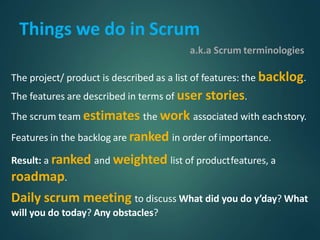
Things we do in Scrum
a.k.a Scrum terminologies
The project/ product is described as a list of features: the backlog.
The features are described in terms of user stories.
The scrum team estimates the work associated with eachstory.
Features in the backlog are ranked in order of importance.
Result: a ranked and weighted list of productfeatures, a
roadmap.
Daily scrum meeting to discuss What did you do y’day? What
will you do today? Any obstacles?
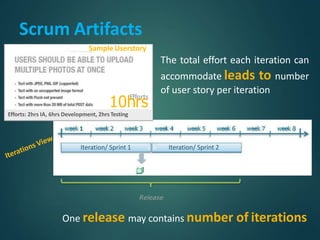
Iteration/ Sprint 1 Iteration/ Sprint 2
Scrum Artifacts
Sample Userstory
10h
Eff
r
or
s
ts
Efforts: 2hrs IA, 6hrs Development, 2hrs Testing
The total effort each iteration can
accommodate leads to number
of user story per iteration
One release may contains number of iterations
Release
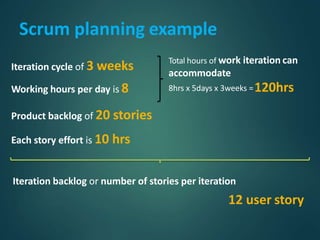
Scrum planning example
Iteration cycle of 3 weeks
Working hours per day is 8
Total hours of work iteration can
accommodate
8hrs x 5days x 3weeks =120hrs
Product backlog of 20 stories
Each story effort is 10 hrs
Iteration backlog or number of stories per iteration
12 user story
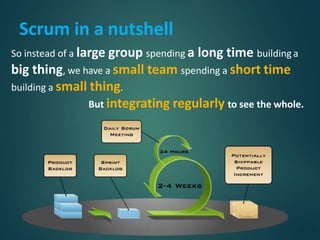
Scrum in a nutshell
So instead of a large group spending a long time building a
big thing, we have a small team spending a short time
building a small thing.
But integrating regularly to see the whole.
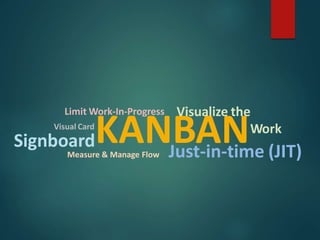
KANBAN
Visualize the
Work
Measure & Manage Flow Just-in-time (JIT)
Signboard
Limit Work-In-Progress
Visual Card
KanbanLean approach to agiledevelopment
Similar to Scrum in the sense that you focus on features as
opposed to groups of features – however Lean takesthis
one step further again.
You select, plan, develop, test and deploy one
feature (in its simplest form) before you
select, plan, develop, test and deploy the next
feature.
Aim is to eliminate ‘waste’ whereverpossible…
Kanban (contd…)
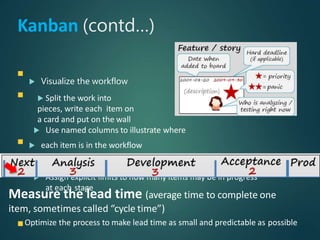
 Visualize the workflow
 Split the work into
pieces, write each item on
a card and put on the wall
 Use named columns to illustrate where
 each item is in the workflow
 Limit WIP (work in progress)
 Assign explicit limits to how many items may be in progress
at each stage
Measure the lead time (average time to complete one
item, sometimes called “cycle time”)
Optimize the process to make lead time as small and predictable as possible
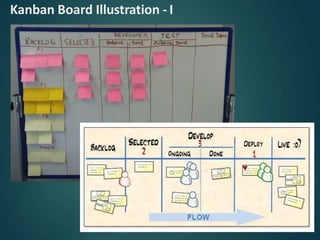
Kanban Board Illustration - I
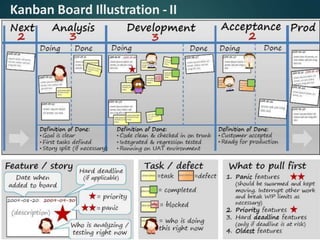
Kanban Board Illustration - II
UX adopts Agile
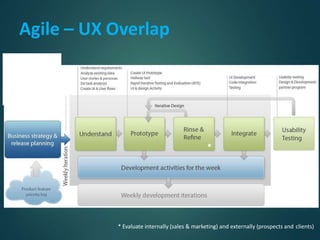
Agile – UX Overlap
* Evaluate internally (sales & marketing) and externally (prospects and clients)
*
Resources
• Agile 101
http://agile101.net/2009/09/08/the-difference-between-waterfall-iterative-
waterfall-scrum-and-lean-in-pictures/
• Kanban and Scrum - making the most of both
http://www.infoq.com/minibooks/kanban-scrum-minibook
• Kanban kick-start example
http://www.limitedwipsociety.org/tag/kanban-board/
Thank You

Agile methodology

  • 1.
    Overview of Agile Methodology DhruvKumar [Mercer : Correspondence Team]
  • 2.
    A [really] shorthistory of Software development processes
  • 3.
    to software development REQUIREMENTS DESIGN DEVELOPMENT TESTING MAINTENANCE WaterfallDevelopment is another name for the more traditional approach Waterfall Development
  • 4.
    Waterfall Development (contd..) You completeone phase (e.g. design) before moving on to the next phase (e.g.development) You rarely aim to re-visit a ‘phase’ once it’s completed. That means, you better get whatever you’re doing right the first time!
  • 5.
    This approach ishighly risky, often more costly and generally less efficient than Agileapproaches DESIGN DEVELOPMENT TESTING MAINTENANCE Takes too long Changes REQUIREMENTS Skipped You don’t realize any value until the end of the project You leave the testing until the end You don’t seek approval from the stakeholders until late in the day But…
  • 6.
    AdaptableRapid AGILEQuality-driven Cooperative Iterative Not aprocess, it's a philosophy or set of values
  • 7.
    Individuals and interactionsover processes and tools Working software over comprehensive documentation Customer collaboration over contract negotiation Responding to change over following a plan Agile Manifesto
  • 8.
    Agile Umbrella Agile XP DSDM FDD Scrum Crystal Kanban XP (13) Scrum(9) Kanban (3) Do Whatever!! (0)RUP and fewmore… * Check wikipedia for list of all Agile methods RUP has over 30 roles, over 20 activities, and over 70 artifacts More Prescriptive more rules to follow RUP (120+) More Adaptive fewer rules to follow
  • 9.
    ScrumA light-weight agileprocesstool Split your organization into small, cross-functional, self- organizing teams. Scrum Team Scrum Master Split your work into a list of small, concrete deliverables. Sort the list by priority and estimate the relative effort of each item. Product/ Project Owner
  • 10.
    Scrum (contd..) Split time intoshort fixed-length iterations/ sprints (usually 2 – 4 weeks), with potentially shippable code demonstrated after each iteration. January May Optimize the release plan and update priorities in collaboration with the customer, based on insights gained by inspecting the release after each iteration. Optimize the process by having a retrospective after each iteration.
  • 11.
  • 12.
  • 13.
    Things we doin Scrum a.k.a Scrum terminologies The project/ product is described as a list of features: the backlog. The features are described in terms of user stories. The scrum team estimates the work associated with eachstory. Features in the backlog are ranked in order of importance. Result: a ranked and weighted list of productfeatures, a roadmap. Daily scrum meeting to discuss What did you do y’day? What will you do today? Any obstacles?
  • 14.
    Iteration/ Sprint 1Iteration/ Sprint 2 Scrum Artifacts Sample Userstory 10h Eff r or s ts Efforts: 2hrs IA, 6hrs Development, 2hrs Testing The total effort each iteration can accommodate leads to number of user story per iteration One release may contains number of iterations Release
  • 15.
    Scrum planning example Iterationcycle of 3 weeks Working hours per day is 8 Total hours of work iteration can accommodate 8hrs x 5days x 3weeks =120hrs Product backlog of 20 stories Each story effort is 10 hrs Iteration backlog or number of stories per iteration 12 user story
  • 16.
    Scrum in anutshell So instead of a large group spending a long time building a big thing, we have a small team spending a short time building a small thing. But integrating regularly to see the whole.
  • 17.
    KANBAN Visualize the Work Measure &Manage Flow Just-in-time (JIT) Signboard Limit Work-In-Progress Visual Card
  • 18.
    KanbanLean approach toagiledevelopment Similar to Scrum in the sense that you focus on features as opposed to groups of features – however Lean takesthis one step further again. You select, plan, develop, test and deploy one feature (in its simplest form) before you select, plan, develop, test and deploy the next feature. Aim is to eliminate ‘waste’ whereverpossible…
  • 19.
    Kanban (contd…)  Visualizethe workflow  Split the work into pieces, write each item on a card and put on the wall  Use named columns to illustrate where  each item is in the workflow  Limit WIP (work in progress)  Assign explicit limits to how many items may be in progress at each stage Measure the lead time (average time to complete one item, sometimes called “cycle time”) Optimize the process to make lead time as small and predictable as possible
  • 20.
  • 21.
  • 22.
  • 23.
    Agile – UXOverlap * Evaluate internally (sales & marketing) and externally (prospects and clients) *
  • 24.
    Resources • Agile 101 http://agile101.net/2009/09/08/the-difference-between-waterfall-iterative- waterfall-scrum-and-lean-in-pictures/ •Kanban and Scrum - making the most of both http://www.infoq.com/minibooks/kanban-scrum-minibook • Kanban kick-start example http://www.limitedwipsociety.org/tag/kanban-board/
  • 25.