PM World Journal (ISSN: 2330-4480) The Impact of Correlation on Risks
Vol. IX, Issue XII – December 2020 in Programs and Projects
www.pmworldjournal.com Featured Paper by Bob Prieto
© 2020 Robert Prieto www.pmworldlibrary.net Page 1 of 11
The Impact of Correlation on Risks in Programs and Projects 1
By Bob Prieto
Chairman & CEO
Strategic Program Management LLC
One of the most under considered elements of cost and schedule risk is the correlation
that exists within various WBS elements of a project or across projects comprising a
program. Failure to adequately consider correlation between various activities and
projects compounds the impact of other factors present in large complex projects.
These include:
• MAIMS – “Money Allocated Is Money Spent”
• Parkinson’s Law – work expands to fill the time allotted
• Overconfidence in assessing uncertainties
• Complexity with hidden coupling – risk events are likely to affect multiple cost
elements with the potential for cascading impacts
• State of technology
• Common management, staff and work processes
• Optimism bias
• Overly simplistic probabilistic cost analysis (PCA)
This paper looks at correlation in project and program risk assessments and some of the
impacts of a failure to adequately consider such correlation in project risk assessments
related to both cost and schedule.
Key points:
• Recognize that correlations exist not only among cost elements in a project but
among the cost elements in different projects in a program
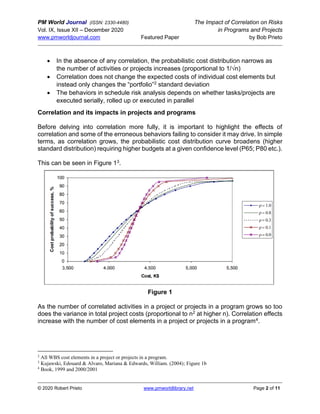
• As correlation grows, the probabilistic cost distribution curve broadens (higher
standard distribution) requiring higher budgets at a given confidence level
• As the number (n) of correlated activities in a project or projects in a program
grows so too does the variance in total project costs (proportional to n2 at higher
n). Correlation effects increase with the number of cost elements in a project or
projects in a program
1
How to cite this paper: Prieto, R. (2020). The Impact of Correlation on Risks in Programs and Projects; PM World
Journal, Vol. IX, Issue XII, December.
PM World Journal (ISSN: 2330-4480) The Impact of Correlation on Risks
Vol. IX, Issue XII – December 2020 in Programs and Projects
www.pmworldjournal.com Featured Paper by Bob Prieto
© 2020 Robert Prieto www.pmworldlibrary.net Page 2 of 11
• In the absence of any correlation, the probabilistic cost distribution narrows as
the number of activities or projects increases (proportional to 1/√n)
• Correlation does not change the expected costs of individual cost elements but
instead only changes the “portfolio”2 standard deviation
• The behaviors in schedule risk analysis depends on whether tasks/projects are
executed serially, rolled up or executed in parallel
Correlation and its impacts in projects and programs
Before delving into correlation more fully, it is important to highlight the effects of
correlation and some of the erroneous behaviors failing to consider it may drive. In simple
terms, as correlation grows, the probabilistic cost distribution curve broadens (higher
standard distribution) requiring higher budgets at a given confidence level (P65; P80 etc.).
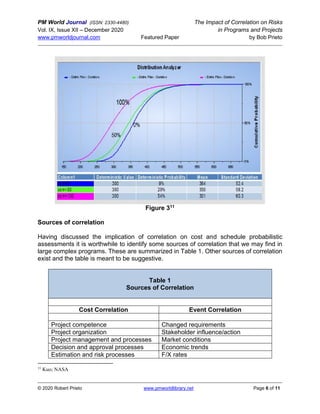
This can be seen in Figure 13.
Figure 1
As the number of correlated activities in a project or projects in a program grows so too
does the variance in total project costs (proportional to n2 at higher n). Correlation effects
increase with the number of cost elements in a project or projects in a program4.
2
All WBS cost elements in a project or projects in a program.
3
Kujawski, Edouard & Alvaro, Mariana & Edwards, William. (2004); Figure 1b
4
Book, 1999 and 2000/2001
PM World Journal (ISSN: 2330-4480) The Impact of Correlation on Risks
Vol. IX, Issue XII – December 2020 in Programs and Projects
www.pmworldjournal.com Featured Paper by Bob Prieto
© 2020 Robert Prieto www.pmworldlibrary.net Page 3 of 11
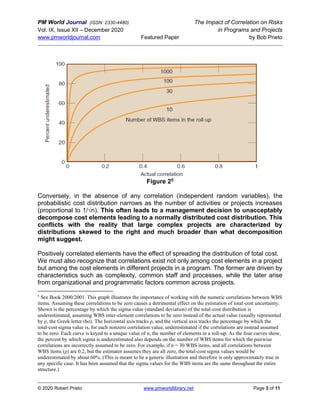
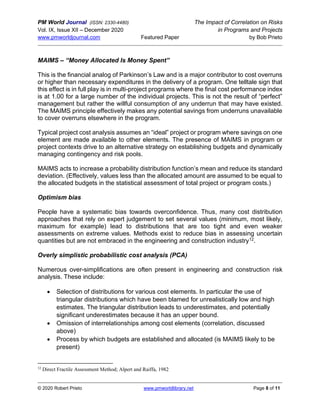
Figure 25
Conversely, in the absence of any correlation (independent random variables), the
probabilistic cost distribution narrows as the number of activities or projects increases
(proportional to 1/√n). This often leads to a management decision to unacceptably
decompose cost elements leading to a normally distributed cost distribution. This
conflicts with the reality that large complex projects are characterized by
distributions skewed to the right and much broader than what decomposition
might suggest.
Positively correlated elements have the effect of spreading the distribution of total cost.
We must also recognize that correlations exist not only among cost elements in a project
but among the cost elements in different projects in a program. The former are driven by
characteristics such as complexity, common staff and processes, while the later arise
from organizational and programmatic factors common across projects.
5
See Book 2000/2001. This graph illustrates the importance of working with the numeric correlations between WBS
items. Assuming these correlations to be zero causes a detrimental effect on the estimation of total-cost uncertainty.
Shown is the percentage by which the sigma value (standard deviation) of the total-cost distribution is
underestimated, assuming WBS inter-element correlations to be zero instead of the actual value (usually represented
by ρ, the Greek letter rho). The horizontal axis tracks ρ, and the vertical axis tracks the percentage by which the
total-cost sigma value is, for each nonzero correlation value, underestimated if the correlations are instead assumed
to be zero. Each curve is keyed to a unique value of n, the number of elements in a roll-up. As the four curves show,
the percent by which sigma is underestimated also depends on the number of WBS items for which the pairwise
correlations are incorrectly assumed to be zero. For example, if n = 30 WBS items, and all correlations between
WBS items (ρ) are 0.2, but the estimator assumes they are all zero, the total-cost sigma values would be
underestimated by about 60%. (This is meant to be a generic illustration and therefore is only approximately true in
any specific case. It has been assumed that the sigma values for the WBS items are the same throughout the entire
structure.)
PM World Journal (ISSN: 2330-4480) The Impact of Correlation on Risks
Vol. IX, Issue XII – December 2020 in Programs and Projects
www.pmworldjournal.com Featured Paper by Bob Prieto
© 2020 Robert Prieto www.pmworldlibrary.net Page 4 of 11
So, what is correlation?
Correlation measures linear dependence between two random variables and as such only
provides us with a partial picture of their dependence. It does not indicate causality and
even a correlation coefficient of 1.0 does not indicate causality, only perfect dependence.
When we speak of correlation we typically are referring to “Pearson’s” product moment
coefficient6. When data is nonlinear, non-parametric correlation may be more robust.
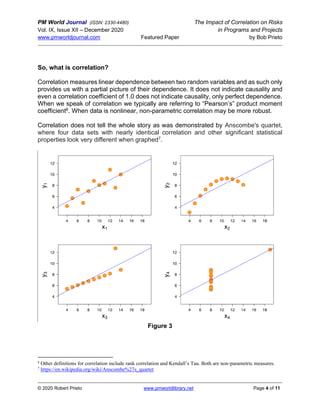
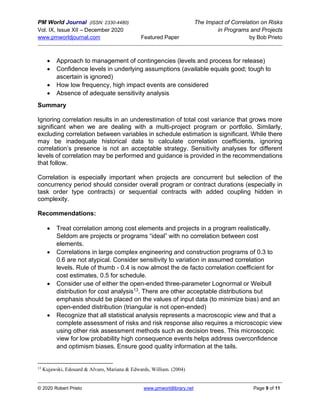
Correlation does not tell the whole story as was demonstrated by Anscombe's quartet,
where four data sets with nearly identical correlation and other significant statistical
properties look very different when graphed7.
Figure 3
6
Other definitions for correlation include rank correlation and Kendall’s Tau. Both are non-parametric measures.
7
https://en.wikipedia.org/wiki/Anscombe%27s_quartet
PM World Journal (ISSN: 2330-4480) The Impact of Correlation on Risks
Vol. IX, Issue XII – December 2020 in Programs and Projects
www.pmworldjournal.com Featured Paper by Bob Prieto
© 2020 Robert Prieto www.pmworldlibrary.net Page 5 of 11
The correlation coefficient is dependent on the variance8 of the data and degrades with
volatility of the data. Correlation does not change the expected costs of individual cost
elements but instead only changes the “portfolio”9 standard deviation. This in turn
changes the shape of the traditional S-curve, increasing budget requirements for
confidence levels greater than the expected value (P50) (where we are less confident in
point estimates). Conversely, below expected values we are actually more confident in
point estimates than without correlation. These relationships can all be seen in Figure 1.
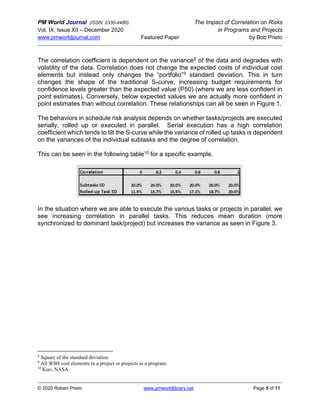
The behaviors in schedule risk analysis depends on whether tasks/projects are executed
serially, rolled up or executed in parallel. Serial execution has a high correlation
coefficient which tends to tilt the S-curve while the variance of rolled up tasks is dependent
on the variances of the individual subtasks and the degree of correlation.
This can be seen in the following table10 for a specific example.
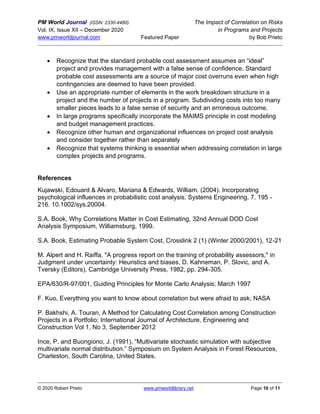
In the situation where we are able to execute the various tasks or projects in parallel, we
see increasing correlation in parallel tasks. This reduces mean duration (more
synchronized to dominant task/project) but increases the variance as seen in Figure 3.
8
Square of the standard deviation
9
All WBS cost elements in a project or projects in a program.
10
Kuo; NASA
PM World Journal (ISSN: 2330-4480) The Impact of Correlation on Risks
Vol. IX, Issue XII – December 2020 in Programs and Projects
www.pmworldjournal.com Featured Paper by Bob Prieto
© 2020 Robert Prieto www.pmworldlibrary.net Page 6 of 11
Figure 311
Sources of correlation
Having discussed the implication of correlation on cost and schedule probabilistic
assessments it is worthwhile to identify some sources of correlation that we may find in
large complex programs. These are summarized in Table 1. Other sources of correlation
exist and the table is meant to be suggestive.
Table 1
Sources of Correlation
Cost Correlation Event Correlation
Project competence Changed requirements
Project organization Stakeholder influence/action
Project management and processes Market conditions
Decision and approval processes Economic trends
Estimation and risk processes F/X rates
11
Kuo; NASA
PM World Journal (ISSN: 2330-4480) The Impact of Correlation on Risks
Vol. IX, Issue XII – December 2020 in Programs and Projects
www.pmworldjournal.com Featured Paper by Bob Prieto
© 2020 Robert Prieto www.pmworldlibrary.net Page 7 of 11
Table 1
Sources of Correlation
Wages, benefits, payroll taxes Trade actions
Productivity Regulatory changes/actions
Raw material costs Low frequency high impact events of
scale
Design development Archaeology finds
Means & methods
State of technology - common new
technology/materials
Uncertainty factors/known unknowns
Budgeting and contingency
management strategy and approach
Packaging and contracting strategy
Schedule precedencies
Shared/common assumptions
Failures/delays at interfaces
MAIMS – “Money Allocated Is Money
Spent”
Parkinson’s Law – work expands to
fill the time allotted
Optimism and other biases
consistently applied
Location factors
Correlation between pairs of projects in a program can be calculated as the sum of the
products of the standard deviation for each common risk divided by the product of the
standard deviation of all risks in each project. Selection of appropriate distributions for
each risk is important. As the number of projects in the program grows calculation of
overall program correlation becomes more challenging and more important. Ignoring
dependency among cost components results in underestimation of total cost variance.
Other factors impacting project and program risk assessment
Several factors beyond correlation can impact the output and more importantly validity
and conclusions from a probabilistic risk assessment. Some of these are outlined in the
introduction and succinctly discussed here.
PM World Journal (ISSN: 2330-4480) The Impact of Correlation on Risks
Vol. IX, Issue XII – December 2020 in Programs and Projects
www.pmworldjournal.com Featured Paper by Bob Prieto
© 2020 Robert Prieto www.pmworldlibrary.net Page 8 of 11
MAIMS – “Money Allocated Is Money Spent”
This is the financial analog of Parkinson’s Law and is a major contributor to cost overruns
or higher than necessary expenditures in the delivery of a program. One telltale sign that
this effect is in full play is in multi-project programs where the final cost performance index
is at 1.00 for a large number of the individual projects. This is not the result of “perfect”
management but rather the willful consumption of any underrun that may have existed.
The MAIMS principle effectively makes any potential savings from underruns unavailable
to cover overruns elsewhere in the program.
Typical project cost analysis assumes an “ideal” project or program where savings on one
element are made available to other elements. The presence of MAIMS in program or
project contexts drive to an alternative strategy on establishing budgets and dynamically
managing contingency and risk pools.
MAIMS acts to increase a probability distribution function’s mean and reduce its standard
deviation. (Effectively, values less than the allocated amount are assumed to be equal to
the allocated budgets in the statistical assessment of total project or program costs.)
Optimism bias
People have a systematic bias towards overconfidence. Thus, many cost distribution
approaches that rely on expert judgement to set several values (minimum, most likely,
maximum for example) lead to distributions that are too tight and even weaker
assessments on extreme values. Methods exist to reduce bias in assessing uncertain
quantities but are not embraced in the engineering and construction industry12.
Overly simplistic probabilistic cost analysis (PCA)
Numerous over-simplifications are often present in engineering and construction risk
analysis. These include:
• Selection of distributions for various cost elements. In particular the use of
triangular distributions which have been blamed for unrealistically low and high
estimates. The triangular distribution leads to underestimates, and potentially
significant underestimates because it has an upper bound.
• Omission of interrelationships among cost elements (correlation, discussed
above)
• Process by which budgets are established and allocated (is MAIMS likely to be
present)
12
Direct Fractile Assessment Method; Alpert and Raiffa, 1982
PM World Journal (ISSN: 2330-4480) The Impact of Correlation on Risks
Vol. IX, Issue XII – December 2020 in Programs and Projects
www.pmworldjournal.com Featured Paper by Bob Prieto
© 2020 Robert Prieto www.pmworldlibrary.net Page 9 of 11
• Approach to management of contingencies (levels and process for release)
• Confidence levels in underlying assumptions (available equals good; tough to
ascertain is ignored)
• How low frequency, high impact events are considered
• Absence of adequate sensitivity analysis
Summary
Ignoring correlation results in an underestimation of total cost variance that grows more
significant when we are dealing with a multi-project program or portfolio. Similarly,
excluding correlation between variables in schedule estimation is significant. While there
may be inadequate historical data to calculate correlation coefficients, ignoring
correlation’s presence is not an acceptable strategy. Sensitivity analyses for different
levels of correlation may be performed and guidance is provided in the recommendations
that follow.
Correlation is especially important when projects are concurrent but selection of the
concurrency period should consider overall program or contract durations (especially in
task order type contracts) or sequential contracts with added coupling hidden in
complexity.
Recommendations:
• Treat correlation among cost elements and projects in a program realistically.
Seldom are projects or programs “ideal” with no correlation between cost
elements.
• Correlations in large complex engineering and construction programs of 0.3 to
0.6 are not atypical. Consider sensitivity to variation in assumed correlation
levels. Rule of thumb - 0.4 is now almost the de facto correlation coefficient for
cost estimates, 0.5 for schedule.
• Consider use of either the open-ended three-parameter Lognormal or Weibull
distribution for cost analysis13. There are other acceptable distributions but
emphasis should be placed on the values of input data (to minimize bias) and an
open-ended distribution (triangular is not open-ended)
• Recognize that all statistical analysis represents a macroscopic view and that a
complete assessment of risks and risk response also requires a microscopic view
using other risk assessment methods such as decision trees. This microscopic
view for low probability high consequence events helps address overconfidence
and optimism biases. Ensure good quality information at the tails.
13
Kujawski, Edouard & Alvaro, Mariana & Edwards, William. (2004)
PM World Journal (ISSN: 2330-4480) The Impact of Correlation on Risks
Vol. IX, Issue XII – December 2020 in Programs and Projects
www.pmworldjournal.com Featured Paper by Bob Prieto
© 2020 Robert Prieto www.pmworldlibrary.net Page 10 of 11
• Recognize that the standard probable cost assessment assumes an “ideal”
project and provides management with a false sense of confidence. Standard
probable cost assessments are a source of major cost overruns even when high
contingencies are deemed to have been provided.
• Use an appropriate number of elements in the work breakdown structure in a
project and the number of projects in a program. Subdividing costs into too many
smaller pieces leads to a false sense of security and an erroneous outcome.
• In large programs specifically incorporate the MAIMS principle in cost modeling
and budget management practices.
• Recognize other human and organizational influences on project cost analysis
and consider together rather than separately
• Recognize that systems thinking is essential when addressing correlation in large
complex projects and programs.
References
Kujawski, Edouard & Alvaro, Mariana & Edwards, William. (2004). Incorporating
psychological influences in probabilistic cost analysis. Systems Engineering. 7. 195 -
216. 10.1002/sys.20004.
S.A. Book, Why Correlations Matter in Cost Estimating, 32nd Annual DOD Cost
Analysis Symposium, Williamsburg, 1999.
S.A. Book, Estimating Probable System Cost, Crosslink 2 (1) (Winter 2000/2001), 12-21
M. Alpert and H. Raiffa, "A progress report on the training of probability assessors," in
Judgment under uncertainty: Heuristics and biases, D. Kahneman, P. Slovic, and A.
Tversky (Editors), Cambridge University Press, 1982, pp. 294-305.
EPA/630/R-97/001, Guiding Principles for Monte Carlo Analysis; March 1997
F. Kuo, Everything you want to know about correlation but were afraid to ask; NASA
P. Bakhshi, A. Touran, A Method for Calculating Cost Correlation among Construction
Projects in a Portfolio; International Journal of Architecture, Engineering and
Construction Vol 1, No 3, September 2012
Ince, P. and Buongiono, J. (1991). “Multivariate stochastic simulation with subjective
multivariate normal distribution.” Symposium on System Analysis in Forest Resources,
Charleston, South Carolina, United States.
PM World Journal (ISSN: 2330-4480) The Impact of Correlation on Risks
Vol. IX, Issue XII – December 2020 in Programs and Projects
www.pmworldjournal.com Featured Paper by Bob Prieto
© 2020 Robert Prieto www.pmworldlibrary.net Page 11 of 11
About the Author
Bob Prieto
Chairman & CEO
Strategic Program Management LLC
Jupiter, Florida, USA
Bob Prieto is a senior executive effective in shaping and executing business strategy and
a recognized leader within the infrastructure, engineering and construction industries.
Currently Bob heads his own management consulting practice, Strategic Program
Management LLC. He previously served as a senior vice president of Fluor, one of the
largest engineering and construction companies in the world. He focuses on the
development and delivery of large, complex projects worldwide and consults with owners
across all market sectors in the development of programmatic delivery strategies. He is
author of nine books including “Strategic Program Management”, “The Giga Factor:
Program Management in the Engineering and Construction Industry”, “Application of Life
Cycle Analysis in the Capital Assets Industry”, “Capital Efficiency: Pull All the Levers” and,
most recently, “Theory of Management of Large Complex Projects” published by the
Construction Management Association of America (CMAA) as well as over 750 other
papers and presentations.
Bob is an Independent Member of the Shareholder Committee of Mott MacDonald. He is a
member of the ASCE Industry Leaders Council, National Academy of Construction, a
Fellow of the Construction Management Association of America, Millennium Challenge
Corporation Advisory Board and member of several university departmental and campus
advisory boards. Bob served until 2006 as a U.S. presidential appointee to the Asia Pacific
Economic Cooperation (APEC) Business Advisory Council (ABAC), working with U.S. and
Asia-Pacific business leaders to shape the framework for trade and economic growth. He
had previously served as both as Chairman of the Engineering and Construction
Governors of the World Economic Forum and co-chair of the infrastructure task force
formed after September 11th by the New York City Chamber of Commerce. Previously, he
served as Chairman at Parsons Brinckerhoff (PB) and a non-executive director of Cardno
(ASX)
Bob serves as an honorary global advisor for the PM World Journal and Library and can be
contacted at rpstrategic@comcast.net.

Impact of correlation on risks in programs and projects

  • 1.
    PM World Journal(ISSN: 2330-4480) The Impact of Correlation on Risks Vol. IX, Issue XII – December 2020 in Programs and Projects www.pmworldjournal.com Featured Paper by Bob Prieto © 2020 Robert Prieto www.pmworldlibrary.net Page 1 of 11 The Impact of Correlation on Risks in Programs and Projects 1 By Bob Prieto Chairman & CEO Strategic Program Management LLC One of the most under considered elements of cost and schedule risk is the correlation that exists within various WBS elements of a project or across projects comprising a program. Failure to adequately consider correlation between various activities and projects compounds the impact of other factors present in large complex projects. These include: • MAIMS – “Money Allocated Is Money Spent” • Parkinson’s Law – work expands to fill the time allotted • Overconfidence in assessing uncertainties • Complexity with hidden coupling – risk events are likely to affect multiple cost elements with the potential for cascading impacts • State of technology • Common management, staff and work processes • Optimism bias • Overly simplistic probabilistic cost analysis (PCA) This paper looks at correlation in project and program risk assessments and some of the impacts of a failure to adequately consider such correlation in project risk assessments related to both cost and schedule. Key points: • Recognize that correlations exist not only among cost elements in a project but among the cost elements in different projects in a program • As correlation grows, the probabilistic cost distribution curve broadens (higher standard distribution) requiring higher budgets at a given confidence level • As the number (n) of correlated activities in a project or projects in a program grows so too does the variance in total project costs (proportional to n2 at higher n). Correlation effects increase with the number of cost elements in a project or projects in a program 1 How to cite this paper: Prieto, R. (2020). The Impact of Correlation on Risks in Programs and Projects; PM World Journal, Vol. IX, Issue XII, December.
  • 2.
    PM World Journal(ISSN: 2330-4480) The Impact of Correlation on Risks Vol. IX, Issue XII – December 2020 in Programs and Projects www.pmworldjournal.com Featured Paper by Bob Prieto © 2020 Robert Prieto www.pmworldlibrary.net Page 2 of 11 • In the absence of any correlation, the probabilistic cost distribution narrows as the number of activities or projects increases (proportional to 1/√n) • Correlation does not change the expected costs of individual cost elements but instead only changes the “portfolio”2 standard deviation • The behaviors in schedule risk analysis depends on whether tasks/projects are executed serially, rolled up or executed in parallel Correlation and its impacts in projects and programs Before delving into correlation more fully, it is important to highlight the effects of correlation and some of the erroneous behaviors failing to consider it may drive. In simple terms, as correlation grows, the probabilistic cost distribution curve broadens (higher standard distribution) requiring higher budgets at a given confidence level (P65; P80 etc.). This can be seen in Figure 13. Figure 1 As the number of correlated activities in a project or projects in a program grows so too does the variance in total project costs (proportional to n2 at higher n). Correlation effects increase with the number of cost elements in a project or projects in a program4. 2 All WBS cost elements in a project or projects in a program. 3 Kujawski, Edouard & Alvaro, Mariana & Edwards, William. (2004); Figure 1b 4 Book, 1999 and 2000/2001
  • 3.
    PM World Journal(ISSN: 2330-4480) The Impact of Correlation on Risks Vol. IX, Issue XII – December 2020 in Programs and Projects www.pmworldjournal.com Featured Paper by Bob Prieto © 2020 Robert Prieto www.pmworldlibrary.net Page 3 of 11 Figure 25 Conversely, in the absence of any correlation (independent random variables), the probabilistic cost distribution narrows as the number of activities or projects increases (proportional to 1/√n). This often leads to a management decision to unacceptably decompose cost elements leading to a normally distributed cost distribution. This conflicts with the reality that large complex projects are characterized by distributions skewed to the right and much broader than what decomposition might suggest. Positively correlated elements have the effect of spreading the distribution of total cost. We must also recognize that correlations exist not only among cost elements in a project but among the cost elements in different projects in a program. The former are driven by characteristics such as complexity, common staff and processes, while the later arise from organizational and programmatic factors common across projects. 5 See Book 2000/2001. This graph illustrates the importance of working with the numeric correlations between WBS items. Assuming these correlations to be zero causes a detrimental effect on the estimation of total-cost uncertainty. Shown is the percentage by which the sigma value (standard deviation) of the total-cost distribution is underestimated, assuming WBS inter-element correlations to be zero instead of the actual value (usually represented by ρ, the Greek letter rho). The horizontal axis tracks ρ, and the vertical axis tracks the percentage by which the total-cost sigma value is, for each nonzero correlation value, underestimated if the correlations are instead assumed to be zero. Each curve is keyed to a unique value of n, the number of elements in a roll-up. As the four curves show, the percent by which sigma is underestimated also depends on the number of WBS items for which the pairwise correlations are incorrectly assumed to be zero. For example, if n = 30 WBS items, and all correlations between WBS items (ρ) are 0.2, but the estimator assumes they are all zero, the total-cost sigma values would be underestimated by about 60%. (This is meant to be a generic illustration and therefore is only approximately true in any specific case. It has been assumed that the sigma values for the WBS items are the same throughout the entire structure.)
  • 4.
    PM World Journal(ISSN: 2330-4480) The Impact of Correlation on Risks Vol. IX, Issue XII – December 2020 in Programs and Projects www.pmworldjournal.com Featured Paper by Bob Prieto © 2020 Robert Prieto www.pmworldlibrary.net Page 4 of 11 So, what is correlation? Correlation measures linear dependence between two random variables and as such only provides us with a partial picture of their dependence. It does not indicate causality and even a correlation coefficient of 1.0 does not indicate causality, only perfect dependence. When we speak of correlation we typically are referring to “Pearson’s” product moment coefficient6. When data is nonlinear, non-parametric correlation may be more robust. Correlation does not tell the whole story as was demonstrated by Anscombe's quartet, where four data sets with nearly identical correlation and other significant statistical properties look very different when graphed7. Figure 3 6 Other definitions for correlation include rank correlation and Kendall’s Tau. Both are non-parametric measures. 7 https://en.wikipedia.org/wiki/Anscombe%27s_quartet
  • 5.
    PM World Journal(ISSN: 2330-4480) The Impact of Correlation on Risks Vol. IX, Issue XII – December 2020 in Programs and Projects www.pmworldjournal.com Featured Paper by Bob Prieto © 2020 Robert Prieto www.pmworldlibrary.net Page 5 of 11 The correlation coefficient is dependent on the variance8 of the data and degrades with volatility of the data. Correlation does not change the expected costs of individual cost elements but instead only changes the “portfolio”9 standard deviation. This in turn changes the shape of the traditional S-curve, increasing budget requirements for confidence levels greater than the expected value (P50) (where we are less confident in point estimates). Conversely, below expected values we are actually more confident in point estimates than without correlation. These relationships can all be seen in Figure 1. The behaviors in schedule risk analysis depends on whether tasks/projects are executed serially, rolled up or executed in parallel. Serial execution has a high correlation coefficient which tends to tilt the S-curve while the variance of rolled up tasks is dependent on the variances of the individual subtasks and the degree of correlation. This can be seen in the following table10 for a specific example. In the situation where we are able to execute the various tasks or projects in parallel, we see increasing correlation in parallel tasks. This reduces mean duration (more synchronized to dominant task/project) but increases the variance as seen in Figure 3. 8 Square of the standard deviation 9 All WBS cost elements in a project or projects in a program. 10 Kuo; NASA
  • 6.
    PM World Journal(ISSN: 2330-4480) The Impact of Correlation on Risks Vol. IX, Issue XII – December 2020 in Programs and Projects www.pmworldjournal.com Featured Paper by Bob Prieto © 2020 Robert Prieto www.pmworldlibrary.net Page 6 of 11 Figure 311 Sources of correlation Having discussed the implication of correlation on cost and schedule probabilistic assessments it is worthwhile to identify some sources of correlation that we may find in large complex programs. These are summarized in Table 1. Other sources of correlation exist and the table is meant to be suggestive. Table 1 Sources of Correlation Cost Correlation Event Correlation Project competence Changed requirements Project organization Stakeholder influence/action Project management and processes Market conditions Decision and approval processes Economic trends Estimation and risk processes F/X rates 11 Kuo; NASA
  • 7.
    PM World Journal(ISSN: 2330-4480) The Impact of Correlation on Risks Vol. IX, Issue XII – December 2020 in Programs and Projects www.pmworldjournal.com Featured Paper by Bob Prieto © 2020 Robert Prieto www.pmworldlibrary.net Page 7 of 11 Table 1 Sources of Correlation Wages, benefits, payroll taxes Trade actions Productivity Regulatory changes/actions Raw material costs Low frequency high impact events of scale Design development Archaeology finds Means & methods State of technology - common new technology/materials Uncertainty factors/known unknowns Budgeting and contingency management strategy and approach Packaging and contracting strategy Schedule precedencies Shared/common assumptions Failures/delays at interfaces MAIMS – “Money Allocated Is Money Spent” Parkinson’s Law – work expands to fill the time allotted Optimism and other biases consistently applied Location factors Correlation between pairs of projects in a program can be calculated as the sum of the products of the standard deviation for each common risk divided by the product of the standard deviation of all risks in each project. Selection of appropriate distributions for each risk is important. As the number of projects in the program grows calculation of overall program correlation becomes more challenging and more important. Ignoring dependency among cost components results in underestimation of total cost variance. Other factors impacting project and program risk assessment Several factors beyond correlation can impact the output and more importantly validity and conclusions from a probabilistic risk assessment. Some of these are outlined in the introduction and succinctly discussed here.
  • 8.
    PM World Journal(ISSN: 2330-4480) The Impact of Correlation on Risks Vol. IX, Issue XII – December 2020 in Programs and Projects www.pmworldjournal.com Featured Paper by Bob Prieto © 2020 Robert Prieto www.pmworldlibrary.net Page 8 of 11 MAIMS – “Money Allocated Is Money Spent” This is the financial analog of Parkinson’s Law and is a major contributor to cost overruns or higher than necessary expenditures in the delivery of a program. One telltale sign that this effect is in full play is in multi-project programs where the final cost performance index is at 1.00 for a large number of the individual projects. This is not the result of “perfect” management but rather the willful consumption of any underrun that may have existed. The MAIMS principle effectively makes any potential savings from underruns unavailable to cover overruns elsewhere in the program. Typical project cost analysis assumes an “ideal” project or program where savings on one element are made available to other elements. The presence of MAIMS in program or project contexts drive to an alternative strategy on establishing budgets and dynamically managing contingency and risk pools. MAIMS acts to increase a probability distribution function’s mean and reduce its standard deviation. (Effectively, values less than the allocated amount are assumed to be equal to the allocated budgets in the statistical assessment of total project or program costs.) Optimism bias People have a systematic bias towards overconfidence. Thus, many cost distribution approaches that rely on expert judgement to set several values (minimum, most likely, maximum for example) lead to distributions that are too tight and even weaker assessments on extreme values. Methods exist to reduce bias in assessing uncertain quantities but are not embraced in the engineering and construction industry12. Overly simplistic probabilistic cost analysis (PCA) Numerous over-simplifications are often present in engineering and construction risk analysis. These include: • Selection of distributions for various cost elements. In particular the use of triangular distributions which have been blamed for unrealistically low and high estimates. The triangular distribution leads to underestimates, and potentially significant underestimates because it has an upper bound. • Omission of interrelationships among cost elements (correlation, discussed above) • Process by which budgets are established and allocated (is MAIMS likely to be present) 12 Direct Fractile Assessment Method; Alpert and Raiffa, 1982
  • 9.
    PM World Journal(ISSN: 2330-4480) The Impact of Correlation on Risks Vol. IX, Issue XII – December 2020 in Programs and Projects www.pmworldjournal.com Featured Paper by Bob Prieto © 2020 Robert Prieto www.pmworldlibrary.net Page 9 of 11 • Approach to management of contingencies (levels and process for release) • Confidence levels in underlying assumptions (available equals good; tough to ascertain is ignored) • How low frequency, high impact events are considered • Absence of adequate sensitivity analysis Summary Ignoring correlation results in an underestimation of total cost variance that grows more significant when we are dealing with a multi-project program or portfolio. Similarly, excluding correlation between variables in schedule estimation is significant. While there may be inadequate historical data to calculate correlation coefficients, ignoring correlation’s presence is not an acceptable strategy. Sensitivity analyses for different levels of correlation may be performed and guidance is provided in the recommendations that follow. Correlation is especially important when projects are concurrent but selection of the concurrency period should consider overall program or contract durations (especially in task order type contracts) or sequential contracts with added coupling hidden in complexity. Recommendations: • Treat correlation among cost elements and projects in a program realistically. Seldom are projects or programs “ideal” with no correlation between cost elements. • Correlations in large complex engineering and construction programs of 0.3 to 0.6 are not atypical. Consider sensitivity to variation in assumed correlation levels. Rule of thumb - 0.4 is now almost the de facto correlation coefficient for cost estimates, 0.5 for schedule. • Consider use of either the open-ended three-parameter Lognormal or Weibull distribution for cost analysis13. There are other acceptable distributions but emphasis should be placed on the values of input data (to minimize bias) and an open-ended distribution (triangular is not open-ended) • Recognize that all statistical analysis represents a macroscopic view and that a complete assessment of risks and risk response also requires a microscopic view using other risk assessment methods such as decision trees. This microscopic view for low probability high consequence events helps address overconfidence and optimism biases. Ensure good quality information at the tails. 13 Kujawski, Edouard & Alvaro, Mariana & Edwards, William. (2004)
  • 10.
    PM World Journal(ISSN: 2330-4480) The Impact of Correlation on Risks Vol. IX, Issue XII – December 2020 in Programs and Projects www.pmworldjournal.com Featured Paper by Bob Prieto © 2020 Robert Prieto www.pmworldlibrary.net Page 10 of 11 • Recognize that the standard probable cost assessment assumes an “ideal” project and provides management with a false sense of confidence. Standard probable cost assessments are a source of major cost overruns even when high contingencies are deemed to have been provided. • Use an appropriate number of elements in the work breakdown structure in a project and the number of projects in a program. Subdividing costs into too many smaller pieces leads to a false sense of security and an erroneous outcome. • In large programs specifically incorporate the MAIMS principle in cost modeling and budget management practices. • Recognize other human and organizational influences on project cost analysis and consider together rather than separately • Recognize that systems thinking is essential when addressing correlation in large complex projects and programs. References Kujawski, Edouard & Alvaro, Mariana & Edwards, William. (2004). Incorporating psychological influences in probabilistic cost analysis. Systems Engineering. 7. 195 - 216. 10.1002/sys.20004. S.A. Book, Why Correlations Matter in Cost Estimating, 32nd Annual DOD Cost Analysis Symposium, Williamsburg, 1999. S.A. Book, Estimating Probable System Cost, Crosslink 2 (1) (Winter 2000/2001), 12-21 M. Alpert and H. Raiffa, "A progress report on the training of probability assessors," in Judgment under uncertainty: Heuristics and biases, D. Kahneman, P. Slovic, and A. Tversky (Editors), Cambridge University Press, 1982, pp. 294-305. EPA/630/R-97/001, Guiding Principles for Monte Carlo Analysis; March 1997 F. Kuo, Everything you want to know about correlation but were afraid to ask; NASA P. Bakhshi, A. Touran, A Method for Calculating Cost Correlation among Construction Projects in a Portfolio; International Journal of Architecture, Engineering and Construction Vol 1, No 3, September 2012 Ince, P. and Buongiono, J. (1991). “Multivariate stochastic simulation with subjective multivariate normal distribution.” Symposium on System Analysis in Forest Resources, Charleston, South Carolina, United States.
  • 11.
    PM World Journal(ISSN: 2330-4480) The Impact of Correlation on Risks Vol. IX, Issue XII – December 2020 in Programs and Projects www.pmworldjournal.com Featured Paper by Bob Prieto © 2020 Robert Prieto www.pmworldlibrary.net Page 11 of 11 About the Author Bob Prieto Chairman & CEO Strategic Program Management LLC Jupiter, Florida, USA Bob Prieto is a senior executive effective in shaping and executing business strategy and a recognized leader within the infrastructure, engineering and construction industries. Currently Bob heads his own management consulting practice, Strategic Program Management LLC. He previously served as a senior vice president of Fluor, one of the largest engineering and construction companies in the world. He focuses on the development and delivery of large, complex projects worldwide and consults with owners across all market sectors in the development of programmatic delivery strategies. He is author of nine books including “Strategic Program Management”, “The Giga Factor: Program Management in the Engineering and Construction Industry”, “Application of Life Cycle Analysis in the Capital Assets Industry”, “Capital Efficiency: Pull All the Levers” and, most recently, “Theory of Management of Large Complex Projects” published by the Construction Management Association of America (CMAA) as well as over 750 other papers and presentations. Bob is an Independent Member of the Shareholder Committee of Mott MacDonald. He is a member of the ASCE Industry Leaders Council, National Academy of Construction, a Fellow of the Construction Management Association of America, Millennium Challenge Corporation Advisory Board and member of several university departmental and campus advisory boards. Bob served until 2006 as a U.S. presidential appointee to the Asia Pacific Economic Cooperation (APEC) Business Advisory Council (ABAC), working with U.S. and Asia-Pacific business leaders to shape the framework for trade and economic growth. He had previously served as both as Chairman of the Engineering and Construction Governors of the World Economic Forum and co-chair of the infrastructure task force formed after September 11th by the New York City Chamber of Commerce. Previously, he served as Chairman at Parsons Brinckerhoff (PB) and a non-executive director of Cardno (ASX) Bob serves as an honorary global advisor for the PM World Journal and Library and can be contacted at rpstrategic@comcast.net.