Introduction
Dividing complex projects to simpler and manageable tasks is the process identified as Work Breakdown
Structure (WBS).
Usually, the project managers use this method for simplifying the project execution. In WBS, much larger
tasks are broken down to manageable chunks of work. These chunks can be easily supervised and estimated.
WBS is not restricted to a specific field when it comes to application. This methodology can be used for any
type of project management.
Following are a few reasons for creating a WBS in a project:
 Accurate and readable project organization.
 Accurate assignment of responsibilities to the project team.
 Indicates the project milestones and control points.
 Helps to estimate the cost, time and risk.
 Illustrate the project scope, so the stakeholders can have a better understanding of the same.
Construction of a WBS
Identifying the main deliverables of a project is the starting point for deriving a work breakdown structure.
This important step is usually done by the project managers and the subject matter experts (SMEs) involved
in the project. Once this step is completed, the subject matter experts start breaking down the high-level
tasks into smaller chunks of work.
In the process of breaking down the tasks, one can break them down into different levels of detail. One can
detail a high-level task into ten sub-tasks while another can detail the same high-level task into 20 sub-tasks.
Therefore, there is no hard and fast rule on how you should breakdown a task in WBS. Rather, the level of
breakdown is a matter of the project type and the management style followed for the project.
In general, there are a few "rules" used for determining the smallest task chunk. In "two weeks" rule, nothing
is broken down smaller than two weeks worth of work.
This means, the smallest task of the WBS is at least two-week long. 8/80 is another rule used when creating a
WBS. This rule implies that no task should be smaller than 8 hours of work and should not be larger than 80
hours of work.
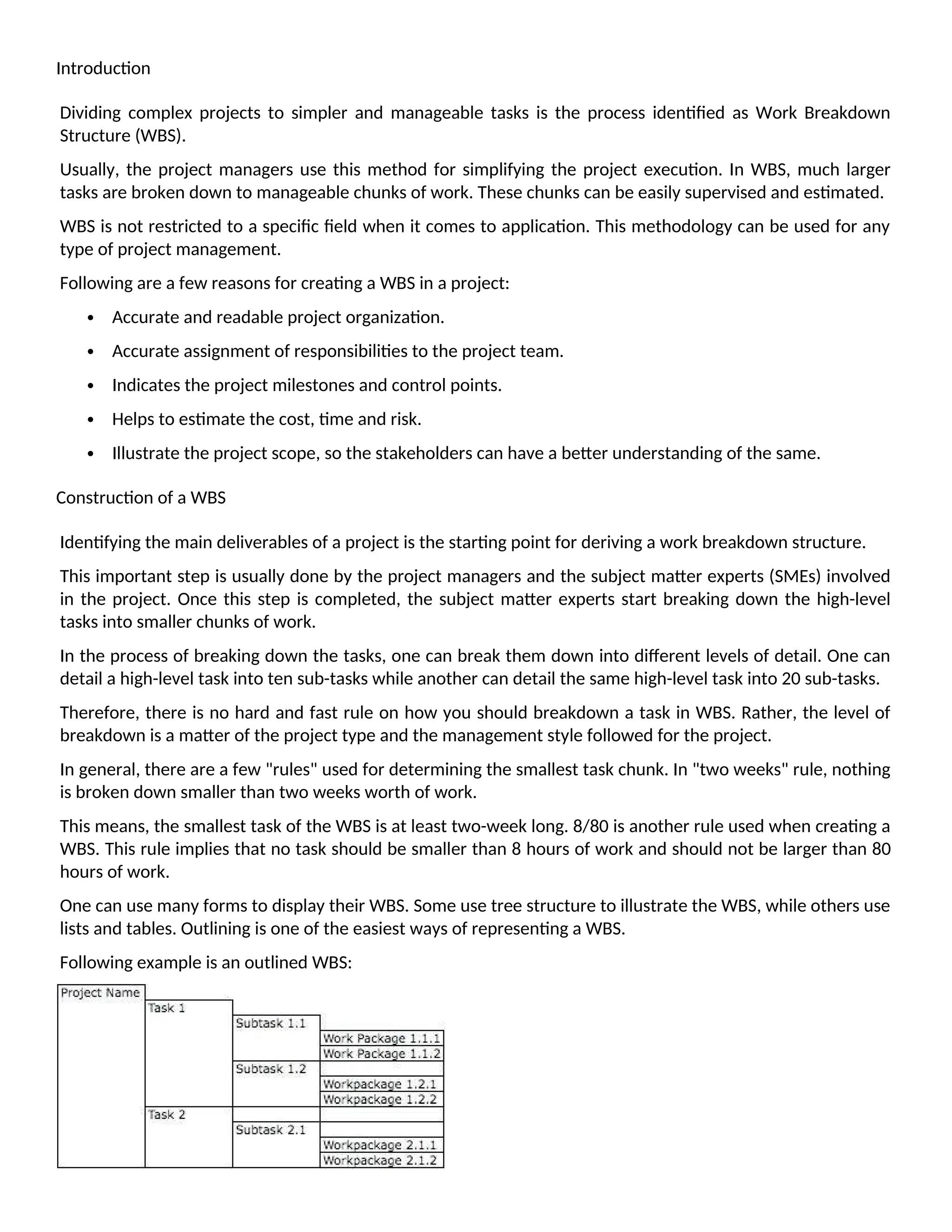
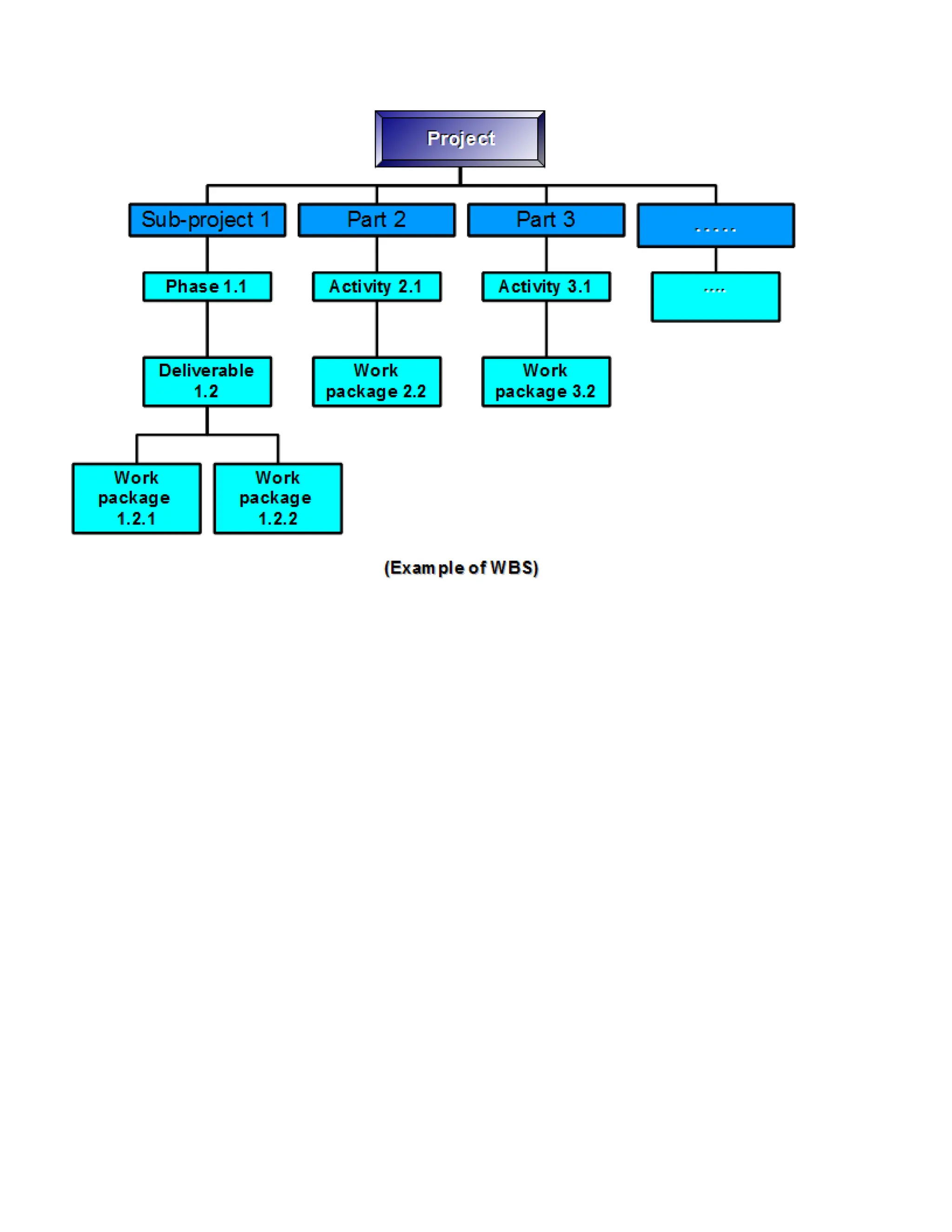
One can use many forms to display their WBS. Some use tree structure to illustrate the WBS, while others use
lists and tables. Outlining is one of the easiest ways of representing a WBS.
Following example is an outlined WBS:
There are many design goals for WBS. Some important goals are as follows:
 Giving visibility to important work efforts.
 Giving visibility to risky work efforts.
 Illustrate the correlation between the activities and deliverables.
 Show clear ownership by task leaders.
WBS Diagram
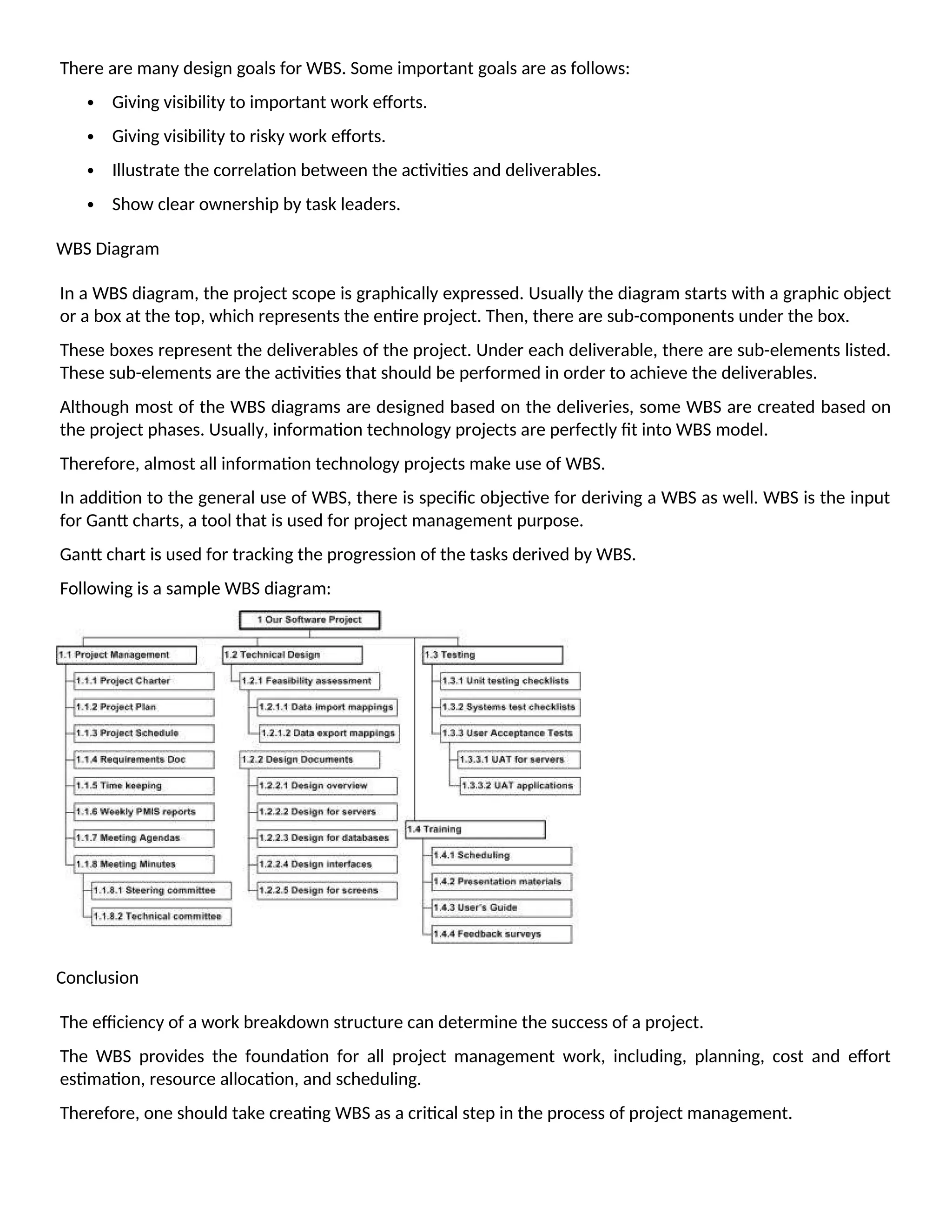
In a WBS diagram, the project scope is graphically expressed. Usually the diagram starts with a graphic object
or a box at the top, which represents the entire project. Then, there are sub-components under the box.
These boxes represent the deliverables of the project. Under each deliverable, there are sub-elements listed.
These sub-elements are the activities that should be performed in order to achieve the deliverables.
Although most of the WBS diagrams are designed based on the deliveries, some WBS are created based on
the project phases. Usually, information technology projects are perfectly fit into WBS model.
Therefore, almost all information technology projects make use of WBS.
In addition to the general use of WBS, there is specific objective for deriving a WBS as well. WBS is the input
for Gantt charts, a tool that is used for project management purpose.
Gantt chart is used for tracking the progression of the tasks derived by WBS.
Following is a sample WBS diagram:
Conclusion
The efficiency of a work breakdown structure can determine the success of a project.
The WBS provides the foundation for all project management work, including, planning, cost and effort
estimation, resource allocation, and scheduling.
Therefore, one should take creating WBS as a critical step in the process of project management.
The organizational chart above shows that an OBS is based on functions that then splits down into the units
and the individuals responsible for conducting the project work packages. This framework clearly shows the
accountability within the project and who signs off each final work package and is designed for efficiency.
The OBS deals with the organizational side of the project by identifying who has the technical abilities, as well
as being available at the time required in the project schedule for key deliverables. This may be an individual, a
business unit or a contractor that is required to meet project deadlines.
A project with use the OBS document in conjunction with the work breakdown structure (WBS) document and
the responsibility assignment matrix to ensure that every work package and project deliverable have a single
business unit assigned to its production.
OBS - ensures a unit and individuals are allocated to perform each project task.
WBS - breaks down the project activities into manageable chunks using a process of decomposition. Each
chunk of work is small enough to accurately cost both in terms of material and time so that it can be
represented on a Gantt chart. The WBS also identifies project cost centers.
RAM - assigns who is responsible and accountable for the production of each work package. This can be a
business unit as well as an individual.
Lower-level areas of the OBS where a manager can be assigned the ownership of this package allow a
management control point to be identified. (Also referred to as a 'control account'.) In the same was as WBS
decomposing deliverables the OBS performs the same exercise until the project team has specific
responsibilities in relation to a single organizational unit.
For example: A variety of resources need to be purchased to conduct the project therefore there must be a
purchasing unit within the project organization. The relationship between OBS and WBS is to establish enough
Control Accounts to ensure good planning and control discipline and visibility, but not so many that the system
becomes overly cumbersome and costly to operate.
It is extremely important not to create a management control process that involves too much administration
and form filling, because this will dramatically reduce the efficiency of the project. As project manager it is
vital that you define the level of integration between the organizational breakdown and levels of work so that
the cost and efficiency of managing the project is optimized.

Work Breakdown Structure & Organisational Breakdown Structure

  • 1.
    Introduction Dividing complex projectsto simpler and manageable tasks is the process identified as Work Breakdown Structure (WBS). Usually, the project managers use this method for simplifying the project execution. In WBS, much larger tasks are broken down to manageable chunks of work. These chunks can be easily supervised and estimated. WBS is not restricted to a specific field when it comes to application. This methodology can be used for any type of project management. Following are a few reasons for creating a WBS in a project:  Accurate and readable project organization.  Accurate assignment of responsibilities to the project team.  Indicates the project milestones and control points.  Helps to estimate the cost, time and risk.  Illustrate the project scope, so the stakeholders can have a better understanding of the same. Construction of a WBS Identifying the main deliverables of a project is the starting point for deriving a work breakdown structure. This important step is usually done by the project managers and the subject matter experts (SMEs) involved in the project. Once this step is completed, the subject matter experts start breaking down the high-level tasks into smaller chunks of work. In the process of breaking down the tasks, one can break them down into different levels of detail. One can detail a high-level task into ten sub-tasks while another can detail the same high-level task into 20 sub-tasks. Therefore, there is no hard and fast rule on how you should breakdown a task in WBS. Rather, the level of breakdown is a matter of the project type and the management style followed for the project. In general, there are a few "rules" used for determining the smallest task chunk. In "two weeks" rule, nothing is broken down smaller than two weeks worth of work. This means, the smallest task of the WBS is at least two-week long. 8/80 is another rule used when creating a WBS. This rule implies that no task should be smaller than 8 hours of work and should not be larger than 80 hours of work. One can use many forms to display their WBS. Some use tree structure to illustrate the WBS, while others use lists and tables. Outlining is one of the easiest ways of representing a WBS. Following example is an outlined WBS:
  • 2.
    There are manydesign goals for WBS. Some important goals are as follows:  Giving visibility to important work efforts.  Giving visibility to risky work efforts.  Illustrate the correlation between the activities and deliverables.  Show clear ownership by task leaders. WBS Diagram In a WBS diagram, the project scope is graphically expressed. Usually the diagram starts with a graphic object or a box at the top, which represents the entire project. Then, there are sub-components under the box. These boxes represent the deliverables of the project. Under each deliverable, there are sub-elements listed. These sub-elements are the activities that should be performed in order to achieve the deliverables. Although most of the WBS diagrams are designed based on the deliveries, some WBS are created based on the project phases. Usually, information technology projects are perfectly fit into WBS model. Therefore, almost all information technology projects make use of WBS. In addition to the general use of WBS, there is specific objective for deriving a WBS as well. WBS is the input for Gantt charts, a tool that is used for project management purpose. Gantt chart is used for tracking the progression of the tasks derived by WBS. Following is a sample WBS diagram: Conclusion The efficiency of a work breakdown structure can determine the success of a project. The WBS provides the foundation for all project management work, including, planning, cost and effort estimation, resource allocation, and scheduling. Therefore, one should take creating WBS as a critical step in the process of project management.
  • 4.
    The organizational chartabove shows that an OBS is based on functions that then splits down into the units and the individuals responsible for conducting the project work packages. This framework clearly shows the accountability within the project and who signs off each final work package and is designed for efficiency. The OBS deals with the organizational side of the project by identifying who has the technical abilities, as well as being available at the time required in the project schedule for key deliverables. This may be an individual, a business unit or a contractor that is required to meet project deadlines. A project with use the OBS document in conjunction with the work breakdown structure (WBS) document and the responsibility assignment matrix to ensure that every work package and project deliverable have a single business unit assigned to its production. OBS - ensures a unit and individuals are allocated to perform each project task. WBS - breaks down the project activities into manageable chunks using a process of decomposition. Each chunk of work is small enough to accurately cost both in terms of material and time so that it can be represented on a Gantt chart. The WBS also identifies project cost centers. RAM - assigns who is responsible and accountable for the production of each work package. This can be a business unit as well as an individual. Lower-level areas of the OBS where a manager can be assigned the ownership of this package allow a management control point to be identified. (Also referred to as a 'control account'.) In the same was as WBS
  • 5.
    decomposing deliverables theOBS performs the same exercise until the project team has specific responsibilities in relation to a single organizational unit. For example: A variety of resources need to be purchased to conduct the project therefore there must be a purchasing unit within the project organization. The relationship between OBS and WBS is to establish enough Control Accounts to ensure good planning and control discipline and visibility, but not so many that the system becomes overly cumbersome and costly to operate. It is extremely important not to create a management control process that involves too much administration and form filling, because this will dramatically reduce the efficiency of the project. As project manager it is vital that you define the level of integration between the organizational breakdown and levels of work so that the cost and efficiency of managing the project is optimized.