An Introduction to Benefits
Realization Management
Craig Letavec, PMP, PgMP, MSP, IPMA-B
Beginning at the
Beginning – A Few Basics
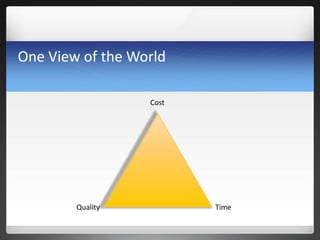
One View of the World
Cost
TimeQuality
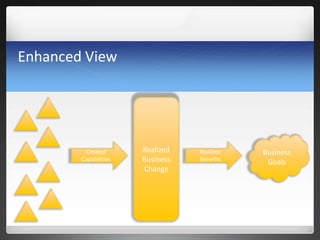
Enhanced View
Business
Goals
Realized
Business
Change
Created
Capabilities
Realized
Benefits
What is a Benefit?
 Definitions vary but in general we can think of a benefit as a positive outcome of a change
 PMI, via the Standard for Program Management, defines a benefit as “an outcome of
actions, behaviors, products, or services that provide utility to the sponsoring organization
as well as to the program’s beneficiaries.”
 A benefit is generally defined as a measurable improvement resulting from an outcome
perceived as an advantage by one or more stakeholders (OGC MSP Standard—www.msp-
officialsite.com)
 Of course, there may be negative outcomes as well. We refer to these as disbenefits.
 An outcome perceived as negative by one or more stakeholders.
 Dis-benefits are actual consequences of an activity, whereas a risk has some
uncertainty about whether it will materialize
Dissecting the Definition
 Positive
 Positive according to stakeholders
 Outcome
 A result
 Change
 Something that we do that consumes something we care about (time, money,
etc.)
 Benefits are a result that cannot be made to happen directly and which have
no direct cost
Example
 Can we think of some benefits?
 Improved customer service
 Reduced cost
 Increased productivity
 Benefits may support other benefits or they may be end results themselves
 Intermediate benefits enable other benefits
 End benefits are beneficial end states that the organization desires
 For example, I reduce errors in order to reduce customer frustration which
improves customer service which, in turn, improves the company’s image
Further Definitions
 We often think of benefits in terms of types and time horizons
 Type
 Tangible benefits—A “hard” benefit that you can measure (e.g. cost savings)
 Intangible benefits—A “soft” benefit that is often more difficult to concretely
measure (e.g. employee morale increases)
 Time Horizon
 Near-term vs. mid-term vs. long-term
 Definitions may vary but the general idea is that some benefits are realized sooner
than others
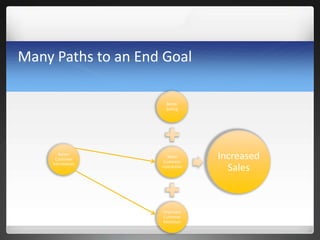
Many Paths to an End Goal
Better
Selling
More
Customer
Interaction
Improved
Customer
Retention
Increased
Sales
Better
Customer
Information
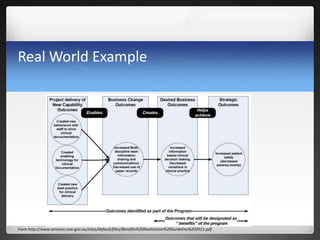
Real World Example
From http://www.services.nsw.gov.au/sites/default/files/Benefits%20Realisation%20Guideline%202011.pdf
Benefits Notes
 Benefits are realized over time (with some realization perhaps not beginning
until after the efforts to create the capabilities are over)
 Benefits require embedding change in an organization; we often rely on a
business change manager and organizational change management
principles to support the capability creation/delivery function in ensuring
success
 Benefits may be tangible or intangible and, in most cases, businesses will
rely on a mix of these when defining and managing benefits
Where Do Benefits Come From?
 Benefits result from change; change often manifests itself in creation or
enhancement of capabilities
 Capabilities may be the result of projects, programs, BAU changes, or other efforts
 The capabilities themselves are embedded in the organization through
organizational change management in order to realize benefits
 Good benefits come from a process that proactively identifies benefits, plans
for their realization, and tracks achievement versus the plan
 This is the essence of benefits management
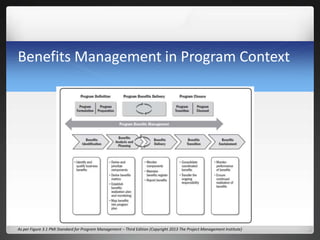
Benefits Management in Program Context
As per Figure 3.1 PMI Standard for Program Management – Third Edition (Copyright 2013 The Project Management Institute)
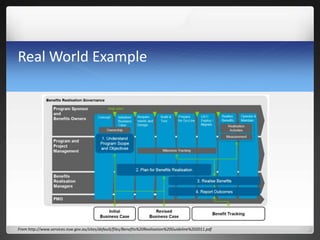
Real World Example
From http://www.services.nsw.gov.au/sites/default/files/Benefits%20Realisation%20Guideline%202011.pdf
Context Notes
 Benefits management is often referred to in the program management
literature (PMI, MSP, etc.) most directly though not exclusively
 Benefits management is a business discipline that, while often applied in the
program context, can exist independent of program management
 In portfolio management
 As a standalone business function
 As part of organizational change management
 As part of project management (though not often)
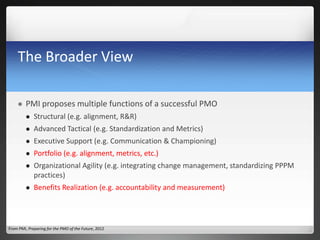
The Broader View
 PMI proposes multiple functions of a successful PMO
 Structural (e.g. alignment, R&R)
 Advanced Tactical (e.g. Standardization and Metrics)
 Executive Support (e.g. Communication & Championing)
 Portfolio (e.g. alignment, metrics, etc.)
 Organizational Agility (e.g. integrating change management, standardizing PPPM
practices)
 Benefits Realization (e.g. accountability and measurement)
From PMI, Preparing for the PMO of the Future, 2012
Challenges in Benefits Management
 Challenges to successfully implementing benefits management often
include
 Inability to effectively describe and document desired benefits
 Unrealistic benefits attainment targets
 Poorly defined data collection and management techniques
 Inadequate organizational change management capability
 Lack of clear ownership for attainment of the benefits
 Poor linkages to related processes (especially portfolio and program management)
 And many more that could be listed here….
Roles and Responsibilities
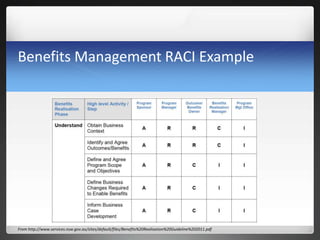
Key Benefits Management Roles
 Senior Responsible Owner (a.k.a. Sponsor)—Ultimately accountable for overall benefits
realization. The SRO is usually a key member of the group sponsoring the initiative that is
tasked with capability creation and benefits realization.
 Benefit Owners—Responsible for change management activities and ensuring the realization of
a specific benefit
 Business Change Manager—Responsible for overall management of business change and
ensuring change is embedded in the organization. This role is absolutely critical for success.
 These roles are supported by
 Program Managers—overall responsibility for capabilities, outcomes, and benefits
 Project Managers—responsible for discrete capability creation to support change
 PMO—providing operational support
Benefits Management RACI Example
From http://www.services.nsw.gov.au/sites/default/files/Benefits%20Realisation%20Guideline%202011.pdf
Keys to Success
 Roles and responsibilities are standardized in the organization
 Roles and responsibilities are clearly documented via role descriptions,
RACI, or other tools
 Roles and responsibilities are agreed (via charter, program management
agreement, etc.)
 Roles and responsibilities are embedded in the benefits realization plan
Fundamentals of the
Benefits Lifecycle
Benefits Identification
 First order of business: Identify benefits
 There is actually a lot of work here, including
 Determining appropriate benefits (qualification)
 Defining the measurement and management processes (including metrics)
 Ensuring appropriate processes for tracking and communication
 Benefits may come from many places, but a primary source of potential benefits
is a business case or similar document that provides justification for investment
 Business cases are often built on tangible and intangible benefits; ensuring that the
benefits in the business case approximate the current reality is key!
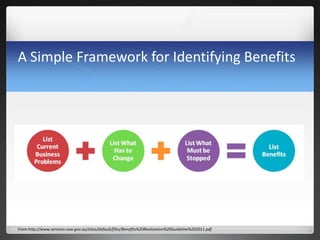
A Simple Framework for Identifying Benefits
From http://www.services.nsw.gov.au/sites/default/files/Benefits%20Realisation%20Guideline%202011.pdf
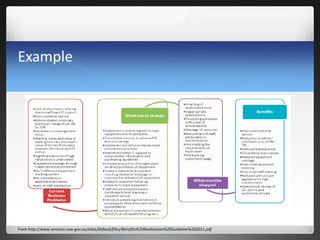
Example
From http://www.services.nsw.gov.au/sites/default/files/Benefits%20Realisation%20Guideline%202011.pdf
Things to Keep in Mind
 When identifying benefits, you need to think about:
 Can I link this benefit to some capability that will be created?
 Can I define work to achieve this benefit and integrate that work into my plans?
 Is the benefit measurable?
 Can a target for benefit attainment be set?
 Can I monitor to determine if the benefit will be obtained?
 Can this benefit be assigned to a clear owner?
 Is the benefit realistically attainable?
Benefits Identification (cont.)
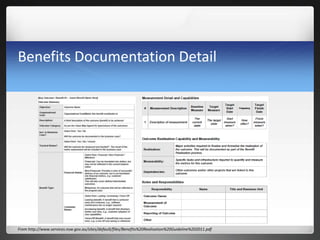
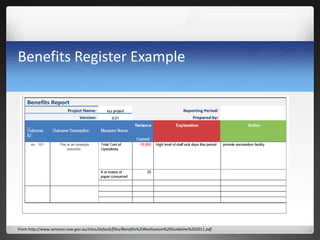
 Identified benefits may be tracked in a benefits register, which often includes
information such as
 Identified benefits
 Relation of benefits to project, program, and operational work
 Benefits targets
 KPIs and measurement criteria
 Status and schedule information
 Roles and Responsibilities for benefits delivery
 Your benefits register does not need to be complex but it does need to be
complete. More importantly, regardless of what you call it, it needs to exist and
be used consistently as the key source of information for agreed benefits,
targets, attainment data, etc.
Benefits Documentation Detail
From http://www.services.nsw.gov.au/sites/default/files/Benefits%20Realisation%20Guideline%202011.pdf
Benefits Register Example
From http://www.services.nsw.gov.au/sites/default/files/Benefits%20Realisation%20Guideline%202011.pdf
Benefits Planning
 Much like the many plans of project and program management in the PMI
standards, benefits management has an associated concept of a benefits
realization plan. In theory, this seems simple enough. Document:
 The benefits
 How you’re going to obtain them (link to project and program work)
 How you’re going to manage attainment, including how to embed the benefits in
the organization
 The process to monitor benefits realization
 The communication and risk management vehicles
Benefits Planning (cont.)
 In reality, this is quite a lot of work but ideally you have an organizational
template that standardizes processes such as monitoring, reporting, risk
management, etc.
 If so, the work to be done on an individual effort basis is focused primarily
on
 The work required to manage benefits attainment
 The integration of this work into relevant plans
 Operationalizing the benefits
 Planning for benefits sustainment
Benefits Delivery
 Benefits delivery means
 Monitoring to ensure continued alignment of the efforts and the benefits to the
organization’s goals and strategies
 Executing project, program, and other work and monitoring to ensure this work
delivers expected benefits
 Risk management
 Communication management including reporting progress
 Benefits delivery seeks to ensure that what we create is well aligned to what
we need
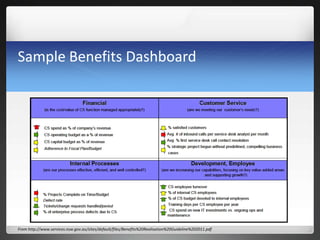
Sample Benefits Dashboard
From http://www.services.nsw.gov.au/sites/default/files/Benefits%20Realisation%20Guideline%202011.pdf
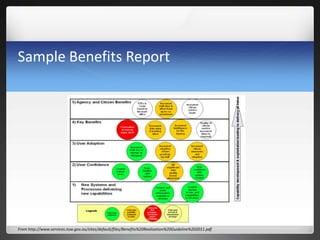
Sample Benefits Report
From http://www.services.nsw.gov.au/sites/default/files/Benefits%20Realisation%20Guideline%202011.pdf
Benefits Transition
 Responsibility for benefits will not stay with the project/program teams
forever; benefits must be embedded in the business environment and
transitioned to the operational organization
 Benefits transition seeks to
 Ensure that delivered benefits are ready for transition to the operational
organization
 Transition delivered benefits to those who will be responsible for ensuring
sustainment ongoing
 Including training, readiness assessment, and associated practices
 Validation that transition was successful
Benefits Sustainment
 Benefits sustainment ensures that transitioned benefits are positioned for
long-term sustainment
 This is often an operational responsibility but in some large programs a
significant amount of sustainment activity may remain with the program for
a period of time
 Regardless of where it resides, the function of benefits sustainment ensures
that we don’t backtrack
Beginning the Benefits
Journey
This is All Very Interesting but Where Do I Begin?
 Organizations seeking to begin proactive benefits realization management
may benefit from a simple, five step process
1. Gain Knowledge
2. Lay the Foundation
3. Build the Process
4. Create a Pilot
5. Plan for the Future
#1: Gain Knowledge
 Clearly, this presentation is not going to be enough
 Much of the available literature in benefits management is closely tied to
program management. Resources you might consider include:
 OGC Managing Successful Programmes
 Benefits Realisation Management by Gerald Bradley
 Internet Resources (most good examples are out of Europe; government examples are
well documented and can be reapplied to many industries)
 Other training you may be able to find
 Benefits management is not necessarily hard to understand but resources such
of those above will help with practical examples, templates, etc.
#1: Gain Knowledge (cont)
 One area of specific note where many organizations can benefits is in the
area of business change management (a.k.a. organizational change
management)
 People responsible for business change can benefit from understanding
standard models, tools, and practices for successful business change. Since
benefits realization requires embedding change in the organization, this
knowledge is especially helpful.
 Training is appropriate for people who will be benefits owners and business
change managers as well as for key program management and PMO staff
#2: Lay the Foundation
 Before beginning to implement benefits management as a business
function, ensure that you have a firm foundation for success. Things you
should check may include:
 Do we have basic project and program management capabilities in place and
working effectively?
 Do we do a good job of creating business cases?
 Do we do a good job of tracking business cases?
 Do we have key stakeholders and sponsors who are supportive of this effort?
 Are we good at spotting problems early?
 Are we good at communicating success and learning from failure?
#2: Lay the Foundation (cont)
 If you have a reasonably firm foundation, your next step is to charter your
benefits management effort. The charter does no need to be a large
document but it does need to
 Establish organizational commitment
 Define near-term, measurable, achievable, business-aligned objectives
 Paint a “rough” picture for the future
 Not be written such that you are positioned to fail from the start
 Practical suggestion: Charter a small scope in a business area where
projects and programs are generally successful already
#2: Lay the Foundation (cont)
 What are you chartering? The activities required to:
 Engage resources to support the effort
 Establish benefits realization processes, tools, and practices
 Conduct a pilot of the benefits realization process on a reasonable scope
 The work required to plan for the extension of benefits realization into the
organization based on pilot success
#3: Build the Process
 Basic models for benefits realization management exist so there is no need
to recreate the wheel here. However, you should:
 Ensure the appropriate integration of whatever you build into your existing
organizational process assets
 Create a process that is actually useful and practical to implement without
overburdening the people who need to do the work
 Spend a lot of time on clearly articulating and documenting roles and
responsibilities as well as how you will manage accountability
 Spend a lot of time educating and training, especially for roles that may exist
outside of your sphere of influence (Senior Responsible Owners, Business Change
Managers, etc.)
#3: Build the Process (cont)
 You can try to build an entire process from the start, but many organizations
find it easier to focus on benefits identification and the benefits realization
plan first
 This seems sensible since there is a lot of work here and for many
organizations simply being able to articulate the benefits they want in a
traceable and reportable way is a big win
 Then, focus on the business change aspects, building capability in business
change management as associated practices
 Later, you can work on benefits transition and sustainment activities
#4: Create a Pilot
 A good pilot candidate for testing out your approach
 Is not the most important project/program/initiative in the company
 Is not the least important project/program/initiative in the company
 Is not the most risky project/program/initiative in the company
 Is not the least risky project/program/initiative in the company
 Has a reasonable change of success
 Has a sponsor who is committed to the effort as well as to the benefits
management approach
 Is reasonably well understood by everyone who is involved in the process
#4: Create a Pilot (cont)
 The goals of this pilot are to
 Test out your processes and tools (especially as related to identifying benefits,
mapping benefits to actual work, and planning for realization)
 Educate additional stakeholders
 Validate if reporting mechanisms are appropriate
 Learn lessons that will be helpful as you move forward
 The pilot is over when
 You are comfortable that the process works and is not burdensome
 You have addressed all major risks and issues you’ve uncovered
 Stakeholders are not complaining excessively
#5: Plan for the Future
 Assuming a successful pilot, you are ready to:
 Develop a rollout roadmap
 Charter the additional work required to bring the process to a broader
organizational scope
 Publish pilot success story and begin to more broadly communicate about your
efforts
 Expand the process capability building efforts as needed
And How Do I Know I’m Done?
@CraigLetavec
Craig Letavec

An Introduction to Benefits Realization Management

  • 1.
    An Introduction toBenefits Realization Management Craig Letavec, PMP, PgMP, MSP, IPMA-B
  • 2.
  • 3.
    One View ofthe World Cost TimeQuality
  • 4.
  • 5.
    What is aBenefit?  Definitions vary but in general we can think of a benefit as a positive outcome of a change  PMI, via the Standard for Program Management, defines a benefit as “an outcome of actions, behaviors, products, or services that provide utility to the sponsoring organization as well as to the program’s beneficiaries.”  A benefit is generally defined as a measurable improvement resulting from an outcome perceived as an advantage by one or more stakeholders (OGC MSP Standard—www.msp- officialsite.com)  Of course, there may be negative outcomes as well. We refer to these as disbenefits.  An outcome perceived as negative by one or more stakeholders.  Dis-benefits are actual consequences of an activity, whereas a risk has some uncertainty about whether it will materialize
  • 6.
    Dissecting the Definition Positive  Positive according to stakeholders  Outcome  A result  Change  Something that we do that consumes something we care about (time, money, etc.)  Benefits are a result that cannot be made to happen directly and which have no direct cost
  • 7.
    Example  Can wethink of some benefits?  Improved customer service  Reduced cost  Increased productivity  Benefits may support other benefits or they may be end results themselves  Intermediate benefits enable other benefits  End benefits are beneficial end states that the organization desires  For example, I reduce errors in order to reduce customer frustration which improves customer service which, in turn, improves the company’s image
  • 8.
    Further Definitions  Weoften think of benefits in terms of types and time horizons  Type  Tangible benefits—A “hard” benefit that you can measure (e.g. cost savings)  Intangible benefits—A “soft” benefit that is often more difficult to concretely measure (e.g. employee morale increases)  Time Horizon  Near-term vs. mid-term vs. long-term  Definitions may vary but the general idea is that some benefits are realized sooner than others
  • 9.
    Many Paths toan End Goal Better Selling More Customer Interaction Improved Customer Retention Increased Sales Better Customer Information
  • 10.
    Real World Example Fromhttp://www.services.nsw.gov.au/sites/default/files/Benefits%20Realisation%20Guideline%202011.pdf
  • 11.
    Benefits Notes  Benefitsare realized over time (with some realization perhaps not beginning until after the efforts to create the capabilities are over)  Benefits require embedding change in an organization; we often rely on a business change manager and organizational change management principles to support the capability creation/delivery function in ensuring success  Benefits may be tangible or intangible and, in most cases, businesses will rely on a mix of these when defining and managing benefits
  • 12.
    Where Do BenefitsCome From?  Benefits result from change; change often manifests itself in creation or enhancement of capabilities  Capabilities may be the result of projects, programs, BAU changes, or other efforts  The capabilities themselves are embedded in the organization through organizational change management in order to realize benefits  Good benefits come from a process that proactively identifies benefits, plans for their realization, and tracks achievement versus the plan  This is the essence of benefits management
  • 13.
    Benefits Management inProgram Context As per Figure 3.1 PMI Standard for Program Management – Third Edition (Copyright 2013 The Project Management Institute)
  • 14.
    Real World Example Fromhttp://www.services.nsw.gov.au/sites/default/files/Benefits%20Realisation%20Guideline%202011.pdf
  • 15.
    Context Notes  Benefitsmanagement is often referred to in the program management literature (PMI, MSP, etc.) most directly though not exclusively  Benefits management is a business discipline that, while often applied in the program context, can exist independent of program management  In portfolio management  As a standalone business function  As part of organizational change management  As part of project management (though not often)
  • 16.
    The Broader View PMI proposes multiple functions of a successful PMO  Structural (e.g. alignment, R&R)  Advanced Tactical (e.g. Standardization and Metrics)  Executive Support (e.g. Communication & Championing)  Portfolio (e.g. alignment, metrics, etc.)  Organizational Agility (e.g. integrating change management, standardizing PPPM practices)  Benefits Realization (e.g. accountability and measurement) From PMI, Preparing for the PMO of the Future, 2012
  • 17.
    Challenges in BenefitsManagement  Challenges to successfully implementing benefits management often include  Inability to effectively describe and document desired benefits  Unrealistic benefits attainment targets  Poorly defined data collection and management techniques  Inadequate organizational change management capability  Lack of clear ownership for attainment of the benefits  Poor linkages to related processes (especially portfolio and program management)  And many more that could be listed here….
  • 18.
  • 19.
    Key Benefits ManagementRoles  Senior Responsible Owner (a.k.a. Sponsor)—Ultimately accountable for overall benefits realization. The SRO is usually a key member of the group sponsoring the initiative that is tasked with capability creation and benefits realization.  Benefit Owners—Responsible for change management activities and ensuring the realization of a specific benefit  Business Change Manager—Responsible for overall management of business change and ensuring change is embedded in the organization. This role is absolutely critical for success.  These roles are supported by  Program Managers—overall responsibility for capabilities, outcomes, and benefits  Project Managers—responsible for discrete capability creation to support change  PMO—providing operational support
  • 20.
    Benefits Management RACIExample From http://www.services.nsw.gov.au/sites/default/files/Benefits%20Realisation%20Guideline%202011.pdf
  • 21.
    Keys to Success Roles and responsibilities are standardized in the organization  Roles and responsibilities are clearly documented via role descriptions, RACI, or other tools  Roles and responsibilities are agreed (via charter, program management agreement, etc.)  Roles and responsibilities are embedded in the benefits realization plan
  • 22.
  • 23.
    Benefits Identification  Firstorder of business: Identify benefits  There is actually a lot of work here, including  Determining appropriate benefits (qualification)  Defining the measurement and management processes (including metrics)  Ensuring appropriate processes for tracking and communication  Benefits may come from many places, but a primary source of potential benefits is a business case or similar document that provides justification for investment  Business cases are often built on tangible and intangible benefits; ensuring that the benefits in the business case approximate the current reality is key!
  • 24.
    A Simple Frameworkfor Identifying Benefits From http://www.services.nsw.gov.au/sites/default/files/Benefits%20Realisation%20Guideline%202011.pdf
  • 25.
  • 26.
    Things to Keepin Mind  When identifying benefits, you need to think about:  Can I link this benefit to some capability that will be created?  Can I define work to achieve this benefit and integrate that work into my plans?  Is the benefit measurable?  Can a target for benefit attainment be set?  Can I monitor to determine if the benefit will be obtained?  Can this benefit be assigned to a clear owner?  Is the benefit realistically attainable?
  • 27.
    Benefits Identification (cont.) Identified benefits may be tracked in a benefits register, which often includes information such as  Identified benefits  Relation of benefits to project, program, and operational work  Benefits targets  KPIs and measurement criteria  Status and schedule information  Roles and Responsibilities for benefits delivery  Your benefits register does not need to be complex but it does need to be complete. More importantly, regardless of what you call it, it needs to exist and be used consistently as the key source of information for agreed benefits, targets, attainment data, etc.
  • 28.
    Benefits Documentation Detail Fromhttp://www.services.nsw.gov.au/sites/default/files/Benefits%20Realisation%20Guideline%202011.pdf
  • 29.
    Benefits Register Example Fromhttp://www.services.nsw.gov.au/sites/default/files/Benefits%20Realisation%20Guideline%202011.pdf
  • 30.
    Benefits Planning  Muchlike the many plans of project and program management in the PMI standards, benefits management has an associated concept of a benefits realization plan. In theory, this seems simple enough. Document:  The benefits  How you’re going to obtain them (link to project and program work)  How you’re going to manage attainment, including how to embed the benefits in the organization  The process to monitor benefits realization  The communication and risk management vehicles
  • 31.
    Benefits Planning (cont.) In reality, this is quite a lot of work but ideally you have an organizational template that standardizes processes such as monitoring, reporting, risk management, etc.  If so, the work to be done on an individual effort basis is focused primarily on  The work required to manage benefits attainment  The integration of this work into relevant plans  Operationalizing the benefits  Planning for benefits sustainment
  • 32.
    Benefits Delivery  Benefitsdelivery means  Monitoring to ensure continued alignment of the efforts and the benefits to the organization’s goals and strategies  Executing project, program, and other work and monitoring to ensure this work delivers expected benefits  Risk management  Communication management including reporting progress  Benefits delivery seeks to ensure that what we create is well aligned to what we need
  • 33.
    Sample Benefits Dashboard Fromhttp://www.services.nsw.gov.au/sites/default/files/Benefits%20Realisation%20Guideline%202011.pdf
  • 34.
    Sample Benefits Report Fromhttp://www.services.nsw.gov.au/sites/default/files/Benefits%20Realisation%20Guideline%202011.pdf
  • 35.
    Benefits Transition  Responsibilityfor benefits will not stay with the project/program teams forever; benefits must be embedded in the business environment and transitioned to the operational organization  Benefits transition seeks to  Ensure that delivered benefits are ready for transition to the operational organization  Transition delivered benefits to those who will be responsible for ensuring sustainment ongoing  Including training, readiness assessment, and associated practices  Validation that transition was successful
  • 36.
    Benefits Sustainment  Benefitssustainment ensures that transitioned benefits are positioned for long-term sustainment  This is often an operational responsibility but in some large programs a significant amount of sustainment activity may remain with the program for a period of time  Regardless of where it resides, the function of benefits sustainment ensures that we don’t backtrack
  • 37.
  • 38.
    This is AllVery Interesting but Where Do I Begin?  Organizations seeking to begin proactive benefits realization management may benefit from a simple, five step process 1. Gain Knowledge 2. Lay the Foundation 3. Build the Process 4. Create a Pilot 5. Plan for the Future
  • 39.
    #1: Gain Knowledge Clearly, this presentation is not going to be enough  Much of the available literature in benefits management is closely tied to program management. Resources you might consider include:  OGC Managing Successful Programmes  Benefits Realisation Management by Gerald Bradley  Internet Resources (most good examples are out of Europe; government examples are well documented and can be reapplied to many industries)  Other training you may be able to find  Benefits management is not necessarily hard to understand but resources such of those above will help with practical examples, templates, etc.
  • 40.
    #1: Gain Knowledge(cont)  One area of specific note where many organizations can benefits is in the area of business change management (a.k.a. organizational change management)  People responsible for business change can benefit from understanding standard models, tools, and practices for successful business change. Since benefits realization requires embedding change in the organization, this knowledge is especially helpful.  Training is appropriate for people who will be benefits owners and business change managers as well as for key program management and PMO staff
  • 41.
    #2: Lay theFoundation  Before beginning to implement benefits management as a business function, ensure that you have a firm foundation for success. Things you should check may include:  Do we have basic project and program management capabilities in place and working effectively?  Do we do a good job of creating business cases?  Do we do a good job of tracking business cases?  Do we have key stakeholders and sponsors who are supportive of this effort?  Are we good at spotting problems early?  Are we good at communicating success and learning from failure?
  • 42.
    #2: Lay theFoundation (cont)  If you have a reasonably firm foundation, your next step is to charter your benefits management effort. The charter does no need to be a large document but it does need to  Establish organizational commitment  Define near-term, measurable, achievable, business-aligned objectives  Paint a “rough” picture for the future  Not be written such that you are positioned to fail from the start  Practical suggestion: Charter a small scope in a business area where projects and programs are generally successful already
  • 43.
    #2: Lay theFoundation (cont)  What are you chartering? The activities required to:  Engage resources to support the effort  Establish benefits realization processes, tools, and practices  Conduct a pilot of the benefits realization process on a reasonable scope  The work required to plan for the extension of benefits realization into the organization based on pilot success
  • 44.
    #3: Build theProcess  Basic models for benefits realization management exist so there is no need to recreate the wheel here. However, you should:  Ensure the appropriate integration of whatever you build into your existing organizational process assets  Create a process that is actually useful and practical to implement without overburdening the people who need to do the work  Spend a lot of time on clearly articulating and documenting roles and responsibilities as well as how you will manage accountability  Spend a lot of time educating and training, especially for roles that may exist outside of your sphere of influence (Senior Responsible Owners, Business Change Managers, etc.)
  • 45.
    #3: Build theProcess (cont)  You can try to build an entire process from the start, but many organizations find it easier to focus on benefits identification and the benefits realization plan first  This seems sensible since there is a lot of work here and for many organizations simply being able to articulate the benefits they want in a traceable and reportable way is a big win  Then, focus on the business change aspects, building capability in business change management as associated practices  Later, you can work on benefits transition and sustainment activities
  • 46.
    #4: Create aPilot  A good pilot candidate for testing out your approach  Is not the most important project/program/initiative in the company  Is not the least important project/program/initiative in the company  Is not the most risky project/program/initiative in the company  Is not the least risky project/program/initiative in the company  Has a reasonable change of success  Has a sponsor who is committed to the effort as well as to the benefits management approach  Is reasonably well understood by everyone who is involved in the process
  • 47.
    #4: Create aPilot (cont)  The goals of this pilot are to  Test out your processes and tools (especially as related to identifying benefits, mapping benefits to actual work, and planning for realization)  Educate additional stakeholders  Validate if reporting mechanisms are appropriate  Learn lessons that will be helpful as you move forward  The pilot is over when  You are comfortable that the process works and is not burdensome  You have addressed all major risks and issues you’ve uncovered  Stakeholders are not complaining excessively
  • 48.
    #5: Plan forthe Future  Assuming a successful pilot, you are ready to:  Develop a rollout roadmap  Charter the additional work required to bring the process to a broader organizational scope  Publish pilot success story and begin to more broadly communicate about your efforts  Expand the process capability building efforts as needed
  • 49.
    And How DoI Know I’m Done?
  • 50.