BY
MS.UMADEVI
ASSISTANT PROFESSOR
HICON,COIMBATORE
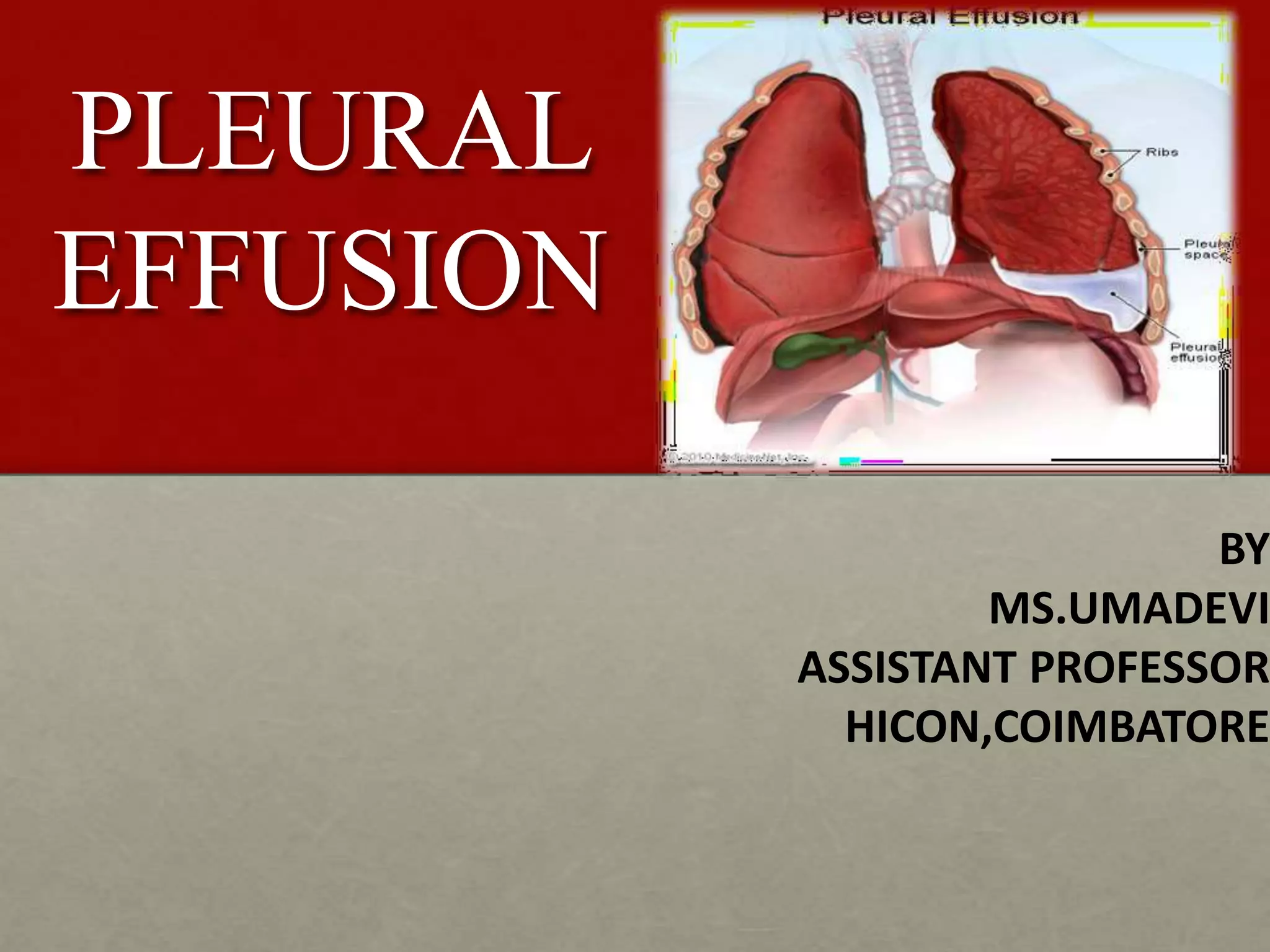
PLEURAL
EFFUSION
INTRODUCTION
Pleural effusion, a collection of fluid in the pleural space, is
rarely a primary disease process but is usually secondary to
other diseases
The pleural space normally contains only about 10-20 ml of
serous fluid
Pleural fluid normally seeps continually into the pleural
space from the capillaries lining the parietal pleura and is
reabsorbed by the visceral pleural capillaries and lymphatic
system
Any condition that interferes with either secretion or
drainage of this fluid leads to pleural effusion
What Is Pleural Effusion?
Pleural effusion, sometimes referred to as
“water on the lungs,” is the build-up of
excess fluid between the layers of
the pleura outside the lungs. The pleura are thin
membranes that line the lungs and the inside of
the chest cavity and act to lubricate and
facilitate breathing
DEFINITION
Pleural effusion is excess fluid that
accumulates between the two pleural layers,
the fluid-filled space that surrounds the
lungs. Excessive amounts of such fluid can
impair breathing by limiting the expansion of
the lungs during ventilation.
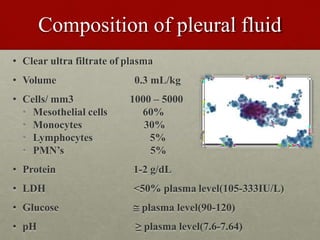
Composition of pleural fluid
• Clear ultra filtrate of plasma
• Volume
• Cells/ mm3
• Mesothelial cells
• Monocytes
• Lymphocytes
• PMN’s
• Protein
• LDH
• Glucose
• pH
0.3 mL/kg
1000 – 5000
60%
30%
5%
5%
1-2 g/dL
<50% plasma level(105-333IU/L)
 plasma level(90-120)
≥ plasma level(7.6-7.64)
Classification
•Can be unilateral or bilateral and classified
A)Based on site
Apical
Interlobar
Sub-pulmonic
Mediastinal
B)Based on mechanism and type of pleural fluid
Transudative (alteration in hydrostatic and oncotic pressure)
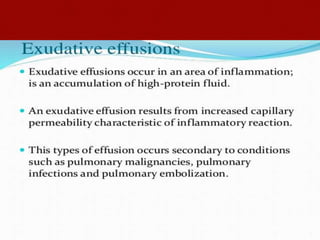
Exudative (alteration in pleural permeability)
c) Based on mechanism and type of pleural fluid
formed
Pyogenic
Chylous
Haemothorax
Pseudochylous
Hydrothorax
Pathogenesis
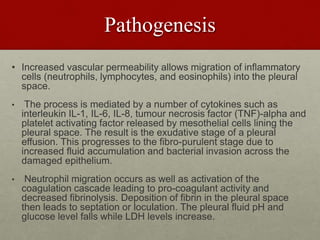
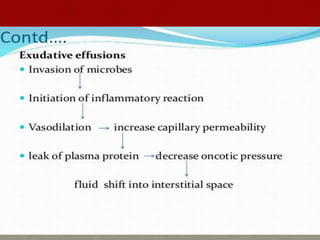
• Increased vascular permeability allows migration of inflammatory
cells (neutrophils, lymphocytes, and eosinophils) into the pleural
space.
• The process is mediated by a number of cytokines such as
interleukin IL-1, IL-6, IL-8, tumour necrosis factor (TNF)-alpha and
platelet activating factor released by mesothelial cells lining the
pleural space. The result is the exudative stage of a pleural
effusion. This progresses to the fibro-purulent stage due to
increased fluid accumulation and bacterial invasion across the
damaged epithelium.
• Neutrophil migration occurs as well as activation of the
coagulation cascade leading to pro-coagulant activity and
decreased fibrinolysis. Deposition of fibrin in the pleural space
then leads to septation or loculation. The pleural fluid pH and
glucose level falls while LDH levels increase.
Etiology
• EXUDATIVE
 Infective: Pneumonia, Bronchiectasis, Pancreatitis, TB, Lung
abscess
 Collagen vascular disease: SLE, Rheumatoid arthritis, Polyarteritis
 Neoplastic: leukemias and lymphomas
 Uremia
 Drugs: Bromocriptine, amiodarone, nitofurantoin, dantrolene, INH,
PAS
 Postradiation
 Traumatic
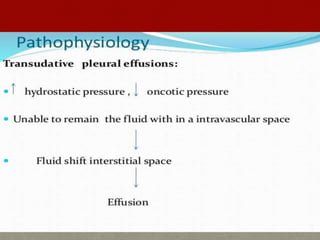
• TRANSUDATIVE:
Renal cause: Nephrotic syndrome
Cardiac cause: Congestive cardiac failure
Hepatic cause: Hepatic failure
Nutritional: Protein energy malnutrition
Hypothyroidism
• PYOGENIC:
Lung abscess
Septicemia
Chest wall injuries
Rupture of oesophagus
Rupture of subphrenic abscess
Rupture of liver abscess
• CHYLOUS:
Trauma to thoracic duct
Tumour (mediastinal lymphoma)
Tuberculosis
Lymphatic obstruction
• HEMOTHORAX:
Chest wall injuries
Bleeding disorders
Neoplasms-leukemias, lymphoma, mesothelioma
Drugs-anticoagulants
Pulmonary infarction
• PSEUDOCHYLOUS:
Rheumatoid pleuritis
Tuberculosis or paragonimiasis(lung fluke infection)
• HYDROTHORAX:
Congestive heart failure
Hepatic & Renal failure
Clinical features
 Many patients have no symptoms due to the effusion when
effusion is small.
 Pleuritic chest pain is the usual symptom of pleural
inflammation.
 Irritation of the pleural surfaces may also result in a dry,
nonproductive cough.
With larger effusions, dyspnea results from lung
compression.
Common symptoms
•chest pain
•dry cough
•fever
•difficulty breathing when lying down
•shortness of breath
•difficulty taking deep breaths
•persistent hiccups
•difficulty with physical activity
Physical examination
Inspection:
 Absent or diminished movements of affected side
Fullness of chest with bulging intercostal spaces
Palpation:
 Diminished breath sounds over the site of the effusion
Decreased or absent tactile fremitus
Percussion:
 Stony dullness to percussion
Auscultation:
 Absence of breath sounds over the effusion
 Vocal resonance absent
 Signs of pneumonia like bronchial breathing, crackles etc.
Investigations
 Total and differential leucocyte counts
• Acute phase reactants-white cell count, total neutrophil
count, CRP, ESR, pro-calcitonin distinguish bacterial from
viral causes
 Radiological examination
• X-ray chest PAview done in erect position-a total of
300mL of fluid is needed to diagnose pleural effusion
clinically and radiologically
• Even 50mL of fluid can be demonstrated radiologically in
lateral decubitus
Findings
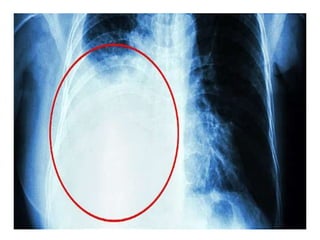
• Obliteration of cardiophrenic and costophrenic angles
• Loculated effusions
• Subpulmonic effusion-collection of fluid below the
diaphragm will lead to elevation of diaphragm, confirmed
by X-ray in lateral decubitus
• Lateral decubitus on side of effusion will show a shift in
the fluid level
• Tracheal and mediastinal shifts are seen in massive
effusion
 Ultrasonogram
Useful in differentiating between loculated pleural effusion and tumour
 CT Scan
Helpful if the effusion is minimal or loculated
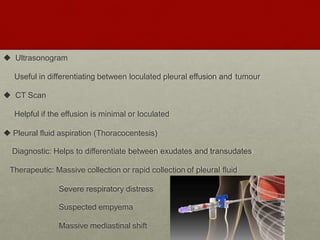
 Pleural fluid aspiration (Thoracocentesis)
Diagnostic: Helps to differentiate between exudates and transudates
Therapeutic: Massive collection or rapid collection of pleural fluid
Severe respiratory distress
Suspected empyema
Massive mediastinal shift
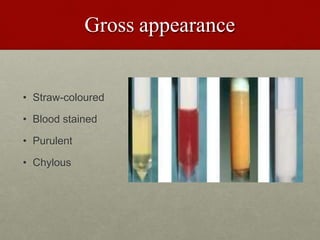
Gross appearance
• Straw-coloured
• Blood stained
• Purulent
• Chylous
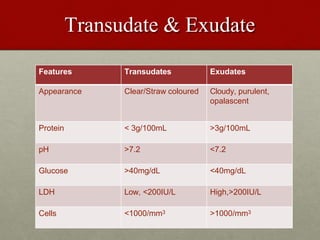
Transudate & Exudate
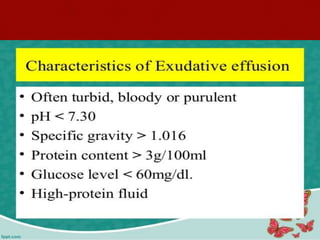
Features Transudates Exudates
Appearance Clear/Straw coloured Cloudy, purulent,
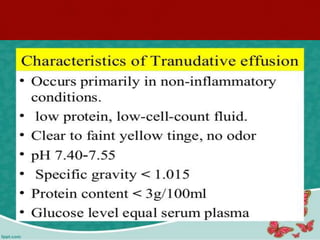
opalascent
Protein < 3g/100mL >3g/100mL
pH >7.2 <7.2
Glucose >40mg/dL <40mg/dL
LDH Low, <200IU/L High,>200IU/L
Cells <1000/mm3 >1000/mm3
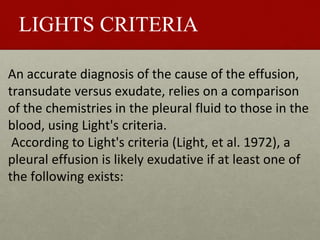
LIGHTS CRITERIA
An accurate diagnosis of the cause of the effusion,
transudate versus exudate, relies on a comparison
of the chemistries in the pleural fluid to those in the
blood, using Light's criteria.
According to Light's criteria (Light, et al. 1972), a
pleural effusion is likely exudative if at least one of
the following exists:
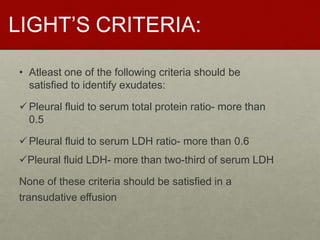
LIGHT’S CRITERIA:
• Atleast one of the following criteria should be
satisfied to identify exudates:
Pleural fluid to serum total protein ratio- more than
0.5
Pleural fluid to serum LDH ratio- more than 0.6
Pleural fluid LDH- more than two-third of serum LDH
None of these criteria should be satisfied in a
transudative effusion
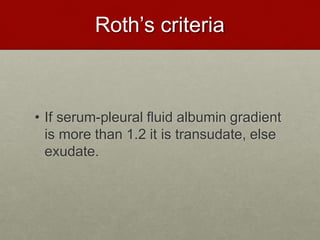
Roth’s criteria
• If serum-pleural fluid albumin gradient
is more than 1.2 it is transudate, else
exudate.
Pleural Fluid Biochemistry
• pH
• Glucose
• Lactate dehydrogenase(LDH)
• Sodium, potassium and calcium conc
• Amylase
• Adenosine deaminase
• Ratio of protein in pleural fluid to serum
• Ratio of LDH values in pleural fluid to serum
PLEURAL FLUID CYTOLOGY
WBC Count
Predominant cell type(neutrophil, lymphocytes, eosinophils, red
blood cells)
Lymphocytosis- if >50% leucocytosis then suspect TB
Malignant cells
PLEURAL FLUID MICROBIOLOGY
Gram stain
Acid fast for AFB
Pleural fluid Culture
AFB Culture
PCR for TB
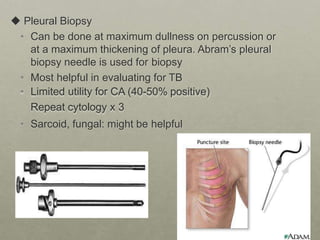
 Pleural Biopsy
• Can be done at maximum dullness on percussion or
at a maximum thickening of pleura. Abram’s pleural
biopsy needle is used for biopsy
• Most helpful in evaluating for TB
• Limited utility for CA (40-50% positive)
Repeat cytology x 3
• Sarcoid, fungal: might be helpful
Other investigations
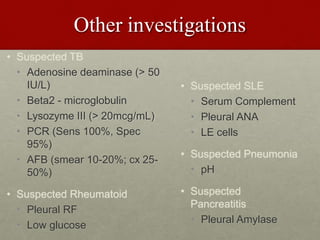
• Suspected TB
• Adenosine deaminase (> 50
IU/L)
• Beta2 - microglobulin
• Lysozyme III (> 20mcg/mL)
• PCR (Sens 100%, Spec
95%)
• AFB (smear 10-20%; cx 25-
50%)
• Suspected Rheumatoid
• Pleural RF
• Low glucose
• Suspected SLE
• Serum Complement
• Pleural ANA
• LE cells
• Suspected Pneumonia
• pH
• Suspected
Pancreatitis
• Pleural Amylase
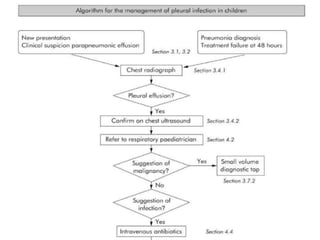
MANAGEMENT
GOAL of treatment is to:
1. Remove the fluid
2. Prevent fluid from building up again
3. Determine and treat the cause of the
fluid buildup
Management
SUPPORTIVE TREATMENT
• Oxygen is necessary if SpO2 <92%
• Fluid therapy if child dehydrated or unable/unwilling
in drinking water
• Initiate IV antibiotics
• Analgesics and antipyretics
• Chest radiography & U/S
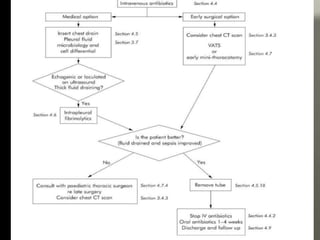
REMOVAL OF FLUID
Removing the fluid (thoracentesis) may
be done if there is a lot of fluid and it is
causing chest pressure, shortness of
breath, or a low oxygen level.
Removing the fluid allows the lung to
expand, making breathing easier.
Medical
• Treat the cause
Pneumonia- initial blind antibiotic treatment
A) Following community acquired pneumonia
• Cefuroxime
• Co-amoxiclav
• Penicillin & flucloxacillin
• Amoxicillin & flucloxaxillin
• Clindamycin
B) Hospital acquired pneumonia
• Broader spectrum antibiotics that cover aerobic gram negative rods
• Tuberculosis- Category I treatment
2HRZE+4HRE
Prednisolone 1-2mg/kg orally 4-6weeks promotes
rapid absorption of the pleural fluid and prevents
fibrosis
• Congestive cardiac failure- treat with diuretics and
other anti-failure medications
Surgical
• Pleural fluid aspiration is done by using a wide bore
needle. If the fluid is thick and cannot be drained by a
needle, an intercostal drainage(under water seal) at the
most dependant part should be done.
• Indications
 Empyema
 Presence of causative organisms in the fluid
 Pleural fluid glucose <50mg/dL
 Pleural fluid pH <7.0
Pleural effusions that cannot be managed through drainage
or pleural sclerosis may require surgical treatment.
The two types of surgery include:
1.Video-assisted thoracoscopic surgery (VATS)
A minimally-invasive approach that is completed through 1
to 3 small (approximately ½ -inch) incisions in the chest.
Also known as thoracoscopic surgery, this procedure is
effective in managing pleural effusions that are difficult to
drain or recur due to malignancy. Sterile talc or an antibiotic
may be inserted at the time of surgery to prevent the
recurrence of fluid build-up.
2.A thoracThoracotomy (Also referred to as traditional,
“open” thoracic surgery)
otomy is performed through a 6- to 8-inch incision in the
chest and is recommended for pleural effusions when
infection is present.
 A thoracotomy is performed to remove all of the fibrous
tissue and aids in evacuating the infection from the pleural
space.
 Patients will require chest tubes for 2 days to 2 weeks
after surgery to continue draining fluid.
• Complications
• Pleural shock
• Introduction of infection
• Pneumothorax
• Pulmonary embolism
• Air embolism
• Acute pulmonary edema
• Injury to neovascular bundles
• Hydropneumothorax

pleuraleffusion.pptx

  • 1.
  • 2.
    INTRODUCTION Pleural effusion, acollection of fluid in the pleural space, is rarely a primary disease process but is usually secondary to other diseases The pleural space normally contains only about 10-20 ml of serous fluid Pleural fluid normally seeps continually into the pleural space from the capillaries lining the parietal pleura and is reabsorbed by the visceral pleural capillaries and lymphatic system Any condition that interferes with either secretion or drainage of this fluid leads to pleural effusion
  • 3.
    What Is PleuralEffusion? Pleural effusion, sometimes referred to as “water on the lungs,” is the build-up of excess fluid between the layers of the pleura outside the lungs. The pleura are thin membranes that line the lungs and the inside of the chest cavity and act to lubricate and facilitate breathing
  • 4.
    DEFINITION Pleural effusion isexcess fluid that accumulates between the two pleural layers, the fluid-filled space that surrounds the lungs. Excessive amounts of such fluid can impair breathing by limiting the expansion of the lungs during ventilation.
  • 5.
    Composition of pleuralfluid • Clear ultra filtrate of plasma • Volume • Cells/ mm3 • Mesothelial cells • Monocytes • Lymphocytes • PMN’s • Protein • LDH • Glucose • pH 0.3 mL/kg 1000 – 5000 60% 30% 5% 5% 1-2 g/dL <50% plasma level(105-333IU/L)  plasma level(90-120) ≥ plasma level(7.6-7.64)
  • 6.
    Classification •Can be unilateralor bilateral and classified A)Based on site Apical Interlobar Sub-pulmonic Mediastinal B)Based on mechanism and type of pleural fluid Transudative (alteration in hydrostatic and oncotic pressure) Exudative (alteration in pleural permeability)
  • 7.
    c) Based onmechanism and type of pleural fluid formed Pyogenic Chylous Haemothorax Pseudochylous Hydrothorax
  • 12.
    Pathogenesis • Increased vascularpermeability allows migration of inflammatory cells (neutrophils, lymphocytes, and eosinophils) into the pleural space. • The process is mediated by a number of cytokines such as interleukin IL-1, IL-6, IL-8, tumour necrosis factor (TNF)-alpha and platelet activating factor released by mesothelial cells lining the pleural space. The result is the exudative stage of a pleural effusion. This progresses to the fibro-purulent stage due to increased fluid accumulation and bacterial invasion across the damaged epithelium. • Neutrophil migration occurs as well as activation of the coagulation cascade leading to pro-coagulant activity and decreased fibrinolysis. Deposition of fibrin in the pleural space then leads to septation or loculation. The pleural fluid pH and glucose level falls while LDH levels increase.
  • 13.
    Etiology • EXUDATIVE  Infective:Pneumonia, Bronchiectasis, Pancreatitis, TB, Lung abscess  Collagen vascular disease: SLE, Rheumatoid arthritis, Polyarteritis  Neoplastic: leukemias and lymphomas  Uremia  Drugs: Bromocriptine, amiodarone, nitofurantoin, dantrolene, INH, PAS  Postradiation  Traumatic
  • 14.
    • TRANSUDATIVE: Renal cause:Nephrotic syndrome Cardiac cause: Congestive cardiac failure Hepatic cause: Hepatic failure Nutritional: Protein energy malnutrition Hypothyroidism
  • 15.
    • PYOGENIC: Lung abscess Septicemia Chestwall injuries Rupture of oesophagus Rupture of subphrenic abscess Rupture of liver abscess
  • 16.
    • CHYLOUS: Trauma tothoracic duct Tumour (mediastinal lymphoma) Tuberculosis Lymphatic obstruction
  • 17.
    • HEMOTHORAX: Chest wallinjuries Bleeding disorders Neoplasms-leukemias, lymphoma, mesothelioma Drugs-anticoagulants Pulmonary infarction
  • 18.
    • PSEUDOCHYLOUS: Rheumatoid pleuritis Tuberculosisor paragonimiasis(lung fluke infection) • HYDROTHORAX: Congestive heart failure Hepatic & Renal failure
  • 21.
    Clinical features  Manypatients have no symptoms due to the effusion when effusion is small.  Pleuritic chest pain is the usual symptom of pleural inflammation.  Irritation of the pleural surfaces may also result in a dry, nonproductive cough. With larger effusions, dyspnea results from lung compression.
  • 22.
    Common symptoms •chest pain •drycough •fever •difficulty breathing when lying down •shortness of breath •difficulty taking deep breaths •persistent hiccups •difficulty with physical activity
  • 23.
    Physical examination Inspection:  Absentor diminished movements of affected side Fullness of chest with bulging intercostal spaces Palpation:  Diminished breath sounds over the site of the effusion Decreased or absent tactile fremitus Percussion:  Stony dullness to percussion Auscultation:  Absence of breath sounds over the effusion  Vocal resonance absent  Signs of pneumonia like bronchial breathing, crackles etc.
  • 24.
    Investigations  Total anddifferential leucocyte counts • Acute phase reactants-white cell count, total neutrophil count, CRP, ESR, pro-calcitonin distinguish bacterial from viral causes  Radiological examination • X-ray chest PAview done in erect position-a total of 300mL of fluid is needed to diagnose pleural effusion clinically and radiologically • Even 50mL of fluid can be demonstrated radiologically in lateral decubitus
  • 25.
    Findings • Obliteration ofcardiophrenic and costophrenic angles • Loculated effusions • Subpulmonic effusion-collection of fluid below the diaphragm will lead to elevation of diaphragm, confirmed by X-ray in lateral decubitus • Lateral decubitus on side of effusion will show a shift in the fluid level • Tracheal and mediastinal shifts are seen in massive effusion
  • 27.
     Ultrasonogram Useful indifferentiating between loculated pleural effusion and tumour  CT Scan Helpful if the effusion is minimal or loculated  Pleural fluid aspiration (Thoracocentesis) Diagnostic: Helps to differentiate between exudates and transudates Therapeutic: Massive collection or rapid collection of pleural fluid Severe respiratory distress Suspected empyema Massive mediastinal shift
  • 28.
    Gross appearance • Straw-coloured •Blood stained • Purulent • Chylous
  • 29.
    Transudate & Exudate FeaturesTransudates Exudates Appearance Clear/Straw coloured Cloudy, purulent, opalascent Protein < 3g/100mL >3g/100mL pH >7.2 <7.2 Glucose >40mg/dL <40mg/dL LDH Low, <200IU/L High,>200IU/L Cells <1000/mm3 >1000/mm3
  • 30.
    LIGHTS CRITERIA An accuratediagnosis of the cause of the effusion, transudate versus exudate, relies on a comparison of the chemistries in the pleural fluid to those in the blood, using Light's criteria. According to Light's criteria (Light, et al. 1972), a pleural effusion is likely exudative if at least one of the following exists:
  • 31.
    LIGHT’S CRITERIA: • Atleastone of the following criteria should be satisfied to identify exudates: Pleural fluid to serum total protein ratio- more than 0.5 Pleural fluid to serum LDH ratio- more than 0.6 Pleural fluid LDH- more than two-third of serum LDH None of these criteria should be satisfied in a transudative effusion
  • 32.
    Roth’s criteria • Ifserum-pleural fluid albumin gradient is more than 1.2 it is transudate, else exudate.
  • 33.
    Pleural Fluid Biochemistry •pH • Glucose • Lactate dehydrogenase(LDH) • Sodium, potassium and calcium conc • Amylase • Adenosine deaminase • Ratio of protein in pleural fluid to serum • Ratio of LDH values in pleural fluid to serum
  • 34.
    PLEURAL FLUID CYTOLOGY WBCCount Predominant cell type(neutrophil, lymphocytes, eosinophils, red blood cells) Lymphocytosis- if >50% leucocytosis then suspect TB Malignant cells PLEURAL FLUID MICROBIOLOGY Gram stain Acid fast for AFB Pleural fluid Culture AFB Culture PCR for TB
  • 35.
     Pleural Biopsy •Can be done at maximum dullness on percussion or at a maximum thickening of pleura. Abram’s pleural biopsy needle is used for biopsy • Most helpful in evaluating for TB • Limited utility for CA (40-50% positive) Repeat cytology x 3 • Sarcoid, fungal: might be helpful
  • 36.
    Other investigations • SuspectedTB • Adenosine deaminase (> 50 IU/L) • Beta2 - microglobulin • Lysozyme III (> 20mcg/mL) • PCR (Sens 100%, Spec 95%) • AFB (smear 10-20%; cx 25- 50%) • Suspected Rheumatoid • Pleural RF • Low glucose • Suspected SLE • Serum Complement • Pleural ANA • LE cells • Suspected Pneumonia • pH • Suspected Pancreatitis • Pleural Amylase
  • 39.
    MANAGEMENT GOAL of treatmentis to: 1. Remove the fluid 2. Prevent fluid from building up again 3. Determine and treat the cause of the fluid buildup
  • 40.
    Management SUPPORTIVE TREATMENT • Oxygenis necessary if SpO2 <92% • Fluid therapy if child dehydrated or unable/unwilling in drinking water • Initiate IV antibiotics • Analgesics and antipyretics • Chest radiography & U/S
  • 41.
    REMOVAL OF FLUID Removingthe fluid (thoracentesis) may be done if there is a lot of fluid and it is causing chest pressure, shortness of breath, or a low oxygen level. Removing the fluid allows the lung to expand, making breathing easier.
  • 42.
    Medical • Treat thecause Pneumonia- initial blind antibiotic treatment A) Following community acquired pneumonia • Cefuroxime • Co-amoxiclav • Penicillin & flucloxacillin • Amoxicillin & flucloxaxillin • Clindamycin B) Hospital acquired pneumonia • Broader spectrum antibiotics that cover aerobic gram negative rods
  • 43.
    • Tuberculosis- CategoryI treatment 2HRZE+4HRE Prednisolone 1-2mg/kg orally 4-6weeks promotes rapid absorption of the pleural fluid and prevents fibrosis • Congestive cardiac failure- treat with diuretics and other anti-failure medications
  • 44.
    Surgical • Pleural fluidaspiration is done by using a wide bore needle. If the fluid is thick and cannot be drained by a needle, an intercostal drainage(under water seal) at the most dependant part should be done. • Indications  Empyema  Presence of causative organisms in the fluid  Pleural fluid glucose <50mg/dL  Pleural fluid pH <7.0
  • 45.
    Pleural effusions thatcannot be managed through drainage or pleural sclerosis may require surgical treatment. The two types of surgery include: 1.Video-assisted thoracoscopic surgery (VATS) A minimally-invasive approach that is completed through 1 to 3 small (approximately ½ -inch) incisions in the chest. Also known as thoracoscopic surgery, this procedure is effective in managing pleural effusions that are difficult to drain or recur due to malignancy. Sterile talc or an antibiotic may be inserted at the time of surgery to prevent the recurrence of fluid build-up.
  • 46.
    2.A thoracThoracotomy (Alsoreferred to as traditional, “open” thoracic surgery) otomy is performed through a 6- to 8-inch incision in the chest and is recommended for pleural effusions when infection is present.  A thoracotomy is performed to remove all of the fibrous tissue and aids in evacuating the infection from the pleural space.  Patients will require chest tubes for 2 days to 2 weeks after surgery to continue draining fluid.
  • 47.
    • Complications • Pleuralshock • Introduction of infection • Pneumothorax • Pulmonary embolism • Air embolism • Acute pulmonary edema • Injury to neovascular bundles • Hydropneumothorax