Hand Gesture Control
Robotic Arm using Image
Processing
Generated by GPT_PPT
Photo by I.am_nah on Unsplash
1.Introduction
2.Background and Motivation
3.Image Processing for Gesture Recognition
4.Robotic Arm Design and Components
5.Integration of Image Processing and Robotic
Arm
6.Hand Gesture Control Algorithm
7.Demonstration and Results
8.Conclusion and Future Work
Photo by ian dooley on Unsplash
Introductio
n
Overview of the presentation
The Introduction section of the presentation provides an
overview of the topic, specifically focusing on the Hand
Gesture Control Robotic Arm and its implementation using
image processing technology.
Purpose of hand gesture control robotic arm
The purpose of developing a hand gesture control robotic arm
utilizing image processing is to provide a more intuitive and
efficient means of controlling robotic arms, allowing users to
interact with them using natural hand movements.
Photo by Lina Trochez on Unsplash
Backgroun
d and
Motivation
History of robotic arms
The history of robotic arms in the field of image processing for
hand gesture control dates back to advancements in computer
vision and artificial intelligence, which have enabled
researchers to develop sophisticated algorithms capable of
interpreting and responding to human gestures with precision
and accuracy.
Motivation for hand gesture control
The motivation for hand gesture control in a robotic arm using
image processing arises from the need to develop more
intuitive and user-friendly human-machine interaction
systems.
Photo by Matthew Henry on
Unsplash
Image
Processing
for Gesture
Recognitio
n
Basic concepts of image processing
The basic concepts of image processing under the Image
Processing for Gesture Recognition section for the topic - Hand
Gesture Control Robotic Arm using image processing involve
techniques such as edge detection, contour extraction, and
feature extraction to analyze and interpret hand gestures
captured by a camera for controlling the movements of a
robotic arm.
Techniques for gesture recognition
The techniques for gesture recognition under the Image
Processing for Gesture Recognition section in Hand Gesture
Control Robotic Arm involve analyzing and processing images
of hand gestures to accurately interpret and respond to user
commands.
Challenges in image processing for gesture
recognition
One of the challenges in image processing for gesture
recognition in the context of Hand Gesture Control Robotic
Arm is accurately detecting and distinguishing hand gestures
from complex backgrounds or varying lighting conditions.
Photo by Nick Moore on Unsplash
Robotic
Arm Design
and
Component
s
Design considerations for robotic arm
When designing a hand gesture control robotic arm using
image processing, important design considerations include the
selection of appropriate sensors and cameras for accurately
capturing and interpreting hand gestures, as well as the
integration of reliable actuators to ensure precise movement
and dexterity of the robotic arm.
Components of the robotic arm
The components of the robotic arm, as discussed in the
Robotic Arm Design and Components section for the topic of
Hand Gesture Control Robotic Arm using image processing,
include a camera module for capturing hand gestures, an
image processing unit to analyze the captured images, servo
motors for controlling arm movements based on detected
gestures, and a microcontroller to coordinate all these
components.
Kinematics and dynamics of robotic arm
The Robotic Arm Design and Components section of the topic
Hand Gesture Control Robotic Arm using image processing
explores the kinematics, which refers to the motion and
positioning analysis, as well as dynamics, which considers
forces and torques involved, of a robotic arm.
Photo by Shoeib Abolhassani on
Unsplash
Integration
of Image
Processing
and
Robotic
Arm
Connecting image processing with robotic arm
By integrating image processing technology with a robotic
arm, it is possible to enable hand gesture control for the
robotic arm.
Synchronization and communication
The synchronization and communication under the Integration
of Image Processing and Robotic Arm section refers to the
coordination between image processing algorithms for hand
gesture recognition and the robotic arm's movements in order
to achieve effective control of a robotic arm using hand
gestures.
Advantages of integration
One of the advantages of integrating image processing with a
robotic arm for hand gesture control is the ability to
accurately interpret and respond to a wide range of gestures,
allowing for more intuitive and natural interaction between
humans and robots.
Photo by Alex Lvrs on Unsplash
Hand
Gesture
Control
Algorithm
Algorithm for gesture recognition
The algorithm for gesture recognition under the Hand Gesture
Control Algorithm section for the topic - Hand Gesture Control
Robotic Arm using image processing, involves analyzing
captured images or video frames to detect and classify hand
gestures in order to control the movements of a robotic arm.
Real-time control of robotic arm
Real-time control of a robotic arm is achieved through the
implementation of the Hand Gesture Control Algorithm, which
utilizes image processing techniques to interpret and respond
to hand gestures.
Photo by Daiga Ellaby on Unsplash
Demonstrat
ion and
Results
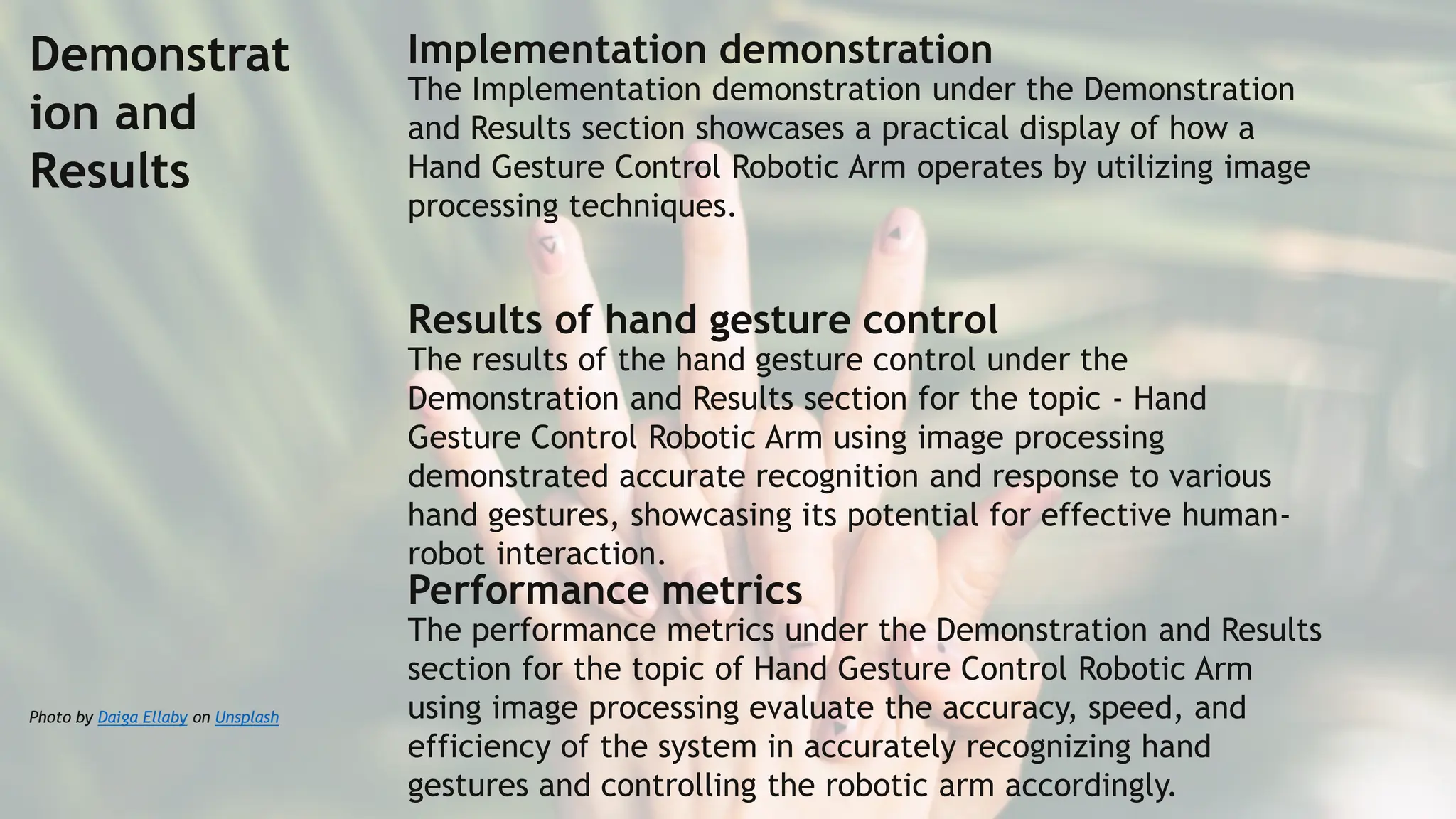
Implementation demonstration
The Implementation demonstration under the Demonstration
and Results section showcases a practical display of how a
Hand Gesture Control Robotic Arm operates by utilizing image
processing techniques.
Results of hand gesture control
The results of the hand gesture control under the
Demonstration and Results section for the topic - Hand
Gesture Control Robotic Arm using image processing
demonstrated accurate recognition and response to various
hand gestures, showcasing its potential for effective human-
robot interaction.
Performance metrics
The performance metrics under the Demonstration and Results
section for the topic of Hand Gesture Control Robotic Arm
using image processing evaluate the accuracy, speed, and
efficiency of the system in accurately recognizing hand
gestures and controlling the robotic arm accordingly.
Photo by Diego PH on Unsplash
Conclusion
and Future
Work
Summary of findings
In conclusion, our study successfully developed a hand gesture
control robotic arm using image processing techniques,
demonstrating accurate and reliable tracking of hand gestures
for controlling the arm's movements. Furthermore, future
work could focus on enhancing the system's performance by
integrating machine learning algorithms to recognize more
complex and varied hand gestures, enabling a wider range of
commands for the robotic arm.
Future research and development
In order to further advance the field of hand gesture control
robotic arms using image processing, future research and
development should focus on optimizing real-time detection
and tracking algorithms, enhancing the accuracy and
robustness of gesture recognition models, exploring
alternative sensing technologies such as depth sensors or
wearable devices for improved gesture capture, and
integrating machine learning techniques to enable adaptive
control algorithms that can adapt to user preferences and
environmental changes.
Potential applications
Potential applications under the Conclusion and Future Work
section for the topic Hand Gesture Control Robotic Arm using
image processing include developing advanced prosthetic
limbs, enhancing human-robot interaction in industrial
settings, and assisting individuals with disabilities in

Hand Gesture Control Robotic Arm using image processing.pptx

  • 1.
    Hand Gesture Control RoboticArm using Image Processing Generated by GPT_PPT Photo by I.am_nah on Unsplash
  • 2.
    1.Introduction 2.Background and Motivation 3.ImageProcessing for Gesture Recognition 4.Robotic Arm Design and Components 5.Integration of Image Processing and Robotic Arm 6.Hand Gesture Control Algorithm 7.Demonstration and Results 8.Conclusion and Future Work
  • 3.
    Photo by iandooley on Unsplash Introductio n Overview of the presentation The Introduction section of the presentation provides an overview of the topic, specifically focusing on the Hand Gesture Control Robotic Arm and its implementation using image processing technology. Purpose of hand gesture control robotic arm The purpose of developing a hand gesture control robotic arm utilizing image processing is to provide a more intuitive and efficient means of controlling robotic arms, allowing users to interact with them using natural hand movements.
  • 4.
    Photo by LinaTrochez on Unsplash Backgroun d and Motivation History of robotic arms The history of robotic arms in the field of image processing for hand gesture control dates back to advancements in computer vision and artificial intelligence, which have enabled researchers to develop sophisticated algorithms capable of interpreting and responding to human gestures with precision and accuracy. Motivation for hand gesture control The motivation for hand gesture control in a robotic arm using image processing arises from the need to develop more intuitive and user-friendly human-machine interaction systems.
  • 5.
    Photo by MatthewHenry on Unsplash Image Processing for Gesture Recognitio n Basic concepts of image processing The basic concepts of image processing under the Image Processing for Gesture Recognition section for the topic - Hand Gesture Control Robotic Arm using image processing involve techniques such as edge detection, contour extraction, and feature extraction to analyze and interpret hand gestures captured by a camera for controlling the movements of a robotic arm. Techniques for gesture recognition The techniques for gesture recognition under the Image Processing for Gesture Recognition section in Hand Gesture Control Robotic Arm involve analyzing and processing images of hand gestures to accurately interpret and respond to user commands. Challenges in image processing for gesture recognition One of the challenges in image processing for gesture recognition in the context of Hand Gesture Control Robotic Arm is accurately detecting and distinguishing hand gestures from complex backgrounds or varying lighting conditions.
  • 6.
    Photo by NickMoore on Unsplash Robotic Arm Design and Component s Design considerations for robotic arm When designing a hand gesture control robotic arm using image processing, important design considerations include the selection of appropriate sensors and cameras for accurately capturing and interpreting hand gestures, as well as the integration of reliable actuators to ensure precise movement and dexterity of the robotic arm. Components of the robotic arm The components of the robotic arm, as discussed in the Robotic Arm Design and Components section for the topic of Hand Gesture Control Robotic Arm using image processing, include a camera module for capturing hand gestures, an image processing unit to analyze the captured images, servo motors for controlling arm movements based on detected gestures, and a microcontroller to coordinate all these components. Kinematics and dynamics of robotic arm The Robotic Arm Design and Components section of the topic Hand Gesture Control Robotic Arm using image processing explores the kinematics, which refers to the motion and positioning analysis, as well as dynamics, which considers forces and torques involved, of a robotic arm.
  • 7.
    Photo by ShoeibAbolhassani on Unsplash Integration of Image Processing and Robotic Arm Connecting image processing with robotic arm By integrating image processing technology with a robotic arm, it is possible to enable hand gesture control for the robotic arm. Synchronization and communication The synchronization and communication under the Integration of Image Processing and Robotic Arm section refers to the coordination between image processing algorithms for hand gesture recognition and the robotic arm's movements in order to achieve effective control of a robotic arm using hand gestures. Advantages of integration One of the advantages of integrating image processing with a robotic arm for hand gesture control is the ability to accurately interpret and respond to a wide range of gestures, allowing for more intuitive and natural interaction between humans and robots.
  • 8.
    Photo by AlexLvrs on Unsplash Hand Gesture Control Algorithm Algorithm for gesture recognition The algorithm for gesture recognition under the Hand Gesture Control Algorithm section for the topic - Hand Gesture Control Robotic Arm using image processing, involves analyzing captured images or video frames to detect and classify hand gestures in order to control the movements of a robotic arm. Real-time control of robotic arm Real-time control of a robotic arm is achieved through the implementation of the Hand Gesture Control Algorithm, which utilizes image processing techniques to interpret and respond to hand gestures.
  • 9.
    Photo by DaigaEllaby on Unsplash Demonstrat ion and Results Implementation demonstration The Implementation demonstration under the Demonstration and Results section showcases a practical display of how a Hand Gesture Control Robotic Arm operates by utilizing image processing techniques. Results of hand gesture control The results of the hand gesture control under the Demonstration and Results section for the topic - Hand Gesture Control Robotic Arm using image processing demonstrated accurate recognition and response to various hand gestures, showcasing its potential for effective human- robot interaction. Performance metrics The performance metrics under the Demonstration and Results section for the topic of Hand Gesture Control Robotic Arm using image processing evaluate the accuracy, speed, and efficiency of the system in accurately recognizing hand gestures and controlling the robotic arm accordingly.
  • 10.
    Photo by DiegoPH on Unsplash Conclusion and Future Work Summary of findings In conclusion, our study successfully developed a hand gesture control robotic arm using image processing techniques, demonstrating accurate and reliable tracking of hand gestures for controlling the arm's movements. Furthermore, future work could focus on enhancing the system's performance by integrating machine learning algorithms to recognize more complex and varied hand gestures, enabling a wider range of commands for the robotic arm. Future research and development In order to further advance the field of hand gesture control robotic arms using image processing, future research and development should focus on optimizing real-time detection and tracking algorithms, enhancing the accuracy and robustness of gesture recognition models, exploring alternative sensing technologies such as depth sensors or wearable devices for improved gesture capture, and integrating machine learning techniques to enable adaptive control algorithms that can adapt to user preferences and environmental changes. Potential applications Potential applications under the Conclusion and Future Work section for the topic Hand Gesture Control Robotic Arm using image processing include developing advanced prosthetic limbs, enhancing human-robot interaction in industrial settings, and assisting individuals with disabilities in