Importance of Play

Regine Joy Acabado
ED201-01
September 22, 2011
Fall 2011
Objectives:
• What is Play?
• Children learn through PLAY!
   – Physical /Motor Development
   – Cognitive Development
   – Language Skills
   – Social/Emotional Skills
• Piaget’s Theory: The Preoperational Stage
   – Make-believe Play
• Advantages and Disadvantages of Play
• Parent Involvement in Play
• Playtime is Learning Time: 10 Play Time Classic Toys
• Learning through Play in a Classroom
   – Self-efficacy       - Literacy skills - Social Skills
   – Play as an avenue for learning
• Summary
• *Felt Board Activity*
What is Play?
• Play is critical to the healthy growth and development
  of children.
• One of the ways children learn about themselves, the
  people around them, their environment, and their
  community.
• By playing, a child will then learn how to process and
  make sense of what sensations he/she receives
  whether it’s by sight, sound, taste, smell, or touch.
• Play relieves stress and boredom, connects people in a
  positive way, stimulates, creative thinking and
  exploration, regulates emotions, and boosts
  confidence.
Children Learn Through Play
• Develop physical skills:
   – Gross motor skills are developed as a child learns to reach,
     grasp, crawl, run, climb, and balance.
   – Fine motor skills are developed as children handle some toys.
     (Control of the hands and fingers improve)
• Cognitive Development
   – Learn to solve problems through play.
   – Learn colors, numbers, size and shapes.
   – Have the ability to enhance their memory skills as well as their
     attention span.
   – Able to move on to higher levels of thought as they play in a
     more stimulating environment.
Children Learn Through Play
• Develop Language Skills:
   – Language develops as a child plays and interacts with
     others.
   – Begins with: Parents playing cooing games with their
     children and advances to practical levels such as
     telling make-believe stories and jokes.
• Develop Social Skills:
   – Natural way for children to interact.
   – Opportunities for cooperating, taking turns, sharing,
     listening, and negotiating exist within the play
     context/rules.
Advantages & Disadvantages of
              Structured Play
Advantages                                  Disadvantages
• New Ideas:                                •   Stress:
    – Providing play opportunities               –  Overscheduled structured play
                                                   causes stress and anxiety to a child.
      allows you to introduce your child
                                                 – Busy structured play schedules may
      to new ideas and types of play.              fall behind at school, complain of
• Social Interaction:                              headaches or stomachaches and
                                                   frequent exhaustion.
    – Opportunities to learn self-
      discipline, sportsmanship, conflict   •   Less Unstructured Play:
      resolution, sharing, etc.                  – Providing too much structured play
                                                   eliminates time for free, child-
    – For younger children, play                   centered play.
      provides opportunities for parents         – Decrease in time assigned for free
      and classmates to model                      play interferes in the developmental
      appropriate behaviors through                benefits of unstructured play such as
      simple games such as “Duck Duck              creativity, imagination, decision-
                                                   making and developmental of
      Goose” or “Red Light Green Light”            overall emotional, cognitive and
    – *Sociodramatic play*                         physical strength.
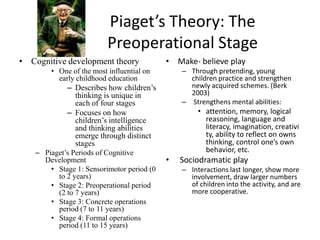
Piaget’s Theory: The
                          Preoperational Stage
• Cognitive development theory              • Make- believe play
        • One of the most influential on        – Through pretending, young
          early childhood education               children practice and strengthen
             – Describes how children’s           newly acquired schemes. (Berk
               thinking is unique in              2003)
               each of four stages              – Strengthens mental abilities:
             – Focuses on how                        • attention, memory, logical
               children’s intelligence                 reasoning, language and
               and thinking abilities                  literacy, imagination, creativi
               emerge through distinct                 ty, ability to reflect on owns
               stages                                  thinking, control one’s own
    – Piaget’s Periods of Cognitive                    behavior, etc.
      Development                           •   Sociodramatic play
        • Stage 1: Sensorimotor period (0       – Interactions last longer, show more
          to 2 years)                             involvement, draw larger numbers
        • Stage 2: Preoperational period          of children into the activity, and are
          (2 to 7 years)                          more cooperative.
        • Stage 3: Concrete operations
          period (7 to 11 years)
        • Stage 4: Formal operations
          period (11 to 15 years)
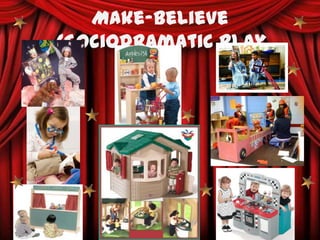
Make-Believe
/Sociodramatic Play
Parental Involvement
• Parents are their children’s first and best
  playmates.
• Children tend to be more creative.
   – Observe: Watch your child closely to learn what he or
     she can do and has problems doing. Be aware of your
     child’s favorite activities.
   – Follow: Join in and play with your child so that he or
     she knows you are interested in what he or she is
     doing.
   – Be creative: Use toys in different ways. Being creative
     will make playing more fun for you and your child.
Playtime is Learning Time:
        Play Time Classic Toys

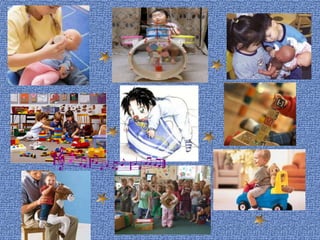
• Playtime has a unique way of helping
  children learn new developmental and
  social skills.
• Toys are tools that can help children
  learn about themselves and the world
  around them.
Playtime is Learning Time: Play Time
                  Classic Toys
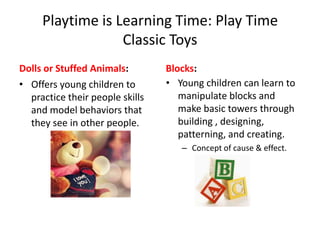
Dolls or Stuffed Animals:        Blocks:
• Offers young children to       • Young children can learn to
  practice their people skills      manipulate blocks and
  and model behaviors that          make basic towers through
  they see in other people.         building , designing,
                                    patterning, and creating.
                                    – Concept of cause & effect.
Playtime is Learning Time: Play Time
              Classic Toys
• Music Sets                   • Ride-on Toy
  – Allows babies and            – Child’s imagination
    toddlers to create their       increases
    own music, builds            – Strengthens their safety
    confidence and an ear          skills by teaching dolls to
    for what sounds good to        buckle up and develop
    them.                          their sense of
  – Cause and effect               independence by
                                   pretending to go on
                                   adventures on their
                                   own.
Learning Through Play in the
                Classroom
• Play as an avenue for learning
  – Classroom environments can be altered to decrease
    children’s stress levels.
  – Play should be in a relaxed environment.
  – Teachers can create environments that are more
    playful and less stressful by allowing children to make
    choices about their activities.
  – Allowing students to make decisions about what and
    how they learn helps them find learning enjoyable.
  – Freedom = Confidence in their growing abilities
Learning Through Play in the
                   Classroom
Self-efficacy                      Literacy skills
•  is the belief that people can   •  Critical for literacy learning in
  influence what happens in life     language development.
  through actions they take.       • With play, children develop
• They develop the sense that        their understanding of
                                     language and how it allows
  they can have control over         them to interact with people.
  themselves and their
                                   • Materials:
  environment.
                                       –   magnetic letters to spell words
• “Can-do” attitude                    –   signs to read
    – Making choices                   –   word games
    – Cause and effect of their        –   flannel boards & characters
      actions (problem solving)        –   tape players for storytelling
Summary
• Play provides many opportunities for children to
  practice skills, stretch thinking abilities, work through
  emotions, socialize, and be creative
• Children learn through PLAY!
   – Physical /Motor Development, Cognitive
     Development, Language Skills, and
     Social/Emotional Skills
• Advantages and Disadvantages of Structured Play
• Piaget’s Preoperational Stages
• Parental Involvement
• Classic Toys
• Learning through play in the classroom
References
• Bandura, A. "Acknowledging Learning Through Play in the Primary
  Grades." Childhood Education. 2010.
• Berk, Laura E. "Chapter 7 pg. 173-174." Exploring Lifespan Development,
  Pearson. 2008. Pearson. Unites States : Pearson,Education, Inc, 2008.
• H., Corley. "10 Play Time Classic Toys for Fun and Learning." Marianas
  Variety. 2011. Magazine.
• St. Jude Chidren's Research Hospital. "Childhood, Adolescent and Young
  Adult Cancer Program: Great Information." 2006. 15 Sep. 2011.
  <http://www.ucdmc.ucdavis.edu/cancer/pedresource/pedres_docs/Childr
  enLearnThruPlay.pdf>.
• Titus, Mandi. "The Advantages and Disadvantages of Structured Play."
  eHow Family. eHow Contributer. 15 Sep. 2011.
  <http://www.ehow.com/list_6954899_advantages-disadvantages-
  structured-play.html>.

Importance of play

  • 1.
    Importance of Play RegineJoy Acabado ED201-01 September 22, 2011 Fall 2011
  • 2.
    Objectives: • What isPlay? • Children learn through PLAY! – Physical /Motor Development – Cognitive Development – Language Skills – Social/Emotional Skills • Piaget’s Theory: The Preoperational Stage – Make-believe Play • Advantages and Disadvantages of Play • Parent Involvement in Play • Playtime is Learning Time: 10 Play Time Classic Toys • Learning through Play in a Classroom – Self-efficacy - Literacy skills - Social Skills – Play as an avenue for learning • Summary • *Felt Board Activity*
  • 3.
    What is Play? •Play is critical to the healthy growth and development of children. • One of the ways children learn about themselves, the people around them, their environment, and their community. • By playing, a child will then learn how to process and make sense of what sensations he/she receives whether it’s by sight, sound, taste, smell, or touch. • Play relieves stress and boredom, connects people in a positive way, stimulates, creative thinking and exploration, regulates emotions, and boosts confidence.
  • 4.
    Children Learn ThroughPlay • Develop physical skills: – Gross motor skills are developed as a child learns to reach, grasp, crawl, run, climb, and balance. – Fine motor skills are developed as children handle some toys. (Control of the hands and fingers improve) • Cognitive Development – Learn to solve problems through play. – Learn colors, numbers, size and shapes. – Have the ability to enhance their memory skills as well as their attention span. – Able to move on to higher levels of thought as they play in a more stimulating environment.
  • 5.
    Children Learn ThroughPlay • Develop Language Skills: – Language develops as a child plays and interacts with others. – Begins with: Parents playing cooing games with their children and advances to practical levels such as telling make-believe stories and jokes. • Develop Social Skills: – Natural way for children to interact. – Opportunities for cooperating, taking turns, sharing, listening, and negotiating exist within the play context/rules.
  • 6.
    Advantages & Disadvantagesof Structured Play Advantages Disadvantages • New Ideas: • Stress: – Providing play opportunities – Overscheduled structured play causes stress and anxiety to a child. allows you to introduce your child – Busy structured play schedules may to new ideas and types of play. fall behind at school, complain of • Social Interaction: headaches or stomachaches and frequent exhaustion. – Opportunities to learn self- discipline, sportsmanship, conflict • Less Unstructured Play: resolution, sharing, etc. – Providing too much structured play eliminates time for free, child- – For younger children, play centered play. provides opportunities for parents – Decrease in time assigned for free and classmates to model play interferes in the developmental appropriate behaviors through benefits of unstructured play such as simple games such as “Duck Duck creativity, imagination, decision- making and developmental of Goose” or “Red Light Green Light” overall emotional, cognitive and – *Sociodramatic play* physical strength.
  • 7.
    Piaget’s Theory: The Preoperational Stage • Cognitive development theory • Make- believe play • One of the most influential on – Through pretending, young early childhood education children practice and strengthen – Describes how children’s newly acquired schemes. (Berk thinking is unique in 2003) each of four stages – Strengthens mental abilities: – Focuses on how • attention, memory, logical children’s intelligence reasoning, language and and thinking abilities literacy, imagination, creativi emerge through distinct ty, ability to reflect on owns stages thinking, control one’s own – Piaget’s Periods of Cognitive behavior, etc. Development • Sociodramatic play • Stage 1: Sensorimotor period (0 – Interactions last longer, show more to 2 years) involvement, draw larger numbers • Stage 2: Preoperational period of children into the activity, and are (2 to 7 years) more cooperative. • Stage 3: Concrete operations period (7 to 11 years) • Stage 4: Formal operations period (11 to 15 years)
  • 8.
  • 9.
    Parental Involvement • Parentsare their children’s first and best playmates. • Children tend to be more creative. – Observe: Watch your child closely to learn what he or she can do and has problems doing. Be aware of your child’s favorite activities. – Follow: Join in and play with your child so that he or she knows you are interested in what he or she is doing. – Be creative: Use toys in different ways. Being creative will make playing more fun for you and your child.
  • 10.
    Playtime is LearningTime: Play Time Classic Toys • Playtime has a unique way of helping children learn new developmental and social skills. • Toys are tools that can help children learn about themselves and the world around them.
  • 11.
    Playtime is LearningTime: Play Time Classic Toys Dolls or Stuffed Animals: Blocks: • Offers young children to • Young children can learn to practice their people skills manipulate blocks and and model behaviors that make basic towers through they see in other people. building , designing, patterning, and creating. – Concept of cause & effect.
  • 12.
    Playtime is LearningTime: Play Time Classic Toys • Music Sets • Ride-on Toy – Allows babies and – Child’s imagination toddlers to create their increases own music, builds – Strengthens their safety confidence and an ear skills by teaching dolls to for what sounds good to buckle up and develop them. their sense of – Cause and effect independence by pretending to go on adventures on their own.
  • 14.
    Learning Through Playin the Classroom • Play as an avenue for learning – Classroom environments can be altered to decrease children’s stress levels. – Play should be in a relaxed environment. – Teachers can create environments that are more playful and less stressful by allowing children to make choices about their activities. – Allowing students to make decisions about what and how they learn helps them find learning enjoyable. – Freedom = Confidence in their growing abilities
  • 15.
    Learning Through Playin the Classroom Self-efficacy Literacy skills • is the belief that people can • Critical for literacy learning in influence what happens in life language development. through actions they take. • With play, children develop • They develop the sense that their understanding of language and how it allows they can have control over them to interact with people. themselves and their • Materials: environment. – magnetic letters to spell words • “Can-do” attitude – signs to read – Making choices – word games – Cause and effect of their – flannel boards & characters actions (problem solving) – tape players for storytelling
  • 16.
    Summary • Play providesmany opportunities for children to practice skills, stretch thinking abilities, work through emotions, socialize, and be creative • Children learn through PLAY! – Physical /Motor Development, Cognitive Development, Language Skills, and Social/Emotional Skills • Advantages and Disadvantages of Structured Play • Piaget’s Preoperational Stages • Parental Involvement • Classic Toys • Learning through play in the classroom
  • 18.
    References • Bandura, A."Acknowledging Learning Through Play in the Primary Grades." Childhood Education. 2010. • Berk, Laura E. "Chapter 7 pg. 173-174." Exploring Lifespan Development, Pearson. 2008. Pearson. Unites States : Pearson,Education, Inc, 2008. • H., Corley. "10 Play Time Classic Toys for Fun and Learning." Marianas Variety. 2011. Magazine. • St. Jude Chidren's Research Hospital. "Childhood, Adolescent and Young Adult Cancer Program: Great Information." 2006. 15 Sep. 2011. <http://www.ucdmc.ucdavis.edu/cancer/pedresource/pedres_docs/Childr enLearnThruPlay.pdf>. • Titus, Mandi. "The Advantages and Disadvantages of Structured Play." eHow Family. eHow Contributer. 15 Sep. 2011. <http://www.ehow.com/list_6954899_advantages-disadvantages- structured-play.html>.