OBJECTIVES 
Define Play 
Discuss types of play in relation to Paiget’s, Erikson’s & Fraud’s theories 
Illustrate role of play in understanding learning process
INTRODUCTION 
Play is the most natural of childhood activities and one of the most 
frequently observed. 
(Hughes, 2003, p. 21) 
Three criteria that may help to define play: 
freedom of choice 
personal enjoyment 
focus is on the activity itself rather than its outcomes.
CHARACTERISTICS OF PLAY: 
self-directed 
self-selected 
open-ended 
voluntary 
enjoyable 
flexible 
motivating 
individual or group
FUNCTIONS OF PLAY 
Research has demonstrated that play enables children to: 
make sense of their world, expand social and cultural understandings 
express personal thoughts and feelings practise flexible and divergent thinking 
encounter and solve real problems learn to consider other people’s 
perspectives 
negotiate play roles and plans and • develop self control 
extend language and literacy skills 
enhance brain and motor development.
PLAY 
Play is a spontaneous, voluntary , pleasurable and flexible activity involving a 
combination of body, object, symbol use and relationships 
Disorganized, for own sake 
A legitimate right 
An opportunity to engage and learn 
Creativity 
Essential for education 
Social learning skills, express possible stress
TYPES OF PLAY 
Children’s play ranges from simple physical play with objects 
cognitive play in games with many rules 
Parten (1932) observed children’s social behavior during play. Observations, she 
developed a continuum showing levels of 
children’s participation in social play, which includes types of social 
participation.
TYPES OF PLAY 
Passive Play: 
Uninvolved: in which the child moves about but does not participate in any type of 
play 
• 
Onlooker: in which the child may watch or 
speak with players but is not involved in the 
play.
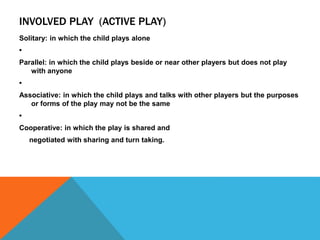
INVOLVED PLAY (ACTIVE PLAY) 
Solitary: in which the child plays alone 
• 
Parallel: in which the child plays beside or near other players but does not play 
with anyone 
• 
Associative: in which the child plays and talks with other players but the purposes 
or forms of the play may not be the same 
• 
Cooperative: in which the play is shared and 
negotiated with sharing and turn taking.
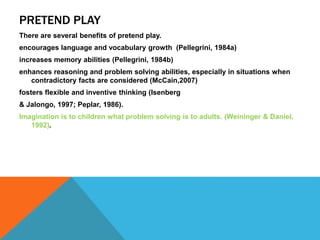
PRETEND PLAY 
There are several benefits of pretend play. 
encourages language and vocabulary growth (Pellegrini, 1984a) 
increases memory abilities (Pellegrini, 1984b) 
enhances reasoning and problem solving abilities, especially in situations when 
contradictory facts are considered (McCain,2007) 
fosters flexible and inventive thinking (Isenberg 
& Jalongo, 1997; Peplar, 1986). 
Imagination is to children what problem solving is to adults. (Weininger & Daniel, 
1992).
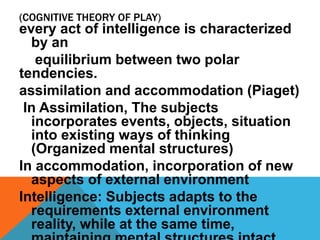
(COGNITIVE THEORY OF PLAY) 
every act of intelligence is characterized 
by an 
equilibrium between two polar 
tendencies. 
assimilation and accommodation (Piaget) 
In Assimilation, The subjects 
incorporates events, objects, situation 
into existing ways of thinking 
(Organized mental structures) 
In accommodation, incorporation of new 
aspects of external environment 
Intelligence: Subjects adapts to the 
requirements external environment 
reality, while at the same time, 
maintaining mental structures intact
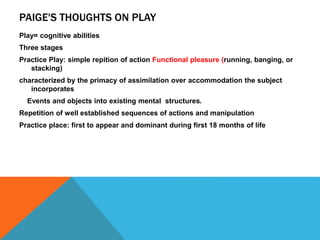
PAIGE'S THOUGHTS ON PLAY 
Play= cognitive abilities 
Three stages 
Practice Play: simple repition of action Functional pleasure (running, banging, or 
stacking) 
characterized by the primacy of assimilation over accommodation the subject 
incorporates 
Events and objects into existing mental structures. 
Repetition of well established sequences of actions and manipulation 
Practice place: first to appear and dominant during first 18 months of life
CONTINUE 
constructive play: use of blocks or materials to 
make something 
dramatic/pretend play: use of imagination and 
role play 
Games with rules: accepts predetermined rules, to play games such as Cricket/ football. 
Knowledge helps educators provide appropriate environments that support children’s 
development. It enables them to enjoy, encourage, and appreciate age-appropriate 
play behaviour. (Isenberg & Jalongo, 1997, p. 60).
SYMBOLIC PLAY: 
through pretence, make or belive 
Identification of one object with another 
A banana is telephone 
Uses’ words for objects 
It lasts 02 to 03 years 
Body parts as other things ( after 03 Y) 
Not for practical or instrumental purpose 
But for pleasure derived from motor skills mastery (arises from……………………..)
MORE THOUGHTS 
Symbolic play relates to their verbal abilities (Lewis, V 2000) 
Children with visual impairments demonstrate similar level of sophistication 
Low in quantity 
Socio-dramatic play: imitating older’ activities 
Doctors, mothers, fathers, going to shop etc 
extension of make or believe play 
Culminates after 6-7 years
Symbolic Play: Purposive, when practice play becomes less numerous and 
diminish 
Child passes from mere repition to fortuitous and then purposes combination of 
actions and manipulations 
Set goals and transfer to constructions 
Elaborate sequences of Scio dramatic play 
Rules spontaneously created 
Rigidity
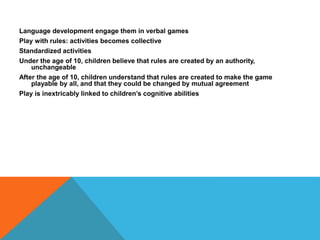
Language development engage them in verbal games 
Play with rules: activities becomes collective 
Standardized activities 
Under the age of 10, children believe that rules are created by an authority, 
unchangeable 
After the age of 10, children understand that rules are created to make the game 
playable by all, and that they could be changed by mutual agreement 
Play is inextricably linked to children’s cognitive abilities
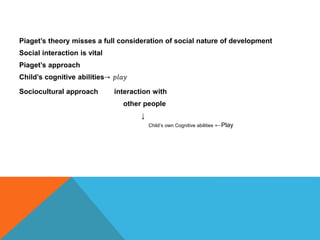
Piaget’s theory misses a full consideration of social nature of development 
Social interaction is vital 
Piaget’s approach 
Child’s cognitive abilities 푝푙푎푦 
Sociocultural approach interaction with 
other people 
↓ 
Child’s own Cognitive abilities ←Play
SOCIO-DRAMATIC PLAY 
Relates strongly to children’s cognitive and social abilities. It offers rich 
opportunities for children to: 
Develop abstract thinking (Piaget, 1962) 
Refine their understandings about the world 
(McCain, Mustard, & Shanker, 2007) 
Solve problems in a safe context (Smilansky & 
Sheftaya, 1990)
SOCIAL ASPECT OF PLAY 
Play results from interaction with other peoples (Vygostsky) 
Helps to develop their cognitive abilities 
In infancy 
Babies tend to be played to by adults 
Passive role 
After 12 months 
Able to imitate actions 
More active role
PRETEND PLAY 
A sophisticated activity 
Integrate different representations of objects and events 
Seeing its mother pretending that a banana is telephone 
True identity of banana 
Is different from 
Pretend identity as telephone
SOCIAL PLAY 
It is characterized by playful interactions with parents (up to age 2) and/or other children 
(from two years onwards) 
Parallel Play. In spite of being around other children of their age, children between 2 to 3 
years old commonly play next to each other without much interaction 
Socio-dramatic Play: As their cognitive skills develop, including their ability to imagine, 
imitate and understand other’s beliefs and intents, children start to engage in
PHYSICAL/ LOCO MOTOR PLAY 
While interacting with same age peers, children develops narrative thinking, 
problem solving skills (e.g., when negotiating roles), and a general 
understanding of the building blocks of story. 
Around the same time, physical/locomotor play also increases in frequency. 
Running and climbing, play fighting (three to six)
Gender differences → Boys & Girls Play differently 
Sociocultural theorists suggest play useful way of practicing in a non threatening 
environment 
Students have opportunity to learn relationships, roles, and conventional pattern 
of behavior 
Strengthen the distinction between appearance (pretend) and reality 
Provide social interaction, basis for cognitive D
FREUD’S VIEW ON PLAY 
Play is a means by which children could compensate for the anxieties and 
frustrations that they experiences in everyday life 
Desire to mastery, to emulate their parents by staying up late, safe, stress free 
environment 
Anxiety to go to the doctor 
Play is an outlet for creativity 
Function is equally important 
Imaginary companions
The boundary between play and aggression 
Children disturb others if they themselves or poor players 
Popular player are those with positive and happy disposition, show high level of 
cooperative play, little aggression 
Unpopular children 
(a) rejected: disruptive, argumentative, extremely active, talkative, unwillingness to 
share and solitary behavior as consequence
(b)Neglected: shy, rarely aggressive, antisocial, 
Avoid interaction, 
Bullying: laughter and smiling, restraint 
It is different from fighting, rough, tumble play 
Repeated and intentional hurt (physical or psychological) 
Common in school age children 
Have lack of social skills ( lacking in home environment, previous unsuccessful 
play experiences
flexibility (objects are put in new combinations or roles are acted out in new 
ways), 
Object play refers to playful use of objects such as building blocks, cars, dolls, etc 
allows children to try out new combinations of actions, free of external constraint, and 
may help develop problem solving skills. 
Pretend play: involves pretending an object or an action is something else than it really 
is. 
A banana is a telephone, 
15 months of age with simple actions, such as pretending to sleep or putting dolly to 
bed,
SOCIO DRAMATIC PLAY 
around 3 years of age, 
is pretend play with others, sustained role taking, 
understanding others’ intent, sophisticated language constructions, 
Negotiate meanings and roles (“You be daddy, right?”) and argue about 
appropriate behavior (“No, you don’t feed the baby like that!”). 
Develop language skills and preliterally Skill
SOCIO DRAMATIC PLAY 
Dramatic Play gives children the opportunity to 
Express themselves and explore language freely 
Explore feelings and find out about themselves and others 
Develop co-operation, care, consideration and control 
Exercise choice and make decisions 
Use mathematical language and develop mathematical concepts 
Develop a range of motor skills 
Use their skills to make the things needed for their play and adapt as necessary 
Explore a fantasy world of their own creation
REFERENCES 
Smith, P.K. Learning through play. Encyclopedia on early child hood development 
Smythe, P.K, Taylor, A. Lamont, A & Joiner, R. (2006). Developmental Psychology 
and you. (2nd Ed). BPS Blackwell [Ch# Playing and Learning]75-90

Play and Learning (Developmental Psychology

  • 2.
    OBJECTIVES Define Play Discuss types of play in relation to Paiget’s, Erikson’s & Fraud’s theories Illustrate role of play in understanding learning process
  • 3.
    INTRODUCTION Play isthe most natural of childhood activities and one of the most frequently observed. (Hughes, 2003, p. 21) Three criteria that may help to define play: freedom of choice personal enjoyment focus is on the activity itself rather than its outcomes.
  • 4.
    CHARACTERISTICS OF PLAY: self-directed self-selected open-ended voluntary enjoyable flexible motivating individual or group
  • 5.
    FUNCTIONS OF PLAY Research has demonstrated that play enables children to: make sense of their world, expand social and cultural understandings express personal thoughts and feelings practise flexible and divergent thinking encounter and solve real problems learn to consider other people’s perspectives negotiate play roles and plans and • develop self control extend language and literacy skills enhance brain and motor development.
  • 6.
    PLAY Play isa spontaneous, voluntary , pleasurable and flexible activity involving a combination of body, object, symbol use and relationships Disorganized, for own sake A legitimate right An opportunity to engage and learn Creativity Essential for education Social learning skills, express possible stress
  • 7.
    TYPES OF PLAY Children’s play ranges from simple physical play with objects cognitive play in games with many rules Parten (1932) observed children’s social behavior during play. Observations, she developed a continuum showing levels of children’s participation in social play, which includes types of social participation.
  • 8.
    TYPES OF PLAY Passive Play: Uninvolved: in which the child moves about but does not participate in any type of play • Onlooker: in which the child may watch or speak with players but is not involved in the play.
  • 9.
    INVOLVED PLAY (ACTIVEPLAY) Solitary: in which the child plays alone • Parallel: in which the child plays beside or near other players but does not play with anyone • Associative: in which the child plays and talks with other players but the purposes or forms of the play may not be the same • Cooperative: in which the play is shared and negotiated with sharing and turn taking.
  • 10.
    PRETEND PLAY Thereare several benefits of pretend play. encourages language and vocabulary growth (Pellegrini, 1984a) increases memory abilities (Pellegrini, 1984b) enhances reasoning and problem solving abilities, especially in situations when contradictory facts are considered (McCain,2007) fosters flexible and inventive thinking (Isenberg & Jalongo, 1997; Peplar, 1986). Imagination is to children what problem solving is to adults. (Weininger & Daniel, 1992).
  • 11.
    (COGNITIVE THEORY OFPLAY) every act of intelligence is characterized by an equilibrium between two polar tendencies. assimilation and accommodation (Piaget) In Assimilation, The subjects incorporates events, objects, situation into existing ways of thinking (Organized mental structures) In accommodation, incorporation of new aspects of external environment Intelligence: Subjects adapts to the requirements external environment reality, while at the same time, maintaining mental structures intact
  • 12.
    PAIGE'S THOUGHTS ONPLAY Play= cognitive abilities Three stages Practice Play: simple repition of action Functional pleasure (running, banging, or stacking) characterized by the primacy of assimilation over accommodation the subject incorporates Events and objects into existing mental structures. Repetition of well established sequences of actions and manipulation Practice place: first to appear and dominant during first 18 months of life
  • 13.
    CONTINUE constructive play:use of blocks or materials to make something dramatic/pretend play: use of imagination and role play Games with rules: accepts predetermined rules, to play games such as Cricket/ football. Knowledge helps educators provide appropriate environments that support children’s development. It enables them to enjoy, encourage, and appreciate age-appropriate play behaviour. (Isenberg & Jalongo, 1997, p. 60).
  • 14.
    SYMBOLIC PLAY: throughpretence, make or belive Identification of one object with another A banana is telephone Uses’ words for objects It lasts 02 to 03 years Body parts as other things ( after 03 Y) Not for practical or instrumental purpose But for pleasure derived from motor skills mastery (arises from……………………..)
  • 15.
    MORE THOUGHTS Symbolicplay relates to their verbal abilities (Lewis, V 2000) Children with visual impairments demonstrate similar level of sophistication Low in quantity Socio-dramatic play: imitating older’ activities Doctors, mothers, fathers, going to shop etc extension of make or believe play Culminates after 6-7 years
  • 16.
    Symbolic Play: Purposive,when practice play becomes less numerous and diminish Child passes from mere repition to fortuitous and then purposes combination of actions and manipulations Set goals and transfer to constructions Elaborate sequences of Scio dramatic play Rules spontaneously created Rigidity
  • 17.
    Language development engagethem in verbal games Play with rules: activities becomes collective Standardized activities Under the age of 10, children believe that rules are created by an authority, unchangeable After the age of 10, children understand that rules are created to make the game playable by all, and that they could be changed by mutual agreement Play is inextricably linked to children’s cognitive abilities
  • 18.
    Piaget’s theory missesa full consideration of social nature of development Social interaction is vital Piaget’s approach Child’s cognitive abilities 푝푙푎푦 Sociocultural approach interaction with other people ↓ Child’s own Cognitive abilities ←Play
  • 19.
    SOCIO-DRAMATIC PLAY Relatesstrongly to children’s cognitive and social abilities. It offers rich opportunities for children to: Develop abstract thinking (Piaget, 1962) Refine their understandings about the world (McCain, Mustard, & Shanker, 2007) Solve problems in a safe context (Smilansky & Sheftaya, 1990)
  • 20.
    SOCIAL ASPECT OFPLAY Play results from interaction with other peoples (Vygostsky) Helps to develop their cognitive abilities In infancy Babies tend to be played to by adults Passive role After 12 months Able to imitate actions More active role
  • 21.
    PRETEND PLAY Asophisticated activity Integrate different representations of objects and events Seeing its mother pretending that a banana is telephone True identity of banana Is different from Pretend identity as telephone
  • 22.
    SOCIAL PLAY Itis characterized by playful interactions with parents (up to age 2) and/or other children (from two years onwards) Parallel Play. In spite of being around other children of their age, children between 2 to 3 years old commonly play next to each other without much interaction Socio-dramatic Play: As their cognitive skills develop, including their ability to imagine, imitate and understand other’s beliefs and intents, children start to engage in
  • 23.
    PHYSICAL/ LOCO MOTORPLAY While interacting with same age peers, children develops narrative thinking, problem solving skills (e.g., when negotiating roles), and a general understanding of the building blocks of story. Around the same time, physical/locomotor play also increases in frequency. Running and climbing, play fighting (three to six)
  • 24.
    Gender differences →Boys & Girls Play differently Sociocultural theorists suggest play useful way of practicing in a non threatening environment Students have opportunity to learn relationships, roles, and conventional pattern of behavior Strengthen the distinction between appearance (pretend) and reality Provide social interaction, basis for cognitive D
  • 25.
    FREUD’S VIEW ONPLAY Play is a means by which children could compensate for the anxieties and frustrations that they experiences in everyday life Desire to mastery, to emulate their parents by staying up late, safe, stress free environment Anxiety to go to the doctor Play is an outlet for creativity Function is equally important Imaginary companions
  • 26.
    The boundary betweenplay and aggression Children disturb others if they themselves or poor players Popular player are those with positive and happy disposition, show high level of cooperative play, little aggression Unpopular children (a) rejected: disruptive, argumentative, extremely active, talkative, unwillingness to share and solitary behavior as consequence
  • 27.
    (b)Neglected: shy, rarelyaggressive, antisocial, Avoid interaction, Bullying: laughter and smiling, restraint It is different from fighting, rough, tumble play Repeated and intentional hurt (physical or psychological) Common in school age children Have lack of social skills ( lacking in home environment, previous unsuccessful play experiences
  • 28.
    flexibility (objects areput in new combinations or roles are acted out in new ways), Object play refers to playful use of objects such as building blocks, cars, dolls, etc allows children to try out new combinations of actions, free of external constraint, and may help develop problem solving skills. Pretend play: involves pretending an object or an action is something else than it really is. A banana is a telephone, 15 months of age with simple actions, such as pretending to sleep or putting dolly to bed,
  • 29.
    SOCIO DRAMATIC PLAY around 3 years of age, is pretend play with others, sustained role taking, understanding others’ intent, sophisticated language constructions, Negotiate meanings and roles (“You be daddy, right?”) and argue about appropriate behavior (“No, you don’t feed the baby like that!”). Develop language skills and preliterally Skill
  • 30.
    SOCIO DRAMATIC PLAY Dramatic Play gives children the opportunity to Express themselves and explore language freely Explore feelings and find out about themselves and others Develop co-operation, care, consideration and control Exercise choice and make decisions Use mathematical language and develop mathematical concepts Develop a range of motor skills Use their skills to make the things needed for their play and adapt as necessary Explore a fantasy world of their own creation
  • 31.
    REFERENCES Smith, P.K.Learning through play. Encyclopedia on early child hood development Smythe, P.K, Taylor, A. Lamont, A & Joiner, R. (2006). Developmental Psychology and you. (2nd Ed). BPS Blackwell [Ch# Playing and Learning]75-90