LECTURE 2 –
Additional Notes
PLAY AND
LEARNING
Types of Play
• Solitary play
• Onlooker play
• Parallel play
• Associative play
• Cooperative play
PLAY
What is Play?
Types of Play
The Elements of Play
The Important/ Benefits of Play
Prepared by
Mr. Manogaran Subramanian, JIP
What is Play
All children play
From the infant squealing in
delight during a game of peek-
a-boo to the older child playing
a game of basketball
What is Play
Play is recognized as an
important part of a child's
development.
What is Play
Pretend to go grocery shopping; play the
roles of shoppers, and employee
Reflection of the children's experiences
and interactions with their environment
Piaget described play as a "child's work."
What is Play
Francis Wardle, an author and instructor
at the University of Phoenix (Colorado),
who defines play as "child-centered
learning”
What is Play
Play then, is a natural, child-
directed way for children to learn
new concepts and to develop new
skills that will provide the basis for
success in future settings.
Elements of Play
The social elements of play describe the
amount of social interaction that the child is
engaged in
The cognitive elements describe the
complexity of the child's play skills
Social and cognitive play elements are
interrelated and will often overlap. Children
may demonstrate several social and
cognitive elements during one play activity
Elements of Play
The social elements are identified as
solitary, parallel, or social play.
The cognitive elements of play are
described as being sensorimotor, pretend,
constructive, mastery, or games with rules.
Social elements
of Play
In solitary play, a child plays alone
The child is not reliant upon the actions
or words of others
Examples of solitary play include an
infant shaking a rattle in her crib and a
preschooler quietly looking at a book by
herself. Children of all ages engage in
solitary play
Social elements of Play
In parallel play children play side-by-
side, using the same toys and materials,
but do not engage in social interaction.
A child may notice what his peers are
doing
No directly attempt social contact
Common among children ages two to
three.
Social elements of Play
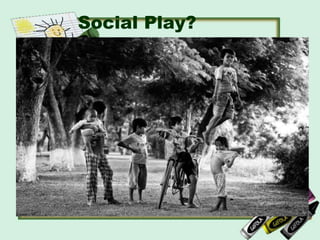
Social or group play is observed during
the preschool years
Children learn social rules such as
sharing, taking turns, and cooperation
Children begin to develop friendships
Social Play?
Cognitive
Elements of Play
In sensorimotor play, children engage in
motor movements beginning with early
reflexes and moving toward more
intentional actions
Infancy through age two
Cognitive
Elements of Play
Pretend play usually begins around
eighteen months of age
Children at the pretend play level are
able to act out adult roles, actions, and
events that are familiar to them
At about the age of three or four, pretend
play skills become more symbolic
Cognitive
Elements of Play
Children are able to substitute one object
for another
The younger child "feeds" a baby doll
with a toy bottle
It is during this level of play that the
child's own experiences directly influence
and provide a foundation for their play
Cognitive Elements of Play
Age of three to four that children develop an
interest in constructive play.
Manipulate objects and materials in their world
resulting in an end product, such as a chalk
picture, a block tower, or a sand mountain.
Draw designs on a piece of paper, build with
blocks, play and dig in the sand, and so forth.
Become more skilled in expressing thoughts,
ideas, and concepts.
TYPES OF PLAY
The classic study of how play develops in
children was carried out by Mildred Parten
in the late 1920s at the Institute of Child
Development in Minnesota
She closely observed children between
the ages of 2 and 5 years and categorised
their play into six types
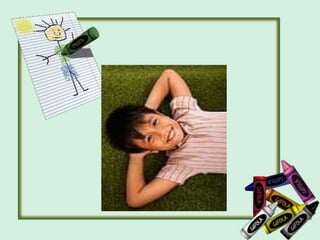
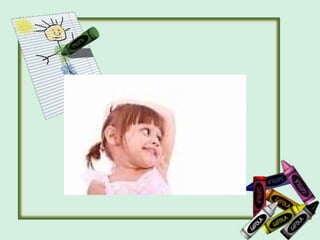
Unoccupied Play
The child is relatively stationary and
appears to be performing random
movements with no apparent purpose
A relatively infrequent style of play
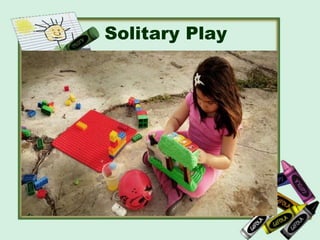
Solitary Play
The child is are completely
engrossed in playing and does not
seem to notice other children.
Most often seen in children between
2 and 3 years-old.
Solitary Play
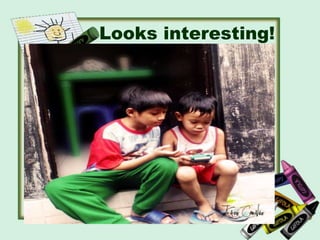
Onlooker Play
Child takes an interest in other
children's play but does not join in.
May ask questions or just talk to
other children
But the main activity is simply to
watch.
Looks interesting!
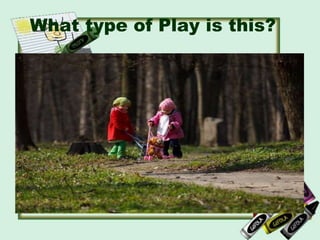
Parallel Play
The child mimics other children's
play but doesn't actively engage with
them.
For example they may use the same
toy.
What type of Play is this?
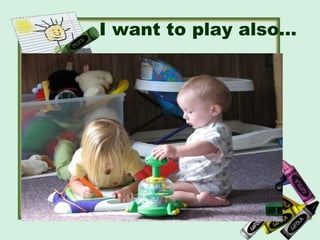
Associative Play
Now more interested in each other
than the toys they are using.
This is the first category that involves
strong social interaction between the
children while they play.
I want to play also…
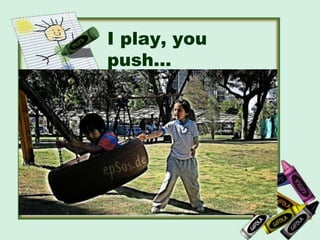
I play, you
push…
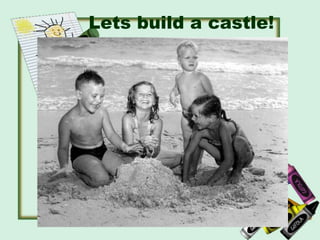
Cooperative Play
Some organisation enters children's
play
For example the playing has some
goal and children often adopt roles
and act as a group.
Lets build a castle!
Types of Play
• Other sources
• http://www.learningchild.com.au
/ccd/play
Discovery play
(exploring play)
Enables a child to find out about things:
what they are like - their size, shape, texture,
colour; how they are made; what she can do
with them, for example playing with water or
sand. The child will also discover that things
can be broken, and this can help to teach her
to take care of her possessions.
Physical play
(exercise)
takes place when a child is actively
moving around - running, jumping, climbing,
crawling, balancing, swinging, throwing a
ball, and so on.
Social Play
Creative play
A child expresses her own ideas and
feelings to make something which is original
For example, a picture, an animal in
modelling dough, a house in building blocks
Able to express feelings and ideas more
easily by painting and drawing
As the child becomes more skilled with
words, she may then be able to write a story,
poem or play.
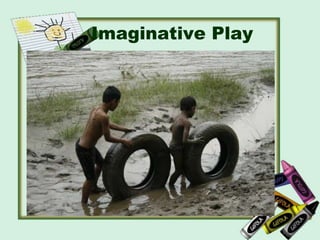
Imaginative play
Is 'pretend' or fantasy play. The child
imagines that she is someone else or an
animal such as a rabbit or dog.
Children imitate the ways of adults when
they play in a Wendy house or play 'shopping'.
Attempting to behave like someone else
helps the child to understand more clearly the
ways other people behave.
Imaginative Play
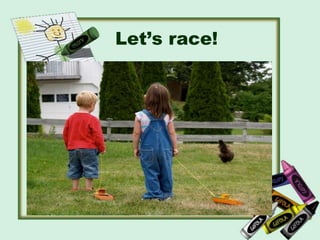
Let’s race!
A Wendy House
• A Wendy house fit for a Queen:
The secrets and history of the
tiny Welsh cottage in the
grounds of Windsor where
generations of royals have
played
• A Wendy house is a small play
house for children, large enough for
one or more children to enter
Wendy House
Manipulative play
Involves skilful use of the hands. During
manipulative play the hands, eyes and brain
are being trained to co-ordinate, that is, to
work smoothly together
Babies become increasingly skilful with
their hands as they play with rattles, soft
toys and other objects. Later on, they
benefit from playing with such things as
modelling dough
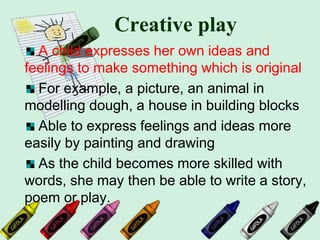
Social play
Takes place when children play together.
It teaches them to co-operate, to share,
and to be honest
It also teaches them that antisocial
behaviour, like cheating, leads to isolation
and loss of friendship.
Children often quarrel and in doing so
learn about each other's reactions.
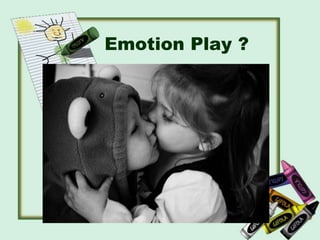
Emotion Play ?
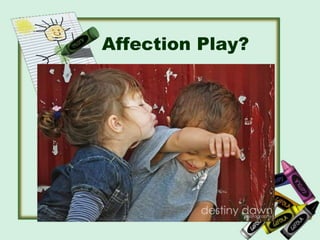
Affection Play?
Importance of
Play
Children play because it gives them
pleasure. They do not play when it is not
enjoyable or if they are bored with the
game.
Play is also an essential part of their
education because while they are playing
they are learning. It is an important part of
socialisation.
Importance of Play
The children learn how others behave and how to
mix easily with them
Children need to play on their own and without
interference in order to learn how to amuse
themselves
If adults spend too much time playing with a child,
the child will feel bored and miserable when left on
her own. Then, instead of playing happily, the child
will spend her time trying to demand attention.
Importance of Play
Other sources
Importance of Play
Enhance physical, language, social, and
cognitive development
Increase their knowledge and
understanding of self, others, and the physical
world around them
Motor development becomes increasingly
more refined through the physical activity
Importance of Play
The development of children's language
skills – solve problem; communicate
Opportunities for social interaction with
peers; follow social rules; learn to express and
control their emotions and to resolve conflicts
Cognitive skills are developed and
challenged; gain confidence; seek out even
more challenging activities
Benefits of Play
1. Play enables children to find out about
themselves and the world.
It allows them to:
discover
experiment
create
concentrate
express ideas
Benefits of Play
develop speech
develop muscles
invent
learn new skills
learn how other people behave
role-play (pretend to be someone else)
share possessions
use the imagination
·
Benefits of Play
co-operate with others
show off (children like to let others know
what they can do)
act protectively towards someone less
powerful than themselves.
Benefits of Play
2. Play helps towards happiness
A child who is absorbed in play is likely to be a
happy child, as play produces feelings of
satisfaction and achievement.
Benefits of Play
3. Play helps prevent boredom.
Preventing a child from being bored is very
important, as boredom can quickly lead to bad
temper, irritability and destructiveness.
Benefits of Play
4. Play can help reduce stress.
The acting out of stressful situations can help them
to seem more familiar and therefore less frightening.
For example, by playing 'schools' a child becomes
familiar with the idea of going to school. This will
help to reduce any nervousness about school which
the child might have. In the same way. playing
'doctors and nurses' can help prepare a child for a
stay in hospital.
Benefits of Play
5. Play can help divert aggressive
instincts.
Using a hammer to nail pieces of wood
together to make a 'boat' is preferable to using
the hammer to hurt someone or destroy
property.
THE END
Prepare for Tutorial 2
In groups of 3 or 4, prepare and
demonstrate “Traditional Games/Play”
playable in a Primary Classroom

01a Topic1 TYPES OF PLAY.pptx

  • 1.
    LECTURE 2 – AdditionalNotes PLAY AND LEARNING
  • 3.
    Types of Play •Solitary play • Onlooker play • Parallel play • Associative play • Cooperative play
  • 4.
    PLAY What is Play? Typesof Play The Elements of Play The Important/ Benefits of Play Prepared by Mr. Manogaran Subramanian, JIP
  • 5.
    What is Play Allchildren play From the infant squealing in delight during a game of peek- a-boo to the older child playing a game of basketball
  • 6.
    What is Play Playis recognized as an important part of a child's development.
  • 7.
    What is Play Pretendto go grocery shopping; play the roles of shoppers, and employee Reflection of the children's experiences and interactions with their environment Piaget described play as a "child's work."
  • 8.
    What is Play FrancisWardle, an author and instructor at the University of Phoenix (Colorado), who defines play as "child-centered learning”
  • 9.
    What is Play Playthen, is a natural, child- directed way for children to learn new concepts and to develop new skills that will provide the basis for success in future settings.
  • 10.
    Elements of Play Thesocial elements of play describe the amount of social interaction that the child is engaged in The cognitive elements describe the complexity of the child's play skills Social and cognitive play elements are interrelated and will often overlap. Children may demonstrate several social and cognitive elements during one play activity
  • 11.
    Elements of Play Thesocial elements are identified as solitary, parallel, or social play. The cognitive elements of play are described as being sensorimotor, pretend, constructive, mastery, or games with rules.
  • 12.
    Social elements of Play Insolitary play, a child plays alone The child is not reliant upon the actions or words of others Examples of solitary play include an infant shaking a rattle in her crib and a preschooler quietly looking at a book by herself. Children of all ages engage in solitary play
  • 13.
    Social elements ofPlay In parallel play children play side-by- side, using the same toys and materials, but do not engage in social interaction. A child may notice what his peers are doing No directly attempt social contact Common among children ages two to three.
  • 14.
    Social elements ofPlay Social or group play is observed during the preschool years Children learn social rules such as sharing, taking turns, and cooperation Children begin to develop friendships
  • 15.
  • 16.
    Cognitive Elements of Play Insensorimotor play, children engage in motor movements beginning with early reflexes and moving toward more intentional actions Infancy through age two
  • 17.
    Cognitive Elements of Play Pretendplay usually begins around eighteen months of age Children at the pretend play level are able to act out adult roles, actions, and events that are familiar to them At about the age of three or four, pretend play skills become more symbolic
  • 18.
    Cognitive Elements of Play Childrenare able to substitute one object for another The younger child "feeds" a baby doll with a toy bottle It is during this level of play that the child's own experiences directly influence and provide a foundation for their play
  • 19.
    Cognitive Elements ofPlay Age of three to four that children develop an interest in constructive play. Manipulate objects and materials in their world resulting in an end product, such as a chalk picture, a block tower, or a sand mountain. Draw designs on a piece of paper, build with blocks, play and dig in the sand, and so forth. Become more skilled in expressing thoughts, ideas, and concepts.
  • 20.
    TYPES OF PLAY Theclassic study of how play develops in children was carried out by Mildred Parten in the late 1920s at the Institute of Child Development in Minnesota She closely observed children between the ages of 2 and 5 years and categorised their play into six types
  • 21.
    Unoccupied Play The childis relatively stationary and appears to be performing random movements with no apparent purpose A relatively infrequent style of play
  • 25.
    Solitary Play The childis are completely engrossed in playing and does not seem to notice other children. Most often seen in children between 2 and 3 years-old.
  • 26.
  • 27.
    Onlooker Play Child takesan interest in other children's play but does not join in. May ask questions or just talk to other children But the main activity is simply to watch.
  • 28.
  • 29.
    Parallel Play The childmimics other children's play but doesn't actively engage with them. For example they may use the same toy.
  • 30.
    What type ofPlay is this?
  • 31.
    Associative Play Now moreinterested in each other than the toys they are using. This is the first category that involves strong social interaction between the children while they play.
  • 32.
    I want toplay also…
  • 33.
  • 34.
    Cooperative Play Some organisationenters children's play For example the playing has some goal and children often adopt roles and act as a group.
  • 35.
    Lets build acastle!
  • 36.
    Types of Play •Other sources • http://www.learningchild.com.au /ccd/play
  • 37.
    Discovery play (exploring play) Enablesa child to find out about things: what they are like - their size, shape, texture, colour; how they are made; what she can do with them, for example playing with water or sand. The child will also discover that things can be broken, and this can help to teach her to take care of her possessions.
  • 38.
    Physical play (exercise) takes placewhen a child is actively moving around - running, jumping, climbing, crawling, balancing, swinging, throwing a ball, and so on.
  • 39.
  • 40.
    Creative play A childexpresses her own ideas and feelings to make something which is original For example, a picture, an animal in modelling dough, a house in building blocks Able to express feelings and ideas more easily by painting and drawing As the child becomes more skilled with words, she may then be able to write a story, poem or play.
  • 41.
    Imaginative play Is 'pretend'or fantasy play. The child imagines that she is someone else or an animal such as a rabbit or dog. Children imitate the ways of adults when they play in a Wendy house or play 'shopping'. Attempting to behave like someone else helps the child to understand more clearly the ways other people behave.
  • 42.
  • 43.
  • 44.
    A Wendy House •A Wendy house fit for a Queen: The secrets and history of the tiny Welsh cottage in the grounds of Windsor where generations of royals have played • A Wendy house is a small play house for children, large enough for one or more children to enter
  • 45.
  • 46.
    Manipulative play Involves skilfuluse of the hands. During manipulative play the hands, eyes and brain are being trained to co-ordinate, that is, to work smoothly together Babies become increasingly skilful with their hands as they play with rattles, soft toys and other objects. Later on, they benefit from playing with such things as modelling dough
  • 47.
    Social play Takes placewhen children play together. It teaches them to co-operate, to share, and to be honest It also teaches them that antisocial behaviour, like cheating, leads to isolation and loss of friendship. Children often quarrel and in doing so learn about each other's reactions.
  • 48.
  • 49.
  • 50.
    Importance of Play Children playbecause it gives them pleasure. They do not play when it is not enjoyable or if they are bored with the game. Play is also an essential part of their education because while they are playing they are learning. It is an important part of socialisation.
  • 51.
    Importance of Play Thechildren learn how others behave and how to mix easily with them Children need to play on their own and without interference in order to learn how to amuse themselves If adults spend too much time playing with a child, the child will feel bored and miserable when left on her own. Then, instead of playing happily, the child will spend her time trying to demand attention.
  • 52.
  • 53.
    Importance of Play Enhancephysical, language, social, and cognitive development Increase their knowledge and understanding of self, others, and the physical world around them Motor development becomes increasingly more refined through the physical activity
  • 54.
    Importance of Play Thedevelopment of children's language skills – solve problem; communicate Opportunities for social interaction with peers; follow social rules; learn to express and control their emotions and to resolve conflicts Cognitive skills are developed and challenged; gain confidence; seek out even more challenging activities
  • 55.
    Benefits of Play 1.Play enables children to find out about themselves and the world. It allows them to: discover experiment create concentrate express ideas
  • 56.
    Benefits of Play developspeech develop muscles invent learn new skills learn how other people behave role-play (pretend to be someone else) share possessions use the imagination ·
  • 57.
    Benefits of Play co-operatewith others show off (children like to let others know what they can do) act protectively towards someone less powerful than themselves.
  • 58.
    Benefits of Play 2.Play helps towards happiness A child who is absorbed in play is likely to be a happy child, as play produces feelings of satisfaction and achievement.
  • 59.
    Benefits of Play 3.Play helps prevent boredom. Preventing a child from being bored is very important, as boredom can quickly lead to bad temper, irritability and destructiveness.
  • 60.
    Benefits of Play 4.Play can help reduce stress. The acting out of stressful situations can help them to seem more familiar and therefore less frightening. For example, by playing 'schools' a child becomes familiar with the idea of going to school. This will help to reduce any nervousness about school which the child might have. In the same way. playing 'doctors and nurses' can help prepare a child for a stay in hospital.
  • 61.
    Benefits of Play 5.Play can help divert aggressive instincts. Using a hammer to nail pieces of wood together to make a 'boat' is preferable to using the hammer to hurt someone or destroy property.
  • 62.
    THE END Prepare forTutorial 2 In groups of 3 or 4, prepare and demonstrate “Traditional Games/Play” playable in a Primary Classroom