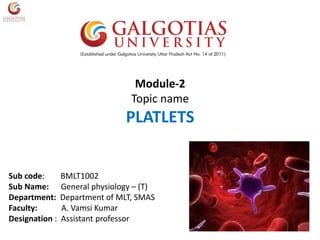
Module-2
Topic name
PLATLETS
Sub code: BMLT1002
Sub Name: General physiology – (T)
Department: Department of MLT, SMAS
Faculty: A. Vamsi Kumar
Designation : Assistant professor
Course outcomes
On completion of this course, the student can be
able to:
• Perform ESR, PCV, & Teach blood cell functions
Learning outcomes
On completion of this course, the student can be able to:
1. Be able to diagram the structure of a mature platelet and show the location of: dense granules,
alpha granules, glycoprotein Ib, glycoprotein IIb/IIIa, and phospholipids.
2. Be able to list three functions of platelets.
3. Be able to construct a simple diagram that depicts the process of platelet adhesion. Include in the
drawing subendothelial collagen, von Willebrand factor, and glycoprotein Ib. Explain why
platelet adhesion to blood vessels does not occur under normal circumstances.
4. Similarly, be able to construct a simple diagram that shows the process of platelet aggregation;
include the release reaction (ADP), thromboxane synthesis, ADP and thromboxane receptors,
glycoprotein IIb/IIIa, and fibrinogen.
5. List three mechanisms that could lead to thrombocytopenia.
6. Be able to identify three methods of treating ITP and the mechanism by which they increase the
platelet counts.
Contents
1. „Define platelets
2. Structure of platelets
3. Properties of platelets
4. Granules of platelets
5. Functions of platelets
6. Normal count of platelets
7. Clinical conditions of platelet dysfunction
Importance of platelets
Reference
• Essentials of medical physiology Sembulingam
6th edition.
Platlets

Platlets

  • 1.
    Module-2 Topic name PLATLETS Sub code:BMLT1002 Sub Name: General physiology – (T) Department: Department of MLT, SMAS Faculty: A. Vamsi Kumar Designation : Assistant professor
  • 2.
    Course outcomes On completionof this course, the student can be able to: • Perform ESR, PCV, & Teach blood cell functions
  • 3.
    Learning outcomes On completionof this course, the student can be able to: 1. Be able to diagram the structure of a mature platelet and show the location of: dense granules, alpha granules, glycoprotein Ib, glycoprotein IIb/IIIa, and phospholipids. 2. Be able to list three functions of platelets. 3. Be able to construct a simple diagram that depicts the process of platelet adhesion. Include in the drawing subendothelial collagen, von Willebrand factor, and glycoprotein Ib. Explain why platelet adhesion to blood vessels does not occur under normal circumstances. 4. Similarly, be able to construct a simple diagram that shows the process of platelet aggregation; include the release reaction (ADP), thromboxane synthesis, ADP and thromboxane receptors, glycoprotein IIb/IIIa, and fibrinogen. 5. List three mechanisms that could lead to thrombocytopenia. 6. Be able to identify three methods of treating ITP and the mechanism by which they increase the platelet counts.
  • 4.
    Contents 1. „Define platelets 2.Structure of platelets 3. Properties of platelets 4. Granules of platelets 5. Functions of platelets 6. Normal count of platelets 7. Clinical conditions of platelet dysfunction
  • 5.
  • 11.
    Reference • Essentials ofmedical physiology Sembulingam 6th edition.