Fever in a Post-Transplant
Patient
A Review – September 27, 2017
Matthew Fabiszak, D.O., PGY2
Pearls
• Post-transplant fever can be categorized into big categories:
• Infection
• Rejection
• Drug induced
• Post-Transplant Lymphoproliferative Disorders
• Risk and types of infection after transplant changes over time!
Infection
• It’s more difficult to recognize infection in transplant recipients than
in patients with normal immune function.
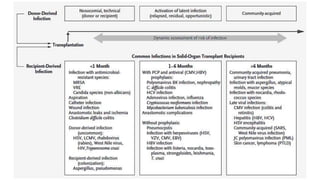
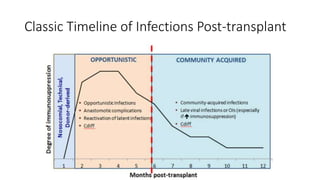
• Risk of infection after transplant changes over time, with
modifications in immunosuppression.
• Broadly, think in terms of 4 broad categories:
• Donor derived infections
• Recipient derived infections
• Nosocomial infections
• Community infections
Classic Timeline of Infections Post-transplant
Rejection
• Acute cellular rejection:
• Within 90 days of transplantation
• Late cellular rejection:
• Associated with low concentrations of immunosuppressive medications, and
associated with reduced graft survival.
• Biopsy is the gold standard for diagnosis
Medication Effect
• Cyclosporine/Tacrolimus toxicity
• Headache, fatigue, nephrotoxicity, fever (20-48%)
Post-Transplant Lymphoproliferative Disorders
(PTLD)
• Lymphoid or plasmacytic proliferations status post solid organ or
allogeneic hematopoietic cell transplantation secondary to
immunosuppression.
• Theorized to be related to EBV (although EBV negative disease can
occur 20-30% of cases)
• Risk factors include:
• Degree of immunosuppression
• EBV serostatus of recipient
• Treatment with anti-thymocyte globulin
Post-Transplant Lymphoproliferative Disorders
(PTLD)
• Early lesions
• This presents as an infectious mononucleosis-type acute illness characterized
by polyclonal B cell proliferation with no evidence to suggest malignant
transformation.
• Polymorphic PTLD
• Polyclonal or monoclonal lymphoid infiltrates that demonstrate evidence of
malignant transformation but do not meet all of the criteria for one of the B
cell or T/NK cell lymphomas recognized in immunocompetent patients.
• Monomorphic PTLD
• Monoclonal lymphoid proliferations that meet the criteria for one of the B cell
or T/NK cell lymphomas recognized in immunocompetent patients.
Post-Transplant Lymphoproliferative Disorders
(PTLD)
• Clinical presentation:
• Constitutional symptoms such as fever, weight loss, and fatigue are common
• Abnormal laboratory results:
• Unexplained anemia, thrombocytopenia, or leukopenia
• Elevated level of serum lactate dehydrogenase (LDH)
• Hypercalcemia
• Hyperuricemia
• Monoclonal protein in the serum or urine
Sources
• http://www.nejm.org/doi/pdf/10.1056/NEJMra064928
• https://www.uptodate.com/contents/infection-in-the-solid-organ-
transplant-recipient?source=search_result&search=Post-
Transplant%20fever&selectedTitle=1~150
• https://www.uptodate.com/contents/epidemiology-clinical-
manifestations-and-diagnosis-of-post-transplant-lymphoproliferative-
disorders?source=search_result&search=Post-
Transplant%20Lymphoproliferative%20Disorders&selectedTitle=1~86
• https://ucsfmed.wordpress.com/2016/11/14/fever-in-a-post-
transplant-patient/

Fever in a Post Transplant Patient

  • 1.
    Fever in aPost-Transplant Patient A Review – September 27, 2017 Matthew Fabiszak, D.O., PGY2
  • 2.
    Pearls • Post-transplant fevercan be categorized into big categories: • Infection • Rejection • Drug induced • Post-Transplant Lymphoproliferative Disorders • Risk and types of infection after transplant changes over time!
  • 3.
    Infection • It’s moredifficult to recognize infection in transplant recipients than in patients with normal immune function. • Risk of infection after transplant changes over time, with modifications in immunosuppression. • Broadly, think in terms of 4 broad categories: • Donor derived infections • Recipient derived infections • Nosocomial infections • Community infections
  • 5.
    Classic Timeline ofInfections Post-transplant
  • 6.
    Rejection • Acute cellularrejection: • Within 90 days of transplantation • Late cellular rejection: • Associated with low concentrations of immunosuppressive medications, and associated with reduced graft survival. • Biopsy is the gold standard for diagnosis
  • 7.
    Medication Effect • Cyclosporine/Tacrolimustoxicity • Headache, fatigue, nephrotoxicity, fever (20-48%)
  • 8.
    Post-Transplant Lymphoproliferative Disorders (PTLD) •Lymphoid or plasmacytic proliferations status post solid organ or allogeneic hematopoietic cell transplantation secondary to immunosuppression. • Theorized to be related to EBV (although EBV negative disease can occur 20-30% of cases) • Risk factors include: • Degree of immunosuppression • EBV serostatus of recipient • Treatment with anti-thymocyte globulin
  • 9.
    Post-Transplant Lymphoproliferative Disorders (PTLD) •Early lesions • This presents as an infectious mononucleosis-type acute illness characterized by polyclonal B cell proliferation with no evidence to suggest malignant transformation. • Polymorphic PTLD • Polyclonal or monoclonal lymphoid infiltrates that demonstrate evidence of malignant transformation but do not meet all of the criteria for one of the B cell or T/NK cell lymphomas recognized in immunocompetent patients. • Monomorphic PTLD • Monoclonal lymphoid proliferations that meet the criteria for one of the B cell or T/NK cell lymphomas recognized in immunocompetent patients.
  • 10.
    Post-Transplant Lymphoproliferative Disorders (PTLD) •Clinical presentation: • Constitutional symptoms such as fever, weight loss, and fatigue are common • Abnormal laboratory results: • Unexplained anemia, thrombocytopenia, or leukopenia • Elevated level of serum lactate dehydrogenase (LDH) • Hypercalcemia • Hyperuricemia • Monoclonal protein in the serum or urine
  • 11.
    Sources • http://www.nejm.org/doi/pdf/10.1056/NEJMra064928 • https://www.uptodate.com/contents/infection-in-the-solid-organ- transplant-recipient?source=search_result&search=Post- Transplant%20fever&selectedTitle=1~150 •https://www.uptodate.com/contents/epidemiology-clinical- manifestations-and-diagnosis-of-post-transplant-lymphoproliferative- disorders?source=search_result&search=Post- Transplant%20Lymphoproliferative%20Disorders&selectedTitle=1~86 • https://ucsfmed.wordpress.com/2016/11/14/fever-in-a-post- transplant-patient/