APPROACHTO
BLEEDING DISORDERS
PART- I
- Dr. Bidhan Chandra Nayak
- MD PGT, Department of Pathology,
- B.S. Medical College & Hospital
Part 1-
1) Normal coagulation homeostasis
2) Bleeding disorders- introduction & classification
3) Clinical evaluation of bleeding disorders
Part 2-
1) Lab investigations:-
I) Screening
A. Screening tests for primary hemostasis
B. Screening tests for secondary hemostasis
II) Specific tests
A. Tests for platelet functions
B. For coagulation factors
C. For fibrinolysis.
2) Different scenarios ~ Summary and conclusion
 Every human being has the same circulatory fluid ~ BLOOD.
 Blood flows within a closed system, in a fluid state ~ kept in fluidity by different factors.
 If this closed system, consisting of blood vessels, is injured  Blood tries to escape out of the vessels  to
prevent this, different regulatory mechanisms are activated to fill the gap with help of platelets,
coagulation factors & some other substances this process is k/a Hemostasis.
 In homeostasis this regulatory mechanism balances between factors promoting hemostasis (procoagulant)
and factors inhibiting hemostasis (anticoagulant).
 So, obviously there are 2 possible extreme abnormalities of this regulatory process  1) ed Procoagulant
&/or ed Anticoagulant activity resulting in hypercoagulability, 2) ed Procoagulant &/or ed Anticoagulant
activity resulting in ed propensity to bleed.
INTRODUCTION:-
Prevention of blood clotting in normal blood vessels :–
• The smoothness of vascular endothelium prevents platelet adhesion and contact
activation of intrinsic clotting cascade.
• A layer of Glycocalyx on endothelium repels platelets and intrinsic factor to contact .
• Protein bound to endothelium called Trombomodulin binds with Thrombin and slows
the process of clotting and their complex molecule “ Thrombomodulin-thrombin“
activates protein C , inhibits factor V and VIII.
• Anticoagulants are also present in blood itself ----They remove thrombin from the
blood.
Normal Coagulation Homeostasis
 Hemostasis is a precisely orchestrated process involving platelets, clotting
factors, and endothelium that occurs at the site of vascular injury and
culminates in the formation of a blood clot, which serves to prevent or limit the
extent of bleeding.
DEFINITION OF HEMOSTASIS:-
 Primary haemostasis involves the
binding of platelets to exposed
collagen in the sub endothelium of
damaged vessels.
 Secondary haemostasis is the process
of activation of coagulation factors
leading to the production of
thrombin.
7
(A)  After vascular injury, local neurohumoral
factors induce a transient vasoconstriction.
(B)  Platelets bind via glycoprotein Ib (GpIb)
receptors to von Willebrand factor (vWF) on exposed
extracellular matrix (ECM) and are activated,
undergoing a shape change and granule release.
Released ADP & thromboxane A2 (TxA2) induce
additional platelet aggregation through platelet
GpIIb-IIIa receptor binding to fibrinogen, and form
the primary hemostatic plug.
Platelet adhesion and aggregation-
Von Willebrand factor functions as an
adhesion bridge between subendothelial
collagen and the glycoprotein Ib (GpIb)
platelet receptor. Aggregation occurs by
fibrinogen bridging GpIIb-IIIa receptors on
different platelets.
Congenital deficiencies in the various
receptors or bridging molecules lead to
different diseases.
(C)  Local activation of the coagulation cascade
(involving tissue factor and platelet phospholipids) results
in fibrin polymerization, “cementing” the platelets into a
definitive secondary hemostatic plug.
(D)  Counterregulatory mechanisms, mediated by
tissue plasminogen activator (t-PA, a fibrinolytic product)
and thrombomodulin, confine the hemostatic process to
the site of injury
SIMPLIFIED DIAGRAM OF COAGULATION CASCADE:-
..COAGULATION CASCADE.. Cont’d. :-
Procoagulant & Anticoagulant factors
PROCOAGULANT FACTORS :-
PROCOAGULANT FACTORS.. Cont’d.. :-
ANTICOAGULANT FACTORS:-
Some Other Inhibitors of Coagulation:-
 α2 macroglobulin – It act as antithrombin, antiplasmin and inactivate kallikrein.
α2 antitrypsin ( alpha globulin) – Inhibitor of factor XIa and antiplasmin and is weakly antithrombin.
α2 antiplasmin – Inactivate plasmin.
Heparin – inhibit the action of thrombin - delay the interaction of thrombin and fibrinogen.
ANTICOAGULANTS..regulating the coagulation cascade:-
FIBRINOLYSIS:-
So, it’s all about a
finely tuned balance ~
regulating
Procoagulant,
Anticoagulant &
Fibrinolytic factors..
Bleeding disorders – Introduction &
Classification
Bleeding disorders can be due to
Blood vessel anomalies Platelet abnormalities Coagulation disorders
Disorders associated with abnormal bleeding inevitably stem from
primary or secondary defects in vessel walls, platelets, or coagulation
factors, all of which must function properly to ensure hemostasis.
HEREDITARY:-
1) Hereditary hemorrhagic telangiectasia (Osler–Weber–Rendu disease )
2) Ehler Danlos Syndrome
ALLERGIC:-
1) Henoch–Schönlein purpura (HSP)
2) Leucocytoclastic angitis
ATROPHIC:-
1) Senile purpura
2) Scurvy
MISCELLANEOUS:-
1) Simple easy bruising
2) Amyloidosis
3) Infections
DISORDERS OF VESSEL WALL:-
PLATELET
ABNORMALITIES
QUALITATIVE QUANTITATIVE
•THROMBASTHENIA
•BERNARD-SOULIER SYNDROME
•DRUGS(ASPIRIN,TXA2,INDOMETHACIN
•THROMBOCYTOPENIA
•THROMBOCYTHEMIA
PLATELET DISORDERS:-
PLATELET DISORDERS.. Cont’d:-
DISORDERS OF COAGULATION:-
INHERITED ACQUIRED
HEMOPHILIAA DIC
HEMOPHILIA B LIVER DISEASE
vWD HDN
DISORDERS OF FIBRINOGEN-
HEREDITARY AFIBRINOGENAEMIA
HYPOFIBRINOGENAEMIA
DYSFIBRINOGENAEMIA
Nephrotic Syndrome
FXIII deficiency APLS
FV deficiency HEPARIN OR ORAL ANTICOAGULANT
THERAPY
VIT K DEFICIENCY
MASSIVE TRANSFUSION OF STORED
BLOOD
COAGULATION FACTOR DEFICIENCIES:-
BLEEDING DISORDERS ~ Diagnostic
approach
Diagnosis of bleeding disorders ~ a stepwise approach ~
HISTORY
CLINICAL EXAMINATION
LABORATORY INVESTIGATIONS
BLEEDING DISORDERS - Clinical evaluation
~ A diagnostic tool
HISTORY:-
1)Age of first manifestation,
2)Family history of bleeding,
3)Spontaneous or after trauma,
4) Time of manifestation after injury,
5)Ease with which bleeding is controlled,
6) Drug history.
Clinical evaluation:-
INHERITED DISORDERS
• Early age of presentation
• Family history positive
• More severe
• Bleeding is the dominant feature
• Single factor defect
ACQUIRED DISORDERS
• Later age of presentation
• Family history usually negative
• Less severe
• Clinical picture is dominated by the
underlying disorder e.g.DIC
• Multiple hemostatic defect
Clinical evaluation.. Cont’d:-
HEREDITARY ACQUIRED
1) History of disorder only in males on the maternal
side for many generations – X linked recessive
Hemophilia A or B.
2) History of consanguineous marriage, both males
and females only from the current generation
affected –Autosomal recessive disorders like
afibrinogenemia, FactorV or Factor X deficiency,
vWD disease(Types 1 and 2 autosomal dominant
traits and type 3 autosomal recessive, type 2
Occasionally AR)
3) Bleeding in both males and females, bleeding in one
parent, bleeding in all generations – Autosomal
dominantdisorders like von willebrand disease,
hereditary hemorrhagic telengectasia
Usually secondary to disorders of
1. liver
2. uremia
3. hematologic malignancies
4. carcinoma
5. sepsis
Clinical evaluation.. Cont’d:-
Pinpoint purpura
Petechiae, Purpura and Ecchymoses are the three terms that refer to bleeding that occurs in the skin.
The term “petechiae” refers to smaller lesions. “Purpura” and “ecchymoses” are terms that refer to larger lesions.
Petechiae  <3 mm, Purpura 0.3–1 cm (3–10 mm), ecchymoses >1 cm.
Clinical evaluation.. Cont’d:-
ECCHYMOSES IN ARM
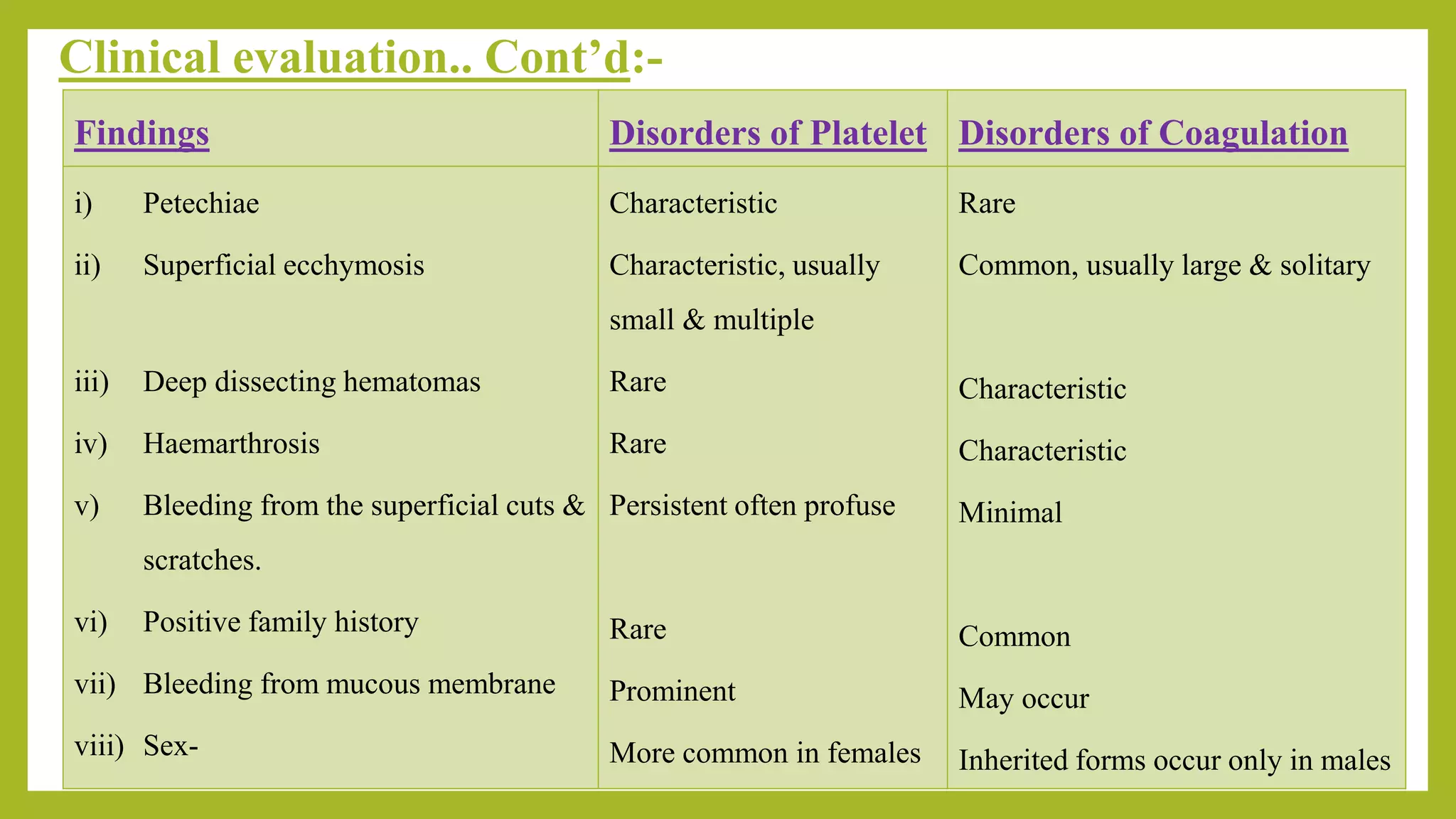
Findings Disorders of Platelet Disorders of Coagulation
i) Petechiae
ii) Superficial ecchymosis
iii) Deep dissecting hematomas
iv) Haemarthrosis
v) Bleeding from the superficial cuts &
scratches.
vi) Positive family history
vii) Bleeding from mucous membrane
viii) Sex-
Characteristic
Characteristic, usually
small & multiple
Rare
Rare
Persistent often profuse
Rare
Prominent
More common in females
Rare
Common, usually large & solitary
Characteristic
Characteristic
Minimal
Common
May occur
Inherited forms occur only in males
Clinical evaluation.. Cont’d:-
PALPABLE PURPURA:-
Mn- HoPe DREAM
Henoch-Schönlein purpura (HSP)
Polyarteritis Nodosa
Disseminated gonococcal infection
Rocky Mountain Spotted Fever
Ecthyma gangrenosum
Acute meningococcemia
Mixed cryoglobulinemia
Clinical evaluation.. Cont’d:-
Hemarthrosis in a case of Hemophilia Purpura in a case of ITP
Clinical evaluation.. Cont’d:-
Henoch–Schönlein purpura (HSP):- Typical purpura on lower limbs and buttocks
Clinical evaluation.. Cont’d:-
SCURVY – Easy bruising SCURVY – Gum bleeding
Thank you..

Approach to bleeding disorders part 1

  • 1.
    APPROACHTO BLEEDING DISORDERS PART- I -Dr. Bidhan Chandra Nayak - MD PGT, Department of Pathology, - B.S. Medical College & Hospital
  • 2.
    Part 1- 1) Normalcoagulation homeostasis 2) Bleeding disorders- introduction & classification 3) Clinical evaluation of bleeding disorders Part 2- 1) Lab investigations:- I) Screening A. Screening tests for primary hemostasis B. Screening tests for secondary hemostasis II) Specific tests A. Tests for platelet functions B. For coagulation factors C. For fibrinolysis. 2) Different scenarios ~ Summary and conclusion
  • 3.
     Every humanbeing has the same circulatory fluid ~ BLOOD.  Blood flows within a closed system, in a fluid state ~ kept in fluidity by different factors.  If this closed system, consisting of blood vessels, is injured  Blood tries to escape out of the vessels  to prevent this, different regulatory mechanisms are activated to fill the gap with help of platelets, coagulation factors & some other substances this process is k/a Hemostasis.  In homeostasis this regulatory mechanism balances between factors promoting hemostasis (procoagulant) and factors inhibiting hemostasis (anticoagulant).  So, obviously there are 2 possible extreme abnormalities of this regulatory process  1) ed Procoagulant &/or ed Anticoagulant activity resulting in hypercoagulability, 2) ed Procoagulant &/or ed Anticoagulant activity resulting in ed propensity to bleed. INTRODUCTION:-
  • 4.
    Prevention of bloodclotting in normal blood vessels :– • The smoothness of vascular endothelium prevents platelet adhesion and contact activation of intrinsic clotting cascade. • A layer of Glycocalyx on endothelium repels platelets and intrinsic factor to contact . • Protein bound to endothelium called Trombomodulin binds with Thrombin and slows the process of clotting and their complex molecule “ Thrombomodulin-thrombin“ activates protein C , inhibits factor V and VIII. • Anticoagulants are also present in blood itself ----They remove thrombin from the blood.
  • 5.
  • 6.
     Hemostasis isa precisely orchestrated process involving platelets, clotting factors, and endothelium that occurs at the site of vascular injury and culminates in the formation of a blood clot, which serves to prevent or limit the extent of bleeding. DEFINITION OF HEMOSTASIS:-
  • 7.
     Primary haemostasisinvolves the binding of platelets to exposed collagen in the sub endothelium of damaged vessels.  Secondary haemostasis is the process of activation of coagulation factors leading to the production of thrombin. 7
  • 9.
    (A)  Aftervascular injury, local neurohumoral factors induce a transient vasoconstriction. (B)  Platelets bind via glycoprotein Ib (GpIb) receptors to von Willebrand factor (vWF) on exposed extracellular matrix (ECM) and are activated, undergoing a shape change and granule release. Released ADP & thromboxane A2 (TxA2) induce additional platelet aggregation through platelet GpIIb-IIIa receptor binding to fibrinogen, and form the primary hemostatic plug.
  • 10.
    Platelet adhesion andaggregation- Von Willebrand factor functions as an adhesion bridge between subendothelial collagen and the glycoprotein Ib (GpIb) platelet receptor. Aggregation occurs by fibrinogen bridging GpIIb-IIIa receptors on different platelets. Congenital deficiencies in the various receptors or bridging molecules lead to different diseases.
  • 11.
    (C)  Localactivation of the coagulation cascade (involving tissue factor and platelet phospholipids) results in fibrin polymerization, “cementing” the platelets into a definitive secondary hemostatic plug. (D)  Counterregulatory mechanisms, mediated by tissue plasminogen activator (t-PA, a fibrinolytic product) and thrombomodulin, confine the hemostatic process to the site of injury
  • 12.
    SIMPLIFIED DIAGRAM OFCOAGULATION CASCADE:-
  • 13.
  • 16.
  • 17.
  • 18.
  • 19.
    ANTICOAGULANT FACTORS:- Some OtherInhibitors of Coagulation:-  α2 macroglobulin – It act as antithrombin, antiplasmin and inactivate kallikrein. α2 antitrypsin ( alpha globulin) – Inhibitor of factor XIa and antiplasmin and is weakly antithrombin. α2 antiplasmin – Inactivate plasmin. Heparin – inhibit the action of thrombin - delay the interaction of thrombin and fibrinogen.
  • 20.
  • 21.
  • 22.
    So, it’s allabout a finely tuned balance ~ regulating Procoagulant, Anticoagulant & Fibrinolytic factors..
  • 23.
    Bleeding disorders –Introduction & Classification
  • 24.
    Bleeding disorders canbe due to Blood vessel anomalies Platelet abnormalities Coagulation disorders Disorders associated with abnormal bleeding inevitably stem from primary or secondary defects in vessel walls, platelets, or coagulation factors, all of which must function properly to ensure hemostasis.
  • 25.
    HEREDITARY:- 1) Hereditary hemorrhagictelangiectasia (Osler–Weber–Rendu disease ) 2) Ehler Danlos Syndrome ALLERGIC:- 1) Henoch–Schönlein purpura (HSP) 2) Leucocytoclastic angitis ATROPHIC:- 1) Senile purpura 2) Scurvy MISCELLANEOUS:- 1) Simple easy bruising 2) Amyloidosis 3) Infections DISORDERS OF VESSEL WALL:-
  • 26.
  • 27.
  • 28.
    DISORDERS OF COAGULATION:- INHERITEDACQUIRED HEMOPHILIAA DIC HEMOPHILIA B LIVER DISEASE vWD HDN DISORDERS OF FIBRINOGEN- HEREDITARY AFIBRINOGENAEMIA HYPOFIBRINOGENAEMIA DYSFIBRINOGENAEMIA Nephrotic Syndrome FXIII deficiency APLS FV deficiency HEPARIN OR ORAL ANTICOAGULANT THERAPY VIT K DEFICIENCY MASSIVE TRANSFUSION OF STORED BLOOD
  • 29.
  • 30.
    BLEEDING DISORDERS ~Diagnostic approach
  • 31.
    Diagnosis of bleedingdisorders ~ a stepwise approach ~ HISTORY CLINICAL EXAMINATION LABORATORY INVESTIGATIONS
  • 32.
    BLEEDING DISORDERS -Clinical evaluation ~ A diagnostic tool
  • 33.
    HISTORY:- 1)Age of firstmanifestation, 2)Family history of bleeding, 3)Spontaneous or after trauma, 4) Time of manifestation after injury, 5)Ease with which bleeding is controlled, 6) Drug history. Clinical evaluation:-
  • 34.
    INHERITED DISORDERS • Earlyage of presentation • Family history positive • More severe • Bleeding is the dominant feature • Single factor defect ACQUIRED DISORDERS • Later age of presentation • Family history usually negative • Less severe • Clinical picture is dominated by the underlying disorder e.g.DIC • Multiple hemostatic defect Clinical evaluation.. Cont’d:-
  • 35.
    HEREDITARY ACQUIRED 1) Historyof disorder only in males on the maternal side for many generations – X linked recessive Hemophilia A or B. 2) History of consanguineous marriage, both males and females only from the current generation affected –Autosomal recessive disorders like afibrinogenemia, FactorV or Factor X deficiency, vWD disease(Types 1 and 2 autosomal dominant traits and type 3 autosomal recessive, type 2 Occasionally AR) 3) Bleeding in both males and females, bleeding in one parent, bleeding in all generations – Autosomal dominantdisorders like von willebrand disease, hereditary hemorrhagic telengectasia Usually secondary to disorders of 1. liver 2. uremia 3. hematologic malignancies 4. carcinoma 5. sepsis Clinical evaluation.. Cont’d:-
  • 36.
    Clinical evaluation.. Cont’d:- Pinpointpurpura Petechiae, Purpura and Ecchymoses are the three terms that refer to bleeding that occurs in the skin. The term “petechiae” refers to smaller lesions. “Purpura” and “ecchymoses” are terms that refer to larger lesions. Petechiae  <3 mm, Purpura 0.3–1 cm (3–10 mm), ecchymoses >1 cm.
  • 37.
  • 38.
    Findings Disorders ofPlatelet Disorders of Coagulation i) Petechiae ii) Superficial ecchymosis iii) Deep dissecting hematomas iv) Haemarthrosis v) Bleeding from the superficial cuts & scratches. vi) Positive family history vii) Bleeding from mucous membrane viii) Sex- Characteristic Characteristic, usually small & multiple Rare Rare Persistent often profuse Rare Prominent More common in females Rare Common, usually large & solitary Characteristic Characteristic Minimal Common May occur Inherited forms occur only in males Clinical evaluation.. Cont’d:-
  • 39.
  • 40.
    Clinical evaluation.. Cont’d:- PALPABLEPURPURA:- Mn- HoPe DREAM Henoch-Schönlein purpura (HSP) Polyarteritis Nodosa Disseminated gonococcal infection Rocky Mountain Spotted Fever Ecthyma gangrenosum Acute meningococcemia Mixed cryoglobulinemia
  • 41.
    Clinical evaluation.. Cont’d:- Hemarthrosisin a case of Hemophilia Purpura in a case of ITP
  • 42.
    Clinical evaluation.. Cont’d:- Henoch–Schönleinpurpura (HSP):- Typical purpura on lower limbs and buttocks
  • 43.
    Clinical evaluation.. Cont’d:- SCURVY– Easy bruising SCURVY – Gum bleeding
  • 44.