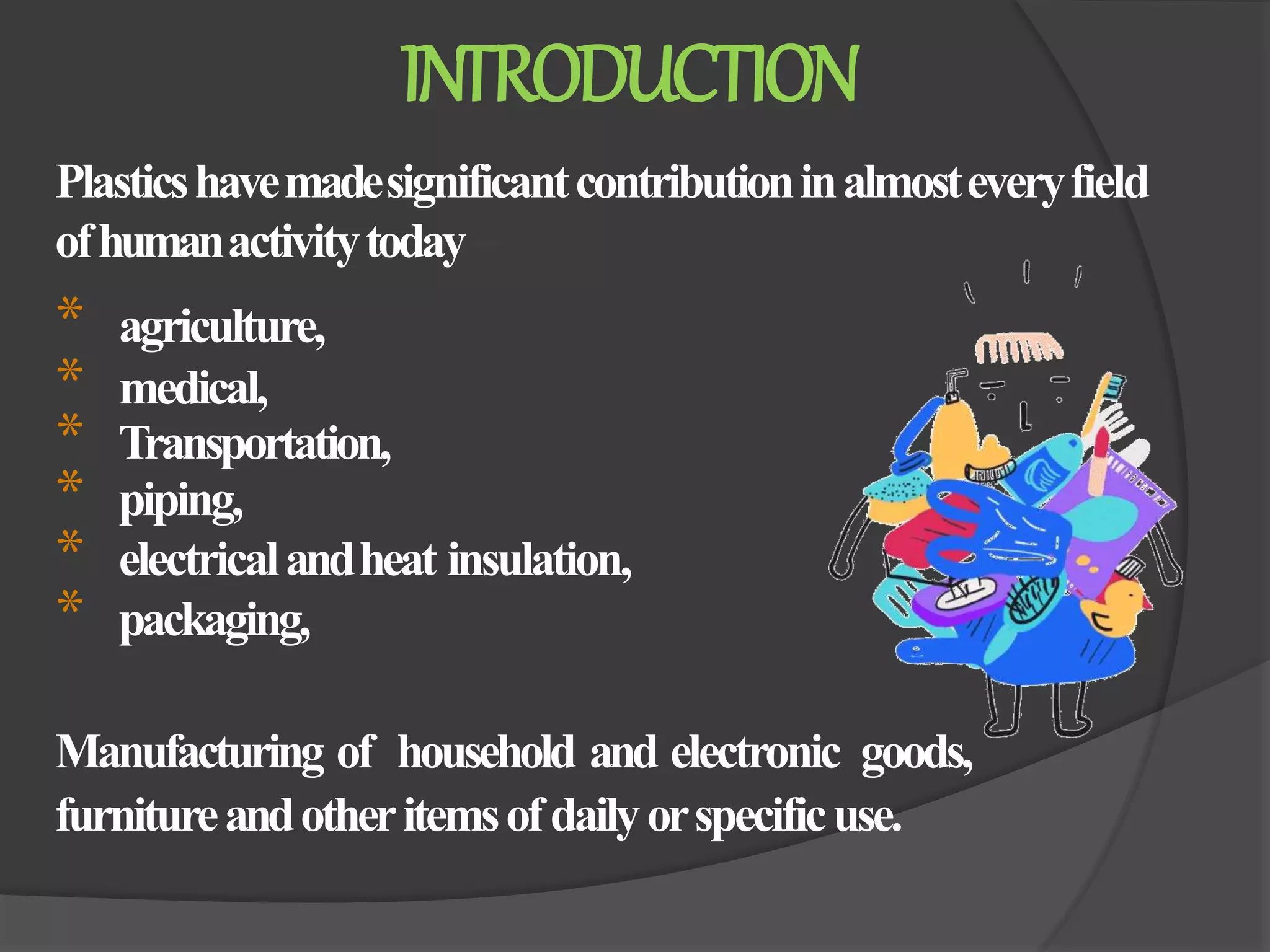
Plasticshavemadesignificantcontributioninalmosteveryfield
ofhumanactivitytoday–
* agriculture,
* medical,
* Transportation,
* piping,
* electricalandheat insulation,
* packaging,
Manufacturing of household and electronic goods,
furnitureandotheritemsofdailyorspecificuse.
INTRODUCTION
Plastics are widely used because of theirlight weight nature,
durability, potential for diverse applications and low price.
i. Hygienic –inert and chemical resistance
ii. Light weight and non-breakability
iii. Excellent barrier properties - enhancing shelf-life,
iv. Superior impact resistance,
v.Sterilizable and resistance to bacterial and other microbialGrowth,
vi. Transparencyaswellas opacity.
WHY PLASTIC USE?
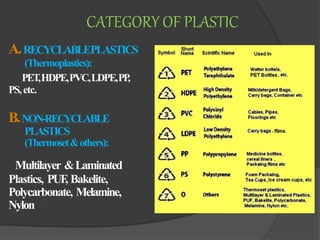
A.RECYCLABLEPLASTICS
(Thermoplastics):
PET,HDPE,PVC,LDPE,PP
,
PS,etc.
B.NON-RECYCLABLE
PLASTICS
(Thermoset&others):
Multilayer &Laminated
Plastics, PUF
, Bakelite,
Polycarbonate, Melamine,
Nylon etc.
CATEGORY OF PLASTIC
CONTAMINATIONOFMARINEENVIRONMENT
BYPLASTICDEBRIS
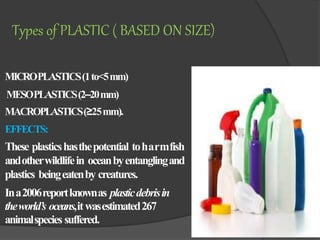
MICROPLASTICS(1to<5mm)
MESOPLASTICS(2–20mm)
MACROPLASTICS(≥25mm).
EFFECTS:
These plasticshasthepotential toharmfish
andotherwildlifein oceanbyentanglingand
plastics beingeatenby creatures.
Ina2006reportknownas plasticdebrisin
theworld’s oceans,itwasestimated267
animalspecies suffered.
Types of PLASTIC ( BASED ON SIZE)
TECHNOLOGIES FOR PLASTIC
WASTE MANAGEMENT (PWM)
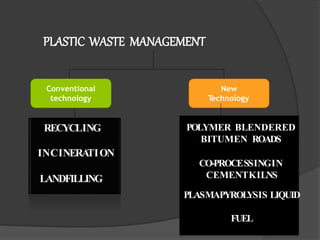
PLASTIC WASTE MANAGEMENT
Conventional
technology
New
T
echnology
RECYCLING
INCINERA
TION
LANDFILLING
POLYMER BLENDERED
BITUMEN ROADS
CO-PROCESSINGIN
CEMENTKILNS
PLASMAPYROL
YSIS LIQUID
FUEL
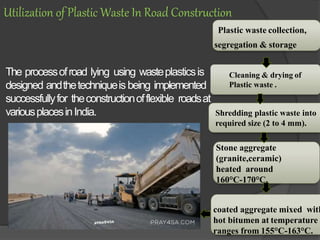
The processofroad lying using wasteplasticsis
designed andthetechniqueis being implemented
successfullyfor theconstructionofflexible roadsat
variousplacesinIndia.
Plastic waste collection,
segregation & storage
Cleaning & drying of
Plastic waste .
Shredding plastic waste into
required size (2 to 4 mm).
Stone aggregate
(granite,ceramic)
heated around
160°C-170°C.
coated aggregate mixed with
hot bitumen at temperature
ranges from 155°C-163°C.
Utilization of Plastic Waste In Road Construction
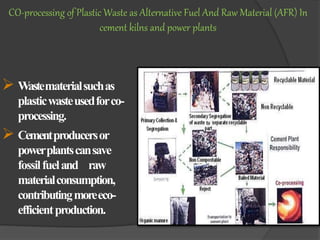
 Wastematerialsuchas
plasticwasteusedforco-
processing.
 Cementproducersor
powerplantscansave
fossilfueland raw
materialconsumption,
contributingmoreeco-
efficientproduction.
CO-processing of Plastic Waste as Alternative Fuel And Raw Material (AFR) In
cement kilns and power plants
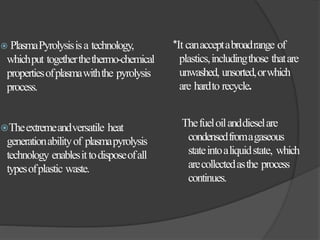
*It canacceptabroadrange of
plastics,includingthose thatare
unwashed, unsorted,orwhich
are hardto recycle.
 PlasmaPyrolysisisa technology,
whichput togetherthethermo-chemical
propertiesofplasmawiththe pyrolysis
process.
Theextremeandversatile heat
generationabilityof plasmapyrolysis
technology enablesittodisposeofall
typesofplastic waste.
Thefueloilanddieselare
condensedfromagaseous
stateintoaliquidstate, which
arecollectedasthe process
continues.
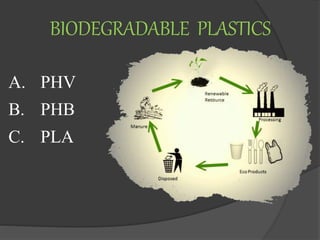
BIODEGRADABLE PLASTICS
A. PHV
B. PHB
C. PLA
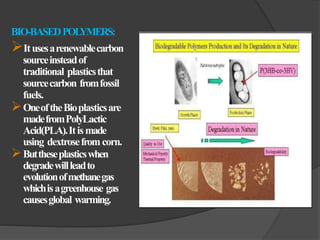
BIO-BASEDPOL
YMERS:
Itusesarenewablecarbon
sourceinsteadof
traditional plasticsthat
sourcecarbon fromfossil
fuels.
OneoftheBioplasticsare
madefromPolyLactic
Acid(PLA).Itismade
using dextrosefrom corn.
Buttheseplasticswhen
degradewillleadto
evolutionofmethanegas
whichisagreenhouse gas
causesglobal warming.
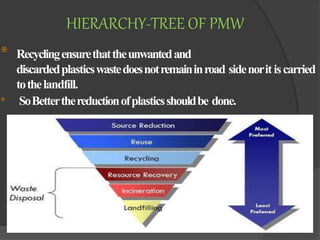
* Recyclingensurethattheunwantedand
discardedplasticswastedoesnotremaininroad sidenoritiscarried
tothelandfill.
* SoBetterthereductionofplasticsshouldbe done.
HIERARCHY-TREE OF PMW
CONCLUSION
*Recyclingofwasteplasticsisanefficientwaytoimprove the
environmentalproblems.
*Appropriateeducationprogrammes,measurementof sourcescanbe
effectiveinpromotingchangesindisposal practicesthatultimately
reducetheamountsofplastic enteringtheenvironment.
*PlasticWasteManagementhasassumedgreat significanceinpresent
daycontext.Variousschemeshas tobeimplementedtomitigatethe
impactsofplasticwaste acrosstheworld.
Thank you

Plastic waste management