PLASTIC
PREVENTING ENVIRONMENT FROM PLASTIC
INTRODUCTION
 What is Plastics ?
 Types of Plastics
 Common plastic and uses
 History of plastic
 Bakelite
 Prevention
 Control
 Reduction
What is plastic ?
 Plastic is a material consisting of any of a wide range of synthetic or semi-
synthetic organics that are malleable and can be molded into solid objects of diverse shapes.
Plastics are typically organic polymers of high molecular mass, but they often contain other
substances. They are usually synthetic, most commonly derived from petrochemicals, but
many are partially natural.[2] Plasticity is the general property of all materials that are able
to irreversibly deform without breaking, but this occurs to such a degree with this class of
moldable polymers that their name is an emphasis on this ability.
 Due to their relatively low cost, ease of manufacture, versatility, and imperviousness to
water, plastics are used in an enormous and expanding range of products, from paper clips to
spaceships. They have already displaced many traditional materials, such
as wood, stone, horn and bone, leather, paper, metal, glass, and ceramic, in most of their
former uses. In developed countries, about a third of plastic is used in packaging and another
third in buildings such as piping used in plumbing or vinyl siding.[3] Other uses include
automobiles (up to 20% plastic[3]), furniture, and toys.[3] In the developing world, the ratios
may be different - for example, reportedly 42% of India's consumption is used in
packaging.[3] Plastics have many uses in the medical field as well, to include polymer
implants, however the field of plastic surgery is not named for use of plastic material, but
rather the more generic meaning of the word plasticity in regards to the reshaping of flesh.
Types of Plastics
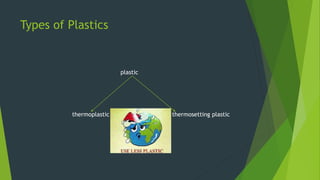
plastic
thermoplastic thermosetting plastic
THERMOSETTING AND THERMOPLASTIC
 There are two types of plastics: thermoplastics and thermosetting polymers.
Thermoplastics are the plastics that do not undergo chemical change in their
composition when heated and can be molded again and again. Examples
include polyethylene, polypropylene, polystyrene and polyvinyl
chloride.[18] Common thermoplastics range from 20,000 to 500,000 while
thermosets are assumed to have infinite molecular weight. These chains are
made up of many repeating molecular units, known as repeat units, derived
from monomers; each polymer chain will have several thousand repeating
units.
 Thermosets can melt and take shape once; after they have solidified, they
stay solid. In the thermosetting process, a chemical reaction occurs that is
irreversible. The vulcanization of rubber is a thermosetting process. Before
heating with sulphur, the polyisoprene is a tacky, slightly runny material, but
after vulcanization the product is rigid and non-tacky.
Common plastic and uses
 Polypropylene (PP) – Bottle caps, drinking straws, yogurt containers,
appliances, car fenders (bumpers), plastic pressure pipe systems.
 Polystyrene (PS) – Packaging foam/"peanuts", food containers, plastic
tableware, disposable cups, plates, cutlery, CD and cassette boxes.
 High impact polystyrene (HIPS) -: Refrigerator liners, food packaging, vending
cups.
 Polyamides (PA) (Nylons) – Fibres, toothbrush bristles, tubing, fishing line, low
strength machine parts: under-the-hood car engine parts or gun frames.
 Acrylonitrile butadiene styrene (ABS) – Electronic equipment cases (e.g.,
computer monitors, printers, keyboards), drainage pipe.
 Polyethylene/Acrylonitrile Butadiene Styrene (PE/ABS) – A slippery blend of PE
and ABS used in low-duty dry bearings.
History of plastic
 The development of plastics has evolved from the use of natural plastic
materials (e.g., chewing gum, shellac) to the use of chemically modified,
natural materials (e.g., rubber, nitrocellulose, collagen, galalite) and finally
to completely synthetic molecules (e.g., Bakelite, epoxy, Polyvinyl chloride).
Early plastics were bio-derived materials such as egg and blood proteins,
which are organic polymers. In 1600 BC, Mesoamericans used natural rubber
for balls, bands, and figurines.[3]Treated cattle horns were used as windows
for lanterns in the Middle Ages. Materials that mimicked the properties of
horns were developed by treating milk-proteins (casein) with lye.
Bakelite
 The first plastic based on a synthetic polymer was made
from phenol and formaldehyde, with the first viable and cheap synthesis
methods invented in 1907, by Leo Hendrik Baekeland, a Belgian-born
American living in New York state. Baekeland was looking for an insulating
shellac to coat wires in electric motors and generators. He found that
combining phenol (C6H5OH) and formaldehyde (HCOH) formed a sticky mass
and later found that the material could be mixed with wood flour, asbestos,
or slate dust to create strong and fire resistant "composite" materials. The
new material tended to foam during synthesis, requiring that Baekeland build
pressure vessels to force out the bubbles and provide a smooth, uniform
product, as he announced in 1909, in a meeting of the American Chemical
Society.[23] Bakelite was originally used for electrical and mechanical parts,
coming into widespread use in consumer goods and jewelry in the 1920s.
Prevention,control and reduction
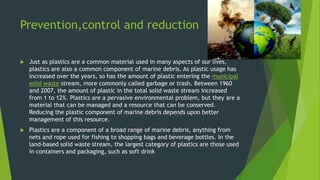
 Just as plastics are a common material used in many aspects of our lives,
plastics are also a common component of marine debris. As plastic usage has
increased over the years, so has the amount of plastic entering the municipal
solid waste stream, more commonly called garbage or trash. Between 1960
and 2007, the amount of plastic in the total solid waste stream increased
from 1 to 12%. Plastics are a pervasive environmental problem, but they are a
material that can be managed and a resource that can be conserved.
Reducing the plastic component of marine debris depends upon better
management of this resource.
 Plastics are a component of a broad range of marine debris, anything from
nets and rope used for fishing to shopping bags and beverage bottles. In the
land-based solid waste stream, the largest category of plastics are those used
in containers and packaging, such as soft drink
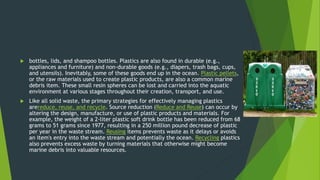
 bottles, lids, and shampoo bottles. Plastics are also found in durable (e.g.,
appliances and furniture) and non-durable goods (e.g., diapers, trash bags, cups,
and utensils). Inevitably, some of these goods end up in the ocean. Plastic pellets,
or the raw materials used to create plastic products, are also a common marine
debris item. These small resin spheres can be lost and carried into the aquatic
environment at various stages throughout their creation, transport, and use.
 Like all solid waste, the primary strategies for effectively managing plastics
arereduce, reuse, and recycle. Source reduction (Reduce and Reuse) can occur by
altering the design, manufacture, or use of plastic products and materials. For
example, the weight of a 2-liter plastic soft drink bottle has been reduced from 68
grams to 51 grams since 1977, resulting in a 250 million pound decrease of plastic
per year in the waste stream. Reusing items prevents waste as it delays or avoids
an item's entry into the waste stream and potentially the ocean. Recycling plastics
also prevents excess waste by turning materials that otherwise might become
marine debris into valuable resources.
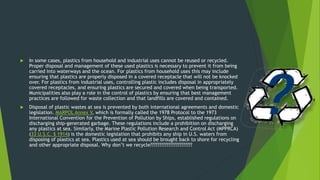
 In some cases, plastics from household and industrial uses cannot be reused or recycled.
Proper disposal and management of these used plastics is necessary to prevent it from being
carried into waterways and the ocean. For plastics from household uses this may include
ensuring that plastics are properly disposed in a covered receptacle that will not be knocked
over. For plastics from industrial uses, controlling plastic includes disposal in appropriately
covered receptacles, and ensuring plastics are secured and covered when being transported.
Municipalities also play a role in the control of plastics by ensuring that best management
practices are followed for waste collection and that landfills are covered and contained.
 Disposal of plastic wastes at sea is prevented by both international agreements and domestic
legislation. MARPOL Annex V, which is formally called the 1978 Protocol to the 1973
International Convention for the Prevention of Pollution by Ships, established regulations on
discharging ship-generated garbage. These regulations include a prohibition on discharging
any plastics at sea. Similarly, the Marine Plastic Pollution Research and Control Act (MPPRCA)
(33 U.S.C. § 1914) is the domestic legislation that prohibits any ship in U.S. waters from
disposing of plastics at sea. Plastics used at sea should be brought back to shore for recycling
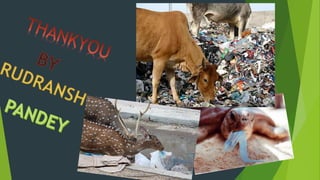
and other appropriate disposal. Why don’t we recycle???????????????????????
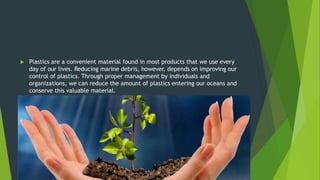
 Plastics are a convenient material found in most products that we use every
day of our lives. Reducing marine debris, however, depends on improving our
control of plastics. Through proper management by individuals and
organizations, we can reduce the amount of plastics entering our oceans and
conserve this valuable material.

Plastic

Plastic

  • 1.
  • 2.
    INTRODUCTION  What isPlastics ?  Types of Plastics  Common plastic and uses  History of plastic  Bakelite  Prevention  Control  Reduction
  • 3.
    What is plastic?  Plastic is a material consisting of any of a wide range of synthetic or semi- synthetic organics that are malleable and can be molded into solid objects of diverse shapes. Plastics are typically organic polymers of high molecular mass, but they often contain other substances. They are usually synthetic, most commonly derived from petrochemicals, but many are partially natural.[2] Plasticity is the general property of all materials that are able to irreversibly deform without breaking, but this occurs to such a degree with this class of moldable polymers that their name is an emphasis on this ability.  Due to their relatively low cost, ease of manufacture, versatility, and imperviousness to water, plastics are used in an enormous and expanding range of products, from paper clips to spaceships. They have already displaced many traditional materials, such as wood, stone, horn and bone, leather, paper, metal, glass, and ceramic, in most of their former uses. In developed countries, about a third of plastic is used in packaging and another third in buildings such as piping used in plumbing or vinyl siding.[3] Other uses include automobiles (up to 20% plastic[3]), furniture, and toys.[3] In the developing world, the ratios may be different - for example, reportedly 42% of India's consumption is used in packaging.[3] Plastics have many uses in the medical field as well, to include polymer implants, however the field of plastic surgery is not named for use of plastic material, but rather the more generic meaning of the word plasticity in regards to the reshaping of flesh.
  • 4.
  • 5.
    THERMOSETTING AND THERMOPLASTIC There are two types of plastics: thermoplastics and thermosetting polymers. Thermoplastics are the plastics that do not undergo chemical change in their composition when heated and can be molded again and again. Examples include polyethylene, polypropylene, polystyrene and polyvinyl chloride.[18] Common thermoplastics range from 20,000 to 500,000 while thermosets are assumed to have infinite molecular weight. These chains are made up of many repeating molecular units, known as repeat units, derived from monomers; each polymer chain will have several thousand repeating units.  Thermosets can melt and take shape once; after they have solidified, they stay solid. In the thermosetting process, a chemical reaction occurs that is irreversible. The vulcanization of rubber is a thermosetting process. Before heating with sulphur, the polyisoprene is a tacky, slightly runny material, but after vulcanization the product is rigid and non-tacky.
  • 6.
    Common plastic anduses  Polypropylene (PP) – Bottle caps, drinking straws, yogurt containers, appliances, car fenders (bumpers), plastic pressure pipe systems.  Polystyrene (PS) – Packaging foam/"peanuts", food containers, plastic tableware, disposable cups, plates, cutlery, CD and cassette boxes.  High impact polystyrene (HIPS) -: Refrigerator liners, food packaging, vending cups.  Polyamides (PA) (Nylons) – Fibres, toothbrush bristles, tubing, fishing line, low strength machine parts: under-the-hood car engine parts or gun frames.  Acrylonitrile butadiene styrene (ABS) – Electronic equipment cases (e.g., computer monitors, printers, keyboards), drainage pipe.  Polyethylene/Acrylonitrile Butadiene Styrene (PE/ABS) – A slippery blend of PE and ABS used in low-duty dry bearings.
  • 7.
    History of plastic The development of plastics has evolved from the use of natural plastic materials (e.g., chewing gum, shellac) to the use of chemically modified, natural materials (e.g., rubber, nitrocellulose, collagen, galalite) and finally to completely synthetic molecules (e.g., Bakelite, epoxy, Polyvinyl chloride). Early plastics were bio-derived materials such as egg and blood proteins, which are organic polymers. In 1600 BC, Mesoamericans used natural rubber for balls, bands, and figurines.[3]Treated cattle horns were used as windows for lanterns in the Middle Ages. Materials that mimicked the properties of horns were developed by treating milk-proteins (casein) with lye.
  • 8.
    Bakelite  The firstplastic based on a synthetic polymer was made from phenol and formaldehyde, with the first viable and cheap synthesis methods invented in 1907, by Leo Hendrik Baekeland, a Belgian-born American living in New York state. Baekeland was looking for an insulating shellac to coat wires in electric motors and generators. He found that combining phenol (C6H5OH) and formaldehyde (HCOH) formed a sticky mass and later found that the material could be mixed with wood flour, asbestos, or slate dust to create strong and fire resistant "composite" materials. The new material tended to foam during synthesis, requiring that Baekeland build pressure vessels to force out the bubbles and provide a smooth, uniform product, as he announced in 1909, in a meeting of the American Chemical Society.[23] Bakelite was originally used for electrical and mechanical parts, coming into widespread use in consumer goods and jewelry in the 1920s.
  • 9.
    Prevention,control and reduction Just as plastics are a common material used in many aspects of our lives, plastics are also a common component of marine debris. As plastic usage has increased over the years, so has the amount of plastic entering the municipal solid waste stream, more commonly called garbage or trash. Between 1960 and 2007, the amount of plastic in the total solid waste stream increased from 1 to 12%. Plastics are a pervasive environmental problem, but they are a material that can be managed and a resource that can be conserved. Reducing the plastic component of marine debris depends upon better management of this resource.  Plastics are a component of a broad range of marine debris, anything from nets and rope used for fishing to shopping bags and beverage bottles. In the land-based solid waste stream, the largest category of plastics are those used in containers and packaging, such as soft drink
  • 10.
     bottles, lids,and shampoo bottles. Plastics are also found in durable (e.g., appliances and furniture) and non-durable goods (e.g., diapers, trash bags, cups, and utensils). Inevitably, some of these goods end up in the ocean. Plastic pellets, or the raw materials used to create plastic products, are also a common marine debris item. These small resin spheres can be lost and carried into the aquatic environment at various stages throughout their creation, transport, and use.  Like all solid waste, the primary strategies for effectively managing plastics arereduce, reuse, and recycle. Source reduction (Reduce and Reuse) can occur by altering the design, manufacture, or use of plastic products and materials. For example, the weight of a 2-liter plastic soft drink bottle has been reduced from 68 grams to 51 grams since 1977, resulting in a 250 million pound decrease of plastic per year in the waste stream. Reusing items prevents waste as it delays or avoids an item's entry into the waste stream and potentially the ocean. Recycling plastics also prevents excess waste by turning materials that otherwise might become marine debris into valuable resources.
  • 11.
     In somecases, plastics from household and industrial uses cannot be reused or recycled. Proper disposal and management of these used plastics is necessary to prevent it from being carried into waterways and the ocean. For plastics from household uses this may include ensuring that plastics are properly disposed in a covered receptacle that will not be knocked over. For plastics from industrial uses, controlling plastic includes disposal in appropriately covered receptacles, and ensuring plastics are secured and covered when being transported. Municipalities also play a role in the control of plastics by ensuring that best management practices are followed for waste collection and that landfills are covered and contained.  Disposal of plastic wastes at sea is prevented by both international agreements and domestic legislation. MARPOL Annex V, which is formally called the 1978 Protocol to the 1973 International Convention for the Prevention of Pollution by Ships, established regulations on discharging ship-generated garbage. These regulations include a prohibition on discharging any plastics at sea. Similarly, the Marine Plastic Pollution Research and Control Act (MPPRCA) (33 U.S.C. § 1914) is the domestic legislation that prohibits any ship in U.S. waters from disposing of plastics at sea. Plastics used at sea should be brought back to shore for recycling and other appropriate disposal. Why don’t we recycle???????????????????????
  • 12.
     Plastics area convenient material found in most products that we use every day of our lives. Reducing marine debris, however, depends on improving our control of plastics. Through proper management by individuals and organizations, we can reduce the amount of plastics entering our oceans and conserve this valuable material. 