PLASTIC ROADS
A Longlastingroadfromwaste plastic for a
better andgreenworld….
Introduction
What is plastic ??
Basic process
Methods
Merits
De-Merits
Conclusion
INTRODUCTION
• Plastic roads mainly use plastic carry-bags,
disposable cups and PET bottles that are
collected from garbage dumps as an
important ingredient of the construction
material.
• When mixed with hot bitumen, plastics melt
to form an oily coat over the aggregate and
the mixture is laid on the road surface like a
normal bitumen road.
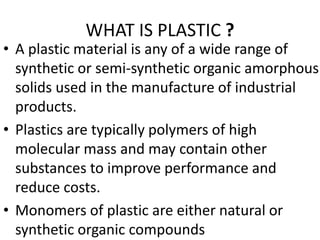
WHAT IS PLASTIC ?
• A plastic material is any of a wide range of
synthetic or semi-synthetic organic amorphous
solids used in the manufacture of industrial
products.
• Plastics are typically polymers of high
molecular mass and may contain other
substances to improve performance and
reduce costs.
• Monomers of plastic are either natural or
synthetic organic compounds
BASIC PROCESS
1. Segregation.
2. Cleaning process.
3. Shredding process.
4. Collection process .
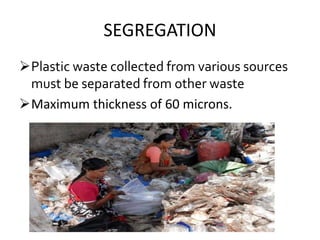
SEGREGATION
Plastic waste collected from various sources
must be separated from other waste
Maximum thickness of 60 microns.
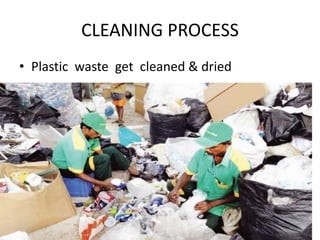
CLEANING PROCESS
• Plastic waste get cleaned & dried
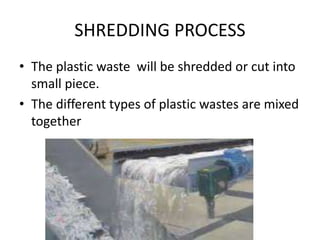
SHREDDING PROCESS
• The plastic waste will be shredded or cut into
small piece.
• The different types of plastic wastes are mixed
together
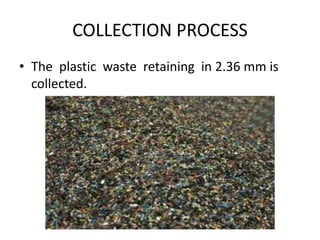
COLLECTION PROCESS
• The plastic waste retaining in 2.36 mm is
collected.
METHODS OF LAYING OF
PLASTIC ROADS
1.DRY PROCESS
2.WET PROCESS
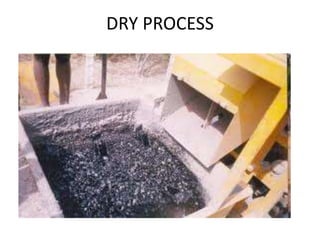
DRY PROCESS
• The aggregate is heated to 170 ° C in the
Mini hot Mix Plant .
• The shredded plastic will be added in equal
proportions
• Immediately the hot Bitumen 60/70 or 80
/100 grade (160°C) is added.
• The mixture is transferred to the road and the
road is laid.
DRY PROCESS
WET PROCESS
• Waste plastics by direct mixing with hot
bitumen at 160 ° C .
• Mechanical stirrer is needed.
• Addition of stabilizers and proper cooling.
• Since the wet process require a lot of
investment and bigger plants .
• Not commonly used..
MERITS
• Use higher percentage of plastic waste.
• Reduce the need of bitumen by around 10%.
• Increase the strength and performance of the road.
• Reduce the cost to around Rs. 5000/Km. of single lane
road.
• Generate jobs for rag pickers. Develop a technology,
which is eco-friendly .
• 100% improvement in fatigue life of roads.
• Reduced penetration and ductility, a higher softening
point, less rutting and cold cracking
DE-MERITS
• 1. Cleaning process Toxics present in the
co-mingled plastic waste would start leaching .
• 2. During the road laying process In the
presence of chlorine will definitely release
noxious HCL gas
• 3.After the road laying It is opined that the
first rain will trigger leaching.
CONCLUSION
THANK YOU
HARINATH REDDY.P
PLASTIC ROADS

plastic roads

  • 1.
    PLASTIC ROADS A Longlastingroadfromwasteplastic for a better andgreenworld….
  • 2.
    Introduction What is plastic?? Basic process Methods Merits De-Merits Conclusion
  • 3.
    INTRODUCTION • Plastic roadsmainly use plastic carry-bags, disposable cups and PET bottles that are collected from garbage dumps as an important ingredient of the construction material. • When mixed with hot bitumen, plastics melt to form an oily coat over the aggregate and the mixture is laid on the road surface like a normal bitumen road.
  • 4.
    WHAT IS PLASTIC? • A plastic material is any of a wide range of synthetic or semi-synthetic organic amorphous solids used in the manufacture of industrial products. • Plastics are typically polymers of high molecular mass and may contain other substances to improve performance and reduce costs. • Monomers of plastic are either natural or synthetic organic compounds
  • 5.
    BASIC PROCESS 1. Segregation. 2.Cleaning process. 3. Shredding process. 4. Collection process .
  • 6.
    SEGREGATION Plastic waste collectedfrom various sources must be separated from other waste Maximum thickness of 60 microns.
  • 7.
    CLEANING PROCESS • Plasticwaste get cleaned & dried
  • 8.
    SHREDDING PROCESS • Theplastic waste will be shredded or cut into small piece. • The different types of plastic wastes are mixed together
  • 9.
    COLLECTION PROCESS • Theplastic waste retaining in 2.36 mm is collected.
  • 10.
    METHODS OF LAYINGOF PLASTIC ROADS 1.DRY PROCESS 2.WET PROCESS
  • 11.
    DRY PROCESS • Theaggregate is heated to 170 ° C in the Mini hot Mix Plant . • The shredded plastic will be added in equal proportions • Immediately the hot Bitumen 60/70 or 80 /100 grade (160°C) is added. • The mixture is transferred to the road and the road is laid.
  • 12.
  • 13.
    WET PROCESS • Wasteplastics by direct mixing with hot bitumen at 160 ° C . • Mechanical stirrer is needed. • Addition of stabilizers and proper cooling. • Since the wet process require a lot of investment and bigger plants . • Not commonly used..
  • 14.
    MERITS • Use higherpercentage of plastic waste. • Reduce the need of bitumen by around 10%. • Increase the strength and performance of the road. • Reduce the cost to around Rs. 5000/Km. of single lane road. • Generate jobs for rag pickers. Develop a technology, which is eco-friendly . • 100% improvement in fatigue life of roads. • Reduced penetration and ductility, a higher softening point, less rutting and cold cracking
  • 15.
    DE-MERITS • 1. Cleaningprocess Toxics present in the co-mingled plastic waste would start leaching . • 2. During the road laying process In the presence of chlorine will definitely release noxious HCL gas • 3.After the road laying It is opined that the first rain will trigger leaching.
  • 16.
  • 17.