PLASTICROADS
ASeminarReportSubmitted
InPartialFulfillmentoftheRequirements
Forthedegreeof
BACHELOROFTECHNOLOGY
IN
CIVILENGINEERING
BY
MANOJKUMARNS
1CR15CV043
Underthesupervision
Of
MrNARENDRAKUMARFATEHPURIA
AssistantProfessor
TothefacultyofCivilEngineering
VISVESVARAYATECHNOLOGICALUNIVERSITY
BELGAUM
MARCH-2019
CERTIFICATE
ThisistoCertifythatMANOJKUMARNS(1CR15CV033)
hascarriedouttheworkpresentedinthisseminarentitled
“PLASTICROADS”undermysupervision.
Signature Signature
NARENDRAKUMARFATEHPURIA Dr.ASHAMNAIR
AssistantProfessor Headof
Department
DepartmentofCivilEngineering DepartmentofCivil
Engineering
Date: Date:
Signature Signature
Mr Narendra Kumar Fatehpuria Dr. Asha M Nair
Assistant professor. Professor and HOD
(Department of Civil Engineering) (Department of Civil Engineering)
Date : Date :
AKNOWLEDGEMENT
Itakegreatpleasuretoexpressmysincerethanksanddeep
senseofgratitudetoDr.AshaM Nair,Professor&Headof
Department,forgivingmethisopportunity.
Ialsotakethisopportunitytoexpressmyprofoundgratitudeanddeep
regards to ourguide Mr.Narendra KumarFatehpuria,Assistant
Professor,forhisexemplaryguidanceandmonitoring.
Iwouldalsoliketoexpressoursincerethankstoalltheteaching
andnon-teachingstaffoftheDepartmentofCivilEngineeringwho
havehelpedmedirectlyorindirectly.
MANOJKUMARNS
1CR15CV043
ABSTRACT
Plasticisatoxic&persistentmaterial.Itisgenerallyfoundtobenearly5%in
MunicipalSolid Wastes (MSW)which is a majorenvironmentalthreat.
Nowadays,plasticsareusedinourday-to-daylifeforenormouspurposesviz.
carrybagsinvariousshops,plasticsheetmaterialsformaking roofsof
temporarykutchahousesandhutments,packagingmaterialsinLDPE&HDPE
manufacturingindustries,indrinkingwatersupplyandsanitaryappurtenances,
inelectricalappliances,inmanufacturingofvariouselectronicappliancesetc.
TheoutcomeofLifeCycleAssessment(LCA)oftheseplasticmaterialsisnot
satisfactory.Generallypeopledisposeofftheseplasticmaterialsandplastic
productsaftertheirusageonopengroundassurfaceimpoundmentinlieuof
theirreuse,recycleandreductioninvolumewhichhasbecomeaprominent
ecological& environmentalproblem.Waste plasticbags& waste plastic
materialsinterruptstheinfiltrationandpercolationofrainwaterthroughsoil
poresandinturndiminishesthegroundwaterrechargeinaquifers.Nowadays
wehavetonesofplasticsolidwastesinoursurroundings.Therearesomany
instituteswhichafterconsistentresearcheshavecometoaconclusionthat
wasteplasticscanbeusedinmodifyingroads.Ifweuseplasticsinroad
construction,wecanreducethecostofroadconstructionandpollutionindex
ofenvironmenttoanappreciableextent.Wecanuseplasticsasbinderwith
bitumen.Itmaygivebetterfinish-ability,stability,bindingproperty,resistanceto
wateranddurability.
CONTENTS
1.INTRODUCTION
2.OBJECTIVES
3.LITERATUREREVIEW
4.MATERIALSANDMETHOD
5.CLASSIFICATIONOFPLASTIC
6.METHODOLOGYANDPROCEDURE
7.ADVANTAGESANDDISADVANTAGES
8.RESULTANDDISCUSSION
9.CONCLUSION
10. REFERENCES
INTRODUCTION
Amaterialthatcontainsoneormoreorganicpolymersoflargemolecularweight,
solidinitsfinishedstateandatsomestatewhilemanufacturingorprocessinginto
finishedarticles,canbeshapedbyitsflow,iscalledas‘Plastic’.Plasticsaredurable
anddegradeveryslowly;thechemicalbondsthatmakeplasticsodurablemakeit
equallyresistanttonaturalprocessesofdegradation.Plasticscanbedividedinto
twomajorcategories:thermosesandthermoplastics.A thermosetsolidifiesor
“sets”irreversiblywhenheated.Theyareusefulfortheirdurabilityandstrength,and
arethereforeusedprimarilyinautomobilesandconstructionapplications.These
plastics are polyethylene, polypropylene, polyamide, polyoxymethylene,
polytetrafluorethylene.Athermoplasticsoftenswhenexposedtoheatandreturns
tooriginalconditionatroomtemperature.Thermoplasticscaneasilybeshapedand
mouldedintoproductssuchasmilkjugs,floorcoverings,creditcards,andcarpet
fibres.Theseplastictypesareknownasphenolic,melamine,unsaturatedpolyester,
epoxyresin,silicone,andpolyurethane.Accordingtorecentstudies,plasticscan
stayunchangedforaslongas4500yearsonearthwithincreaseintheglobal
populationandtherisingdemandforfoodandotheressentials,therehasbeena
riseintheamountofwastebeinggenerateddailybyeachhousehold.Plasticin
differentformsisfoundtobealmost5%inmunicipalsolidwaste,whichistoxicin
nature.Itisacommonsightinbothurbanandruralareastofindemptyplasticbags
andothertypeofplasticpackingmateriallitteringtheroadsaswellasdrains.Due
to itsbiodegradabilityitcreatesstagnation ofwaterand associated hygiene
problems.Inordertocontainthisproblem experimentshavebeencarriedout
whetherthiswasteplasticcanbereusedproductively.Theexperimentationat
severalinstitutesindicatedthatthewasteplastic,whenaddedtohotaggregatewill
form afinecoatofplasticovertheaggregateandsuchaggregate,whenmixedwith
thebinderisfoundtogivehigherstrength,higherresistancetowaterandbetter
performanceoveraperiodoftime.Wasteplasticsuchascarrybags,disposable
cupsandlaminatedpoucheslikechips,panmasala,aluminum foilandpackaging
materialusedforbiscuits,chocolates,milkandgroceryitemscanbeusedfor
surfacingroads.Useofplasticalongwiththebitumeninconstructionofroadsnot
onlyincreasesitslifeandsmoothnessbutalsomakesiteconomicallysoundand
environmentfriendly.Plasticwasteisusedasmodifierofbitumentoimprovesome
ofbitumenpropertiesRoadsthatareconstructedusingplasticwasteareknownas
PlasticRoadsandarefoundtoperform bettercomparedtothoseconstructedwith
conventionalbitumen.Furtherithasbeenfoundthatsuchroadswerenotsubjected
tostrippingwhencomeincontactwithwater.Useofhigherpercentageofplastic
wastereducestheneedofbitumenby10%.Italsoincreasesthestrengthand
performanceoftheroad.Plasticincreasesthemeltingpointofbitumenandhence
missingcanbedoneinmorebetterandeasierway.AccordingtoDr.R.Vasudevan,
Dean ECA and Professor,DepartmentofChemistry,ThiagarajarCollege of
Engineering,Madurai,plasticwastereplaces10%to15%ofbitumen,andthereby
saves approximatelyRs.35000 to Rs.45000 perkilometerofa road stretch.
Inclusionofplasticwasteinroadconstructioneliminatestheplasticshrinkage
crackingofroadsurfaceandreducesthedryingshrinkagetosomeextent.
PROBLEMSTATEMENT
Thedebateontheuseandabuseofplasticsvis-à-visenvironmentalprotectioncan
goon,withoutyieldingresultsuntilpracticalstepsareinitiatedatthegrassroots
levelbyeveryonewhoisinapositiontodosomethingaboutit.Theplasticwastes
couldbeusedinroadconstructionandthefieldtestswithstoodthestressand
provedthatplasticwastesusedafterproperprocessingasanadditivewould
enhancethelifeoftheroadsandalsosolveenvironmentalproblems.Thepresent
write-uphighlightsthedevelopmentsinusingplasticswastetomakeplasticroads.
Therapidrateofurbanizationanddevelopmenthasledtoincreasingplasticwaste
generation.Asplasticisnon-biodegradableinnature,itremainsinenvironmentfor
severalyears and disposing plastic wastes atlandfillare unsafe since toxic
chemicalsleachoutintothesoil,andunder-groundwaterandpollutethewater
bodies. Due to littering habits,inadequate waste management system /
infrastructure,plasticwastedisposalcontinuetobeamajorproblem forthecivic
authorities,especiallyintheurbanareas.Asstatedabove,plasticdisposalisoneof
themajorproblemsfordevelopingcountrieslikeIndia,atasametimeIndianeedsa
largenetworkofroadsforitssmootheconomicandsocialdevelopment.Scarcityof
bitumenneedsadeepthinkingtoensurefastroadconstruction.
2.OBJECTIVES
Basicintentionistoefficientlyutilizethewasteplasticinconstructivewaysothatit
canbebeneficialtosocietyhowevermainobjectivesofcurrentprojectworkare:
 Tocoattheaggregateswiththewasteplasticmaterials.
 Tocheckthepropertiesofbituminousmixspecimen.
 Tocheckthepropertiesofbituminousmixspecimenduetocoatingofwaste
plasticmaterials.
 Tocomparethepropertiesofbituminousmixspecimenwiththepropertiesof
coatedaggregate.
LITERATUREREVIEW
 VermaS.S(2008).Concludedthatplasticswillincreasethemeltingpointof
thebitumen.Thistechnologynotonlystrengthenedtheroadconstructionbut
alsoincreasedtheroadlife.
 Dr.R.Vasudevan.Whenitusedforroadconstructionitcanwithstanditcan
withstandhighertemperatureandload.Thecoatingofplasticsreducesthe
porosity,absorptionofmoistureandimprovessoundness.Hencetheuseof
plasticwasteforflexiblepavementisoneofthebestmethodsforeasy
disposalofwaste plastics.The results indicated thatthere was an
improvementinstrengthpropertieswhencomparedtoaconventionalmix.
Therefore,thelifeofpavementsurfacingusingthewasteplasticisexpected
toincreasesubstantiallyincomparisontotheuseofconventionalbituminous
mix.Hencetheuseofwasteplasticsforflexiblepavementisoneofthebest
methodsforeasydisposalofwasteplastics.Thistechnologynotonly
strengthenedtheroadconstructionbutalsoincreasedtheroadlife.
 Zoorab& Suparmareportedtheuseofrecycledplasticscomposed
predominantlyofpolypropylene and low densitypolyethylene in plain
bituminousconcretemixtureswithincreaseddurabilityandimproved
fatiguelife.Densebituminousmacadam withrecycledplastics,mainlylow
densitypolyethylene(LDPE)replacing 30% of2.36-5mm aggregates,
reducedthemixdensityby16%andshoweda250%increaseinMarshall
Stability;the indirecttensile strength (ITS)was also improved in the
‘Plastiphalt’mixturesD.N.Littleworkedonthesamethemeandhefound
thatresistancetodeformationofasphalticconcretemodifiedwithlow
densitypolythenewasimprovedincomparisonwithunmodifiedmixes.Itis
foundthattherecycledpolyethylenebagsmaybeusefulinbituminous
pavementsresultinginreducedpermanentdeformationintheform of
rutting and reduced low temperature cracking ofpavementsurfacing
Binduetal.Investigatesthebenefitsofstabilizingthestonemasticasphalt
(SMA)mixtureinflexiblepavementwithshreddedwasteplastic.
MATERIALSUSED
Aggregates
Theaggregatesareboundtogethereitherbybituminousmaterialsorby
cement.Inafew cases,therockdustitselfwhenmixedwithwaterforms
slurrywhichactsasabindingmedium.Theaggregatesmaybeclassifiedinto
naturalandartificialaggregates.Thenaturalaggregatesagainareclassifiedas
coarseaggregatesconsistingofcrushedrockaggregatesorgravelsandfine
aggregatesorsand.Theblastfurnaceslagobtainedasby-productfrom blast
furnacesistheoneextensivelyused asroad construction material.Stone
aggregateusedforroadworkshouldbehard,tough,durableandhydrophobicfor
bituminoussurface.Gravelshouldbewellgraded(6.4mm to38mm)andshould
haveafinenessmodulusofnotlessthan5.75.Sandshouldbesharp,well
graded,cleanofallsilts,clayandorganicmatter.Thequantityofaggregates
usedinfirstcoatofsurfacedressingshouldbe0.15m3per10m2areaof12mm
nominalsize.Ontheotherhand,thequantityofaggregateusedinsecondcoatof
surfacedressingshouldbe0.15m3per10m2areasandof10mmnominalsize.
Bitumen
Bitumen isused asbindersin pavementsconstructions.Bitumen maybe
derivedfrom theresidueleftbytherefineryfrom naturallyoccurringasphalt.As
perdefinitiongivenbytheAmerican Society ofTesting Materials bitumen
hasbeen defined as“Mixturesofhydrocarbonsofnaturalorpyrogenous
origin,orcombination ofboth,frequentlyaccompaniedbytheirnon-metallic
derivatives,whichmaybegaseous,liquid,semi-solidorsolid,andwhichare
completelysolubleincarbondisulphide.”Bitumenfoundinnaturalstateknownas
asphaltcontainslargequantitiesofsolidmineralmatter.Whenpetroleumcrudeis
refinedinarefinery,theyareseparatedbyfractionaldistillationintheorderof
decreasingvolatility.Ondistillationoftheresidualbituminousresidue,straight-run
bitumenisobtained.Thisbitumenisknownaspenetrationgradebitumenorsteam
refined petroleum bitumen.The grades of bitumen used for pavement
constructionisknownaspavinggradesandthatusedforwaterproofingof
structuresisknownasindustrialgrades.Thegradeofstraightrunbitumenis
chosendependingupontheclimaticconditionsoftheregioninwhichsurface
dressingistobeconstructed.InmostpartsofIndia80/100and180/200
gradebitumenisused.Heaviergradecutbacks,rapidsettingemulsionsor
heaviergradetarsmayalsobeused.Thegradeofbasicbitumenisalteredeither
bycontrolledrefiningorbymixingwithdieseloilorotheroils.Forsingle
dressingsonWBM basecourse,quantityofbitumenneededrangesfrom 17to
195kgper10m2areasand10to12kgper10m2areaincaseofrenewalof
blacktopsurfacing.Forsecondcoatofsurfacedressing,thequantityofbitumen
neededrangesfrom10to12kgper10m2area.BulkbitumenLorrieswithtanksof
capacityrangingfrom 5000to15000litresareusedtotransportbulkbitumen.
AsperPMC,thebitumencontentinamixshouldbe4%ofweightbytotalmixfor
B.M.ThepavingbitumenavailableinIndiaisclassifiedintotwocategories:Paving
bitumenfromAssampetroleumdenotedasA-typeanddesignatedasgradesA35,
A90,etc.Pavingbitumenfrom othersourcesdenotedasS-typeanddesignatedas
gradesS35,S90,etc.
Importantpropertiesofbitumenare:
 Viscosityofbitumen should be adequate atthe time ofmixing and
compaction.Itisachievedbyheatingpriortomixingandbyuseof
cutbacksandemulsion.Inpresenceofwaterbitumenshouldnotstrip
offfrom aggregate.Bitumenshouldbedurableinallseasons.Itshould
notbecometoosoftduringsummersanddevelopcracksduringwinters.
 Bitumengrade:60/70,80/100gradebitumen.
Plasticmaterial
Plastics are usuallyclassified bytheirchemicalstructure ofthe polymer's
backboneandsidechains.Someimportantgroupsintheseclassificationsarethe
acrylics,polyesters,silicones,polyurethanes,and halogenated plastics.
Plasticscanalsobeclassifiedbythechemicalprocessusedintheirsynthesis,
suchascondensation,polyaddition,andcrosslinking.Therearetwotypesof
plastics:thermoplasticsand thermosetting polymers.Thermoplasticsare the
plasticsthatdonotundergochemicalchangeintheircompositionwhenheated
and can be moulded again and again. Examples include polyethylene,
polypropylene,polystyrene,polyvinylchloride,andpolytetrafluoroethylene(PTFE)
Inthethermosettingprocess,achemicalreactionoccursthatisirreversible.
Thevulcanizationofrubberisathermosettingprocess.Beforeheatingwith
sulphur,thepolyisopreneisatacky,slightlyrunnymaterial,butaftervulcanization
theproductisrigidandnon-tacky.Thepropertiesofplasticsaredefinedchiefly
by the organic chemistry ofthe polymer.such as hardness,density,and
resistancetoheat,organicsolvents,oxidation,andionizingradiation.
Typesofplastic
1.polyethyleneterephthalate(PET)
2.High-densitypolyethylene(HDPE)
3.Polyvinylchloride(PVC)
4.Low-densitypolyethylene(LDPE)
5.Polypropylene(PP)
6.Polystyrene(PS)
Plasticsaredurableanddegradeveryslowly;thechemicalbondsthatmakeplastic
sodurablemakeitequallyresistanttonaturalprocessesofdegradation.Sincethe
1950s,onebilliontonsofplastichavebeendiscardedandmaypersistfor
hundredsoreventhousandsofyears.Perhapsthebiggestenvironmentalthreat
from plasticcomesfrom nurdles,whicharetheraw materialfrom whichall
plasticsaremade.Theyaretinypre-plasticpelletsthatkilllargenumbersoffish
andbirdsthatmistakethem forfood.PriortothebanontheuseofCFCsin
extrusionofpolystyrene(andgeneraluse,exceptinlife-criticalfiresuppression
systems;seeMontrealProtocol),theproductionofpolystyrenecontributedtothe
depletionoftheozonelayer;however,non-CFCsarecurrentlyusedintheextrusion
process.Thermoplasticscanberemeltedandreused,andthermosetplasticscan
begroundupandusedasfiller,althoughthepurityofthematerialtendsto
degradewitheachreusecycle.Therearemethodsbywhichplasticscanbe
brokenbackdowntoafeedstockstate.
Classificationofplasticwaste
a)Polyethylene
 LDPE(LowDensityPoly-Ethylene):
Low densitypoly-ethylenethisplasticwasteavailableintheform ofcarrybags
generallyinstorestheseplasticbagsareverythinandalsoeasilyavailable.
 HDPE(HighDensityPoly-Ethylene):
GenerallyHighdensitypoly-ethylenetypeofplasticwasteisavailableintheform
ofcarrybagsandeasilyavailableinthemarket.
b)Polypropylene
Thisplasticmaybeavailableintheform ofcarrybagsorsolidplasticit’sdepend
upontheuseandneedoftheindustries.Itisavailableintheform ofplasticbottles
andmatsheetsetc.
Preparationofplasticwastematerial
Plasticwastescenario
Theuseofplasticmaterialssuchascarrybags,cups,etc.isconstantly
increasing.Theconsumptionofplasticshasincreasedfrom4000tons/annumto
4milliontons/annum anditisexpectedtorise8milliontons/annum duringthe
year2010.Nearly50to60%ofthetotalplasticsareconsumedforpacking.
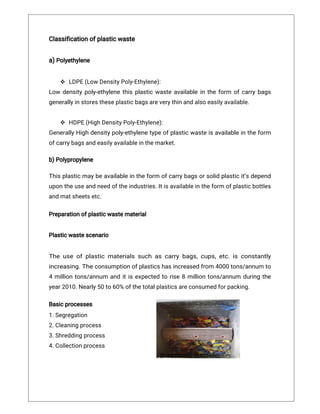
Basicprocesses
1.Segregation
2.Cleaningprocess
3.Shreddingprocess
4.Collectionprocess
SHREDDINGMACHINE
Plasticwasteblendingmaterials
a)Preparationofblend
Polyethylenecarrybagsarecutintopiecesusingashreddingmachine.Theyare
sievedandtheplasticpiecespassingthrough4.75mm sieveandretainingat
2.36mm sievegetscollected.Theseplasticpiecesareaddedslowlytothehot
bitumen oftemperature around 170-1800C.The mixture stirred wellusing
mechanicalstirrerforabout20-30minutes.Polymer-bitumenmixturesofdifferent
compositionscanbepreparedandusedforcarryingoutvarioustests.
b)Separationtest(IRC-SP:53-1999)
Samples ofdifferentcomposition can be subjected to the separation test.
Homogeneitycanbeobtainedapproximatelyupto1.5% blend.Beyondthis
composition,thevariationofsofteningpointismuchhigherforthetopand
bottom layerofthetestsamplesshowingthatthereisaseparationofpolymer
frombitumenonstanding.
c)Characterizationofplasticwaste-bitumenblendforflexiblepavement
Theutilityoftheplasticwasteblendedbitumen-aggregatemixforflexible
pavementconstructionischaracterizedbystudyingstrippingvalueandMarshall
Stabilityvalueofthemixfortheblendshavingamaximumof1.5%plasticwaste.
d)Preparationofplastic-wastecoatedaggregate
Theaggregateareheatedtoaround170ᵒC;theplasticwasteshreddedtothe
sizevaryingbetween2.36mm and4.75mm.Thisshreddedplasticwasteisadded
overhotaggregatewithconstantmixingtogiveauniformdistribution.Theplastic
getsoftenedandcoatedovertheaggregate.Thehotplasticwastecoated
aggregatesaremixedwithhotbitumen60/70or80/100grade.
Twoprocessesusedintheconstructionofplasticroads
1.Wetprocess
Inthisprocess,thewasteplasticisdirectlymixedwithhotBitumenat160ᵒCand
thismixtureisthenmixedusingamechanicalstirrer.Thismixturealso
containsadditionalstabilizersandrequirespropercooling.Itisnotpopular
becauseitrequireshugeinvestments,largerplantsandmoreequipmentthanthe
DryProcess.
2.Dryprocess
Firsttheplasticwasteiscollected,segregatedandstored.Thesegregationisdone
becausecertainkindsofplasticlikepolyvinylchloride(PVC)andfluxsheets
cannotbeusedduetosafetyconcerns.Thenextstepinvolvesthecleaningof
theplastic.Thisisnecessarybecausemostoftheplasticwastecollectedhas
beenusedforpackaging(55% inIndia)andhenceislikelytocontainresidual
substancessuchaslittlebitsoffoodwhichmustberemoved.Afterthisthe
plasticgoesthroughtheprocessofshreddingwhichreducesittothecorrect
thickness,2-4mm.Theaggregateisheatedtoaround160ᵒC-170ᵒCandthenthe
plasticisaddedandafter30-40sauniform coatingisobserved.Thiscoating
givesitanoilylook.TheBitumenisthenaddedandthemixtureisthoroughly
mixedbeforelaying.TheBitumenisaddedatatemperatureofaround155ᵒC-
163ᵒC.Thistemperatureiscarefullyregulatedtomakesurethatthebindingis
strong.Theprocessisdescribedbythediagrambelow.
Constructionofplasticcoatedbitumenroad
Plasticwastecollection Plasticwasteissegregated
Plasticwasteisshredded(2-4mm) Plasticwasteiscleanedanddried
Stoneaggregateisheated(160ᵒ-170ᵒC) Shreddedplasticisaddedto
heatedagg
Upto4layersofthemixtureis
The Bitumen (temp.155ᵒC-
163ᵒC)isthenaddedandmixed
withthecoatedaggregate
laidrolledandcleaned
ADVANTAGES
 This is a verysimple technologywhich does notinvolve anyspecial
machinesdeploymentorotheradvancedskilledprofessionals.
 Thereisspotuseofthewasteplastic.
 Thesewaterproofroadsprovideconsiderablyincreaseddurability.
 Nostrippingofroadshappensasthiskindofroadsresistthepermeationof
water.
 Moreemploymentcanbegeneratedaslabourswillberequiredincollection,
segregationandshreddingofwasteplastics.
 Multi‐layerfilmscanbeusedwhichprovidestrengthanddurability.
 Nomaintenancewillberequiredforyearsasthesurfaceremainswithoutany
crackingorpotholes.
DISADVANTAGES
 Mostchallenging task to be collected good quality ofplastic waste,
availabilityandsegregatingofuniqueobjects.
 Toxicspresentintheco-mingledplasticwastewouldstartleaching.
 Duringtheroadlayingprocess,Inthepresenceofchlorinewilldefinitely
releasenoxiousHCLgas.
 Aftertheroadlaying,Thecomponentsoftheroad,onceithasbeenlaid,are
notinert.
CONCLUSION
❖ The use ofthe innovative technologynotonlystrengthened the road
construction.
❖ Butalso increased the road life as wellas willhelp to improve the
environmentandalsocreatingasourceofincome.
❖Plasticswillincreasethemeltingpointofthebitumen.
❖ PlasticroadswouldbeaboonforIndia’shotandextremelyhumidclimate,
wheretemperaturesfrequentlycross50°Candtorrentialrainscreatehavoc,
leavingmostoftheroadswithbigpotholes.
❖ Itishopedthatinnearfuturewewillhavestrong,durableandeco-friendly
roadswhichwillrelievetheearthfromalltypeofplastic-waste.
REFFERENCE
❖R.Vasudevan.(2011)“Atechniquetodisposewasteplasticsinanecofriendlyway
Applicationinconstructionofflexiblepavements”ConstructionandBuilding
MaterialsVol.8DepartmentofChemistry,ThiagarajarCollegeofEngineering,
Madurai,TamilNadu,India,pp311–320.
❖ MissApurvaJChavan-UseofplasticwasteinflexiblePavements-ISSN2319–
4847,Volume2,Issue4,April2013
❖ S.S.Verma-Roadsfrom plasticwaste-TheIndianConcreteJournal-November
2008
❖ KshitijAditeyaSingh-UseofPlasticsinRoadConstructionImplementationof
TechnologyandRollout–CENTREFORINNOVATIONSIN PUBLICSYSTEMS
November2014
❖ IRC:SP:98-2013 GUIDLINES FOR THE USE OF WASTE PLASTIC IN HOT
BITUMINOUSMIXES(DRYPROCESS)INWEARINGCOURSES
 ZoorabS.EandSuparmaL.B“LaboratoryDesignandInvestigationofBituminous
Composite containing waste recycled plastics aggregate replacement,CIB
symposium onconstructionandenvironmenttheoryintopractice,SaoPaulo,
BrazilNov-2000
26

Plastic roads report