Plastic roads
A presentation on plastic roads
Presented by-
Siyaram meena
1120077
c8
• Plastic roads mainly use plastic carry
bags, disposable cups and bottles that are collected
from garbage dumps as an important
ingredient of the construction material.
• When mixed with hot bitumen, plastics melt to form an
oily coat over the aggregate and the mixture is laid on
the road surface like a normal tar road.
Introduction-:
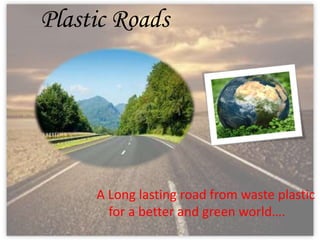
Plastic Roads
A Long lasting road from waste plastic
for a better and green world….
What are waste plastic roads?
The roads constructed using waste plastic, popularly
known
as Plastic Roads, are found to perform better
compared
to those constructed with conventional bitumen.
1)The Indian Centre for Plastics in the
Environment (ICPE) has been promoting the use of
plastic waste to construct asphalt roads.
2) A few trial roads have been paved successfully by
combining waste plastic with bitumen.
NEED OF STUDY
1)Disposal of waste plastic is a major problem.
Waste Plastic dumped on roads
2)It is non-biodegradable.
3)It mainly consists of low-density polyethylene.
4)To find its utility in bituminous mixes for road
construction.
5)Burning of these waste plastic bags causes
environmental pollution.
6)Laboratory performance studies were conducted on
bituminous mixes.
7)studies proved that waste plastic enhances the property
of the mix.
8)Improvement in properties of bituminous mix provides
the solution for disposal in an useful way.
 AGGREGATE:-
 Aggregate of 20mm, 10 mm.
 Stone Dust and Lime as Filler
 BITUMEN:-
 60/70,80/100grade bitumen.
 WASTE PLASTIC:-
 Waste plastic in the shredded form.(PVC is not
Used)
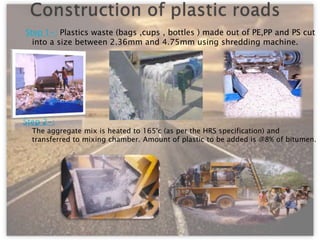
Step 1-: Plastics waste (bags ,cups , bottles ) made out of PE,PP and PS cut
into a size between 2.36mm and 4.75mm using shredding machine.
Step 2-:
The aggregate mix is heated to 165°c (as per the HRS specification) and
transferred to mixing chamber. Amount of plastic to be added is @8% of bitumen.
STEP 3-:
 Similarly the bitumen is to be heated up to a maximum of 160°c to have good
binding and to prevent weak bonding.
 Step 4-: At the mixing chamber, the shredded plastics waste is to be added. It
get coated uniformly over the aggregate within 30 to 60 seconds, giving an oily
look.
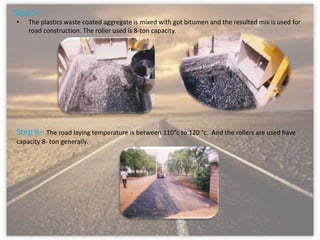
Step 5-:
• The plastics waste coated aggregate is mixed with got bitumen and the resulted mix is used for
road construction. The roller used is 8-ton capacity.
Step 6-: The road laying temperature is between 110°c to 120 °c. And the rollers are used have
capacity 8- ton generally.
Overall process-:
Field trials
There are two type of field trials-:
1. DRY PROCESS
2.WET PROCESS
1.DRY PROCESS-:
 The aggregate is heated to 170°C in the Mini hot Mix Plant .
 Heated aggregates
 The shredded plastic waste is added in equal proportion.
 Adding shredded plastic .
2.Wet Process-:
 Waste plastics by direct mixing with hot bitumen at 160°C.
 Mechanical stirrer is needed.
 Addition of stabilizers and proper cooling.
 Since the wet process require a lot of investment and bigger plants.
 Not commonly used.
COMPARISON BETWEEN ORDINARY BITUMINOUS ROADS AND WASTE PLASTIC BITUMINOUS
ROADS:-
S.No. Properties Plastic Road Ordinary Road
1. MARSHALL STABILITY VALUE MORE LESS
2. BINDING PROPERTY BETTER GOOD
3. SOFTENING POINT LESS MORE
4. PENETRATION VALUE MORE LESS
5. TENSILE STRENGTH HIGH LESS
6. RUTTING LESS MORE
7. STRIPPING(POT HOLES) NO MORE
8. SEEPAGE OF WATER NO YES
9 DURABILITY OF THE ROADS BETTER GOOD
10. COST OF PAVEMENT LESS NORMAL
ADVANTAGE OF WASTE PLASTIC BITUMINOUS MIX-:
 1) Stronger road with increased Marshall Stability Value.
 2) Better resistance towards rain water and water stagnation.
 3) No stripping and no potholes.
 4) Increase binding and better bonding of the mix.
 5) Reduction in pores in aggregate and hence less rutting and raveling.
 6) No leaching of plastics.
 7) No effect of radiation like UV.
 8) The strength of the road is increased by 100%.
 9) The load withstanding property increases. It helps to
satisfy today’s need of increased road transport.
 10) For 1km X 3.75m road, 1 ton of plastic (10 lakh carry
bags) is used and 1 ton of bitumen is saved.
 11)Value addition to the waste plastics (cost per kilogram
increases from Rs 4 to Rs12).
 12) The cost of road construction is also decreased.
 13) The maintenance cost of road is almost nil.
 14)Disposal of waste plastic will no longer be a problem.
1. Cleaning process -:
Toxics present in the co-mingled plastic waste would
start leaching.
2. During the road laying process -:
In the presence of chlorine will definitely release noxious
HCL gas.
3.After the road laying -:
It is opined that the first rain will trigger leaching. As the
plastics will merely form a sticky layer, (mechanical
abrasion).
The components of the road, once it has been laid, are
not inert.
•WASTE PLASTIC ROADS CONSTRUCTED:-
 The Bruhat Bengaluru Mahanagara Palike (BBMP) has used plastic on about 600 km
of roads, including many thoroughfares and arterial roads.
 It uses the plastic blend in at least 25% of the road-laying works, including the
present project to upgrade about 45 roads in the city.
 The plastic model was successful on major roads in Bangalore, including -:
 Shankar Mutt Road,
 K H Road,
 M G Road (towards Trinity Circle),
 J C Nagar Road ,
 Miller's Road and Cunningham Road,
 inner ring road,
 Rajarajeshwari Junction,
 Mysore Bangalore state highway.
Dollars colony
Banglore-mysore state Highway
Manipal Road
M G Road (towards Trinity Circle)
The experimentation at several institutes indicated that the waste plastic, when added to hot aggregate will
form a fine coat of plastic over the aggregate and such aggregate, when mixed with the binder is found
to give higher strength, higher resistance to water and better performance over a period of time.
Therefore, it is proposed that we may use waste plastic in the construction of Roads.
CONCLUSION:-
 Evidence of Better Performance of the Plastic Tar Roads-:
The performance studies carried out on the roads constructed in
Tamil Nadu indicated satisfactory performance with good skid resistance, good
texture value, stronger and less amount of progressive unevenness over a period of
time.
 The experimentation carried out by CRRI also indicated better stability value,
indicating higher strength, less flow and more air voids.
 The use of the innovative technology not only strengthened
the road construction but also increased the road life as well as
will help to improve the environment and also creating a source
of income.
Plastic roads would be a boon for India’s hot and extremely
humid climate, leaving most of the roads with big potholes.
It is hoped that in near future we will have strong, durable and
eco-friendly roads which will relieve the earth from all type of
plastic-waste .
Hence the use of waste plastics for pavement is one of the best
methods for easy disposal of waste plastics.
REFERENCES:
1) Ministry of Road Transport and High Ways, Manual for construction and
supervision of Bituminous works, New Delhi, November 2001.
2) Sri Ram Institute for Industrial Research, Plastics Processing and Environmental
Aspects, New Delhi - 7
3) Vasudevan, R., Utilization of waste plastics for flexible pavement, Indian High
Ways (Indian Road Congress), Vol. 34, No.7. (July 2006).
4) Utilizations of Waste Plastic Bags in Bituminous Mix for Improved Performance
of Roads, Centre for Transportation Engineering, Bangalore University,
Bangalore, India [Unpublished] Apr02
Plastic roads

Plastic roads

  • 1.
    Plastic roads A presentationon plastic roads Presented by- Siyaram meena 1120077 c8
  • 2.
    • Plastic roadsmainly use plastic carry bags, disposable cups and bottles that are collected from garbage dumps as an important ingredient of the construction material. • When mixed with hot bitumen, plastics melt to form an oily coat over the aggregate and the mixture is laid on the road surface like a normal tar road. Introduction-:
  • 3.
    Plastic Roads A Longlasting road from waste plastic for a better and green world….
  • 4.
    What are wasteplastic roads? The roads constructed using waste plastic, popularly known as Plastic Roads, are found to perform better compared to those constructed with conventional bitumen. 1)The Indian Centre for Plastics in the Environment (ICPE) has been promoting the use of plastic waste to construct asphalt roads. 2) A few trial roads have been paved successfully by combining waste plastic with bitumen.
  • 5.
    NEED OF STUDY 1)Disposalof waste plastic is a major problem. Waste Plastic dumped on roads 2)It is non-biodegradable. 3)It mainly consists of low-density polyethylene.
  • 6.
    4)To find itsutility in bituminous mixes for road construction. 5)Burning of these waste plastic bags causes environmental pollution. 6)Laboratory performance studies were conducted on bituminous mixes. 7)studies proved that waste plastic enhances the property of the mix. 8)Improvement in properties of bituminous mix provides the solution for disposal in an useful way.
  • 7.
     AGGREGATE:-  Aggregateof 20mm, 10 mm.  Stone Dust and Lime as Filler  BITUMEN:-  60/70,80/100grade bitumen.  WASTE PLASTIC:-  Waste plastic in the shredded form.(PVC is not Used)
  • 8.
    Step 1-: Plasticswaste (bags ,cups , bottles ) made out of PE,PP and PS cut into a size between 2.36mm and 4.75mm using shredding machine. Step 2-: The aggregate mix is heated to 165°c (as per the HRS specification) and transferred to mixing chamber. Amount of plastic to be added is @8% of bitumen.
  • 9.
    STEP 3-:  Similarlythe bitumen is to be heated up to a maximum of 160°c to have good binding and to prevent weak bonding.  Step 4-: At the mixing chamber, the shredded plastics waste is to be added. It get coated uniformly over the aggregate within 30 to 60 seconds, giving an oily look.
  • 10.
    Step 5-: • Theplastics waste coated aggregate is mixed with got bitumen and the resulted mix is used for road construction. The roller used is 8-ton capacity. Step 6-: The road laying temperature is between 110°c to 120 °c. And the rollers are used have capacity 8- ton generally.
  • 11.
  • 12.
    Field trials There aretwo type of field trials-: 1. DRY PROCESS 2.WET PROCESS 1.DRY PROCESS-:  The aggregate is heated to 170°C in the Mini hot Mix Plant .  Heated aggregates  The shredded plastic waste is added in equal proportion.  Adding shredded plastic . 2.Wet Process-:  Waste plastics by direct mixing with hot bitumen at 160°C.  Mechanical stirrer is needed.  Addition of stabilizers and proper cooling.  Since the wet process require a lot of investment and bigger plants.  Not commonly used.
  • 13.
    COMPARISON BETWEEN ORDINARYBITUMINOUS ROADS AND WASTE PLASTIC BITUMINOUS ROADS:- S.No. Properties Plastic Road Ordinary Road 1. MARSHALL STABILITY VALUE MORE LESS 2. BINDING PROPERTY BETTER GOOD 3. SOFTENING POINT LESS MORE 4. PENETRATION VALUE MORE LESS 5. TENSILE STRENGTH HIGH LESS 6. RUTTING LESS MORE 7. STRIPPING(POT HOLES) NO MORE 8. SEEPAGE OF WATER NO YES 9 DURABILITY OF THE ROADS BETTER GOOD 10. COST OF PAVEMENT LESS NORMAL
  • 14.
    ADVANTAGE OF WASTEPLASTIC BITUMINOUS MIX-:  1) Stronger road with increased Marshall Stability Value.  2) Better resistance towards rain water and water stagnation.  3) No stripping and no potholes.  4) Increase binding and better bonding of the mix.  5) Reduction in pores in aggregate and hence less rutting and raveling.  6) No leaching of plastics.  7) No effect of radiation like UV.
  • 15.
     8) Thestrength of the road is increased by 100%.  9) The load withstanding property increases. It helps to satisfy today’s need of increased road transport.  10) For 1km X 3.75m road, 1 ton of plastic (10 lakh carry bags) is used and 1 ton of bitumen is saved.  11)Value addition to the waste plastics (cost per kilogram increases from Rs 4 to Rs12).  12) The cost of road construction is also decreased.  13) The maintenance cost of road is almost nil.  14)Disposal of waste plastic will no longer be a problem.
  • 16.
    1. Cleaning process-: Toxics present in the co-mingled plastic waste would start leaching. 2. During the road laying process -: In the presence of chlorine will definitely release noxious HCL gas. 3.After the road laying -: It is opined that the first rain will trigger leaching. As the plastics will merely form a sticky layer, (mechanical abrasion). The components of the road, once it has been laid, are not inert.
  • 17.
    •WASTE PLASTIC ROADSCONSTRUCTED:-  The Bruhat Bengaluru Mahanagara Palike (BBMP) has used plastic on about 600 km of roads, including many thoroughfares and arterial roads.  It uses the plastic blend in at least 25% of the road-laying works, including the present project to upgrade about 45 roads in the city.  The plastic model was successful on major roads in Bangalore, including -:  Shankar Mutt Road,  K H Road,  M G Road (towards Trinity Circle),  J C Nagar Road ,  Miller's Road and Cunningham Road,  inner ring road,  Rajarajeshwari Junction,  Mysore Bangalore state highway.
  • 18.
  • 19.
    M G Road(towards Trinity Circle) The experimentation at several institutes indicated that the waste plastic, when added to hot aggregate will form a fine coat of plastic over the aggregate and such aggregate, when mixed with the binder is found to give higher strength, higher resistance to water and better performance over a period of time. Therefore, it is proposed that we may use waste plastic in the construction of Roads.
  • 20.
    CONCLUSION:-  Evidence ofBetter Performance of the Plastic Tar Roads-: The performance studies carried out on the roads constructed in Tamil Nadu indicated satisfactory performance with good skid resistance, good texture value, stronger and less amount of progressive unevenness over a period of time.  The experimentation carried out by CRRI also indicated better stability value, indicating higher strength, less flow and more air voids.
  • 21.
     The useof the innovative technology not only strengthened the road construction but also increased the road life as well as will help to improve the environment and also creating a source of income. Plastic roads would be a boon for India’s hot and extremely humid climate, leaving most of the roads with big potholes. It is hoped that in near future we will have strong, durable and eco-friendly roads which will relieve the earth from all type of plastic-waste . Hence the use of waste plastics for pavement is one of the best methods for easy disposal of waste plastics.
  • 22.
    REFERENCES: 1) Ministry ofRoad Transport and High Ways, Manual for construction and supervision of Bituminous works, New Delhi, November 2001. 2) Sri Ram Institute for Industrial Research, Plastics Processing and Environmental Aspects, New Delhi - 7 3) Vasudevan, R., Utilization of waste plastics for flexible pavement, Indian High Ways (Indian Road Congress), Vol. 34, No.7. (July 2006). 4) Utilizations of Waste Plastic Bags in Bituminous Mix for Improved Performance of Roads, Centre for Transportation Engineering, Bangalore University, Bangalore, India [Unpublished] Apr02