CHAPTER 5
Essential question: How are plants best propagated and
conserved?
Reproduction enables different life
forms on Earth to continue existing.
Like humans and animals, plants
also reproduce to form new plants.
Plants may also reproduce either
sexually or asexually.
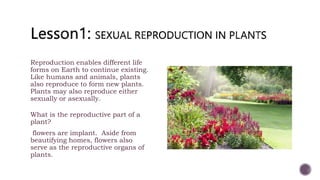
What is the reproductive part of a
plant?
flowers are implant. Aside from
beautifying homes, flowers also
serve as the reproductive organs of
plants.
Many plants reproduce
sexually, in sexual
reproduction. An egg
cell and sperm cell join
in fertilization. For
fertilization to occur in
plants, pollination must
take place first.
Pollination and
fertilization involve
different parts of a
flower.
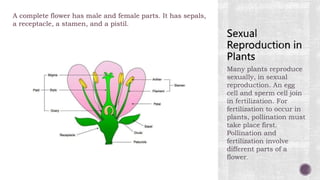
A complete flower has male and female parts. It has sepals,
a receptacle, a stamen, and a pistil.
The receptacle is the enlarged upper end of a flower stalk and
bears the flower.
Sepals protect the developing flower bud. A group of sepals is
called calyx. Petals are usually brightly colored, making the
flowers attractive to pollinators like insects. A group of petals is
called corolla.
The stamen is the male reproductive organ. It produces pollen. The
stamen has two parts; the anther, the pollen-producing part; and the
filament, which holds up the anther. The pollen grains contain the
male gametes.
The pistil, also called carpel, is the female reproductive organ. It
consists of the following parts:
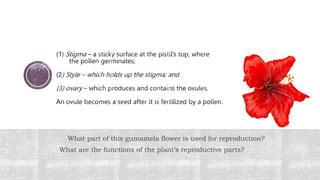
What part of this gumamela flower is used for reproduction?
What are the functions of the plant’s reproductive parts?
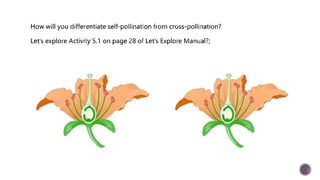
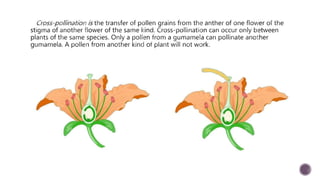
There are two kinds of pollination: self-pollination and
cross-pollination.
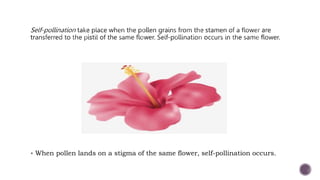
 When pollen lands on a stigma of the same flower, self-pollination occurs.
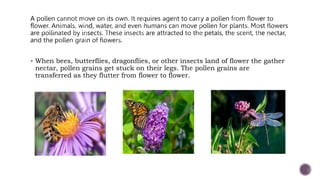
 When bees, butterflies, dragonflies, or other insects land of flower the gather
nectar, pollen grains get stuck on their legs. The pollen grains are
transferred as they flutter from flower to flower.
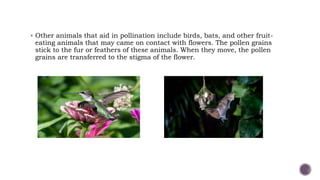
 Other animals that aid in pollination include birds, bats, and other fruit-
eating animals that may came on contact with flowers. The pollen grains
stick to the fur or feathers of these animals. When they move, the pollen
grains are transferred to the stigma of the flower.
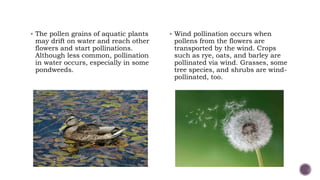
 The pollen grains of aquatic plants
may drift on water and reach other
flowers and start pollinations.
Although less common, pollination
in water occurs, especially in some
pondweeds.
 Wind pollination occurs when
pollens from the flowers are
transported by the wind. Crops
such as rye, oats, and barley are
pollinated via wind. Grasses, some
tree species, and shrubs are wind-
pollinated, too.
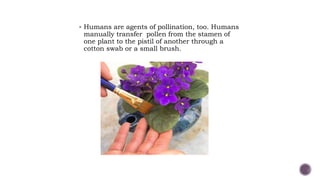
 Humans are agents of pollination, too. Humans
manually transfer pollen from the stamen of
one plant to the pistil of another through a
cotton swab or a small brush.
LESSON 2
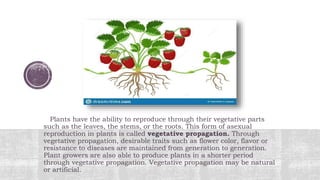
Plants have the ability to reproduce through their vegetative parts
such as the leaves, the stems, or the roots. This form of asexual
reproduction in plants is called vegetative propagation. Through
vegetative propagation, desirable traits such as flower color, flavor or
resistance to diseases are maintained from generation to generation.
Plant growers are also able to produce plants in a shorter period
through vegetative propagation. Vegetative propagation may be natural
or artificial.
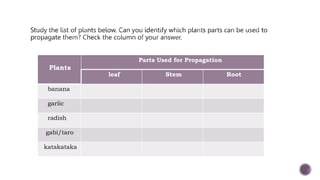
Plants
Parts Used for Propagation
leaf Stem Root
banana
garlic
radish
gabi/taro
katakataka
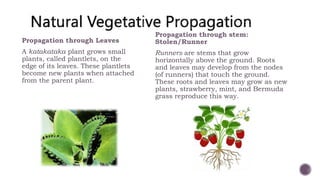
Propagation through Leaves
A katakataka plant grows small
plants, called plantlets, on the
edge of its leaves. These plantlets
become new plants when attached
from the parent plant.
Propagation through stem:
Stolen/Runner
Runners are stems that grow
horizontally above the ground. Roots
and leaves may develop from the nodes
(of runners) that touch the ground.
These roots and leaves may grow as new
plants, strawberry, mint, and Bermuda
grass reproduce this way.
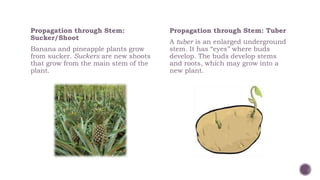
Propagation through Stem:
Sucker/Shoot
Banana and pineapple plants grow
from sucker. Suckers are new shoots
that grow from the main stem of the
plant.
Propagation through Stem: Tuber
A tuber is an enlarged underground
stem. It has “eyes’’ where buds
develop. The buds develop stems
and roots, which may grow into a
new plant.
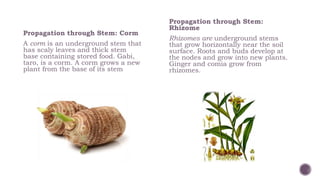
Propagation through Stem: Corm
A corm is an underground stem that
has scaly leaves and thick stem
base containing stored food. Gabi,
taro, is a corm. A corm grows a new
plant from the base of its stem
Propagation through Stem:
Rhizome
Rhizomes are underground stems
that grow horizontally near the soil
surface. Roots and buds develop at
the nodes and grow into new plants.
Ginger and comia grow from
rhizomes.
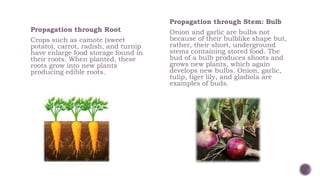
Propagation through Root
Crops such as camote (sweet
potato), carrot, radish, and turnip
have enlarge food storage found in
their roots. When planted, these
roots grow into new plants
producing edible roots.
Propagation through Stem: Bulb
Onion and garlic are bulbs not
because of their bulblike shape but,
rather, their short, underground
stems containing stored food. The
bud of a bulb produces shoots and
grows new plants, which again
develops new bulbs. Onion, garlic,
tulip, tiger lily, and gladiola are
examples of buds.
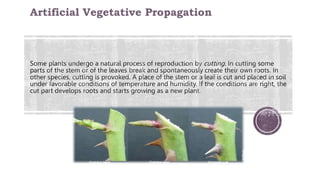
Artificial Vegetative Propagation
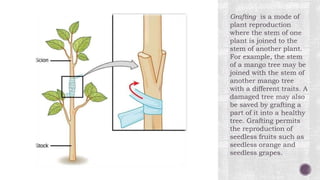
Grafting is a mode of
plant reproduction
where the stem of one
plant is joined to the
stem of another plant.
For example, the stem
of a mango tree may be
joined with the stem of
another mango tree
with a different traits. A
damaged tree may also
be saved by grafting a
part of it into a healthy
tree. Grafting permits
the reproduction of
seedless fruits such as
seedless orange and
seedless grapes.
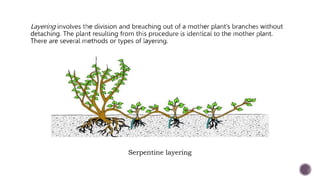
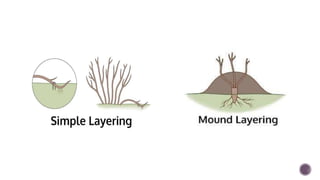
Serpentine layering
LESSON 3
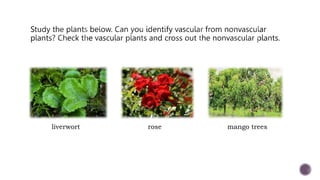
liverwort rose mango trees
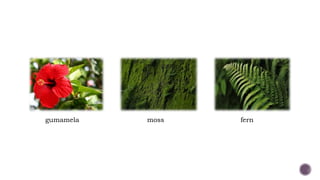
gumamela moss fern
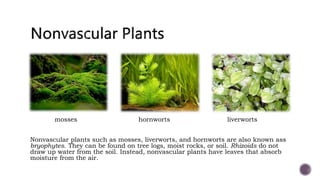
mosses hornworts liverworts
Nonvascular plants such as mosses, liverworts, and hornworts are also known ass
bryophytes. They can be found on tree logs, moist rocks, or soil. Rhizoids do not
draw up water from the soil. Instead, nonvascular plants have leaves that absorb
moisture from the air.
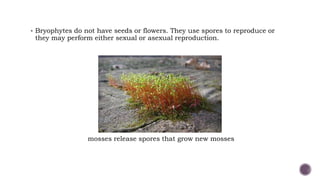
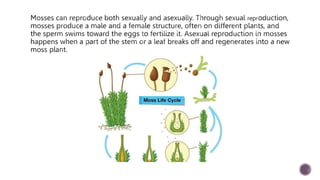
 Bryophytes do not have seeds or flowers. They use spores to reproduce or
they may perform either sexual or asexual reproduction.
mosses release spores that grow new mosses
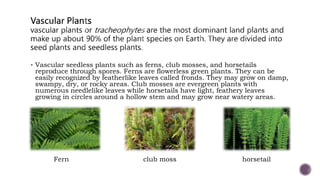
 Vascular seedless plants such as ferns, club mosses, and horsetails
reproduce through spores. Ferns are flowerless green plants. They can be
easily recognized by featherlike leaves called fronds. They may grow on damp,
swampy, dry, or rocky areas. Club mosses are evergreen plants with
numerous needlelike leaves while horsetails have light, feathery leaves
growing in circles around a hollow stem and may grow near watery areas.
Fern club moss horsetail
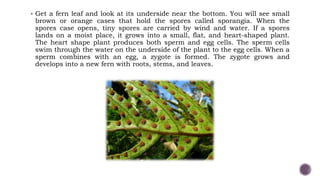
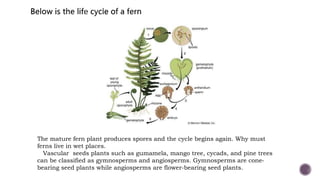
 Get a fern leaf and look at its underside near the bottom. You will see small
brown or orange cases that hold the spores called sporangia. When the
spores case opens, tiny spores are carried by wind and water. If a spores
lands on a moist place, it grows into a small, flat, and heart-shaped plant.
The heart shape plant produces both sperm and egg cells. The sperm cells
swim through the water on the underside of the plant to the egg cells. When a
sperm combines with an egg, a zygote is formed. The zygote grows and
develops into a new fern with roots, stems, and leaves.
The mature fern plant produces spores and the cycle begins again. Why must
ferns live in wet places.
Vascular seeds plants such as gumamela, mango tree, cycads, and pine trees
can be classified as gymnosperms and angiosperms. Gymnosperms are cone-
bearing seed plants while angiosperms are flower-bearing seed plants.
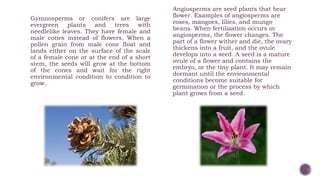
Gymnosperms or conifers are large
evergreen plants and trees with
needlelike leaves. They have female and
male cones instead of flowers. When a
pollen grain from male cone float and
lands either on the surface of the scale
of a female cone or at the end of a short
stem, the seeds will grow at the bottom
of the cones and wait for the right
environmental condition to condition to
grow.
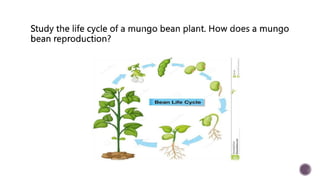
Angiosperms are seed plants that bear
flower. Examples of angiosperms are
roses, mangoes, lilies, and mungo
beans. When fertilization occurs in
angiosperms, the flower changes. The
part of a flower wither and die, the ovary
thickens into a fruit, and the ovule
develops into a seed. A seed is a mature
ovule of a flower and contains the
embryo, or the tiny plant. It may remain
dormant until the environmental
conditions become suitable for
germination or the process by which
plant grows from a seed.
PLANT-REPRODUCTION-1 (1).pptx

PLANT-REPRODUCTION-1 (1).pptx

  • 1.
    CHAPTER 5 Essential question:How are plants best propagated and conserved?
  • 2.
    Reproduction enables differentlife forms on Earth to continue existing. Like humans and animals, plants also reproduce to form new plants. Plants may also reproduce either sexually or asexually. What is the reproductive part of a plant? flowers are implant. Aside from beautifying homes, flowers also serve as the reproductive organs of plants.
  • 3.
    Many plants reproduce sexually,in sexual reproduction. An egg cell and sperm cell join in fertilization. For fertilization to occur in plants, pollination must take place first. Pollination and fertilization involve different parts of a flower. A complete flower has male and female parts. It has sepals, a receptacle, a stamen, and a pistil.
  • 4.
    The receptacle isthe enlarged upper end of a flower stalk and bears the flower. Sepals protect the developing flower bud. A group of sepals is called calyx. Petals are usually brightly colored, making the flowers attractive to pollinators like insects. A group of petals is called corolla.
  • 5.
    The stamen isthe male reproductive organ. It produces pollen. The stamen has two parts; the anther, the pollen-producing part; and the filament, which holds up the anther. The pollen grains contain the male gametes. The pistil, also called carpel, is the female reproductive organ. It consists of the following parts:
  • 6.
    What part ofthis gumamela flower is used for reproduction? What are the functions of the plant’s reproductive parts?
  • 8.
    There are twokinds of pollination: self-pollination and cross-pollination.
  • 9.
     When pollenlands on a stigma of the same flower, self-pollination occurs.
  • 11.
     When bees,butterflies, dragonflies, or other insects land of flower the gather nectar, pollen grains get stuck on their legs. The pollen grains are transferred as they flutter from flower to flower.
  • 12.
     Other animalsthat aid in pollination include birds, bats, and other fruit- eating animals that may came on contact with flowers. The pollen grains stick to the fur or feathers of these animals. When they move, the pollen grains are transferred to the stigma of the flower.
  • 13.
     The pollengrains of aquatic plants may drift on water and reach other flowers and start pollinations. Although less common, pollination in water occurs, especially in some pondweeds.  Wind pollination occurs when pollens from the flowers are transported by the wind. Crops such as rye, oats, and barley are pollinated via wind. Grasses, some tree species, and shrubs are wind- pollinated, too.
  • 14.
     Humans areagents of pollination, too. Humans manually transfer pollen from the stamen of one plant to the pistil of another through a cotton swab or a small brush.
  • 15.
  • 16.
    Plants have theability to reproduce through their vegetative parts such as the leaves, the stems, or the roots. This form of asexual reproduction in plants is called vegetative propagation. Through vegetative propagation, desirable traits such as flower color, flavor or resistance to diseases are maintained from generation to generation. Plant growers are also able to produce plants in a shorter period through vegetative propagation. Vegetative propagation may be natural or artificial.
  • 17.
    Plants Parts Used forPropagation leaf Stem Root banana garlic radish gabi/taro katakataka
  • 18.
    Propagation through Leaves Akatakataka plant grows small plants, called plantlets, on the edge of its leaves. These plantlets become new plants when attached from the parent plant. Propagation through stem: Stolen/Runner Runners are stems that grow horizontally above the ground. Roots and leaves may develop from the nodes (of runners) that touch the ground. These roots and leaves may grow as new plants, strawberry, mint, and Bermuda grass reproduce this way.
  • 19.
    Propagation through Stem: Sucker/Shoot Bananaand pineapple plants grow from sucker. Suckers are new shoots that grow from the main stem of the plant. Propagation through Stem: Tuber A tuber is an enlarged underground stem. It has “eyes’’ where buds develop. The buds develop stems and roots, which may grow into a new plant.
  • 20.
    Propagation through Stem:Corm A corm is an underground stem that has scaly leaves and thick stem base containing stored food. Gabi, taro, is a corm. A corm grows a new plant from the base of its stem Propagation through Stem: Rhizome Rhizomes are underground stems that grow horizontally near the soil surface. Roots and buds develop at the nodes and grow into new plants. Ginger and comia grow from rhizomes.
  • 21.
    Propagation through Root Cropssuch as camote (sweet potato), carrot, radish, and turnip have enlarge food storage found in their roots. When planted, these roots grow into new plants producing edible roots. Propagation through Stem: Bulb Onion and garlic are bulbs not because of their bulblike shape but, rather, their short, underground stems containing stored food. The bud of a bulb produces shoots and grows new plants, which again develops new bulbs. Onion, garlic, tulip, tiger lily, and gladiola are examples of buds.
  • 22.
  • 23.
    Grafting is amode of plant reproduction where the stem of one plant is joined to the stem of another plant. For example, the stem of a mango tree may be joined with the stem of another mango tree with a different traits. A damaged tree may also be saved by grafting a part of it into a healthy tree. Grafting permits the reproduction of seedless fruits such as seedless orange and seedless grapes.
  • 24.
  • 26.
  • 28.
  • 29.
  • 30.
    mosses hornworts liverworts Nonvascularplants such as mosses, liverworts, and hornworts are also known ass bryophytes. They can be found on tree logs, moist rocks, or soil. Rhizoids do not draw up water from the soil. Instead, nonvascular plants have leaves that absorb moisture from the air.
  • 31.
     Bryophytes donot have seeds or flowers. They use spores to reproduce or they may perform either sexual or asexual reproduction. mosses release spores that grow new mosses
  • 33.
     Vascular seedlessplants such as ferns, club mosses, and horsetails reproduce through spores. Ferns are flowerless green plants. They can be easily recognized by featherlike leaves called fronds. They may grow on damp, swampy, dry, or rocky areas. Club mosses are evergreen plants with numerous needlelike leaves while horsetails have light, feathery leaves growing in circles around a hollow stem and may grow near watery areas. Fern club moss horsetail
  • 34.
     Get afern leaf and look at its underside near the bottom. You will see small brown or orange cases that hold the spores called sporangia. When the spores case opens, tiny spores are carried by wind and water. If a spores lands on a moist place, it grows into a small, flat, and heart-shaped plant. The heart shape plant produces both sperm and egg cells. The sperm cells swim through the water on the underside of the plant to the egg cells. When a sperm combines with an egg, a zygote is formed. The zygote grows and develops into a new fern with roots, stems, and leaves.
  • 35.
    The mature fernplant produces spores and the cycle begins again. Why must ferns live in wet places. Vascular seeds plants such as gumamela, mango tree, cycads, and pine trees can be classified as gymnosperms and angiosperms. Gymnosperms are cone- bearing seed plants while angiosperms are flower-bearing seed plants.
  • 36.
    Gymnosperms or conifersare large evergreen plants and trees with needlelike leaves. They have female and male cones instead of flowers. When a pollen grain from male cone float and lands either on the surface of the scale of a female cone or at the end of a short stem, the seeds will grow at the bottom of the cones and wait for the right environmental condition to condition to grow. Angiosperms are seed plants that bear flower. Examples of angiosperms are roses, mangoes, lilies, and mungo beans. When fertilization occurs in angiosperms, the flower changes. The part of a flower wither and die, the ovary thickens into a fruit, and the ovule develops into a seed. A seed is a mature ovule of a flower and contains the embryo, or the tiny plant. It may remain dormant until the environmental conditions become suitable for germination or the process by which plant grows from a seed.